When a business reaches a stage where its voice communication infrastructure spans hundreds of concurrent endpoints, the standard software-as-a-service (SaaS) subscription model begins to show significant limitations.
What started as an easy per-user monthly expenditure quietly scales into a significant operational balance sheet liability. More importantly, packaged off-the-shelf business systems trap your development engineering teams within rigid, vendor-locked environments. In such environments, modifying deep call-routing properties, altering media codecs, or injecting custom artificial intelligence modules directly at the network level is completely restricted.
For telecom application builders, internet service providers (ISPs), internet telephony service providers (ITSPs), and high-volume digital platforms, evaluating VoIP solution providers requires looking far past standard user dashboards. True platform scaling requires evaluating whether to buy a fixed cloud subscription or build a customized communication engine.
To help guide your structural planning, our engineering groups evaluated the market frameworks using a strict evaluation rubric: processing stability under extreme concurrent loads, direct programmatic access to core media bugs, and the ease of local infrastructure containerization. Let’s detail the field architecture configurations for 2026!
Best VoIP Solutions Quick Comparison
To bring complete transparency to your evaluation process, our validation testing bypasses simple end-user desktop phone apps to focus explicitly on
- Low-level infrastructure capabilities
- Code transparency
- Baseline network distribution styles
| VoIP Solution Provider | Primary Delivery Model | Code Access Level | Ideal Production Target |
| Ecosmob Custom Engine | Custom Telecom Engineering | Full Development Ownership | ISPs, ITSPs, high-scale MVNOs, and AI contact centers. |
| Asterisk Core Framework | Open-Source PBX Engine | Open-Source Source Code | Dedicated turn-based IVR loops and private office branches. |
| FreeSWITCH Platform | Open-Source Media Switch | Open-Source Source Code | High-concurrency WebRTC pipelines and multi-tenant voice networks. |
| Kamailio Proxy Node | Open-Source SIP Router | Open-Source Source Code | High-capacity edge load balancing and core carrier session routing. |
| Twilio API Gateway | Commercial CPaaS Web API | Black-Box Application Loop | Early application testing and fast web-app prototyping. |
| RingCentral MVP | Standard Packaged SaaS | No Code Control (User Seat) | Small corporate offices requiring basic out-of-the-box setups. |
| Zoom Phone Architecture | Standard Packaged SaaS | No Code Control (User Seat) | Basic enterprise environments tied entirely to standard desktops. |
| 8×8 Communication Core | Cloud Packaged SaaS | No Code Control (User Seat) | Distributed office workforces utilizing uniform desktop setups. |
| Dialpad Voice Suite | Cloud Packaged SaaS | No Code Control (User Seat) | Small customer support teams utilizing off-the-shelf cloud tools. |
| Vonage Business | Hybrid CPaaS / SaaS | Restricted API Abstractions | Mid-market businesses running basic programmatic calling steps. |
The 10 Best VoIP Solutions Ranked for 2026
Before we start, remember: every top-tier telecom architecture demands a specific balancing act between operational simplicity, direct engine control, and long-term scaling mechanics.
1. Ecosmob’s Custom VoIP Solutions
Ecosmob engineers and delivers fully containerized, bespoke telecom environments built from the ground up on hardened open-source primitives like FreeSWITCH, Asterisk, and Kamailio.
This deployment path completely eliminates user licensing structures by granting platforms absolute engineering ownership over their core routing scripts.
Key Features:
- Tailored multi-tenant billing models
- Native inline media bugs for real-time speech processing
- Isolated container orchestration loops
Pros:
- Complete source code visibility
- Zero recurring user seat markups
- Infinite architectural customization
Cons:
Demands dedicated engineering collaboration for initial architectural mapping and deployment setup.
Best For:
ISPs, ITSPs, Massive Virtual Network Operators (MVNOs), and enterprise AI-driven contact center applications.
2. Asterisk Core Framework
Asterisk functions as the definitive open-source Private Branch Exchange (PBX) engine, offering robust handling for turn-based call structures and traditional analog-to-IP signaling bridges.
It utilizes highly granular internal application configuration templates to drive traditional call logic securely.
Key Features:
- Advanced channel driver flexibility (PJSIP)
- Flexible internal XML extensions compilation
- Stable voicemail storage architectures
Pros:
- Incredible ecosystem maturity
- Massive open documentation pools
- Highly reliable performance for static dialplan networks
Cons:
Exhibits thread-blocking limitations under high concurrent loads when tied to synchronous application layer scripts.
Best For:
Core office networks, corporate branch systems, and dedicated, turn-based IVR menu trees.
3. FreeSWITCH Platform
FreeSWITCH is a highly optimized, cross-platform open-source telephony switch designed to manage massive, high-concurrency voice and video processing loads cleanly.
It deploys thread-isolated structures where every active channel runs inside its own protected state engine container.
Key Features:
- Native modular software expansion architecture
- Carrier-grade media routing engines
- Full-duplex WebRTC media termination profiles
Pros:
- Highly responsive under thousands of simultaneous calls
- Excellent memory insulation
- Built-in out-of-band event tracking
Cons:
Steep technical learning curve required to master granular XML profiles and module compilation patterns.
Best For:
Multi-tenant communication platforms, carrier-grade WebRTC applications, and real-time streaming interfaces.
4. Kamailio Proxy Node
Kamailio serves as an elite, ultra-fast open-source SIP proxy capable of processing thousands of incoming call routing setups per second at the absolute edge of your network.
It drops all media handling processing entirely, executing purely as a signaling traffic router.
Key Features:
- High-speed stateless configuration loops
- Asynchronous network messaging capabilities
- Direct compatibility with core backend databases
Pros:
- Incredibly light on CPU resources
- Handles massive raw network load spikes smoothly
- Blocks edge attacks effectively
Cons:
Cannot terminate or parse raw media streams, transcode codecs, or play back audio files on its own.
Best For:
High-capacity enterprise load balancing, SIP trunk consolidation tiers, and carrier session routing structures.
5. Twilio API Gateway
Twilio is a dominant cloud-hosted Communications Platform as a Service (CPaaS) that exposes telephony resources to standard web application developers through highly readable REST API abstractions.
It minimizes initial configuration hurdles by shifting all hardware maintenance tasks to the vendor.
Key Features:
- Simple web application webhooks
- Comprehensive worldwide carrier numbers coverage
- Immediate developer sandbox deployments
Pros:
- Exceptionally rapid prototype deployment speeds
- Clean documentation
- Minimal early engineering setup costs
Cons:
Imposes high per-minute API usage markups that become financially restrictive during production scaling stages.
Best For:
Web application startups, early-stage MVP validations, and low-volume transactional communication setups.
6. RingCentral MVP
RingCentral delivers a feature-rich, packaged Unified Communications as a Service (UCaaS) engine designed for corporate productivity environments that do not require custom development.
It bundles standard business telephony, digital chat, and video conferencing suites into a single desktop interface.
Key Features:
- Instant plug-and-play desktop applications
- Extensive off-the-shelf business tool plug-ins
- Robust administrative user consoles
Pros:
- Zero local development engineering requirements
- Quick office deployment speeds
- Straightforward user seat management
Cons:
Completely restricted access to low-level channel settings, media paths, or underlying codec choices.
Best For:
Standard corporate offices seeking a uniform, out-of-the-box workplace system setup.
7. Zoom Phone Architecture
Zoom Phone extends the popular cloud video conferencing framework down into a reliable, enterprise-grade cloud business telephony suite for corporate workstations.
It consolidates internal company directories and external public connections under a centralized client application.
Key Features:
- Direct cross-device client application scaling
- Clean visual user portals
- Immediate provisioning profiles for physical office hardware
Pros:
- Extremely familiar user interface for corporate staff
- Clear audio paths
- Simple admin dashboard tools
Cons:
Traps your system scaling loops completely within a closed-source, proprietary vendor cloud ecosystem.
Best For:
Distributed business teams looking to tie their calling tools directly into their existing conference apps.
8. 8×8 Communication Core
8×8 provides global mid-market organizations with a dependable, cloud-hosted unified calling architecture featuring integrated contact center options and international compliance frameworks.
It operates as a fully packaged business tool suite managed via monthly cloud tiers.
Key Features:
- Worldwide carrier routing paths coverage
- Basic integrated dashboard analytics
- Out-of-the-box workforce management panels
Pros:
- Straightforward international onboarding tracks
- Predictable multi-region numbers setup
- Uniform desktop access
Cons:
Seat-based software billing lines quickly become operational balance sheet liabilities as team headcounts expand.
Best For:
Multi-site corporate operations that require basic calling features across multiple geographic locations.
9. Dialpad Voice Suite
Dialpad integrates basic commercial artificial intelligence tools (such as automated post-call summary transcription text and predictive keyword trackers) straight into its closed-source, cloud-managed business calling software.
Key Features:
- Proprietary cloud speech transcription engine
- Automated meeting analytics readouts
- Simple cloud seat management tools
Pros:
- Instantly accessible text summaries for non-technical users
- Modern app layout
- Low maintenance needs
Cons:
All voice media must flow through the provider’s cloud, creating a complete barrier to custom AI system modifications.
Best For:
Small, independent customer support teams seeking basic AI text tracking features out-of-the-box.
10. Vonage Business
Vonage offers mid-market corporations a hybrid experience, blending standard cloud business seat subscriptions with a set of developer-focused CPaaS API blocks originally adapted from the Nexmo engine.
Key Features:
- Modular text messaging API gateways
- Basic programmable call routing functions
- Standard office desk phone provisioning
Pros:
- Flexible communication mix matching
- Well-documented programmatic SMS endpoints
- Dependable global connections
Cons:
Intermediate API wrappers introduce unavoidable processing latency compared to handling raw media pipelines natively.
Best For:
Growing organizations looking to add basic automated notifications to an existing business network.
Build vs. Buy VoIP | When Should You Build Custom VoIP Solutions?
You should build custom VoIP solutions when your concurrent call traffic surpasses predictable structural boundaries, your workflows require strict local data sovereignty compliance, or your platform needs deeply integrated, low-latency application-layer routing loops.
When your technical operations team evaluates the best VoIP providers, the decision must pivot around the long-term total cost of ownership (TCO) crossover threshold. Standard commercial seat-based phone systems charge a flat subscription fee per user month after month. While this works beautifully for small corporate offices, the economic model breaks down once you scale up to manage high-volume customer contact centers, automated notification dialers, or provider networks.
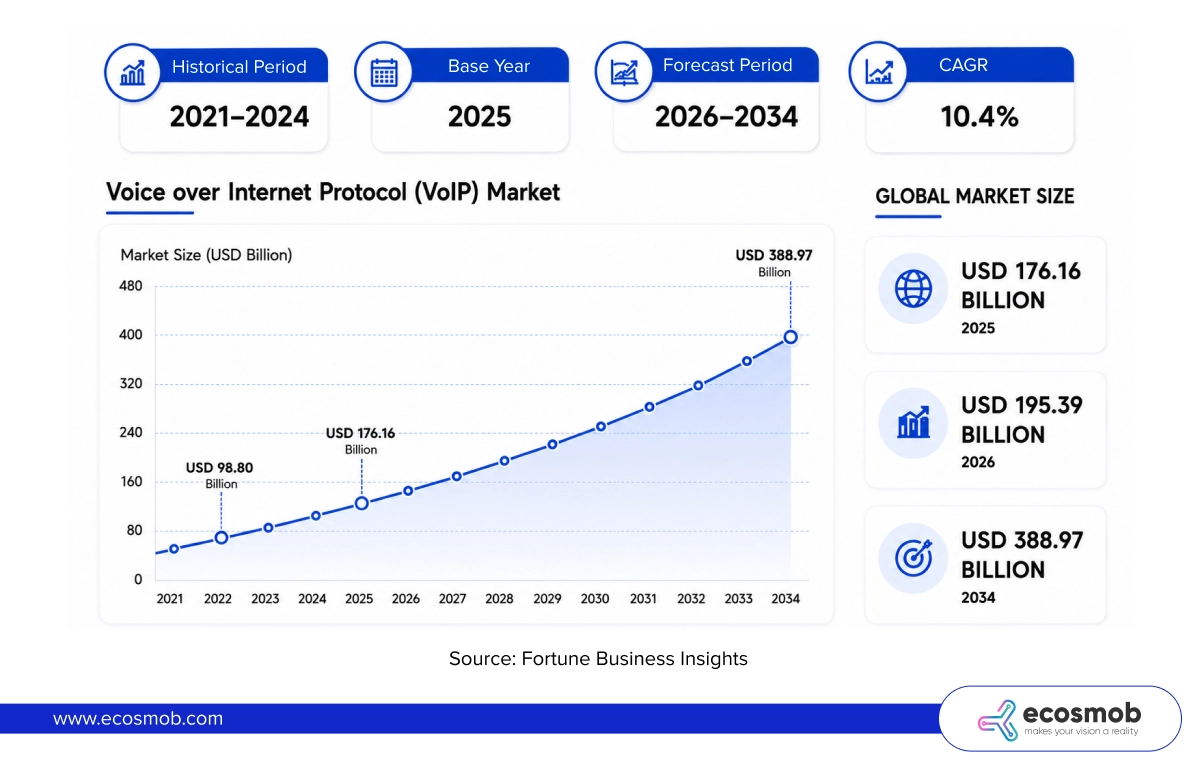
A research study published by Fortune Business Insights highlighted that the global VoIP market size reached a value of USD 176.16 billion in 2025 and is projected to scale cleanly to USD 388.97 billion by 2034, registering a steady 10.4% CAGR. This sustained growth is driven primarily by large enterprises actively migrating away from rigid cloud subscriptions to build their own software-defined communication hubs.
By building a dedicated engine on top of carrier-grade open-source software primitives (like FreeSWITCH or Kamailio), you eliminate recurring user seat taxes. Your monthly operational cost shifts from an unpredictable variable license fee to a highly stable, predictable flat compute infrastructure footprint. This lets you run millions of session minutes at near-wire wholesale rates.
How to Choose the Best VoIP Solution Providers?
Before partnering with a provider, your engineering and operations teams must analyze:
- Structural concurrency limits
- Direct media engine accessibility
- Local data compliance parameters
- Absolute API ownership models
To make your decision-making easier, integrate these target requirements into your Request for Proposal (RFP) evaluation cycles:
Granular Media Control via Native Bugs
Determine if the platform allows your developers to access raw, real-time audio streams out-of-band directly within the active session threads.
Proprietary cloud networks hide these layers behind black-box API wrappers, preventing you from embedding custom transcription algorithms or local AI analysis nodes.
Asynchronous Processing Capacity
Verify if the core engine uses an event-driven loop (like an ARI WebSocket architecture) or relies on process-per-call models (like traditional AGI).
The latter will rapidly trigger thread starvation and system lag when tied to external data lookups under carrier-scale loads.
Regulatory Separation Mechanics
Ensure the VoIP solution allows your network teams to write custom routing blocks capable of scrubbing incoming call headers dynamically.
This is a non-negotiable operational baseline required to isolate international and local traffic lines cleanly (shielding your business from severe regional carrier compliance issues).
Infrastructure Adaptability & Storage Footprint
Validate the VoIP platform’s support for stateless edge scaling patterns.
High-volume operators need routing layers that pull runtime configuration states instantly from fast local memory caches rather than parsing static local flat files on every call setup.
Where Does AI Integrate into Modern VoIP Solutions?
Artificial Intelligence integrates into modern VoIP solutions at two distinct structural layers:
- The infrastructure routing tier for automated call path optimization
- The application processing tier for real-time speech analytics
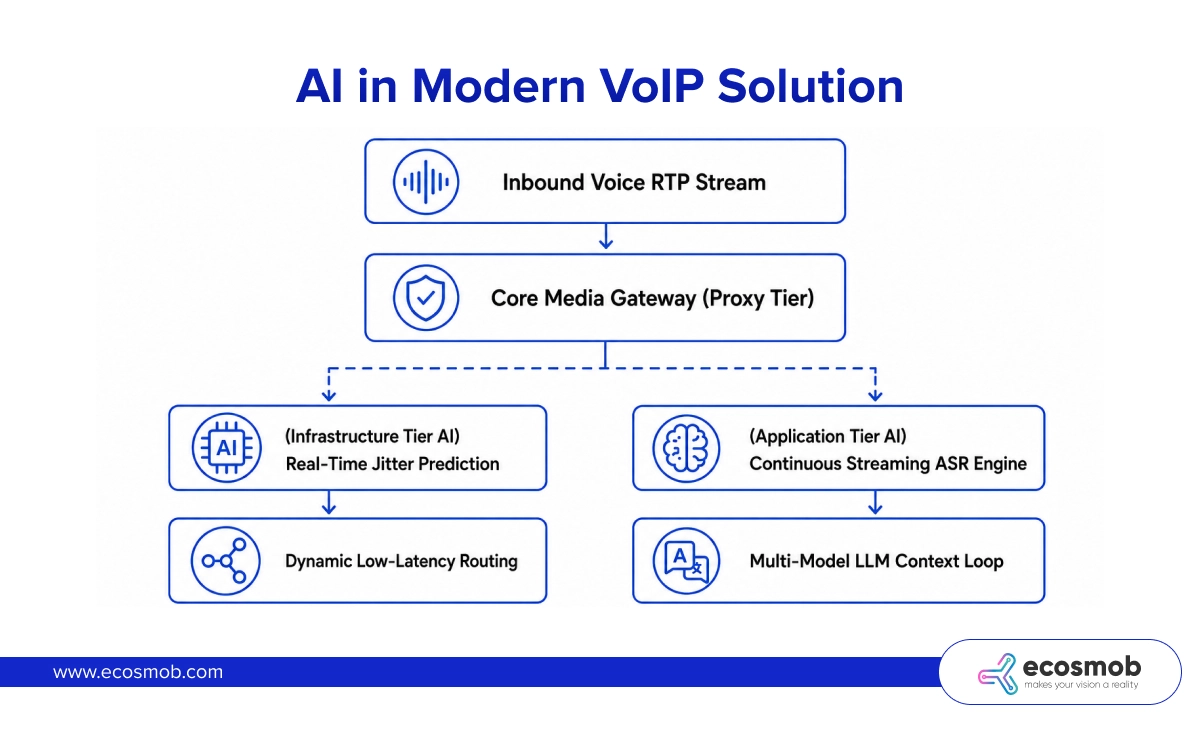
When evaluating a modern custom VoIP development company, look past simple marketing keywords to see exactly where the intelligence models sit within the data pipe:
- The Infrastructure Routing Tier (Network Layer)
At the low-level network layer, localized machine learning loops continuously analyze incoming Real-time Transport Control Protocol (RTCP) packet reports. If the system detects a microsecond jitter spike or packet drop condition along a specific network route, the routing tier automatically updates call paths to avoid congested carrier gateways.
This keeps your active WebRTC channels crystal clear without requiring manual intervention from network engineers.
- The Application Processing Tier (Intelligence Layer)
At this higher level, the engine forks raw call media natively out-of-band, passing uncompressed Linear PCM frames over persistent WebSockets directly into automated speech recognition (ASR) containers. The resulting text is processed through conversational large language models (LLMs) to assist contact center agents with real-time response scripts, compliance warnings, and immediate customer sentiment indicators mid-call.
Is your internal development group running into latency roadblocks or packet drops while integrating streaming speech APIs directly with your core media proxies?
You can simplify your infrastructure design by [collaborating with Ecosmob’s real-time AI voice engineering team!
Deploying VoIP Service in India
Okay, so, how do you navigate complex telecom regulations when launching high-volume communication services inside high-density Asian markets?
If you are configuring an enterprise-grade platform to operate as a compliant VoIP service provider in India, your system architecture must tightly align with strict local regulatory guidelines.
The Telecom Regulatory Authority of India (TRAI), along with the Department of Telecommunications (DoT), enforces rigid infrastructure rules regarding call security and spatial routing parameters. Specifically, networks must maintain absolute structural separation between international calling legs and domestic public switched telephone network (PSTN) traffic.
Building a compliant gateway environment requires deploying highly customized SIP routing blocks that inspect incoming call identifiers (ANI/DNIS) up front.
If the platform detects a mixing violation (such as a user attempting to bridge an untrusted internet call leg straight onto a domestic carrier line), your system logic must
- Automatically block the routing path
- Or, route the session to an interactive warning context
- Or, drop the call leg cleanly to protect your business platform from compliance issues
Maximizing the value of an enterprise communications platform requires moving far past standard, per-user cloud subscriptions. Off-the-shelf SaaS apps work fine for basic office usage, but high-volume platforms require:
- Dedicated architecture built around code transparency
- Predictable operational cost structures
- Unhindered access to your media pipelines
By building your system on an open-source framework, optimizing your network routes with real-time AI tools, and enforcing strict data compliance guardrails at your network boundaries, you construct an enterprise communications foundation built to scale indefinitely.
If your team is running into performance caps with a current vendor, struggling with concurrent capacity bugs, or looking to deploy an automated, containerized telecom platform, we can help! Speak with an Ecosmob enterprise telecom architect today!
Frequently Asked Questions
The primary metrics include your monthly concurrent channel spike profiles, custom data compliance rules, and the integration layout of your automation stack.
If your operations scale past a few hundred endpoints or require direct, out-of-band access to raw media packet streams for real-time speech analysis, switching to a custom open-source architecture eliminates high seat-based license markups and provides full control over your media pipelines.
An open-source engine incorporates inline media bugs that programmatically intercept the raw incoming Real-time Transport Protocol (RTP) packet stream within the active channel thread.
The platform decodes the payload, samples it to a native 16kHz format, and continuously streams the linear PCM chunks over persistent internal WebSockets directly into your transcription and conversational LLM engine pools without adding routing latency.
While commercial cloud engines simplify your initial configuration steps, they impose heavy, unhedged markups on every call minute and incoming data payload. As call traffic scales across large networks, these variable taxes add up rapidly.
Building a dedicated infrastructure core replaces these loose usage premiums with flat, predictable compute and wholesale network carrier costs.
Stateless edge routers (like Kamailio) manage real-time signaling data while separating the raw media path processing completely. The routing layer continually tracks channel packet performance metrics; if a media interface box goes offline, the proxy instantly shifts ongoing sessions to an active parallel node without dropping the connection.
Custom routing profiles deploy automated validation steps that inspect structural metadata (such as ANI, DNIS, and the ingress interface origin) the millisecond an invite arrives at your gateway.
If a mixing violation is identified, the system blocks the path dynamically at the edge to prevent non-compliant bridging across carrier boundaries.