










QUICK SUMMARY
Relying on generic API webhooks to handle real-time voice transitions frequently breaks under carrier-grade traffic profiles. This blog details native Asterisk infrastructure patterns for executing an optimal, zero-loss bot-to-human handoff without causing dead air or audio path failures.
We analyze the signaling mechanics of SIP REFER versus ARI channel redirection, outline strategies for isolating AI bot handoff to human customer disputes, and break down the architecture of an event-driven Voicebot Connector implementation.
If you’ve ever interacted with a modern voicebot only to be blind-transferred to a human who asks for your name, account number, and problem all over again, you know exactly where most enterprise AI voice projects die: the handoff. A live agent picks up, only to ask you for your name, account number, and problem all over again from scratch.
In chat-based support, a delayed transition is hidden behind a loading bubble. In voice, it is an immediate project failure. Dead air, sudden drops in the Real-time Transport Protocol (RTP) audio stream, and forcing customers to repeat information are the fastest ways to destroy user trust and spike your call abandonment rates.
If your enterprise infrastructure relies on Asterisk for its telephony core, building an elite conversational AI isn’t your biggest hurdle. Your true engineering challenge is handling the handoff. Asterisk has no native concept of “AI.” It only understands channels, bridges, extensions, and applications. To build a system that scales under live carrier traffic, you must map your AI’s conversational milestones directly onto native Asterisk media controls.
How Does Bot-to-Human Handoff Work On Asterisk?
A bot-to-human handoff works on Asterisk by using signaling or media application primitives (specifically dialplan macros, AMI/ARI channel redirections, or SIP REFER messages) to dynamically steer an active customer channel away from an AI streaming endpoint and into an agent queue.
When implementing this handoff, your selection of architectural patterns determines whether your transition feels seamless or jarring to the caller. Production architectures generally fall into three distinct routing patterns:
Pattern 1: The Dialplan-Driven Exit (Queue Fall-Through)
The customer channel enters a standard Asterisk dialplan context. The dialplan executes an application (like AudioSocket or an external Media module) that routes the call media to the AI voicebot. When the voicebot finishes the interaction or recognizes an escalation request, it signals its internal application to terminate its side of the session. Asterisk then falls through to the next sequential priority in the dialplan, which invokes the native Queue() application to send the call directly to a human agent group.
But there’s a catch. This creates a completely blind transfer. The moment the bot channel closes, the customer experiences a brief drop in audio before the queue application picks up.
Pattern 2: The ARI Channel Redirection (The Attended Transfer Model)
For high-density platforms where a premium customer experience is non-negotiable, the Asterisk REST Interface (ARI) provides the highest level of execution control.
Under this model, the customer call is placed inside an ARI-managed bridge. The AI engine and the customer stream audio back and forth via continuous WebSockets. When the AI engine detects an escalation trigger, it sends an asynchronous command back to your custom connector middleware.
The middleware fires an ARI POST request to the /channels/{channelId}/redirect endpoint, steering the customer channel cleanly to an internal agent queue extension while preserving the active call leg.
Pattern 3: The SIP REFER Pattern
If your AI voicebot sits completely outside your local network as a hosted cloud service, it operates as a distinct SIP endpoint. When it needs to pass control back to your on-premise team, it fires a standard SIP REFER message back to your core Session Border Controller (SBC) or Asterisk proxy.
The message includes a Refer-To header containing the target extension of your inbound agent queue, instructing your local infrastructure to bridge the new call leg while the cloud bot tears down its own connection.
Which Tools Enable Seamless Handover From Bots To Human Agents?
The primary tools for seamless handover from bots to human agents on open-source telephony networks are the Asterisk REST Interface (ARI), OpenSIPS proxy routers, and low-latency Python or Node.js event middleware running concurrent WebSocket audio handlers.
To coordinate these components without adding overhead, you need a highly optimized mediation layer. Using a bare Asterisk dialplan to handle complex JSON state changes from an LLM API will cause performance drops.
Instead, deployment teams use a fast SIP proxy like OpenSIPS to manage routing paths at the network edge, combined with an isolated Python or Go-based middleware engine that listens directly to your AI’s intents and translates them instantly into system-level execution commands.
Here is how these specialized components handle their respective roles within the production stack:
- Asterisk REST Interface (ARI): Acts as the low-level channel manipulator. It treats active calls as programmable objects, allowing the system to pause media, inject native Music on Hold, and execute asynchronous channel redirections without breaking the underlying trunk connection.
- OpenSIPS Proxy Router: Manages the network edge. It handles high-volume NAT traversal, balances inbound traffic, and utilizes media-forking protocols to offload heavy audio processing routines entirely from the Asterisk core.
- Python / Go Middleware Layer: Operates as the central coordinator. Running asynchronous event loops, this isolated script listens to conversational milestones and instantly converts AI semantic intents into system-level execution directives.
- Persistent WebSockets: Sustains the real-time audio pipeline. It establishes a low-latency, full-duplex TCP connection between your infrastructure and the AI engine to stream raw linear PCM audio back and forth within milliseconds.
- Asynchronous Message Bus (Redis / RabbitMQ): Powers the parallel data sync. The exact millisecond an escalation triggers, it bypasses the voice network to push customer metadata directly to the CRM, ensuring the agent dashboard updates before the audio line bridges.
So, how do these tools work together in production during an AI bot-to-human handoff?
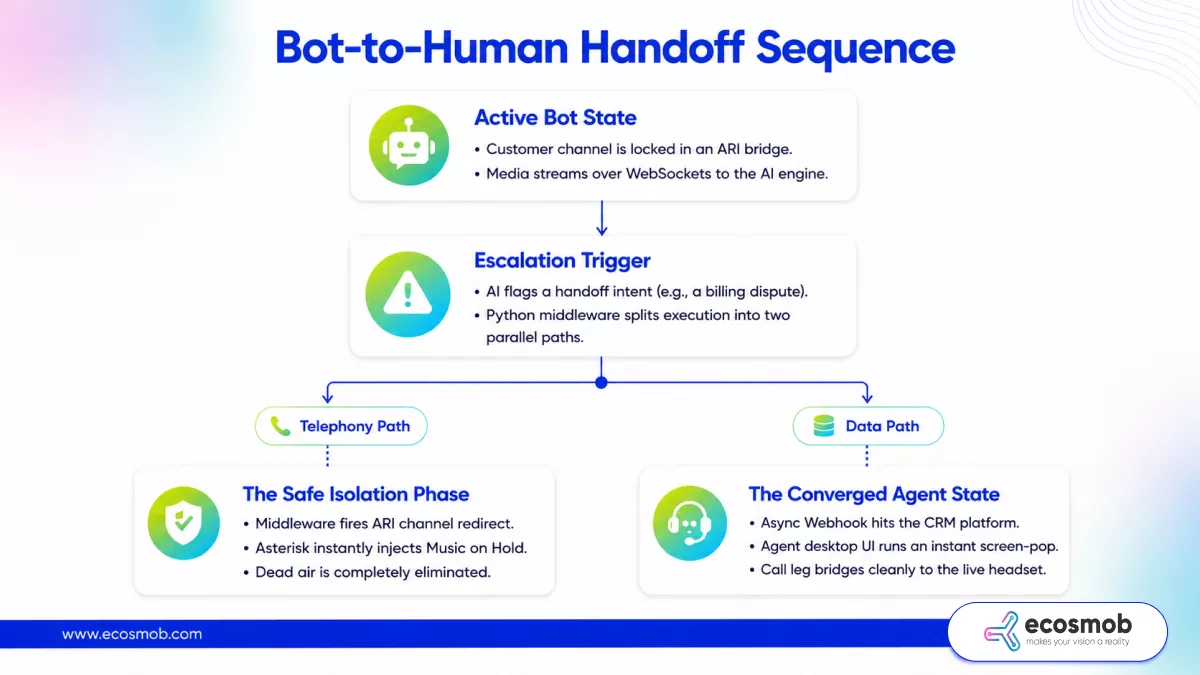
When a call lands, OpenSIPS normalizes the inbound SIP traffic and handles initial routing. Asterisk accepts the session and immediately hands control of the channel over to the Python Middleware via an ARI event loop.
As the caller speaks, the middleware intercepts the audio and pumps it across a persistent WebSocket connection to the AI engine. The moment the AI identifies an escalation trigger (such as a billing dispute), the Python middleware splits the execution flow on two parallel paths: it commands ARI to shift the caller into a safe holding queue with hold music, while simultaneously blasting a session summary across the Message Bus to pop open the customer’s history on the agent’s screen. The voice and data paths converge instantly as the agent answers.
 How Should AI Handle Customer Disputes Or Chargebacks On A Call?
An AI voicebot must route an AI bot handoff to human customer disputes immediately upon identifying a high-risk transaction intent, entirely bypassing the conversational retention loop to protect financial institution compliance and prevent regulatory liability.
According to benchmarking data compiled by SQM Group, roughly 29% of customers are forced to contact a company multiple times for a single issue: a metric that degrades heavily when complex financial disputes are left in the hands of poorly constrained automation.
The moment your AI’s natural language understanding (NLU) model registers keywords like “dispute this charge,” “unauthorized transaction,” or “chargeback,” the conversational model must freeze its generation loops. It should instantly play a reassuring transition phrase and trigger a high-priority handoff to human fraud or compliance teams, protecting your platform from legal and financial exposure.
Experiencing dropped calls or dead air during AI voice transitions?
Eliminating the AI Bot to Human Handoff Failures
Unlike chat-based bots, where an API delay is hidden behind a loading icon, voice networks reveal architectural weaknesses immediately. If your handoff isn’t meticulously timed, your system will introduce severe network issues.
1. Eliminating the Silence Gap with Native MOH Injection
When a bot initiates an escalation via ARI, there is a distinct gap between the moment the AI stops streaming and the moment a human agent answers the phone. If the channel is left floating during this window, the customer experiences a drop in background noise (frequently assuming the call has disconnected).
The Fix
Your custom connector middleware must explicitly send a start_moh command to Asterisk before it executes the channel redirection. The presence of continuous comfort noise or Music on Hold keeps the caller anchored to the active line.
2. Preventing One-Way Audio via Re-INVITE Management
During a standard bot-to-human transition, the underlying network must tear down the media path going to your AI server and establish a new path pointing to the agent’s hardphone or WebRTC endpoint. If your Session Border Controller or carrier trunks do not properly negotiate this mid-call SDP change, your system will experience one-way audio or complete silence.
The Fix
Configure Asterisk to allow direct media re-INVITEs (directmedia=yes) only if your endpoints sit on the same local subnet. For cross-network or cloud-managed AI environments, force Asterisk to remain in the media path as a Back-to-Back User Agent (B2BUA) to handle SDP translations safely without losing packet control.
Ecosmob Expert Tip
When executing an ARI-driven handoff, never redirect the customer directly into an empty queue blindly. Instead, use Asterisk Local Channels (Local/exten@context) to pre-fork an outbound call leg to the agent queue while keeping the customer cleanly isolated in a holding bridge.
Once an actual human agent answers and clears the validation checks, tear down the holding bridge and slam the two active legs together. This isolates your customer completely from internal system signaling anomalies and dial tones.
Implementing Live Agent Whispering During AI Transitions for a “Warm Handoff”
In premium enterprise call centers, forcing an agent to take an escalated call completely cold is an operational bottleneck. Data from a Gartner customer survey of 5,801 U.S. customers revealed that 54% of them trust human agents more than AI for complex, high-stakes, or advisory interactions. Because users demand human validation during these critical moments, the handoff cannot feel like a jarring disconnection. It requires an intentional, orchestrated transition.
To cut down post-transfer handle times while preserving this crucial layer of trust, you should implement a hybrid, three-way transitional state using Asterisk’s native ChanSpy() or bridge features.
Instead of cutting the bot’s media stream instantly, the ARI middleware can execute a “Warm Whisper” phase:
- The Holding Bridge: The customer is placed on a temporary bridge with soft background music.
- The Agent Ingress: The system dials the agent. The moment the agent answers, they are muted to the customer but placed into a one-way listening channel where the AI engine whispers a 5-second audio synthesis of the problem: “Escalating account 4092. User attempting to dispute a $150 retail charge.”
- The Final Merge: The agent hits a key on their desktop, the bot channel drops, and the agent’s microphone opens directly to the customer.
How to Prevent WebSocket Thread Starvation Under High Concurrent Loads?
If you try to stream raw, uncompressed linear Pulse Code Modulation (PCM) audio over WebSockets directly out of Asterisk thread pools for hundreds of simultaneous calls, your core telephony engine will experience thread starvation. Asterisk is optimized for rapid network switching, not sustaining massive, long-lived user-space application socket connections.
To protect your system’s uptime, your architecture must decouple the media streaming layer from the signaling core. By positioning a specialized SIP proxy like OpenSIPS at your network boundary, you can terminate your carrier lines securely and use media-forking protocols (like SIPREC) to duplicate the raw RTP packets at the network layer.
The duplicated packets are then processed by an isolated middleware cluster running optimized Node.js or Python socket loops. This ensures your Asterisk server focuses 100% of its computational cycles on core channel switching, routing, and compliance recording, while your AI computational load scales independently in its own containerized environment.
Need to build a high-availability, low-latency infrastructure for your conversational AI?
How We Built An Event-Driven Voicebot Connector Layer
To prove how these advanced engineering patterns operate under live enterprise pressure, let’s look at the production architecture we at Ecosmob designed and deployed for a high-capacity voice automation platform.
The Challenge
The infrastructure handled live inbound and outbound enterprise sessions daily across a high-volume Asterisk environment. The requirement was to introduce an advanced, third-party AI voicebot into their live call flows as an active, real-time participant.
Crucially, the integration could not alter or disrupt their existing call recording compliance configurations, custom dialplan routing logic, or local operational ownership of their underlying Asterisk nodes.
The Solution
We built a customized Voicebot Connector mediation layer designed to act as a low-latency, real-time bridge between the production Asterisk 16.9 server and the external AI provider.
Rather than modifying the core PBX code or risking system-wide instability, our team deployed an optimized orchestration stack using OpenSIPS for advanced transport-layer signaling proxying and Python to manage real-time WebSocket audio streaming loops safely off-chassis.
The Production Impact
Our implementation closed the critical RTP streaming gap between the PBX and the AI core without destabilizing the production network. Asterisk remains the absolute system of record for all call control and compliance recording, while the AI voicebot actively participates in live sessions.
Most importantly, the connector introduced robust event-driven call escalation handling. When the AI voicebot flags a complex transition event (such as a customer dispute), the connector fires immediate webhook instructions back to Asterisk via native AMI hooks. This triggers an automated, low-latency channel redirection: injecting hold music, transferring full conversational context to the agent desktop, and bridging the live agent into the call leg seamlessly without a single dropped packet or millisecond of dead air.
Streaming low-latency, real-time audio from standard PBX channels to advanced AI models (while maintaining 100% control over your call routing, compliance, and human escalation pipelines).
Read Our Full Integration Success Story
Metrics For Tracking Voicebot Handoff Success
If you cannot measure your AI bot to human handoff performance with precision, you are managing your voice infrastructure blindly. Single-session laboratory benchmarks often obscure system instability under real concurrent load.
To ensure your system remains production-grade, your monitoring platforms should track these verified, telecom-standard thresholds compiled from live infrastructure deployment data:
| Metric | Target Threshold | High-Risk Failure Indicator |
| Handoff Latency | < 250 milliseconds | Delayed channel variable processing or choking API middleware. |
| Dead-Air Duration | 0.0 seconds | Absence of immediate Music on Hold injection during the ARI transfer sequence. |
| Transfer Success Rate | > 99.5% | SDP renegotiation errors or misconfigured re-INVITE handling at the SBC boundary. |
| Repeat Information Rate | < 5.0% | Failure of your parallel webhook data path to populate the agent’s CRM interface prior to call bridging. |
| Post-Transfer AHT Drop | > 30% reduction | Proof that your screen-pop context payload is effectively streamlining the human agent’s resolution path. |
Building a reliable voice infrastructure means focusing strictly on telecom engineering over generic software patterns. A truly seamless bot-to-human handoff requires direct, low-level control over channel redirection, media state caching, and context synchronization loops.
By abandoning simple API workarounds and implementing structural Asterisk primitives alongside event-driven connectors, you eliminate dead air, lower your call abandonment rates, and build a conversational AI architecture that scales seamlessly under heavy production traffic.
Ready to eliminate dead air and optimize your AI voicebot handoff patterns on Asterisk? Connect with Ecosmob’s core open-source telecom and AI specialist teams today!
FAQs
How does the bot-to-human handoff work on Asterisk?
It operates by using application primitives like ARI channel redirection or AMI redirect commands to intercept an active customer channel leg, separate it from the current AI media stream, and route it to an internal dialplan context pointing to an agent queue.
What tools enable seamless handover from bots to human agents?
The most reliable tools include the Asterisk REST Interface (ARI) for low-level channel redirection, OpenSIPS for managing signaling at the network edge, and low-latency Python or Go event middleware running WebSockets for continuous, real-time audio handling.
How do you route a call to the correct human queue by intent and language?
When the AI engine determines an escalation requirement, its middleware parses the extracted intent and language tokens into custom channel variables. When the channel is redirected back to the Asterisk dialplan, these variables dictate which specific Queue() target is executed.
How do you recover if the target human queue is busy or an agent declines the transfer?
Your middleware routing script must include explicit error-handling paths. If the ARI redirection target fails or times out, Asterisk should route the call to an automated voicemail system, execute a fallback to an external backup center, or return the customer to a customized interactive holding bridge.
Does using an AI voicebot connector break existing compliance recording systems?
No, provided you implement the proper architecture. By deploying an event-driven mediation connector, Asterisk remains the core back-to-back user agent for the call. This setup allows you to use standard Asterisk recording mechanisms natively on the server without losing compliance auditing visibility.