










QUICK SUMMARY
⚡ At a Glance
The Problem: Repetitive L1 queries drain talent and drive up support costs.
What This Covers: Why scaling humans fails, and how voice bots and orchestration fix it.
Key Takeaway: Automate repetition. Preserve expertise. Scale smarter.
Every time a skilled engineer or a high-tier agent explains how to “reset a password” or “check an order status,” a piece of your innovation roadmap dies.
That’s not dramatic, but simple math.
Your best people are spending their time answering the same L1 questions over and over. Not solving complex problems. Not building what’s next. Just repeating instructions that could’ve been handled automatically with an AI voicebot for L1 support.
Investing in a custom AI voicebot for L1 support solution isn’t about adding another shiny feature to your support stack. It’s about stopping the quiet drain on your team’s time. It’s about freeing up real human bandwidth so your experts can focus on work that actually moves the business forward.
Because the real risk isn’t a server outage.
It’s wasting your top talent on tasks a bot could handle in seconds.
And nowhere is that inefficiency more visible than in how L1 support operates today.
Understanding L1 Support in Modern Customer Service
L1 support is the front line of customer interaction. It deals with repetitive, predictable, high-frequency queries that follow clear steps and predefined answers. These issues are rarely complex. They are Structured, repeatable, and constant. The real challenge isn’t solving them. It’s handling the volume, especially when AI is already reshaping telephony. When hundreds or thousands of these requests come in daily, they quietly consume time, attention, and operational focus.
That’s where the strain begins.
Common L1 Support Requests Businesses Handle Daily
If you break down your inbound calls or tickets, you’ll likely see the same categories repeated:
- Password resets
- Order status checks
- Basic troubleshooting steps
- Account updates
- Frequently asked questions are answered dozens, sometimes hundreds, of times per day
These aren’t ambiguous problems requiring expert judgment. They’re workflow-driven interactions. Step 1, Step 2, Step 3. The outcome is predictable and a voice bot can actually resolve L1 issues.
Myth vs Reality
❌ Myth: Customers hate talking to bots.
✅ Reality: Customers hate waiting. Speed wins.
Yet most organizations still assign them to humans.
So,
Are your agents busy repeating scripts all day? Give them a coffee break and let AI Voicebot handle the L1 queries.
What’s the Real Cost of Running L1 Support with Humans at Scale for Businesses?
Hiring more agents, rather than deploying AI voice agents, seems like the obvious fix when ticket volume rises. But it solves pressure, not structure. Over time, the model becomes expensive and inefficient.
1. Linear Cost Growth
Every increase in ticket volume demands a proportional increase in headcount. Salaries, benefits, tools, and management overhead all rise together. There’s no leverage, costs grow in a straight line with demand.
2. Training Cycles and Quality Gaps
New hires require onboarding, product training, and supervision. That takes time and senior resources. Meanwhile, service quality varies based on experience, leading to inconsistent customer interactions.
3. 24/7 Coverage Multiplies Expense
Round-the-clock assistance in call centers and custom support requires shift rotations, backups, and overtime. Staffing nights and weekends significantly increases operational costs, without guaranteeing faster resolutions during peak demand.
4. Diminishing Returns on Expansion
Initial hires reduce backlog quickly. But beyond a point, adding more agents leads to marginal improvements while coordination complexity increases. You spend more for smaller gains.
Scaling people increases capacity, but it doesn’t change the model itself.
What happens if your L1 volume doubles next quarter?
Hire?🤔
Or automate?😎
- “One adds cost.”
- “One absorbs volume.”
Voice Bots vs. Human Agents in L1 Support
Before deciding whether automation makes sense, it helps to clearly see the operational difference. L1 support handled only by human agents follows a resource-heavy, shift-based model. L1 support, supported by a voice bot, operates on structured workflows, instant processing, and system integrations.
Instead of explaining it in theory, here’s the difference side by side:
| Human-only L1 Support | L1 Support with Voice Bot |
| Handles calls sequentially | Handles high-volume, rule-based queries instantly |
| Limited by shift hours | Operates 24/7 without queue times |
| Responses vary by agent | Delivers consistent, predefined responses |
| Manual system lookups | Integrates with CRM, order systems, ticketing tools |
| Escalations depend on judgments | Escalates only when human intervention is required |
An AI voice bot for L1 support doesn’t replace your team. It filters and resolves structured interactions before they reach them.
And when that structural shift happens, the business impact becomes measurable.
That hold music in your L1 support isn’t keeping customers happy, it’s testing their patience.
What are the Business Benefits of an AI Voice Bot for L1 Support?
Not every organization needs automation immediately. But when certain operational pressures start repeating month after month, the financial and strategic case for automation becomes clear.
1. High Support Volume
If a large portion of your inbound calls or tickets consist of repetitive L1 queries, your support team is operating in a constant cycle of resolution rather than improvement. Backlogs grow during peak hours. SLAs become harder to maintain. Operational costs increase steadily because each additional ticket requires human time.
Even if your team performs well, the system itself is inefficient. High-frequency, rule-based interactions don’t require judgment; they require structure.
Lower cost per interaction, predictable handling of high-volume queries, and measurable reduction in support load.
2. Rapid Business Growth
Growth amplifies support demand. As your customer base expands, so do inquiries. Entering new regions introduces time-zone challenges. Offering 24/7 support becomes necessary rather than optional.
Hiring more agents may temporarily absorb demand, but recruitment, onboarding, and supervision take time. Meanwhile, customer expectations don’t slow down.
Headcount scales linearly. Customer growth rarely does.
A support model that scales without proportional increases in hiring, enabling growth without operational strain.
3. Inefficient Resource Allocation
When skilled agents repeatedly handle password resets or account updates, expertise is being underutilized. When engineers are drawn into support workflows for structured issues, product momentum slows.
The cost isn’t just operational, it’s strategic. Roadmaps stretch. Innovation cycles lengthen. High-value talent spends time on low-complexity work.
That misalignment compounds over time.
Seamless human escalations toward complex cases, product development, and revenue-driving initiatives.
4. Customer Experience Gaps
Long IVR queues, delayed first responses, and inconsistent service quality create friction. Customers expect immediate answers for simple queries. When resolution time increases for predictable issues, frustration rises, even if your team is working at full capacity.
Inconsistent answers from different agents can further erode trust, especially in regulated or transaction-heavy industries.
Faster, standardized responses, reduced wait times, and more reliable customer interactions.
When these conditions exist, a Voice Bot for L1 support moves beyond being a tactical tool. It becomes part of your operational backbone, a structural shift that stabilizes cost, improves speed, and protects your most valuable human resources.
Here is a quick sneak peek at the ROI of businesses deploying voice bots for L1 support:
| Company/Use Case | Key Benefit | Source |
| Enterprise Contact Centers (e.g., DoorDash, Vodafone) | Automated high-volume L1 calls with high accuracy | Up to 35,000+ calls automated daily at ~94% success rate; major NPS improvements observed |
| BFSI Automation via Conversational IVR | Tier-1 query deflection and support cost savings | 52% of tier-1 tickets deflected, saving firms ~₹18 lakh per quarter |
| AI Voice Agents in Support (Qcall.ai example) | Lower costs and high service rates | ~65–70% cost reduction vs. human agents with ~92.8% success rate |
The real ROI, however, depends on how well the technology behind the voice bot is engineered and integrated.
Voice Bot Orchestration Layer in L1 Support Automation
A voice bot alone is not enough. The real strength lies in the orchestration layer that connects conversations to systems and infrastructure.
An AI-powered voicebot for call centers operates effectively only when multiple layers work together in sync.
 The Core Layers in Voice Bot Orchestration:
Dialog Management – Controls conversation flow, intent handling, and escalation logic.
SIP and Media Handling – Manages real-time call routing, session control, and telecom-grade reliability.
API and Backend Integration – Integrating CRM in VoIP, ticketing, billing, and order systems for real-time data exchange.
AI/NLP Processing – Handles speech recognition, intent detection, and response generation.
What Orchestration Ensures?
- Real-time call control
- Seamless CRM synchronization
- Intelligent human escalation
- Failover logic during system disruptions
- Stable performance under high call volumes
In regulated sectors like healthcare, it also supports secure workflows and compliance (HIPAA, GDPR…) requirements.
This is where many AI voicebot for customer support deployments fall short, not in AI capability, but in backend coordination and telecom architecture.
At Ecosmob, the focus is on building this orchestration backbone to enable reliable, carrier-grade deployments that perform consistently in production environments.
Because without orchestration, automation remains a feature.
With orchestration, it becomes infrastructure.
If orchestration is the control center, the connector is what links it to your real-world telephony and business systems.
Voice Bot Connector for Seamless CRM and SIP Integration
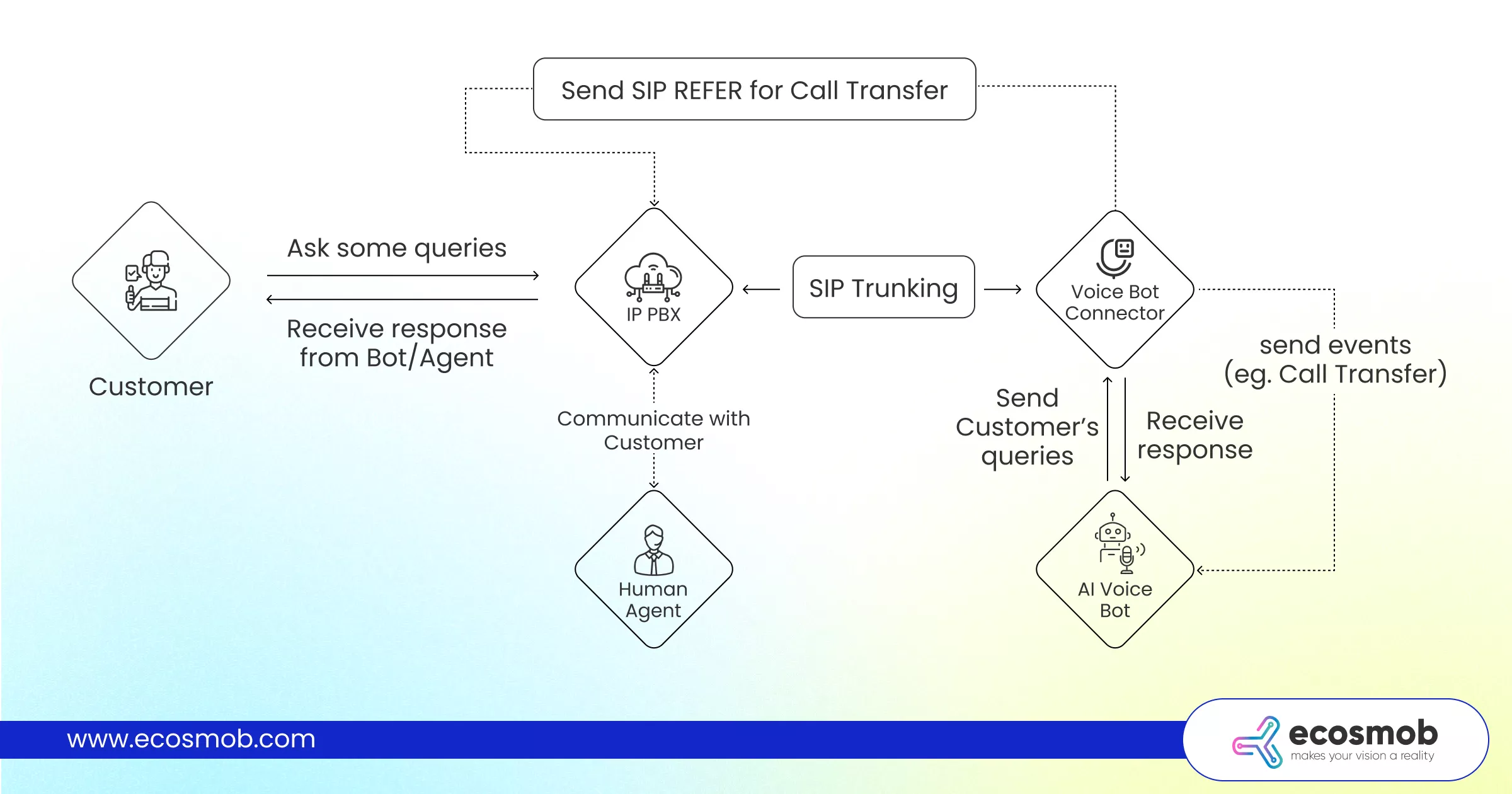
While orchestration coordinates the internal layers, the Voice Bot Connector enables external connectivity.
It acts as the integration bridge between the AI voice bot for L1 support and your communication and business systems, without disrupting existing infrastructure.
 What the Voice Bot Connector Enables?
Telephony Integration – Connects with SIP servers, IVR solutions, PBXs, and carrier networks to manage inbound and outbound calls seamlessly.
CRM and Backend Synchronization – Enables real-time data exchange with CRM platforms, ticketing tools, billing systems, and order management systems.
Secure API Connectivity – Facilitates structured workflows through authenticated API calls.
Scalable Deployment – Supports multi-channel routing and high call concurrency without architectural rework.
Instead of rebuilding your communication stack, a Voice Bot Connector integrates automation into your existing environment.
With Ecosmob, Voice Bot Connector solutions are engineered to align with telecom-grade architecture, ensuring stable media handling, secure backend access, and reliable call control across production environments.
Because automation doesn’t work in isolation. It works when it connects and once the integration layer is in place, the next step is deploying it with a structured rollout strategy.
Move from reactive support to automated L1 resolution with a custom AI voicebot solution.
How to Implement Voice Bots for L1 Support the Right Way
Jumping into full automation rarely works. A phased, structured rollout delivers better results and lower risk.
1. Identify High-Impact L1 Queries
Start with the top 20% of repetitive queries generating the highest volume. These are typically structured, rule-based interactions that offer immediate automation value.
2. Design Clear Workflow Logic
Map each selected query into defined conversational flows. Outline intent recognition with sentiment analysis solutions, response logic, escalation triggers, and fallback paths.
3. Integrate with Backend Systems
Connect the voice bot to CRM platforms, ticketing tools, billing systems, and order databases. Automation should retrieve and update real-time data, not rely on static scripts.
4. Pilot and Measure Performance
Launch in a controlled environment. Track deflection rate, average resolution time, escalation accuracy, and customer satisfaction indicators.
5. Optimize and Expand
Refine workflows based on live data. Once stability and accuracy are validated, expand automation coverage gradually.
An AI voice bot for L1 support becomes operationally effective when it is deployed with measurable objectives, not when everything is automated at once.
Now you know what L1 costs and how voice bots change the model, the choice is yours.
The Bottom Line?
Voice bots aren’t about replacing people. They’re about protecting your best people from low-value work.
Takeaways?
- Humans solve exceptions. AI handles repetition.
- Humans create strategy. AI executes workflows.
- Humans innovate. AI scales consistency.
When implemented properly, a voicebot for L1 support reduces noise, improves speed, and preserves the attention of your most capable teams.
At Ecosmob, the difference lies in orchestration, building AI powered voicebots for call centers that integrate deeply with telecom infrastructure, backend systems, and compliance requirements. From SIP handling to real-time API coordination and failover logic, the goal isn’t just automation, it’s dependable automation.
Because the future of support isn’t choosing between humans and AI. It’s designing systems where both operate where they’re strongest.
FAQs
What is a Voicebot for L1 Support?
A Voicebot for L1 support is an AI-driven system that handles high-volume, repetitive customer queries such as password resets, order tracking, and account updates. It uses speech recognition, intent detection, and backend integrations to resolve structured queries automatically before escalating complex cases to human agents.
How is an AI Voice Bot Different from a Traditional IVR?
Traditional IVRs rely on rigid “press 1, press 2” menus. An AI voice bot for L1 support understands natural speech, identifies intent, retrieves real-time data from backend systems, and completes tasks dynamically, without forcing customers through static menus.
What Happens When a Voice Bot Can’t Resolve an Issue?
When a query falls outside predefined workflows or confidence scores drop below a threshold, the system triggers intelligent escalation:
The bot transfers the call to L2/L3 support in real time
Context, call transcript, and captured data are passed to the agent
The customer does not need to repeat information
What Are the Risks of Deploying a Voice Bot for Customer-Facing L1 Support and How Can They Be Minimized?
Common Risks of Deploying a Voice Bot for Customer-Facing L1 Support are poor speech recognition accuracy, broken backend integrations, improper escalation logic, customer frustration due to rigid flows, compliance and data security gaps and these can be minimized by implementing a strong orchestration layer with real-time backend coordination, using fallback and failover logic for API or system latency, defining escalation thresholds based on confidence scoring, piloting with high-volume, low-complexity workflows first and ensuring secure data handling and regulatory compliance in regulated industries.
Does a Voice Bot Replace Human Agents?
No. An AI voicebot for customer support handles predictable, rule-based interactions. Human agents focus on exceptions, judgment-based decisions, and complex cases. The goal is workload filtering, not workforce replacement.