
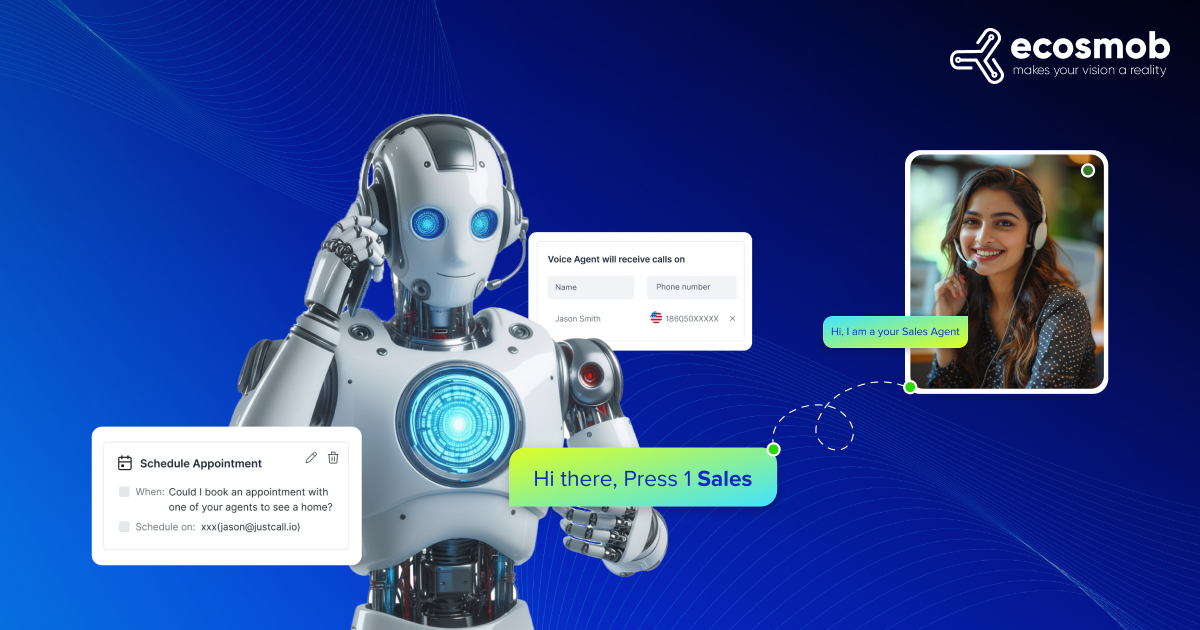
A customer calls a support center, explains their issue to a customer AI bot, and before they can even finish, they are transferred to a live agent who already has all the details.✅
And that’s exactly what you, I, and every customer calling for support want, not long IVR menus and being put on hold.❌
A custom AI voicebot solution. The result? A delighted customer and a problem solved in minutes.
| Scenario | How it works? | Customer Experience |
| AI Handles Everything✅ | AI bot listens, understands, and solves the issue entirely on its own. | Quick, but limited to predefined answers; complex issues may remain unresolved.⭐ |
| AI + Human Support✅✅ | AI gathers issue details, suggests solutions, then escalates seamlessly to a human agent if needed. | Fast, accurate, and personalized; complex problems solved without frustration.⭐⭐ |
This is what real-time call escalation software would do, and in this blog, we’ll show you how to make it happen.
But before we dive into the how, let’s first understand why AI can handle customer support calls and why customers still need human support alongside AI.
6 Challenges in AI-only Customer Support
A Reddit user shared his frustration:
This sentiment reflects a common issue: AI-only systems often fail to provide the subtle support customers need, and that makes Integrating voicebots effectively essential.
Here’s a deeper look at the challenges businesses run into when they rely entirely on automation.
1. Repetition of information
Few things irritate customers more than having to repeat themselves.
Imagine spending two minutes explaining your problem to a bot, only to be transferred and asked the same questions again. This breaks trust immediately and makes the customer feel like their time doesn’t matter. Over time, repetition like this drives down CSAT scores and increases abandonment rates.
2. Lack of emotional understanding
AI can detect keywords and even tone of voice to some extent, but it cannot provide genuine empathy.
When a customer is frustrated over a billing mistake or discrepancy, they don’t want canned responses; they want acknowledgment and assurance. Without a human stepping in, the interaction feels cold and transactional, leaving the customer emotionally disconnected from the brand.
3. Limited problem-solving ability
AI thrives when issues are predictable, like resetting a password or checking account balances.
But when the problem is complex, say, a technical glitch affecting multiple systems, the bot can’t improvise. Customers end up stuck in a loop of irrelevant suggestions, which not only delays resolution but also creates a sense of helplessness. This delay often turns a manageable issue into an escalation crisis.
While AI in call centers can handle routine queries efficiently, real-world use cases show why human support remains crucial for complex problems.
4. Frustration with rigid responses
Automation has its limits, and rigid scripts are one of them.
When bots don’t understand unusual queries, they tend to fall back on repetitive or generic responses like, “I didn’t get that,” or “Let me connect you.” The result is a conversation that feels more like hitting a wall than solving a problem. Customers expect flexibility, not rigidity, and bots that can’t adapt quickly become a pain point.
5. Risk of customer churn
The hidden cost of AI-only support is customer loss.
Research shows that customers are more forgiving of delays than they are of feeling ignored. If they feel trapped in an endless AI loop with no human in sight, many will abandon the call and look for competitors with more human-centric support. While AI saves costs, poor experiences can erode customer trust, loyalty, and lifetime value.
6. Agent-side frustration
AI-only systems don’t just frustrate customers, they frustrate agents too.
When agents finally receive escalated calls, they often lack the context the bot has collected. This forces them to start from scratch, making their jobs harder and increasing stress. Over time, this lowers productivity and morale, creating another operational challenge for call centers.
These challenges highlight why companies offering customer service bots with human escalation deliver far better outcomes than AI-only systems. Real support requires a balance of automation and human intervention.
That’s why seamless human escalation is not optional; it’s essential.
So,
What is Seamless Human Escalation?
Seamless human escalation is the ability to move a customer from AI to a human agent without friction.
Using AI voice agents can significantly speed up initial customer interactions, ensuring your support team focuses on more complex issues, such as seamless escalation.
When considering what tools allow agents to transfer AI-handled calls seamlessly, it becomes clear that it’s not just about transferring the call; it’s about
✅ preserving context,
✅ minimizing wait time, and
✅ ensuring the customer feels heard throughout the process.
In a truly seamless experience, the agent already knows the customer’s issue before saying ‘Hello,’ something made possible by modern tools for seamless AI call transfer that preserve context and ensure continuity.
Now that we understand why AI alone isn’t enough, let’s look at how businesses can implement best practices to make these transitions smooth and stress-free for both customers and agents.
What Are the 5 Best Practices for Smooth Call Transfers?
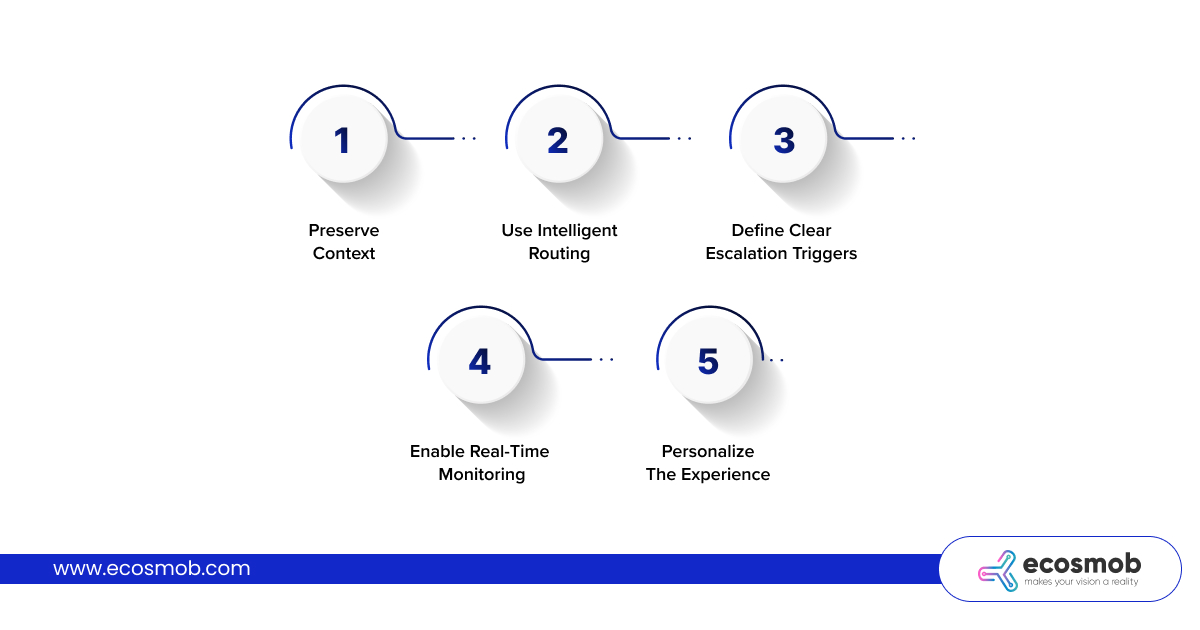
When exploring the best way to escalate voice agent conversations to humans, it’s essential to follow proven strategies. These best practices for escalating voice agent conversations to humans ensure that every handoff feels smooth and intuitive, preserving context, minimizing wait time, and enhancing the overall customer experience.
AI-powered voice bots provide 24/7 support, but escalation to a live agent guarantees that problems beyond automation are resolved quickly. This is essential for achieving a seamless transition from a voice bot to a live agent. Now, how do you make the handoff smooth? Here are some proven strategies:
1. Preserve context
Make sure the agent already knows what the AI collected.
Nothing’s more frustrating for a customer than having to repeat the exact details over and over.
2. Use intelligent routing
Send the call to the right person the first time. Whether it’s a language preference, a skill set, or the type of issue, the customer should reach someone who can actually help. Implementing best practices for routing an escalated mortgage call from a voice bot to the right human team ensures that the handoff is seamless, minimizing wait time and preserving context for both the customer and agent.
3. Define clear escalation triggers
Decide when the AI should hand over the call.
It could be repeated questions, a frustrated tone, or tricky problems that the bot can’t handle.
This is also where teams often ask, “Can sentiment analysis software flag frustrated callers in real time so our voice bot can escalate to a human?” The answer is yes, and it dramatically improves the timing and accuracy of handoffs.
4. Enable real-time monitoring
Keep an eye on in-progress calls.
If something gets stuck between the AI and a human agent, a supervisor can jump in before the customer gets annoyed.
5. Personalize the experience
Agents should start with what the AI already knows.
Something as simple as, “I see you’ve already explained this to our assistant. Let me take it from here,” makes the customer feel heard instantly.
Implementing these strategies becomes much easier with custom communication solutions tailored to your business needs. When exploring the best way to escalate voice agent conversations to humans, it’s helpful to understand how leading automated product support systems handle seamless handover to human agents. Applying these principles ensures every handoff feels smooth, intuitive, and context-aware, so customers never have to repeat themselves.
How do Custom Communication Solutions Help with Seamless Call Transfers?
Generic, one-size-fits-all systems can’t deliver seamless escalation. That’s why SaaS customer messaging providers with bot-to-agent escalation capabilities are critical. Companies offering customer service bots with human escalation bridge this gap by ensuring AI, IVR, and CRM systems work together without losing context.
At Ecosmob, we build custom communication platforms that integrate AI, IVR, and CRM to ensure context never gets lost.
Real-time AI agent assist can guide human agents during escalations, making transitions from bot to agent seamless and reducing call handling time.
Our solutions include
- intelligent call routing,
- AI-powered escalation triggers, and
- unified dashboards,
so both customers and agents have a smoother journey.
With the right tools in place, the benefits of seamless escalation extend far beyond individual calls.
What are the Business Benefits of Seamless Escalation?
When AI-to-human transfers work right, the benefits are hard to ignore:
Faster and smoother resolutions – Customers get their issues solved quickly without repeating themselves, leaving them satisfied and valued.
Reduced agent stress and higher productivity – Agents receive calls with full context, so they can focus on solving problems instead of gathering information.
Improved customer satisfaction and loyalty – When customers experience seamless support, they’re more likely to stay, recommend your brand, and engage further.
Lower operational costs – Fewer repeated calls, fewer escalations gone wrong, and more efficient handling of complex issues save time and resources.
Stronger overall business performance – Smooth escalation boosts efficiency, enhances customer trust, and contributes to long-term growth and retention.
It’s a win for both your customers and your team.
How Artificial Intelligence Benefits Seamless Human Escalation
AI isn’t here to replace humans; it’s here to make the transition smarter and faster. Understanding what impact AI voices have on call escalations is key.
When a customer starts a conversation with a bot, AI captures key details, intent, account information, and sentiment in real time, critical elements for a seamless transition to a live agent during a voice bot handoff.
Understanding what tools allow agents to transfer AI-handled calls seamlessly becomes essential here, because this information is handed over to the agent so that by the time they say “Hello,” they already know what the customer needs.
In short, AI lays the foundation, and humans finish the job with empathy and problem-solving.
Let us now wrap up with some key takeaways!
The Bottom Line?
AI has transformed customer support, but empathy and human understanding remain irreplaceable.
The key is an AI voicebot connector solution where AI and humans work together, AI for speed and efficiency, humans for complexity and care.
Key Takeaways:
- Seamless escalation ensures customers get faster resolutions and a more satisfying support experience.
- Preserving context during AI-to-human transfers helps agents work efficiently and reduces repeated explanations.
- Smooth escalation drives business growth by improving loyalty, lowering costs, and enhancing overall performance.
Seamless escalation ensures your customers never feel stuck, and your agents always start with the right context.
If you’re ready to build customer support that balances automation with empathy, Ecosmob can help.
Frequently Asked Questions
Escalation should happen when a customer expresses frustration, when queries fall outside AI’s scope, or when sentiment analysis shows the need for empathy. Repeated requests or complex issues are also clear triggers.
By integrating AI with CRM and call routing systems, businesses can pass all customer details directly to the agent. This allows the agent to start the call informed and ready to help.
Common issues include customers repeating details, long hold times, dropped calls, and agents starting conversations without context. These missteps hurt customer trust and damage brand reputation.
Customers want quick answers, but when an issue gets complex, they expect a human to step in. A smooth handoff avoids frustration, saves time, and shows that your business values their time and emotions.
Seamless human escalation is when a customer moves from interacting with an AI bot to a live agent without friction. It ensures the agent already has all the details the customer shared with the AI, reducing repetition and improving overall customer satisfaction.