
Customers don’t call to hear menus. They call to be heard.
And that’s where custom AI voicebot solutions for enterprises are changing the game by replacing robotic IVRs with real understanding.
Enterprise telephony has come a long way: from operators to IVRs, and now to intelligent voicebots that actually listen and respond like humans. With AI, NLP, and cloud telephony working together, businesses can finally offer conversations that feel effortless instead of mechanical.
The question now isn’t if your business should evolve beyond IVR, it’s how fast you can!
IVR (Interactive Voice Response): Menu-based system that automates call routing but feels robotic and limited in understanding.
AI Voicebot: Conversational assistant powered by NLP that listens, learns, and responds like a human! Fast, smart, and contextual.
The Shift is simple from “Press 1 for Support” to “How can I help you today?”. The new era of intelligent enterprise communication.
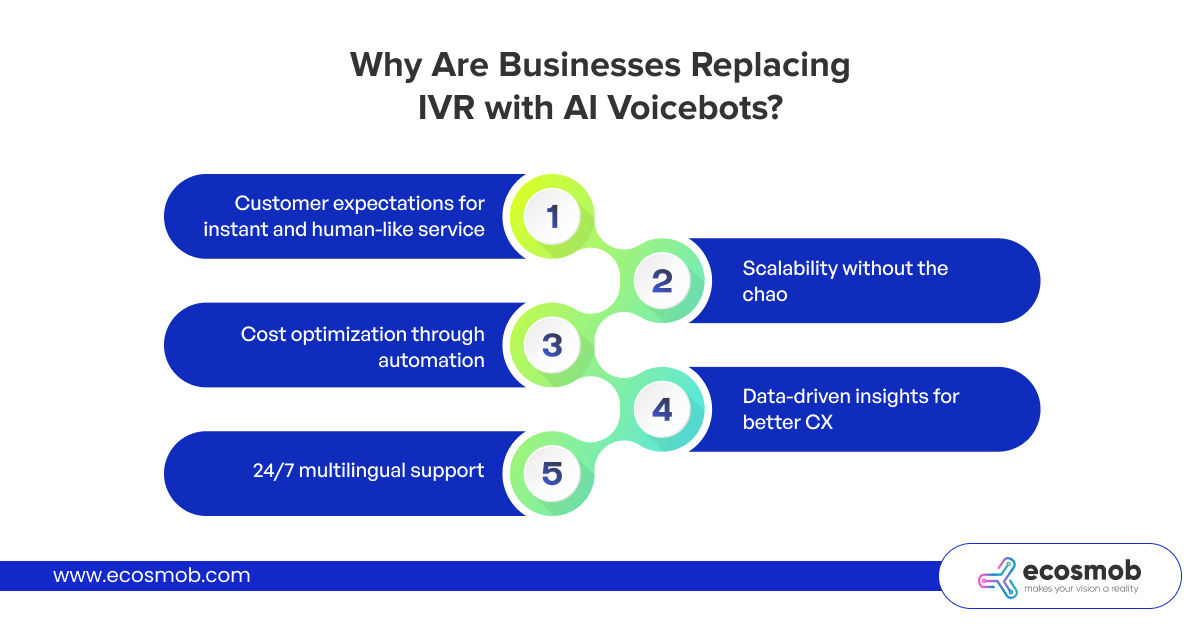
Why Are Businesses Replacing IVR with AI Voicebots?
 Customers today expect conversations, not commands. They want instant, human-like support, and they don’t care whether it comes from a human or a bot, as long as it’s fast, accurate, and effortless.
That’s exactly why enterprises are leaving outdated IVR systems behind and adopting AI-driven voice solutions.
1. Customer expectations for instant and human-like service
No one wants to wait through long menus or repeat themselves. AI voicebots respond instantly, understand natural speech, and resolve queries conversationally, creating smoother, more human-like interactions.
2. Scalability without the chaos
During peak hours or high call volumes, IVRs often buckle under pressure. Voicebots scale effortlessly, handling thousands of simultaneous calls while maintaining consistent quality and tone.
3. Cost optimization through automation
AI automation reduces the dependency on large agent teams for repetitive tasks. Enterprises cut operational costs while freeing human agents to focus on complex, high-value interactions.
4. Data-driven insights for better CX
Unlike IVRs, AI systems don’t just handle calls; they learn from them. Every interaction provides data points that help refine responses, identify customer pain points, and continuously improve experience quality, and ensure seamless human escalations.
5. 24/7 multilingual support
With AI-powered voicebots and customized multi-lingual IVRs, businesses can serve customers across regions and time zones in multiple languages, without additional staffing or scheduling challenges.
So, it’s not just about upgrading systems anymore. It’s about creating smarter, scalable conversations that actually keep customers happy and coming back.
You might think your IVR is “working fine,” but this quick check could tell a different story.
Is Your Current IVR Holding You Back?
If you checked two or more boxes, it’s time to think beyond traditional IVR. |
But how exactly are AI voicebot solutions for enterprises changing the way enterprises communicate?
Let’s break it down.
How are AI Voicebots Transforming Enterprise Telephony?
If you think an automated phone menu is just a mild inconvenience, think again. Many callers feel trapped, irritated, and completely disengaged before they’ve even spoken to a human.
A Reddit user shared a brutally honest experience:
“We got IVR complaints every day. Customers gave their name and postcode to the IVR, but when they reached us, we had to ask again because none of that info came through. They were already frustrated, and repeating everything just made them angrier.”
When even call center agents admit how frustrating traditional IVRs can be, you know the problem runs deep.
If you’re still relying on outdated IVR menus, the next few real-world use cases of AI voicebots might just change your mind.
Telecom: From Button Presses to Smart Conversations
In telecom, traditional IVRs were all about routing: Press 1 for billing, Press 2 for upgrades. It worked, but it wasn’t smart. Customers still ended up waiting, repeating information, or being redirected multiple times.
AI contact center solutions leveraging voicebots flipped that experience. Now, a subscriber can simply say, “Activate my new plan” or “What’s my current data balance?” and the bot understands, verifies, and executes the task instantly. It’s not just faster, it’s personal. Telecom providers are cutting wait times, improving satisfaction scores, and even reducing churn with voice automation that feels as intuitive as talking to a human agent.
Banking: From Menus to Secure, Personalized Conversations
Banking IVRs once limited customers to predefined options like checking the balance or reporting a lost card. There was no flexibility, no personalization, and plenty of frustration.
Enter AI voicebots. Using secure voice authentication, they instantly verify users and respond with tailored information. A customer can ask, “What’s my credit card due date?” or “Transfer a dollar to my savings,” and the bot handles it securely in real time. Beyond convenience, AI-driven voice systems bring compliance, audit trails, and consistent tone, all while delivering a smooth, human-like banking experience that builds trust.
Healthcare: From Hold Music to Humanized Assistance
Healthcare has always struggled with IVRs, long call queues, missed appointments, and stressed-out patients. The old systems could only route calls, not understand urgency or emotion.
AI voicebots have changed that completely. Patients can now call and say, “Book my follow-up appointment with Dr. John” or “Remind me about my prescription pickup,” and it’s done, instantly. The bots also send automated reminders, reschedule appointments, and answer FAQs about reports or timings. Clinics and hospitals are freeing up staff time while ensuring patients always get quick, caring, and accurate responses.
E-commerce: From Scripted Replies to Real-Time Engagement
E-commerce IVRs were once infamous for their monotony, “For order tracking, press 2…” and a five-minute wait followed. Customers had zero patience for that.
AI voicebots now handle these interactions conversationally and in real time. A shopper can ask, “Where’s my package?” or “I want to return my last order,” and the bot instantly checks order history, fetches the tracking status, or initiates the return. It doesn’t just answer, it acts. The result? Faster resolutions, fewer abandoned carts, and customers who actually enjoy calling support.
Across telecom, banking, healthcare, and e-commerce, the story is the same: enterprises are replacing static IVR menus with intelligent voicebots that listen, understand, and adapt, powered by advanced Voicebot Connectors that enable real-time call automation.
What once felt like a routine phone call now feels like a genuine conversation. A faster, smoother, and far more human conversation.
Here’s how the two compare:
| Features | Traditional IVR | AI Voicebot |
| Interaction Style | Menu-based: “Press 1 for Support” | Conversational: “How can I help you today?” |
| User Experience | Frustrating, repetitive, and limited understanding | Natural, context-aware, and empathetic |
| Personlization | One-size-fits-all responses | Learns from past interactions and tailors replies |
| Learning Ability | Minimal data is rarely analyzed | Provides actionable insights through call analytics |
| Integration | Higher due to human dependency | Reduced with automation and efficiency |
The gap between IVR and AI voicebots isn’t just about technology; it’s about flexibility. And that’s where customization starts, redefining how enterprises shape their voice solutions.
The Role of Customization in Enterprise Voice Solutions
No two businesses sound the same, so why should their voice solutions?
Customization is what turns a generic voice system into a communication experience that actually fits your brand, your processes, and your customers.
For enterprises, this means:
- Personalized Call Flows: Tailor every interaction, from greeting messages to intent handling, to reflect your brand tone and customer journey.
- Industry-Specific Integrations: Whether it’s CRM integration for sales, EMR for healthcare, or billing systems for telecom, customized setups ensure seamless context-sharing across tools.
- Language and Tone Adaptability: Build voice solutions that speak your customers’ language, literally and emotionally, across regions and time zones.
- Dynamic Scalability: Scale features, users, and integrations as your operations grow, without starting from scratch.
In short, customization gives enterprises the control and agility they need to make automation feel personal, not robotic.
How can Enterprises Transition from Traditional IVRs to AI-powered Voicebots Smoothly?
Transitioning from a traditional IVR to an AI-powered voicebot doesn’t have to mean starting from scratch. With the right strategy, businesses can adopt AI gradually, modernizing their call flows, enhancing user experience, and improving operational efficiency without disrupting ongoing processes.
At Ecosmob, this approach forms the foundation of every communication solution we build. Customization isn’t an add-on; it’s at the core of how we help enterprises evolve from static IVRs to intelligent, dynamic IVR solutions, AI-driven voice systems that truly listen, learn, and deliver.
Here’s how we make that transition seamless:
Gradual Migration, Not Disruption – We start by integrating AI capabilities into your current IVR workflows. Voicebots can initially handle repetitive or high-volume tasks while legacy systems continue managing complex routes. This hybrid setup lets enterprises test, learn, and scale AI adoption without downtime.
Custom IVR Development – We build IVR systems that reflect your brand voice and logic, not just standard menu trees. Whether it’s dynamic call routing, CRM integration, or multilingual menus, every workflow is designed for your exact operational needs.
AI-Powered Voicebot Solutions – Our AI voicebots leverage advanced NLP and speech recognition to deliver lifelike conversations that adapt to your customers’ intent, tone, and history. From automating support calls to lead qualification, every interaction feels natural, efficient, and truly human.
Integration-Ready Architecture – Ecosmob’s solutions connect seamlessly with your existing enterprise stack, VoIP-integrated CRM, ERP, ticketing, or analytics platforms, creating a unified communication system.
Continuous Optimization – Post-deployment, our analytics layer tracks call performance, intent recognition accuracy, and user satisfaction. These insights continuously fine-tune both IVR and voicebot behavior, ensuring your system gets smarter with every interaction.
At the core, we don’t just deploy technology, but we engineer transitions that are seamless, scalable, and future-proof. Our goal is simple: help enterprises evolve from static IVRs to AI-driven voice systems that truly listen, learn, and deliver.
And that brings us here –
Conclusion
From menu-driven IVRs to conversational voicebots, enterprise telephony has come a long way. What used to be a maze of button presses is now evolving into meaningful, human-like conversations powered by AI.
The takeaway is simple: businesses that embrace intelligent voice automation aren’t just improving call handling; they’re building faster, smarter, and more connected customer experiences.
Ready to transform your enterprise telephony with AI-driven voice solutions? Ecosmob can make it happen.
Frequently Asked Questions
IVR systems follow fixed menu options and basic DTMF inputs, while AI voicebots use natural language processing (NLP) to understand intent and hold real, human-like conversations. Simply put, IVR makes callers choose options; AI voicebots let them talk naturally.
Traditional IVRs often frustrate customers with rigid menus and repetitive prompts. AI voicebots, on the other hand, offer instant, intelligent, and multilingual assistance, improving satisfaction, reducing costs, and handling high call volumes effortlessly.
AI voicebots transform telephony by enabling real-time, context-aware interactions. They can manage support, sales, and service calls autonomously, provide data-driven insights, and deliver consistent customer experiences, all without human intervention.
Yes. Many enterprises adopt a hybrid approach where AI voicebots handle routine queries, while complex cases are transferred to live agents through an IVR system. Ecosmob’s solutions are designed for seamless integration with existing infrastructure.
Industries like telecom, banking, healthcare, and e-commerce see major gains, from faster call handling and secure authentication to appointment scheduling and order tracking. Essentially, any sector managing large customer call volumes benefits from AI voicebots.