
You told your customers, “This call may be recorded.” So you assume you’re covered.
Then someone asks, “Where is that recording stored?” Who can access it? How long will you keep it? What happens if the caller is in another jurisdiction?
You start checking your setup and realize consent is only one piece of the puzzle. Your recording may be secure, but your retention policy is unclear. Your access controls are in place, but your audit trail is incomplete. And your voice platform may be recording calls in ways your compliance policy never accounted for.
That’s where the AI compliance solution gets complicated. Not because you cannot record calls, but because everything around the recording has to work together.
If you’re building or scaling VoIP, UCaaS, CCaaS, CPaaS, or AI voicebot solutions, this guide breaks down the consent, retention, privacy, security, and technical requirements you need to get right.
But before you fix the gaps, do you know what call recording compliance actually requires from your business?
What is Call Recording Compliance and Why Does It Matter?
Call recording compliance means ensuring your recordings are collected, processed, stored, accessed, retained, and deleted according to the rules that apply to your business. It goes beyond simply informing someone that their call is being recorded.
If you handle customer conversations, your compliance responsibilities can span several areas:
- Consent: Did you provide the required notice before recording?
- Privacy: Are you protecting personal or sensitive information?
- Security: Can only authorized people access recordings?
- Retention: Are you keeping recordings only for the required period?
- Deletion: Can you remove recordings when your retention period ends?
- Auditability: Can you prove what happened to a recording?
The exact requirements depend on where you operate, who you serve, why you record calls, and what information those calls contain. A healthcare platform may face different obligations from a sales-focused contact center or a global CPaaS provider, making compliant patient communication platform development especially important when recorded conversations involve sensitive patient data.
Your compliance process therefore needs to account for the entire recording lifecycle, not just the moment you press “record.”
The real question is not whether you can record a call, but whether you can control what happens to it afterward.
That starts with getting consent right.
What Are the Consent and Disclosure Requirements for Call Recording?
You generally need to inform callers that a call is being recorded and follow the consent requirements that apply to your jurisdiction, industry, and use case. The exact rules can vary, especially when your calls involve people across different regions.
If your platform serves multiple markets, one consent workflow may not be enough. What works for one customer or region may not meet the requirements of another.
Your consent process should account for:
- Clear disclosure: Tell the caller that recording is taking place and, where required, explain its purpose.
- Timing: Provide the notice before recording begins when the applicable rules require it.
- Consent handling: Capture the caller’s consent or refusal when consent is required.
- Regional rules: Apply the right workflow based on where your business and callers operate.
- Consent records: Keep enough information to show what notice was provided and when.
This matters even more when your platform uses AI. Your AI voice agent disclosure architecture should distinguish between telling callers they’re speaking with AI and notifying them that the call is being recorded.
You should also decide what happens when someone does not consent. Can you continue the call without recording, route the interaction differently, or offer another communication channel?
The same approach matters when your platform serves different customers with different compliance policies. Your recording controls need enough flexibility to support those requirements without disrupting the call experience.
Getting consent right gives you the foundation, but compliance does not end when the caller hangs up. Your next challenge is deciding what happens to that recording afterward.
How Should Businesses Manage Call Recording Retention, Privacy, and Security?
You need to control how long your recordings are kept, who can access them, and how sensitive information is protected. Your retention and security controls should reflect the regulations, industry requirements, and purpose behind each recording. Integrated call recording solutions can help bring these controls together instead of managing them separately.
A practical approach is to build your policy around three areas:
- Retention
Your retention period should be based on applicable regulatory and business requirements, not simply on how much storage you have.
You should define:
- How long does each recording need to be retained
- When should automatic deletion occur
- How legal holds affect deletion
- How deleted recordings are removed from active and backup systems
- Privacy
Your recordings may contain personal, payment, or other sensitive information. You should avoid collecting more information than you actually need.
For sensitive interactions, you can use controls such as redaction, pause/resume recording, and restricted data access. This becomes particularly important for PCI compliance, call recording regulated compliance, and regulated industries handling customer information.
- Security
Your recordings should be protected throughout their lifecycle. Encryption, role-based access, authentication, audit logs, and secure storage help you control who can view, download, or manage them. With the right architecture, SBCs transforming call recording compliance solutions can also help you control how recording traffic is handled across your voice infrastructure.
If you operate across regions, data residency also deserves attention. Your storage and processing setup should align with the requirements that apply to your customers and markets.
A compliant recording should not become an unmanaged data file once the call ends. Your next challenge is making these controls work within the voice architecture that actually captures your calls.
How Companies Handle Call Recordings for Compliance in a VoIP and SIP Architecture?
You can build an AI compliance solution into your VoIP or SIP architecture by separating call capture from storage, processing, and compliance controls. This gives you greater control over what gets recorded, where it goes, and how it is managed.
A typical flow can look like:
SIP call → Recording layer → Secure recording server → Storage and compliance controls
With a dedicated recording layer, you can capture call audio and metadata without making recording logic part of your core call flow. This is especially useful when your platform needs to support multiple tenants, recording policies, or downstream AI processing.
For more specialized environments, custom SIPREC controller solutions can give you greater flexibility over how your existing SIP infrastructure connects with recording and AI systems.
Where Does SIPREC Fit Into Call Recording Regulatory Compliance?
SIPREC provides a standardized way to send call media and related metadata from your communication infrastructure to a recording system.
This can help you:
- Capture calls from your existing SIP infrastructure
- Separate recording from the primary call path
- Pass useful call metadata with the recording
- Stream audio to recording or AI systems
- Apply recording policies at the platform level
For example, if you operate a contact center or AI voice platform, you may need to record conversations for compliance while also sending audio to an AI engine for transcription or analysis. Following data privacy compliance call recording best practices with a SIPREC-based approach can give you the control layer needed to manage these flows without rebuilding your entire voice stack.
The important distinction is that SIPREC enables recording infrastructure; it does not make the recording itself legally compliant. You still need the right consent, retention, privacy, access, and audit controls around it.
Your architecture determines how much control you have over compliance. With that foundation in place, the next step is applying practical policies to everyday recorded conversations.
What Are the Best Practices for Recording Sales Calls: Compliance and Privacy?
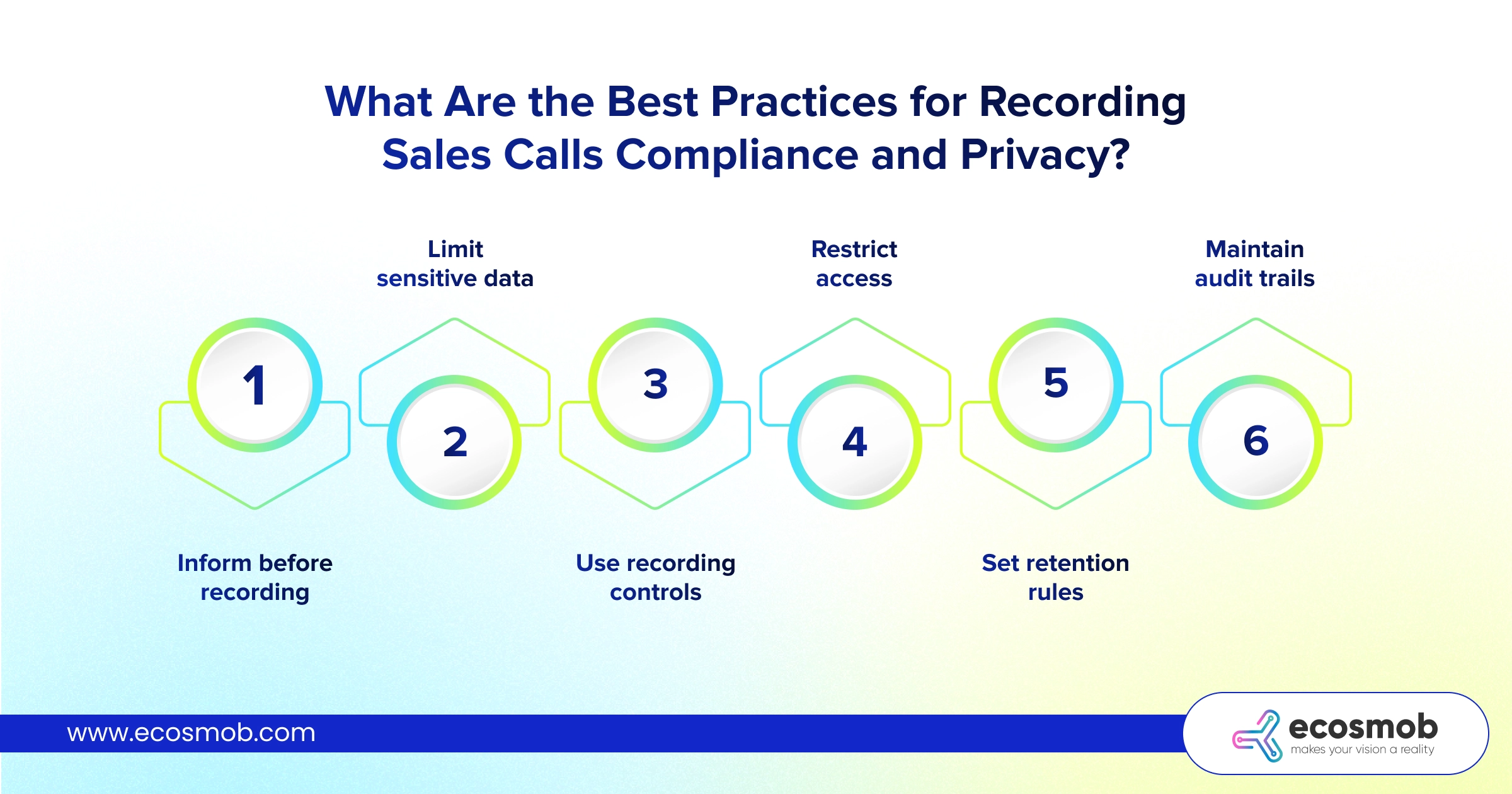
You should treat every recorded sales call as customer data that needs clear consent, controlled access, secure storage, and a defined retention period. This is where features your SIP recording solutions might be missing can make a real difference, helping you spot gaps that could affect privacy and compliance.
Your sales teams can follow these few best practices ofr recording sales calls:
- Inform before recording: Make the required disclosure before recording begins.
- Limit sensitive data: Avoid capturing payment or unnecessary personal information whenever possible.
- Use recording controls: Pause, stop, or redact recordings when sensitive information is shared.
- Restrict access: Give recordings only to people who genuinely need them.
- Set retention rules: Automatically remove recordings when your defined retention period ends.
- Maintain audit trails: Track access, changes, and other important recording activity.
If you operate across regions, your policies should also account for different consent and privacy requirements. Following data privacy compliance call recording best practices becomes particularly important when your sales or support platform serves customers across multiple markets.
The goal is not to add more steps to every customer interaction. Your recording workflow should handle the compliance controls in the background while keeping the conversation natural.
When compliance becomes part of your everyday recording workflow, your checklist becomes much easier to follow.
You’re right to flag this. Some of those checklist points repeat what we already explained, particularly consent, access, retention, data residency, and audit logging.
Since the checklist is supposed to add practical value, it should work as a final verification tool rather than repeat the body content word-for-word.
I’d tighten it like this:
Call Recording Compliance Checklist for Businesses
Before you deploy your recording workflow, use this checklist to identify the practical gaps that could affect your compliance posture.
- Jurisdictions: Have you mapped the regions your callers and customers are located in?
- Recording triggers: Do you know exactly when recording starts and stops?
- Consent evidence: Can you demonstrate when and how the required consent or disclosure was provided?
- Sensitive information: Can your system prevent or minimize the capture of payment and other sensitive data?
- Access controls: Can you restrict recordings based on user roles and responsibilities?
- Retention rules: Can you apply different retention periods to different recording types or use cases?
- Deletion: Does your system automatically remove recordings when they are no longer required?
- Data location: Do you know where your recordings and backups are stored and processed?
- Audit trail: Can you trace who accessed, changed, or exported a recording?
- Compliance testing: Do you regularly test whether your controls actually work as intended?
Important: This checklist is a practical readiness check, not a legal compliance score. Your actual obligations depend on the regulations, jurisdictions, industries, and use cases that apply to you.
Your checklist shows the gaps; now, how do you turn them into compliance-ready controls?
Build Call Recording Compliance Into Your Recording Workflow
Call recording compliance works best when you build it into your voice platform from the start, rather than fixing gaps after deployment. Your consent, recording, storage, retention, access, and audit controls should work as one connected process.
If your checklist flagged gaps, you can address them through a structured implementation approach:
- Assess: Identify the regulations, jurisdictions, data types, and recording workflows that apply to you.
- Design: Define your consent, retention, privacy, security, and data residency policies.
- Implement: Put the required technical controls into your voice and recording infrastructure.
- Test: Verify that recording, consent, access, deletion, and audit workflows work as intended.
- Audit: Review your controls regularly as your platform, customers, or regulatory obligations change.
This approach becomes especially valuable when your platform handles AI-generated conversations, sensitive customer data, or calls across multiple regions. For AI-based real-time communication solutions, your goal is not simply to pass a compliance review, but to build a recording environment that remains secure, auditable, and manageable as you scale.
When compliance is built into your RTC architecture, you spend less time patching gaps later and more time confidently scaling your communication platform.
The Bottom Line?
Call recording compliance is not just about getting consent before you record. Your entire workflow, from disclosure and capture to storage, retention, access, and deletion, needs to support the requirements that apply to you.
If you’re building or scaling a VoIP, UCaaS, CCaaS, CPaaS, or AI voice platform, addressing these controls early can help you avoid costly compliance gaps later.
A structured approach helps you assess your current setup, identify risks, implement the right controls, and validate them before deployment. With RTC Compliance Implementation, you can bring these governance and technical requirements into the same workflow rather than treating compliance as an afterthought.
Ecosmob combines telecom engineering expertise with years of industry experience to guide you through it.
Your goal should be simple: make every recording accountable from the moment it is captured to the moment it is deleted.
Frequently Asked Questions
Call recording compliance applies when your business records customer or employee conversations and is subject to applicable privacy, telecom, or industry regulations. Your exact obligations depend on your location, industry, recording purpose, and the data you capture.
If a customer refuses recording consent, you should follow a predefined alternative workflow based on the rules that apply to you. This may include continuing the call without recording, offering another channel, or ending the recording-enabled interaction.
Call transcripts can be subject to similar privacy and data protection requirements because they may contain the same personal or sensitive information. Your compliance controls should therefore cover transcripts, storage, access, retention, processing, and deletion.
Yes. If your AI voice platform records or transcribes conversations, you need to consider the privacy, consent, security, and regulatory requirements that apply to those interactions. Your AI workflow should incorporate these controls before processing customer conversations.
You can track compliance in recorded sales calls by linking call recordings with consent records, timestamps, AI disclosure events, transcripts, and call metadata. This gives your team a clear audit trail to verify whether required disclosures and consent steps were completed.