
Your company has no shortage of AI ideas.
The problem is almost the opposite. There are too many.
Some could save time. Some could reduce costs. Some could improve customer experience. Others are technically impressive AI solutions but solve problems nobody urgently has.
You cannot implement everything.
So every idea needs to pass through a filter:
- Does it solve a real business problem?
- Are you ready for it?
- Can you integrate it with your existing systems?
- Can you measure its value?
If the answer isn’t clear, it probably shouldn’t be your next AI implementation.
Because an AI implementation strategy isn’t about finding more ways to use AI. It’s about knowing where AI belongs, what should come next, and what should stay off the roadmap.
So, before you decide what makes the cut, do you know what an AI implementation strategy actually is?
What is an AI Implementation Strategy?
An AI implementation strategy is a step-by-step plan for putting AI into practice across an organization. It connects business objectives with AI capabilities, existing workflows, technology, and measurable business value.
An AI strategy answers where and why your organization should use AI. An AI implementation strategy answers how those priorities become working solutions.
Business objective → AI capability → Workflow & integration → Business value
For example, if your objective is to reduce customer support workload, the strategy should determine which AI capability can help, such as conversational AI examples for handling routine customer queries, how it fits into your existing support workflow and systems, and how you will measure whether it actually reduces workload.
That is why implementing AI requires more than selecting an AI technology. The right model or platform can still deliver little value if it solves the wrong problem, cannot integrate with your systems, or does not fit how your teams work.
So, what should actually make it into your AI implementation plan?
What are the Core Steps in AI Implementation?
If you’re implementing AI in your organization, you need a clear path from business objectives to deployment. An AI adoption framework for real-time communication can help structure that path, from assessing AI readiness and defining goals to choosing use cases, preparing systems, running a pilot, training teams, and measuring results before scaling.
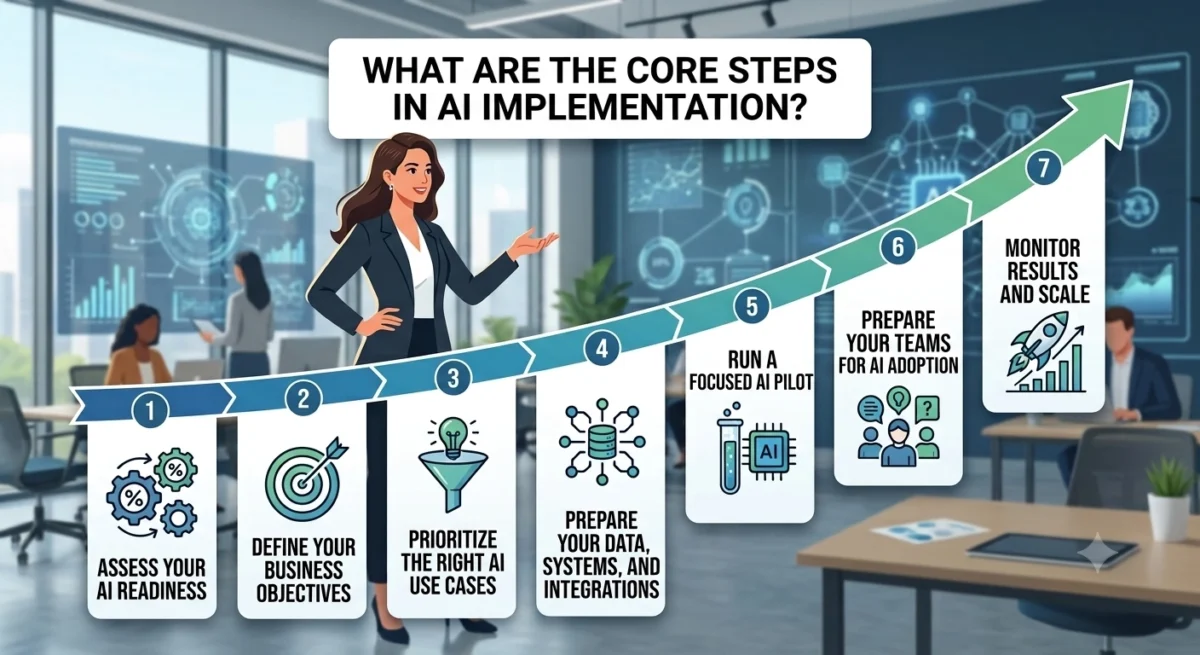
- Assess Your AI Readiness
Before you choose an AI solution, check whether your organization is ready for it. Look at your data, infrastructure, security, existing systems, and internal skills.
Your AI readiness also depends on your AI maturity. If your data is fragmented or your systems cannot support the required integration, solving those gaps may need to come before implementation.
- Define Your Business Objectives
Start with the outcome you want, not the AI technology you want to use. Your business objectives could include reducing support costs, improving response times, increasing productivity, or improving customer experience.
A clear objective also gives you something measurable to compare against after deployment. Without it, your AI implementation can work technically while delivering little business value.
- Prioritize the Right AI Use Cases
Once your objectives are clear, identify the AI use cases that can realistically support them. Compare each idea against its expected impact, implementation effort, available data, risk, and integration requirements.
For example, AI use cases in telecom can range from customer support automation to network operations and fraud detection. But your first implementation could be better suited to a narrower workflow if the required data or integrations are not ready.
- Prepare Your Data, Systems, and Integrations
Your AI capabilities are only useful when they can work with the systems and workflows your teams already use. Check data quality, access requirements, APIs, security controls, and integration points before deployment.
This is especially important when AI integration involves systems such as CRM, CCaaS, CPaaS, or UCaaS platforms. Planning these dependencies early can prevent a promising pilot from becoming an integration project later.
- Run a Focused AI Pilot
Don’t take every AI use case straight to production. Start with a controlled pilot that tests the solution with real data, users, workflows, and performance requirements.
Your pilot should answer a few practical questions: Does it work as expected? Can your teams use it? Can it integrate with your environment? And does it produce the outcome you expected?
- Prepare Your Teams for AI Adoption
Successful AI adoption depends on more than deploying the technology. Your teams need to understand how the solution changes their workflows, when they should use it, and when human judgment should take over.
Training also gives you an early feedback loop. If users struggle with the solution, you can address those issues before expanding the AI deployment.
- Monitor Results and Scale
Once your solution is deployed, track performance, adoption, cost, accuracy, and business outcomes. Use these results to decide whether you should improve the implementation, expand it, or stop it.
Scaling should follow evidence, not enthusiasm. When your AI implementation consistently delivers measurable value, you can extend it to more users, workflows, or business units.
Now that you know the steps, which AI use case should you actually implement first?
How Do You Choose the Right AI Use Cases?
Choose AI use cases by looking at business impact, implementation effort, data readiness, integration complexity, risk, and measurable business value. The right use case solves a meaningful problem and is practical for you to implement and scale.
Start with your business objectives, then shortlist the AI use cases that can directly support them. AI trends can reveal new possibilities, but they should inform your shortlist rather than decide what you implement. Before moving any idea into your AI implementation strategy, ask:
- Does it solve a real problem? Your use case should address a measurable business need, not simply demonstrate an impressive AI capability.
- Can you support it? Check whether your data, infrastructure, skills, and AI readiness are sufficient for the use case.
- Can it fit your workflows? Consider how easily the solution can work with your existing systems, teams, and processes.
- Can you measure the outcome? Define what success looks like before implementation, whether that’s lower costs, faster resolution, higher productivity, or better customer experience.
- Can you scale it? Consider whether the use case can move beyond a small pilot without creating disproportionate cost or complexity.
Your AI capabilities may open dozens of possibilities, but you don’t need to implement them all at once. Start with the use case where your business need, readiness, and expected value intersect.
This format is better because the reader can scan the five questions and immediately apply them to their own AI shortlist, instead of working through another block of explanatory text.
You’ve picked the right use case, but how much time and budget will it actually take to implement?
How Long Does AI Implementation Take and What Does It Cost?
AI implementation can take a few weeks for a focused pilot and several months for a broader deployment. Your cost and timeline depend on the use case, data readiness, integrations, infrastructure, security requirements, and level of customization.
A focused pilot can often fit into a 4–8 week window when your data, systems, and use case are already well defined. Larger AI deployment projects take longer because you may need deeper integrations, testing, compliance reviews, user training, and production hardening.
Your implementation timeline usually depends on these stages:
- AI readiness: Assess your data, infrastructure, security, and skills.
- Use-case planning: Define the scope, success metrics, and required AI capabilities.
- Pilot: Build and test the solution with a controlled group or workflow.
- Production deployment: Complete integrations, testing, security checks, and rollout.
- Scaling: Expand the solution after you have evidence of business value.
Cost works much the same way. Instead of treating AI technology as the entire budget, account for the work around it:
AI technology + development + data + integration + infrastructure + security + training + ongoing operations
For example, an AI voice solution may involve model or API costs, telephony infrastructure, CRM or CCaaS integration, testing, monitoring, and continuous optimization.
So, before you approve an AI implementation budget, ask a more useful question: what will it take to move your chosen use case from an idea to a reliable production system?
What Can Go Wrong During AI Implementation?
AI implementation can go wrong when you choose the wrong use case, underestimate data or integration requirements, scale before proving value, or overlook user adoption and ongoing costs. These gaps can turn a promising AI project into an expensive deployment with limited business value.
An AI readiness assessment can help identify these gaps early, before they affect your implementation. A few risks deserve your attention before you move from planning to AI deployment:
- The use case is unclear: If your AI project does not solve a defined business problem, measuring its value becomes difficult.
- Your data is not ready: Poor-quality, incomplete, or inaccessible data can limit what your AI solution can actually deliver.
- Integration takes longer: Your AI solution may work on its own but struggle to fit into existing systems and workflows.
- Users don’t adopt it: Even capable AI technology creates little value if your teams find it difficult to use or don’t understand how it fits their work.
- You scale too early: Expanding an unproven solution can multiply technical problems, operating costs, and workflow issues.
- Success isn’t measured: Without clear metrics, you may know that your AI system is running but not whether it is creating meaningful business value.
The good news is that these risks can be addressed before they become expensive problems. Your AI implementation strategy should test the use case, data, integration, adoption, and success metrics before you commit to wider deployment.
So, once your AI is live, how do you know it’s actually delivering value?
How Do You Measure AI Implementation Success?
You measure AI implementation success by tracking whether your solution improves the business outcome it was built for. Your metrics should cover business value, operational performance, technical performance, adoption, and cost.
Start with the outcome you defined before implementation. If your goal is to reduce support workload, for example, tracking AI usage alone won’t tell you whether the project worked.
Look at your results across three areas:
- Business impact: Are you reducing costs, improving customer experience, increasing revenue, or achieving another defined business objective?
- Operational impact: Are resolution times, automation rates, productivity, or employee adoption improving?
- Technical performance: Is your solution accurate, reliable, responsive, and cost-effective at the required scale?
You should also compare these results with your baseline. If customer support handled 10,000 queries manually before deployment, for example, measure how many the AI solution handles successfully after deployment.
Your AI capabilities may improve over time, so measurement shouldn’t stop after launch. Monitor performance, user feedback, operating costs, and business value to decide whether you should optimize, expand, or rethink the implementation.
A successful AI deployment isn’t simply one that works. It’s one that delivers the outcome you expected.
You know what to prioritize, what to watch, and how to measure it. Let’s bring it together.
The Bottom Line?
AI implementation is not about adding AI wherever you can. It is about choosing where it can create real value, checking whether your organization is ready, and proving the outcome before you scale.
If you skip that process, a promising AI use case can quickly become an expensive experiment. If you get it right, your AI strategy becomes a practical path from business objectives to measurable results.
That is also how Ecosmob approaches AI implementation. The focus starts with your business problem, then moves through AI readiness, use-case selection, integration, pilot deployment, and measurement before scaling what proves its value. For communication-driven businesses, that also means considering how AI fits into existing VoIP, CPaaS, UCaaS, and customer-service environments.
The takeaway is simple: don’t ask where you can use AI. Ask where your business is ready to make AI work.
Frequently Asked Questions
The AI implementation approach is a structured process for turning AI priorities into working solutions. It typically includes assessing readiness, defining business objectives, selecting use cases, preparing data and systems, running pilots, training teams, and scaling proven results.
Choose an AI use case based on business impact, data readiness, implementation effort, integration complexity, and measurable value. Start with a real business problem, then prioritize the use case that can deliver meaningful results without creating unnecessary technical or operational complexity.
Your organization is ready for AI when it has a clear business objective, usable data, suitable infrastructure, compatible systems, relevant skills, and teams prepared to adopt new workflows. An AI readiness assessment can identify gaps before implementation begins.
AI implementation can take several weeks for a focused pilot and several months for a broader deployment. Cost depends on the AI technology, development, data preparation, integrations, infrastructure, security, training, and ongoing operations required.
Measure AI implementation success against the business outcome you intended to improve. Track metrics such as cost savings, productivity, customer experience, automation, accuracy, adoption, reliability, and operating costs, then compare results with your pre-implementation baseline.