











QUICK SUMMARY
Running a modern enterprise on a legacy PBX is an expensive liability that isolates your workforce and drains your IT budget. Moving from a traditional PBX system to a VoIP PBX is a foundational requirement for scale, but flipping the switch without a rigorous engineering plan guarantees downtime.
This guide will give you a definitive PBX to VoIP migration checklist, architectural strategies, and step-by-step execution plans to ensure a seamless cutover.
Let’s start this with honesty. If you are still maintaining a closet full of legacy PBX line cards, you are bleeding money. You are paying for expensive copper PRI lines, locking your remote workers out of the native telecom environment, and relying on hardware that the original manufacturer stopped supporting years ago.
The solution?
PBX to VoIP migration.
What is PBX to VoIP Migration?
An enterprise VoIP migration shifts voice from a rigid, hardware-bound system into a flexible, software-driven network. But the transition is notoriously brutal if mishandled.
You are moving voice traffic from a dedicated, isolated copper wire onto your active data network. If your network isn’t prepped, or your SIP routing isn’t airtight, your cutover will result in robotic audio, dropped calls, and massive user frustration.
Here is the technical blueprint for executing a successful migration without taking your business offline.
The Business Benefits of Migrating from PBX to VoIP
You don’t undergo a massive infrastructure project just to get new desk phones. The drivers for a business VoIP migration initiative are deeply tied to operational survival and ROI.
- From CAPEX to Predictable OPEX: By eliminating physical PRI circuits and legacy maintenance contracts, VoIP shifts your telecom spend from a heavy capital expenditure to a predictable operational expense.
- Instant Scalability: Scaling a legacy PBX requires ordering physical hardware and waiting weeks for a technician. Scaling VoIP requires adjusting a software license and provisioning an endpoint in seconds.
- Unified Remote Workforce: A remote worker logging in from another continent operates on the exact same dial plan, presence network, and routing logic as an employee sitting at the headquarters.
Traditional PBX vs VoIP
Before planning the migration, you need to understand the architectural reality of what you are changing. You aren’t just swapping vendors; you are fundamentally changing how your voice media is transported.
| Technical Component | Traditional PBX | Modern VoIP PBX |
| Transport Protocol | Circuit-switched (ISDN / PRI copper lines) | Packet-switched (SIP signaling / RTP media over IP) |
| Audio Formatting | Uncompressed analog wave | Digitally compressed via Codecs (G.711, G.729, Opus) |
| Scaling Mechanism | Adding physical line cards to a chassis | Adjusting SIP trunk channel limits via software API |
| System Integrations | Hardwired, proprietary closed ecosystems | API-driven (Native CRM screen-pops, UCaaS syncing) |
| Hardware Footprint | Massive on-site telecom closets | Virtual machines, cloud instances, or edge SBCs |
PBX to VoIP Migration Checklist
The definitive PBX to VoIP migration checklist requires assessing your network QoS, selecting a deployment model, inventorying analog endpoints, and executing a phased SIP tie-trunk cutover.
Before touching a single production server, your IT team must verify these four critical milestones to ensure a zero-downtime transition:
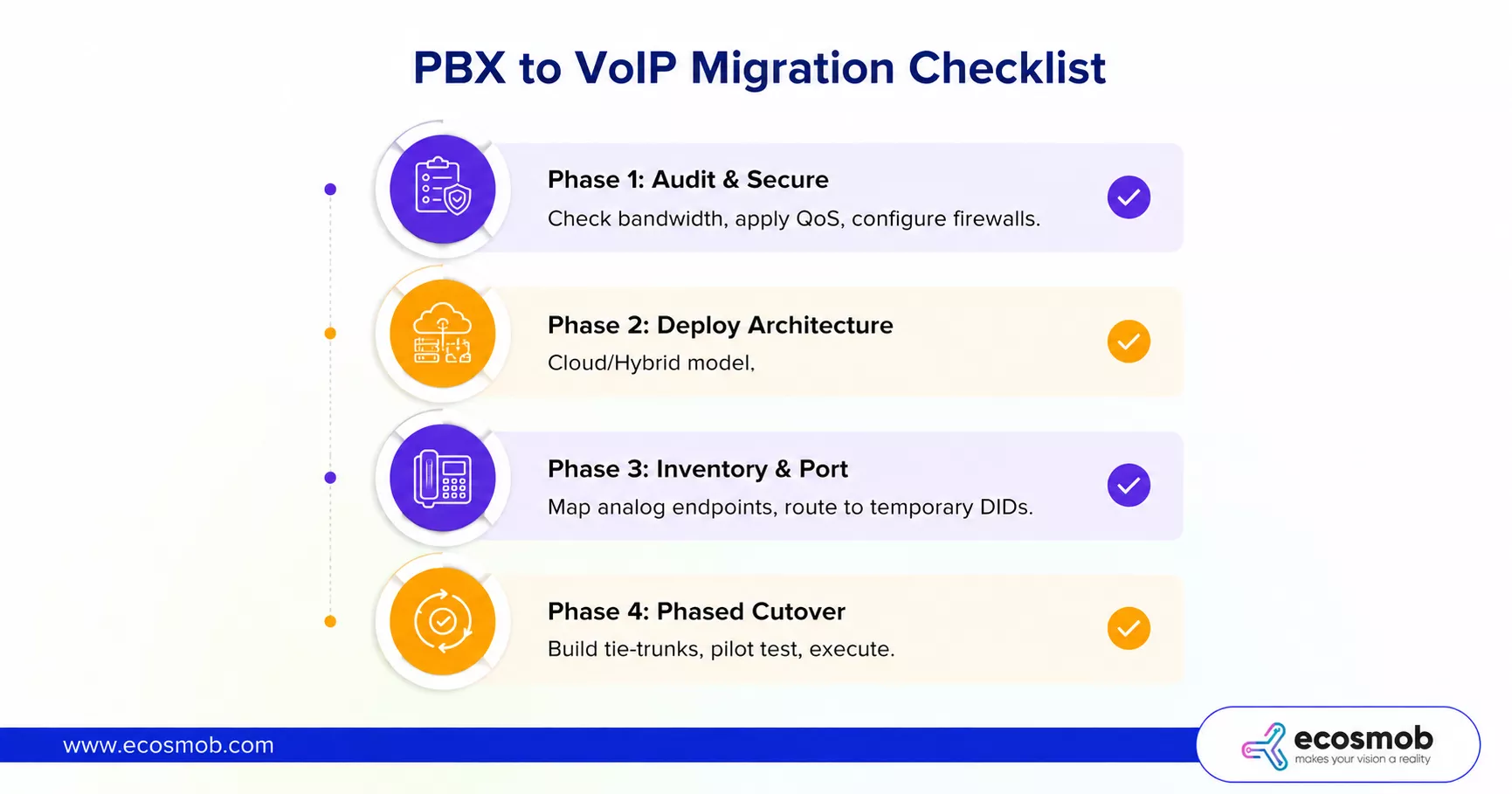
- Network & Security Audit: Verify bandwidth, enforce strict DSCP 46 QoS rules, and map firewall SIP/RTP ports to prevent dropped audio packets.
- Architecture Selection: Choose between a Hosted Cloud PBX or a Hybrid deployment, and deploy Session Border Controllers (SBCs) for edge security.
- Endpoint & Porting Plan: Audit all legacy analog devices (faxes, paging systems) for ATAs, and route main numbers to temporary SIP DIDs.
- Phased Rollout: Build a SIP tie-trunk connecting the legacy PBX to the new VoIP platform, allowing both systems to coexist during the transition.
Maximize FreeSWITCH performance and prevent call drops.
How to Execute a Zero-Downtime PBX to VoIP Migration Plan?
Executing a flawless VoIP migration plan requires moving your legacy PBX to the cloud in four rigorous phases. A successful cutover is won entirely in the discovery phase. Which means, if you migrate blindly, you will break mission-critical systems.
Here is the step-by-step technical execution:
Phase 1: Assess Network Infrastructure & Edge Security
Your voice traffic will now share the exact same pipeline as your company’s data. You cannot treat audio packets like standard web traffic.
Lock Down Your Network and QoS
Voice is incredibly unforgiving. If a data packet drops, a webpage loads a millisecond slower. If a voice RTP packet drops, the CEO’s call cuts out. You must audit your LAN/WAN for bandwidth capacity (roughly 100 kbps per concurrent call) and implement strict Quality of Service (QoS) rules.
You need to prioritize VoIP traffic (usually tagging it with DSCP 46) to ensure you maintain audio clarity even when the network is seeing high call volume.
Map Your Edge Security Posture
Your legacy PBX was a physically closed system. VoIP exposes your voice traffic to the internet. You must review your firewall configurations to allow SIP signaling (Port 5060) and RTP media ports strictly from your chosen SIP trunk provider.
You also need to enforce TLS (for signaling encryption) and SRTP (for media encryption) to satisfy internal security audits and prevent toll fraud.
Phase 2: Choose Your Deployment Model
You do not have to throw out your local hardware immediately. You must decide where the “brains” of your PBX will live based on your security and remote-work needs.
- Hosted VoIP (Cloud PBX): Perfect for an on-premise PBX to cloud migration. You move to a cloud infrastructure fully managed by a vendor, eradicating your hardware footprint and allowing remote workers to connect without VPNs.
- Hybrid PBX: The enterprise standard. You leverage the cloud for the core routing and UCaaS features, but deploy a Survivable Branch Appliance (SBA) locally. If the internet goes down, the local appliance keeps internal site-to-site calling alive.
Phase 3: Plan Number Porting & Endpoint Inventory
Do not blindly order new IP phones until you know exactly what is plugged into the walls of your building.
Audit Every Single Endpoint
Document the firmware of existing IP phones to see if they can be repurposed. More importantly, hunt down every analog endpoint. Elevators, overhead paging systems, fax machines, and door buzzers are the cockroaches of enterprise telecom: they are everywhere, they run on analog lines, and they will completely fail on an IP network unless you map them and provision specific Analog Telephone Adapters (ATAs).
Execute Number Porting via Temporary DIDs
Porting your legacy phone numbers to a new SIP provider is an administrative nightmare that often faces delays. To maintain continuity, forward your legacy main numbers to temporary SIP DIDs on the new platform.
Once the new VoIP system is verified and stable, you submit the final port request to move the numbers permanently.
Phase 4: Phased Cutover and Rollout
A successful PBX to VoIP migration doesn’t happen by shutting down the old server on Friday and hoping the new one works on Monday. You must execute a phased cutover.
Build the SIP Tie-Trunk
To execute a phased migration, you must connect the legacy PBX to the new VoIP PBX using a SIP tie-trunk. This allows a user on the new cloud system to dial a 4-digit extension and reach a user who is still sitting on the legacy Avaya or Cisco box. This coexistence phase prevents total business disruption.
Deploy the Pilot Group & Test Transcoding
Never migrate the executives or the call center first. Migrate a small, technically literate pilot group (usually IT). Stress-test media handling to ensure your PBX is configured to transcode compressed internet codecs (like G.729) into uncompressed formats seamlessly on the fly so internal IVRs don’t result in dead air.
Enforce the Rollback SLA
Document a hard “point of no return.” If a routing loop occurs or a massive configuration failure happens at 3:00 AM, the engineering team must have a documented procedure to revert the DNS records, disable the tie-trunk, and revert users back to the legacy state before business hours begin.
Make your FreeSWITCH deployment resilient and scalable.
Where Do SBCs and SIP Trunks Fit in the Core Infrastructure?
Regardless of your architecture, you need dial tone and security.
SIP Trunks replace your physical PRI lines; they are the virtual connections to the public phone network (PSTN) provided by a telecom carrier.
Session Border Controllers (SBCs) are the network demarcation points. Whether deployed as hardware at your office edge or as virtual instances in the cloud, the SBC sits between your PBX and your SIP trunk to normalize incompatible SIP dialects, handle NAT traversal, and protect the core PBX from attacks.
Ecosmob Expert Tip
SIP ALG attempts to rewrite SIP packets to help them pass through NAT.
In reality, it actively mangles the packet headers, resulting in phones that randomly deregister and calls with persistent one-way audio.
Turn it off on day one!
PBX to VoIP Migration Cost Estimation and ROI Modeling
When calculating your Total Cost of Ownership (TCO) for a hosted PBX migration, look beyond the basic per-user license fee.
You must factor in the procurement of new IP phones (or softphone headsets), the licensing capacity for your SBCs, and metered versus unmetered SIP trunking rates.
The true ROI usually materializes in the 3-to-5-year window.
By eliminating physical PRI line rentals, shedding expensive proprietary hardware maintenance contracts, and consolidating multiple regional PBX boxes into a single centralized instance, most enterprises see a dramatic reduction in their monthly telecom spend (recovering the initial migration costs rapidly).
Choosing the Right VoIP Migration Partner (What to Ask)
You do not want your internal IT team learning how to execute a VoIP migration on your active production network. You need a managed service partner with deep SIP architecture experience. Weed out the amateurs by asking these questions:
1. How do you handle phased cutovers?
If they don’t mention building a SIP tie-trunk between the legacy and new system, walk away.
2. How do you architect SBC high availability (HA)?
They should be able to explain active/standby failover to prevent the SBC from becoming a single point of failure.
3. What is your fallback procedure for a rejected DID port?
They need a documented process for temporary forwarding to ensure no inbound calls are lost during administrative delays.
4. How do you handle analog devices?
They should immediately ask for an inventory of your fax machines and overhead pagers to spec out ATAs.
Delaying a PBX migration might seem like the safe choice, but running an enterprise on outdated copper infrastructure is a massive operational risk. The transition to VoIP is inevitable.
By locking down your network QoS, auditing your endpoints, deploying a secure SBC, and executing a methodical, phased tie-trunk cutover, you can modernize your entire communications stack without dropping a single active call.
You just need to stop maintaining hardware that belongs in a museum and start building a voice architecture that scales with your business.
Ready to safely migrate your legacy PBX? Consult our VoIP Migration Architects today!
FAQs
What dictates the timeline for a multi-site PBX to VoIP migration?
The timeline depends entirely on your architectural complexity. The longest phases are the initial network QoS assessment, procuring analog gateways (ATAs), and the administrative delays of porting legacy phone numbers. While actual departmental cutovers are fast, the strategic planning, pilot testing, and SIP tie-trunk configurations require a carefully managed runway.
What are the upfront and ongoing costs of migrating PBX to hosted VoIP?
Upfront costs cover network upgrades (PoE switches), IP phones, ATAs for analog devices, and migration engineering. Ongoing costs shift to a predictable OPEX model covering PBX software licenses and SIP trunking fees. Ultimately, eliminating expensive PRI lines and proprietary hardware maintenance drives substantial long-term savings.
How do we keep PSTN connectivity and phone numbers during migration?
The safest method is forwarding your main legacy numbers to temporary SIP DIDs on the new platform. This keeps inbound routing seamless during the transition. Once all departments are successfully migrated and tested, you submit a final Local Number Portability (LNP) request to permanently move your numbers.
What security measures are required for an enterprise VoIP migration?
Deploying a Session Border Controller (SBC) is mandatory to hide your network topology and mitigate DDoS attacks via rate-limiting. You must also enforce TLS to encrypt SIP signaling and SRTP to encrypt the audio media. This prevents attackers from executing packet-sniffing or devastating toll fraud exploits.
Should we choose an on‑premise VoIP system, a hosted cloud PBX, or a hybrid model?
Hosted cloud PBX is ideal for offloading maintenance and supporting remote workers. On-premise VoIP suits strict data sovereignty requirements. However, large enterprises usually deploy a hybrid model to leverage the cloud for advanced routing while keeping survivable branch appliances on-site. This helps maintain internal calling if the internet drops.