

For Tier-1 carriers and large-scale cloud PBX providers, the biggest threat to profitability is operational overhead. When an enterprise customer experiences a dropped call or choppy audio, the resulting support ticket triggers a costly chain of events.
A Level 2 engineer must manually pull SIP traces, correlate them with RTCP network data, and determine if the fault lies with the SBC, the carrier trunk, or the customer’s own firewall.
When you process millions of calls per day, manual troubleshooting becomes impossible.
To survive, service providers are evolving their infrastructure into a cloud PBX with AI. By moving AI into the observability and operations layer, providers can automate the detection of network anomalies before the customer even notices a drop in quality.
Scaling PBX Operations Without Scaling Headcount
The most significant operational bottleneck for any cloud PBX platform is the engineering hours spent on root cause analysis. Deploying services on a reliable cloud VPS can help improve performance monitoring, resource management, and troubleshooting efficiency.
The Log Analysis Bottleneck
When a platform scales from 10,000 to 100,000 endpoints, the volume of raw log data becomes unmanageable for a traditional Network Operations Center (NOC). Instead of an engineer manually running grep commands against gigabytes of FreeSWITCH logs to find a SIP 503 error, modern carriers rely on machine learning pipelines.
Automated Root Cause Analysis
By integrating AI into the logging pipeline, providers can scale their platform without proportionally scaling their support staff. When a ticket is created, the AI automatically executes a sequence of actions:
- Ingests the relevant PCAP files and SIP traces.
- Identifies the exact SIP transaction where the failure occurred.
- Correlates the signaling failure with underlying server metrics (e.g., CPU spikes).
- Generates a human-readable summary of the fault for the support agent.
This drastically reduces the Mean Time to Resolution (MTTR) and allows Level 1 support staff to handle complex network issues that previously required senior engineers.
Reducing Enterprise Customer Churn with Predictive Quality Monitoring
Enterprise customers rarely churn over a single catastrophic outage; they churn over chronic, silent degradation.
Chronic Degradation vs. Hard Outages
When a massive call center experiences intermittent jitter or one-way audio, the IT director often blames the PBX provider. If the provider cannot instantly prove where the network degradation occurred, trust is broken. A PBX powered by AI solves this through predictive quality monitoring.
Establishing “Mean Time to Innocence”
The AI engine continuously analyzes RTCP Extended Reports (RTCP-XR) from all active endpoints. By establishing a dynamic baseline of normal network behavior, the AI can detect micro-anomalies.
Before the customer even files a complaint, the AI alerts the provider that the customer’s local ISP or firewall is dropping packets.
Providing this exact demarcation point of the failure protects the provider’s reputation and significantly reduces enterprise churn.
Legacy PBX Operations vs. AI-Powered PBX Operations
| Capability | Legacy Cloud PBX | Cloud PBX with AI |
| Issue Detection | Reactive (Waiting for customer tickets) | Predictive (Detecting RTCP micro-anomalies) |
| Log Analysis | Manual grep searches and PCAP downloads | Automated trace correlation and summarization |
| Fraud Prevention | Static thresholds | Behavioral analysis (Dialing cadence, unusual IPs) |
| Demarcation | Manual network probing after the fact | Instant alerts on localized customer ISP failures |
AI Features to Build for the Enterprise PBX Market
When service providers decide to integrate AI, they often make the mistake of focusing entirely on end-user features like voicebots or meeting transcriptions. To stay competitive in the enterprise market, your engineering focus should be on operational AI features.
Dynamic Fraud Detection
Traditional toll fraud systems rely on static rules, like blocking international calls after hours. AI models analyze real-time call patterns to detect subtle anomalies.
For example, it can instantly flag a compromised endpoint, making concurrent outbound calls to high-cost destinations that perfectly mimic normal human dialing speeds.
Predictive Capacity Routing
While your SBC handles the actual SIP routing, an AI engine analyzes historical traffic loads and carrier performance.
Let’s say the AI engine predicts that your primary SIP trunk will reach capacity in 15 minutes based on current call velocity. It then dynamically updates the routing tables via API to shift overflow traffic to a secondary carrier, completely avoiding a “Fast Busy” outage.
Architectural Integration
Building these telemetry pipelines and integrating AI models with legacy SIP infrastructure is an incredibly complex challenge. This is where Ecosmob’s SIP architects step in, helping service providers design the data ingestion layers (like HOMER and HEP) required to feed accurate voice data into AI engines without impacting core PBX performance.
The Enterprise AI Roadmap
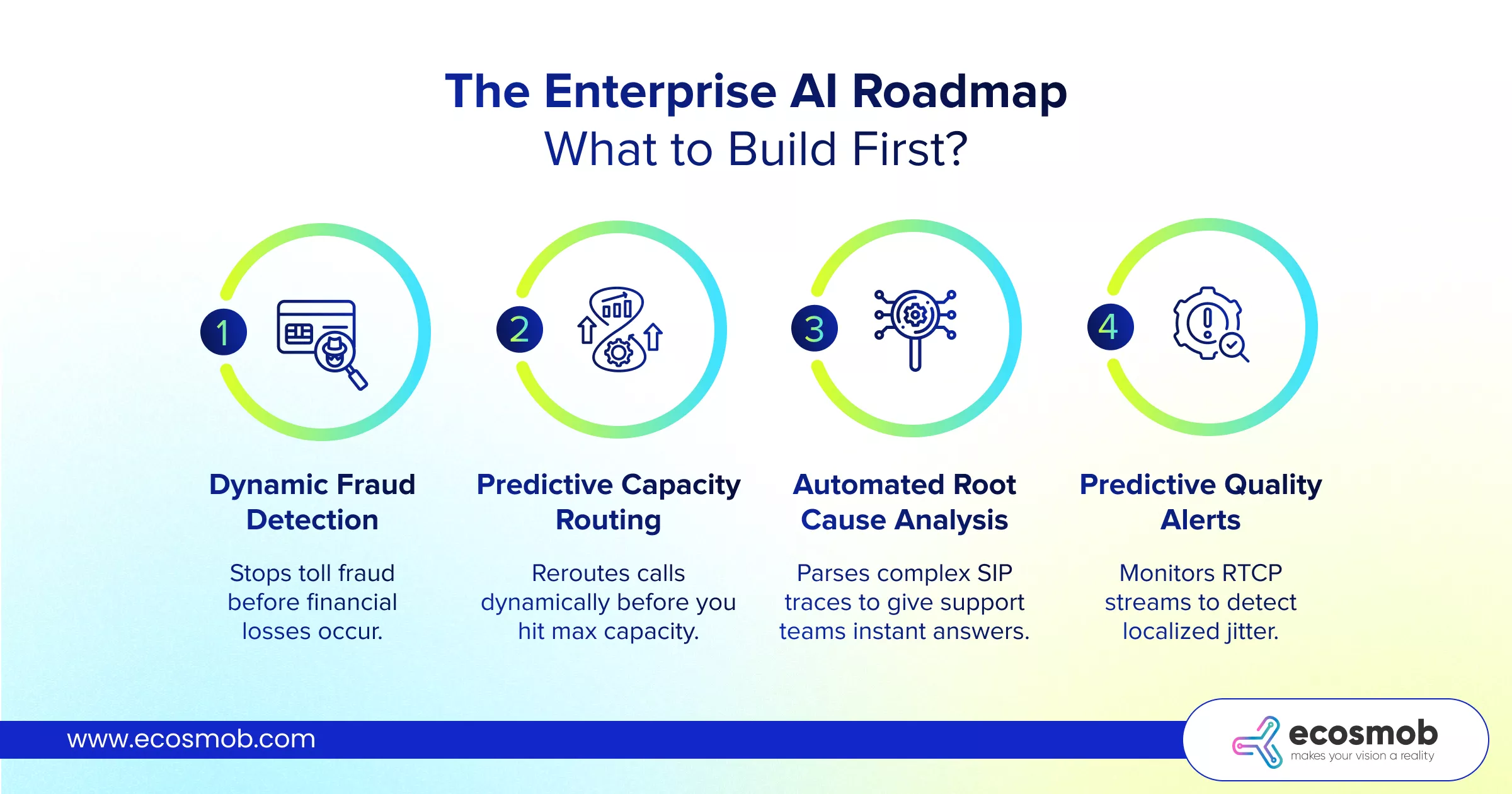
What to Build First?
1. Dynamic Fraud Detection
Stops toll fraud before financial losses occur.
2. Predictive Capacity Routing
Reroutes calls dynamically before you hit max capacity.
3. Automated Root Cause Analysis
Parses complex SIP traces to give support teams instant answers.
4. Predictive Quality Alerts
Monitors RTCP streams to detect localized jitter.
Empowering PBX Resellers to Sell AI to SMBs
If you are a platform selling through Managed Service Providers (MSPs) and resellers, your channel partners face a unique challenge: SMB clients do not care about SIP traces, RTCP data, or machine learning models.
Abstracting the Infrastructure
If your resellers try to sell the technical architecture, they will lose the deal. Service providers must package their AI capabilities into simple, outcome-based value propositions for their resellers to pitch.
Outcome-Based Value Propositions
Instead of technical jargon, train your MSPs to sell these specific outcomes:
- “Self-Healing Voice Quality”: Replaces conversations about automated failover and dynamic capacity routing.
- “Zero-Wait Support Resolution”: Replaces conversations about automated PCAP parsing and log ingestion.
- “Proactive Network Defense”: Replaces conversations about AI-driven toll fraud behavioral analysis.
By abstracting the heavy infrastructure engineering into these simple business outcomes, providers empower their channel partners to win deals against heavily marketed, out-of-the-box UCaaS competitors.
Ecosmob Expert Tip
When architecting a cloud PBX with AI, never run your machine learning models on the same servers that handle your SIP and RTP media.
Voice is a real-time protocol that requires deterministic CPU access.
If a heavy AI log-parsing job spikes the CPU, your active calls will immediately suffer from severe jitter. Always use the HEP (Homer Encapsulation Protocol) to mirror your SIP and RTCP traffic completely off-box to a dedicated analytics and AI cluster.
The future of the voice industry belongs to providers who understand that AI is an infrastructure tool, not just a front-end gimmick.
By deploying AI to monitor the SIP stack, predict routing congestion, and automate complex support tasks, service providers can break the linear relationship between customer growth and operational costs.
Building a PBX powered by AI requires deep expertise in both real-time telecom protocols and modern data engineering.
By focusing on predictive quality and automated root cause analysis, you build a platform that doesn’t just route calls, but actively defends its own uptime.
Ready to integrate AI into your core VoIP architecture? Consult our SIP experts today!
Frequently Asked Questions
Providers use AI to monitor RTCP data and establish dynamic baselines for call quality. When a customer’s local network begins dropping packets or introducing jitter, the AI detects the anomaly before the end-users experience widespread failure. By proactively notifying the enterprise IT team with exact proof of where the network failed (demarcation point analysis), the provider eliminates the finger-pointing that typically causes an enterprise to switch vendors.
Providers should prioritize operational and security features over end-user novelties. The most critical features are Dynamic Fraud Detection, which uses behavioral analysis to instantly block compromised endpoints, and Predictive Capacity Routing, which analyzes trunk utilization to dynamically shift traffic before congestion causes dropped calls. Ecosmob helps providers architect the necessary SIP telemetry pipelines to feed these AI models effectively.
Resellers must translate complex infrastructure engineering into simple business outcomes. They should avoid technical jargon like “anomaly detection” and instead pitch concepts like “Self-Healing Voice Networks” that automatically reroute calls if a carrier fails, or “Proactive Support” that fixes network issues before the SMB’s employees even notice a drop in call quality.
The biggest mistake is running AI analysis jobs on the same physical or virtual servers that are actively processing voice media. Machine learning workloads are CPU-intensive and unpredictable.
If they share resources with your media server, they will cause CPU spikes that lead to severe audio jitter for active calls. Telemetry must always be mirrored to a separate, dedicated environment.
Yes, a legacy platform can be modernized without entirely replacing the core engine. By implementing a SIP packet mirroring protocol like HEP, you can duplicate all signaling and media statistics from your legacy PBX and send them to a modern, AI-driven observability cluster.