

“It still works” is often the most expensive assumption a business makes about its voice infrastructure.
Most voice systems don’t fail loudly. They keep working just enough to avoid attention, even as teams build processes around their limitations. Support agents learn shortcuts. IT teams rely on institutional memory. Leadership assumes stability because calls still connect.
But the real cost of aging voice infrastructure shows up in places that dashboards rarely capture, missed context, delayed decisions, and systems that resist scale at every turn.
Cloud telephony solutions are not a trend; they are a response to how modern organizations communicate. As aging PBX platforms struggle to keep pace with distributed teams and integrated workflows, cloud telephony and virtual phone platforms are increasingly seen as the architectural shift that enables scale.
This transition isn’t driven by novelty, but by the need to move away from systems that demand constant maintenance toward platforms designed to evolve. Let’s see how cloud telephony and virtual phone platforms move voice infrastructure from maintenance mode into scalable modernization.
A Key Point to Note:
The cloud telephony services market is projected to see consistent growth from USD 26.69 billion in 2025 to USD 42.60 billion by 2030, expanding at an annual growth rate of 9.8%.
What Role Do Cloud Telephony and Virtual Phone Platforms Play in Modernizing Voice Infrastructure at Scale?
 Modernizing voice infrastructure at scale isn’t just about swapping out hardware. It’s about transforming how voice communication integrates into daily business operations, making it flexible, resilient, and ready to grow with the organization.
Traditional PBX systems were designed for predictable office environments and limited user configurations. As organizations expand across multiple locations, integrate with digital platforms, and scale team operations, these systems begin to reveal their limitations. Cloud telephony and virtual phone platforms bridge this gap, enabling organizations to operate efficiently at scale without being constrained by legacy infrastructure.
Here’s how these platforms play their critical roles:
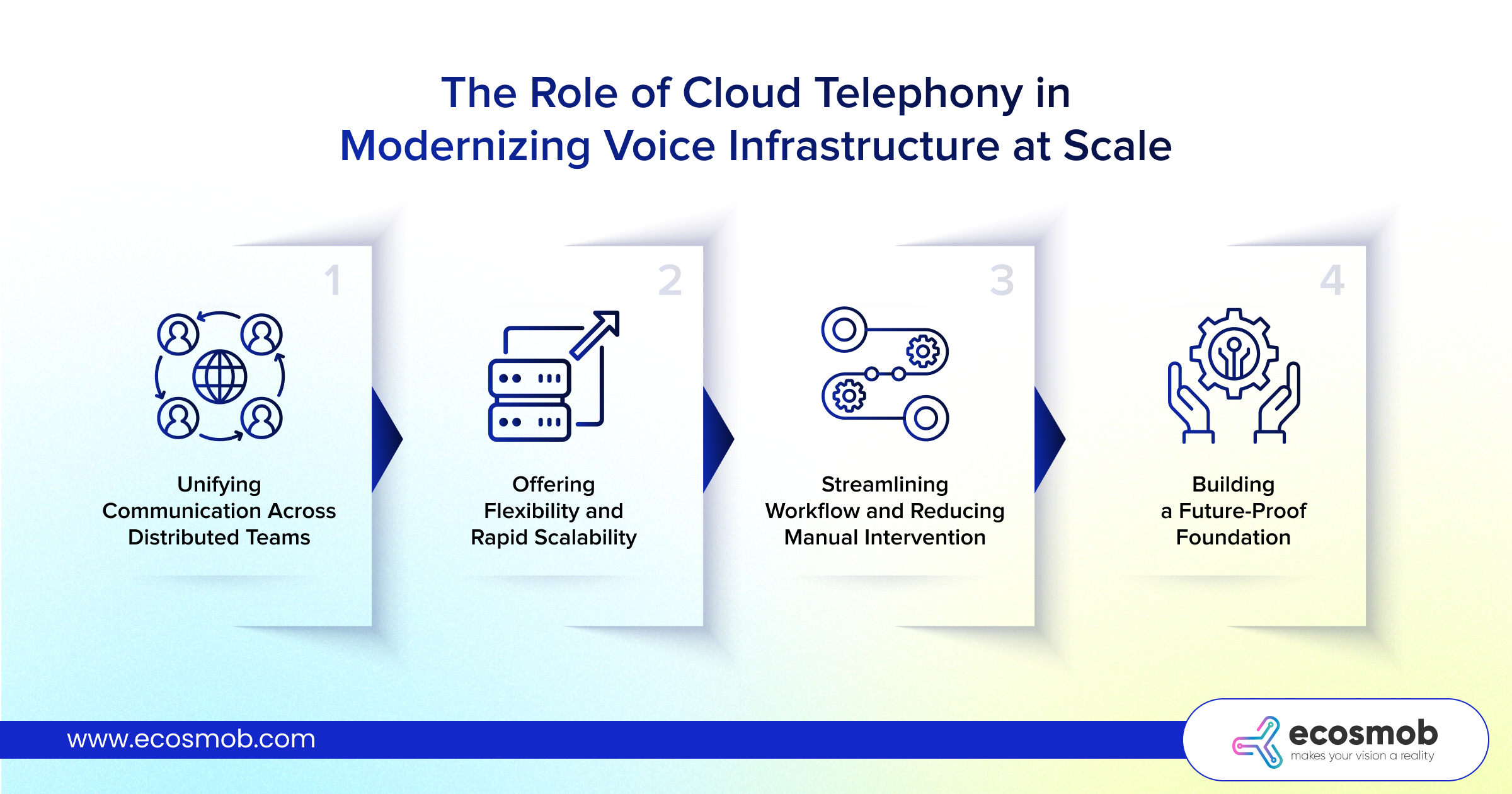
1. Unifying Communication Across Distributed Teams
Cloud-based telephony solutions for business centralize call routing, extensions, and user management, regardless of location. Agents no longer have to toggle between multiple systems to access customer context or transfer calls efficiently. Understanding the benefits of cloud telephony helps businesses see why these platforms aren’t just replacements; they actively enable smoother operations and better collaboration at scale.
2. Streamlining Workflow and Reducing Manual Intervention
Legacy PBX systems often require workarounds, manual provisioning, and repeated troubleshooting. Cloud telephony solutions automate key processes, such as onboarding new users, call logging, and monitoring, so that teams can focus on service rather than maintenance. Imagine a support center managing thousands of calls daily: an agent can access customer history, routing information, and collaboration tools instantly.
Let’s pause here. This moment shows that modernization isn’t just about technical upgrades; it transforms workflows and improves operational efficiency.
3. Offering Flexibility and Rapid Scalability
Adding new users or expanding to multiple locations on a traditional PBX is costly and disruptive. Cloud platforms enable businesses to scale incrementally, integrate with other SaaS tools, and adjust capacity without downtime. This approach directly addresses a common question: how long should it take to switch from an on-premises PBX to the cloud? By allowing phased migration, cloud telephony solutions reduce operational risk while modernizing infrastructure at scale.
4. Building a Future-Proof Foundation
Cloud telephony and virtual phone platforms prepare organizations for evolving communication needs. Beyond immediate scalability benefits, they support analytics, AI-assisted routing, and unified communication channels. This ensures that voice infrastructure evolves alongside broader technology strategies rather than remaining static.
Ultimately, cloud telephony and virtual phone platforms demonstrate that modernizing voice infrastructure isn’t just about keeping systems running; it’s about creating a flexible, intelligent foundation that empowers teams to work efficiently, scale seamlessly, and adapt to the demands of a growing organization.
What Are the Cost and ROI Differences Between Legacy VoIP Systems and Virtual Phone Platforms?
When organizations consider modernizing their voice infrastructure, cost and ROI quickly rise to the top of the discussion. It’s not just about reducing bills; it’s about understanding where investment delivers value, which processes are streamlined, and how future-proofing infrastructure impacts operational efficiency. Legacy VoIP systems often appear “cheaper” at first glance because of upfront investments, but when you factor in ongoing maintenance, scaling challenges, and missed efficiency opportunities, the picture changes dramatically.
Cloud telephony and virtual phone platforms, on the other hand, shift the investment toward flexibility, automation, and long-term operational gains.
To illustrate, here’s a comparison between legacy VoIP systems and cloud/virtual phone platforms:
| Category | Legacy VoIP Systems | Cloud / Virtual Phone Platforms |
| Upfront Costs | Requires significant hardware purchases, physical installations, and IT resources to deploy. | Minimal hardware needed; software-driven setup reduces initial investment. |
| Maintenance & Support | High ongoing maintenance: hardware repairs, manual updates, and IT team involvement. | Automated updates and monitoring reduce maintenance time and cost. |
| Scalability / Flexibility Costs | Adding users or locations is expensive and often disruptive. | Rapidly scale up or down, integrate with other SaaS tools, and expand locations without downtime. |
| Operational Efficiency | Agents spend more time navigating multiple systems; limited visibility slows workflows. | Unified interfaces, integrated call flows, and real-time monitoring streamline workflows and improve team productivity. |
| ROI / Productivity Gains | ROI is constrained by ongoing manual work, slow scalability, and a higher risk of downtime. | ROI realized through time savings, increased collaboration, and the ability to scale without heavy overhead. |
When considering upgrades, many IT leaders explore the cost benefits of switching to cloud-based telephony to understand how cloud platforms can reduce friction, improve workflows, and generate real ROI.
The real ROI of cloud telephony and virtual phone platforms isn’t just in reducing costs, it’s in transforming infrastructure from a constraint into a scalable, flexible foundation that drives productivity, collaboration, and long-term growth.
Is Cloud Telephony Reliable Enough to Replace On-Premise PBX at Enterprise Scale?
Reliability is often the first concern enterprises raise when considering a move from on-premises PBX to cloud telephony. After all, if calls drop during peak hours or systems go offline unexpectedly, even the most advanced features can’t justify the risk. But the reality is that modern cloud telephony and virtual phone platforms are engineered to handle the demands of large, distributed organizations while maintaining high availability.
The architecture of these platforms emphasizes redundancy, distributed routing, and automated failovers, features that traditional PBX systems often struggle to achieve without significant investment in hardware and IT resources.
Here’s how modern cloud telephony platforms deliver that reliability in practice:
1. Redundancy and Failover Built In
Unlike legacy VoIP systems, which can halt operations with a single server or circuit failure, cloud-based telephony solutions automatically reroute calls to alternative nodes. This ensures uninterrupted service even if a component fails. Enterprises that once struggled with downtime now experience seamless operations, with users rarely noticing when failover mechanisms activate in the background.
2. Continuous Monitoring and Proactive Issue Resolution
Cloud platforms include real-time monitoring of system performance, call quality, and network health. Alerts are triggered before minor issues escalate into disruptions, enabling IT teams or the provider to resolve potential problems proactively. Imagine a multinational enterprise managing thousands of simultaneous calls: the cloud platform continuously tracks performance metrics and dynamically adjusts routing to maintain call quality across regions.
This shows that reliability at scale isn’t about luck; it’s about intelligent design, monitoring, and automation.
3. Scalability Without Compromising Stability
One of the key advantages of cloud telephony is the ability to scale operations without introducing instability. Adding hundreds of users or new offices no longer requires hardware upgrades or complex configuration changes. Cloud platforms adapt dynamically, ensuring that expansion doesn’t lead to service interruptions.
4. Integration With Existing Systems
Enterprise organizations often worry that integrating cloud telephony with CRM, collaboration, or analytics tools might impact reliability. Cloud-based telephony solutions are designed to integrate with existing systems, using APIs and connectors to” reduce friction and prevent disruptions. The result is a unified, resilient communications ecosystem where voice is just one seamless part of a larger operational workflow.
Reliability at scale is no longer a barrier for cloud adoption. Modern cloud telephony and virtual phone platforms demonstrate that enterprises can replace legacy PBX systems without compromising uptime, call quality, or operational efficiency.
By combining redundancy, monitoring, and scalable architecture, these platforms turn what was once a vulnerability into a strategic advantage.
What Is the Best Way to Migrate Customers from Legacy Softswitch Systems to Cloud Telephony?
 Migrating from a legacy softswitch system to a cloud telephony platform can feel like moving a city while it’s still running. Every call, extension, and workflow must continue seamlessly; otherwise, the impact on employees and customers is immediate. However, a structured approach allows businesses to transition to cloud-based telephony without disrupting daily operations and unlock reliability, scalability, and efficiency.
Here’s a practical approach to making the migration smoother:
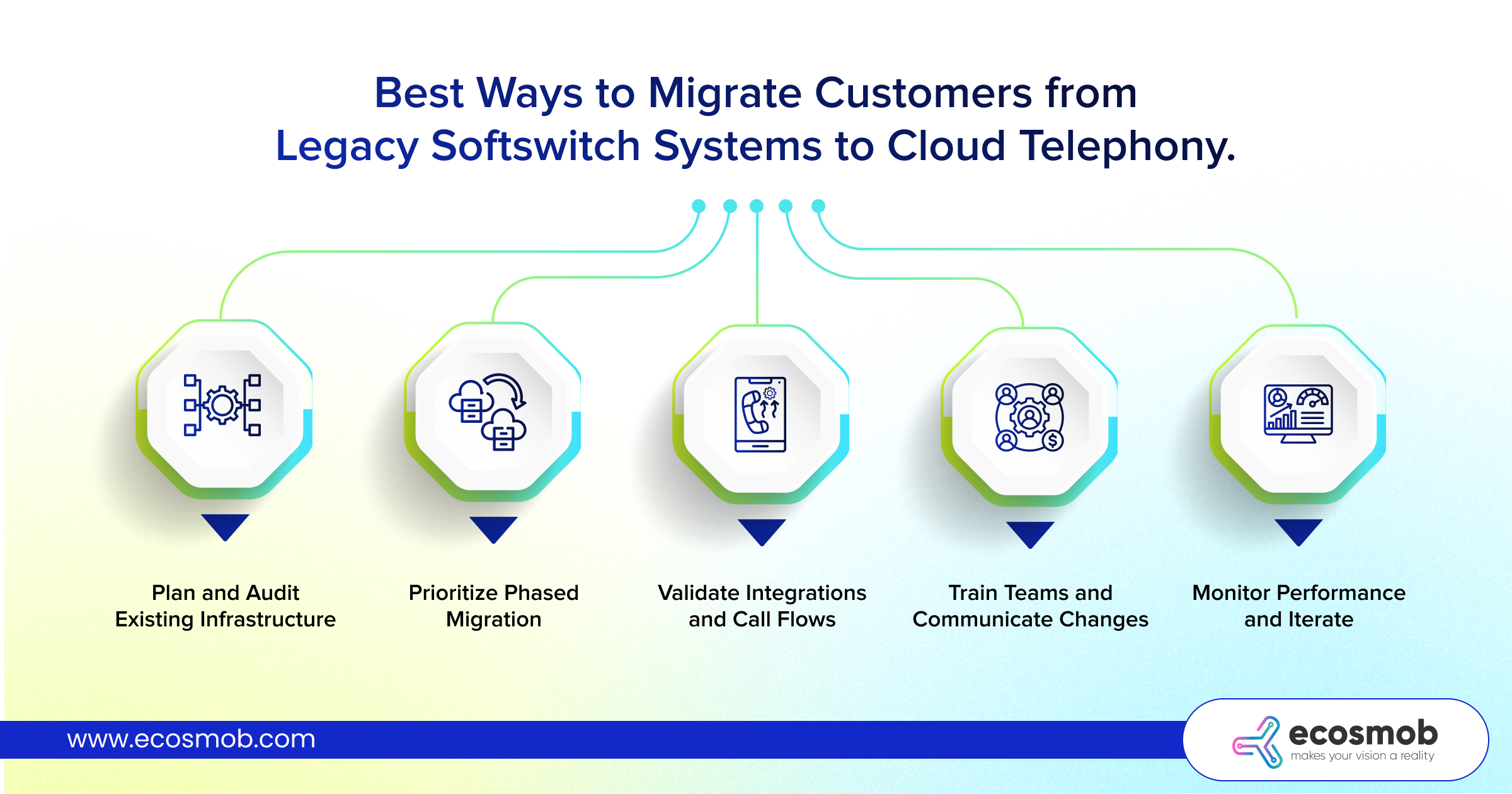
1. Plan and Audit Existing Infrastructure
Before making any moves, understand what’s currently in place. Map all numbers, extensions, call flows, integrations, and dependencies. Knowing which systems connect to your PBX, CRM, and collaboration tools helps prevent surprises and ensures a smoother transition to cloud telephony solutions.
2. Prioritize Phased Migration
Switching all users at once can be risky. Instead, migrate in phases, start with a single department or office. This approach allows IT teams to test call routing, system integrations, and user experience in real-time, while minimizing risk to overall operations. It also gives employees a chance to adapt gradually, rather than facing an abrupt change.
3. Validate Integrations and Call Flows
Cloud telephony platforms are designed to connect seamlessly with CRMs, analytics tools, and other SaaS platforms. During migration, verify that all integrations work as expected. Test automated call flows, IVR menus, and conferencing features to ensure employees can maintain the same level of service or improve it without interruptions.
4. Train Teams and Communicate Changes
Even the most reliable technology can fail if teams don’t know how to use it. Conduct training sessions, create quick-reference guides, and communicate what changes will occur, why they are happening, and what benefits teams can expect. Clear communication reduces friction and ensures everyone is prepared for the new system.
5. Monitor Performance and Iterate
Once the first phase is live, monitor system performance, call quality, and user feedback closely. Address issues immediately, and adjust routing, access permissions, or integrations as needed. With iterative improvements, subsequent migration phases become faster, smoother, and almost invisible to end users.
Thoughtful migration is not just about switching technology; it’s about maintaining business continuity, reducing friction for employees, and ensuring customers experience uninterrupted service.
A successful migration strategy transforms disruptive change into a seamless evolution, enabling organizations to realize the full benefits of cloud telephony while safeguarding reliability, scalability, and user experience. With careful planning, phased deployment, and proactive monitoring, businesses can migrate confidently and position themselves for future growth.
What Impact Does Modern Telephony Have on Customer Experience and Resolution Times?
 Let’s step inside a call center for a moment:
Customer: “I’ve been waiting for an update on my issue for two days… I don’t even know if anyone is looking into it.”
Support Agent: “I can see all your past tickets and the progress on each one right here. Let’s resolve this together in just a few minutes.”
Customer: “Wait, you already know everything? That’s incredible!”
Support Agent: “Yes, our system connects every interaction. You won’t have to repeat yourself, and we can solve your issue faster.”
Modern cloud telephony doesn’t just reduce delays, it transforms every customer interaction into a fast, informed, and personalized experience. Modern cloud telephony doesn’t just reduce delays; by enabling modern call center best practices, it transforms every customer interaction into a fast, informed, and personalized experience. Exploring the best cloud telephony solutions helps businesses identify platforms designed to maximize efficiency, reliability, and customer satisfaction.
Let’s explore the key ways modern telephony drives faster resolutions and better experiences:
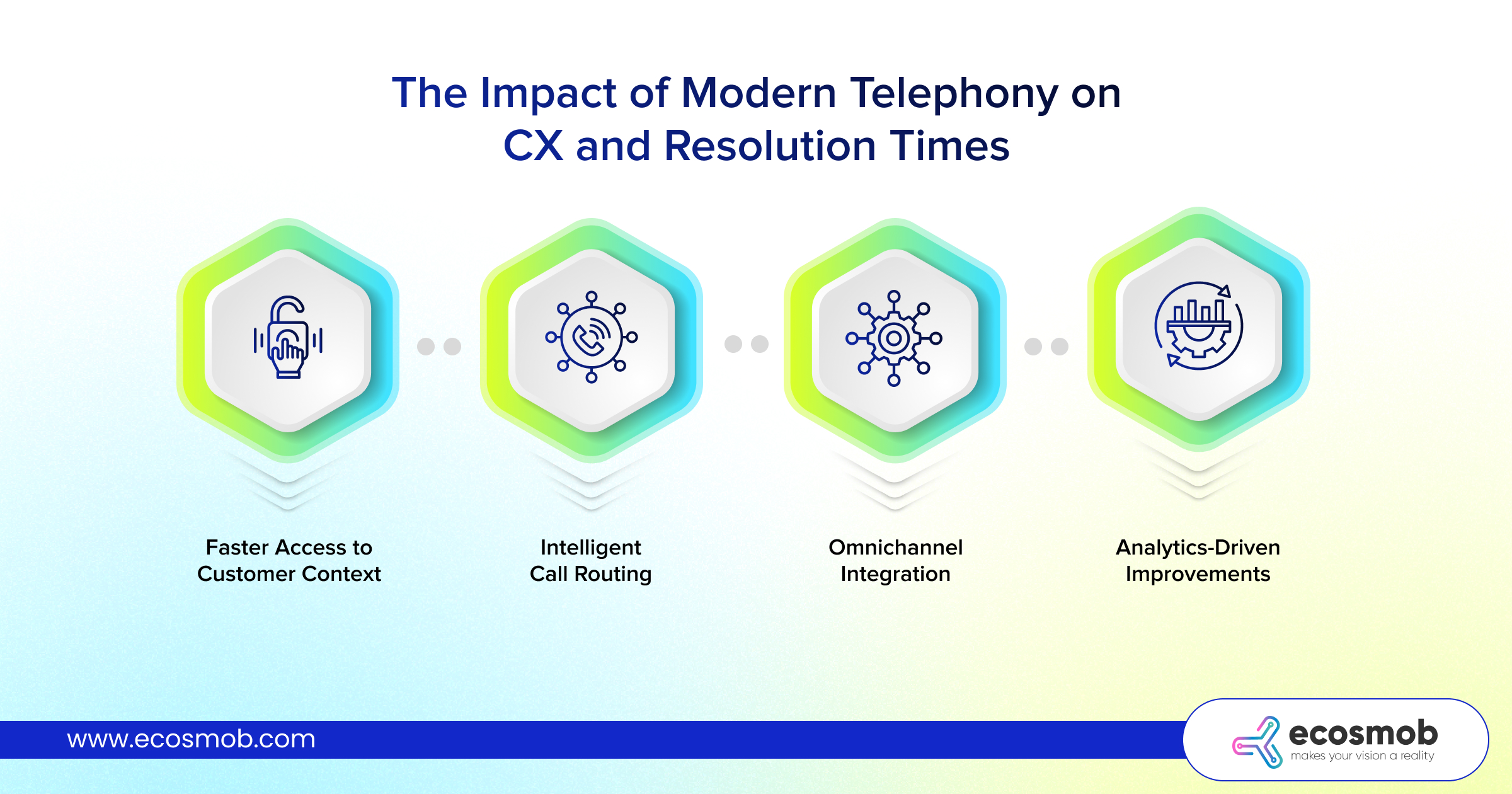
1. Faster Access to Customer Context
With cloud-based telephony solutions for business, agents can instantly access call history, ticket updates, and relevant notes. This reduces repeated questioning and allows agents to address issues immediately, creating a smoother, more satisfying experience.
2. Intelligent Call Routing
Calls are dynamically routed based on agent skill, availability, or priority. Customers reach the right person the first time, reducing wait times and repeat calls while ensuring issues are handled efficiently.
3. Omnichannel Integration
Voice, chat, and email channels are connected, allowing agents to maintain context across communication platforms. Customers can switch channels seamlessly without losing information, resulting in a consistent, coherent support experience.
4. Analytics-Driven Improvements
Real-time monitoring and reporting help managers identify bottlenecks, spot recurring issues, and optimize workflows. Insights from analytics allow teams to continuously improve processes, shortening resolution times and enhancing overall customer satisfaction.
By combining instant access to customer context, intelligent call routing, seamless omnichannel integration, and analytics-driven insights, modern cloud telephony transforms support operations from reactive to proactive. Every interaction becomes faster, more accurate, and more personalized, turning routine calls into opportunities to delight customers.
Final Conclusion
“It still works,” but working isn’t enough anymore. Across every call, every ticket, every interaction, legacy systems quietly shape your business outcomes. Modern cloud telephony and virtual phone platforms don’t just replace old infrastructure; they turn communication into a strategic advantage, making every conversation faster, more innovative, and more seamless.
From intelligent routing and instant access to customer context to omnichannel integration and analytics-driven insights, these platforms empower teams to move from reactive firefighting to proactive problem-solving. Every call becomes an opportunity to delight customers, scale operations, and future-proof your business.
With Ecosmob, your voice infrastructure isn’t just functional, it’s intelligent, resilient, and designed to evolve with your business. The future of communication isn’t waiting for your systems to catch up. With Ecosmob, it’s already here. Get in touch today!
Frequently Asked Questions
Platforms that replace traditional PBX with internet-based voice communication, centralizing calls and integrating with digital tools for scalable operations.
It automates call routing, onboarding, and monitoring, giving teams instant customer context and reducing manual work.
Yes. Built with redundancy, failover, and monitoring, cloud platforms ensure high availability and seamless scaling.
Organizations should assess call volume patterns, compliance requirements, integration dependencies, and network readiness to ensure a smooth and sustainable transition.
Organizations typically see ROI through reduced infrastructure maintenance, improved operational efficiency, and better visibility into call performance, while gaining the flexibility to scale voice systems as business needs evolve.