












QUICK SUMMARY
Launching a carrier-grade voice network doesn’t have to take two years of R&D. This blog breaks down how ISPs can launch a highly profitable voice platform fast, covering the exact architecture, the go-to-market roadmap, and the critical build-vs-buy decisions required to get there.
You already own the hardest part of the telecom business: the physical network. You’ve trenched the fiber and secured the last-mile connection to the customer.
Yet, if you aren’t offering native Voice over IP (VoIP) and Unified Communications as a Service (UCaaS), you are leaving massive ARPU (Average Revenue Per User) on the table. Worse, you are letting third-party cloud PBX providers ride your hard-earned infrastructure for free, capturing the high-margin recurring revenue that should be yours.
Adding voice to your ISP portfolio is the ultimate churn reducer. Customers who bundle internet and voice rarely leave.
But launching a carrier-grade voice network is intimidating. You have to navigate strict FCC compliance, complex SIP routing, and multi-tenant billing (all while ensuring your support desk doesn’t get overwhelmed). You don’t have two years to figure this out. You need to go to market fast.
Here is the unfiltered, engineering-first guide on how ISPs can launch a highly profitable VoIP and UCaaS platform without drowning in upfront CAPEX or operational chaos.
Three VoIP Deployment Paths: White-Label, Custom-Build, or Hybrid
Your first executive decision dictates your entire timeline and profit margin: how much of this infrastructure do you actually want to own?
There is no universally “correct” answer. Your choice depends entirely on your speed-to-market mandate, the depth of your in-house engineering bench, and your appetite for owning the hardware. Let’s look at the three primary paths.
1. The White-Label Route (Maximum Speed)
You buy a fully baked, cloud-hosted PBX solution from an upstream provider, attach your ISP’s logo on the customer portal, and start selling immediately. The vendor handles the SBCs, the media servers, the telecom taxes, and the carrier relations.
2. The Custom-Build Route (Maximum Margin & Control)
You spin up your own infrastructure using open-source heavyweights like Kamailio, FreeSWITCH, or Asterisk. You negotiate your own SIP origination/termination rates with Tier 1 carriers. You own the code, the servers, and the customer experience.
3. The Hybrid Route (The Smart Middle Ground)
While white-labeling is fast and custom-building yields maximum profit, the hybrid approach is rapidly becoming the industry favorite for ISPs.
Why? Because building a massive video conferencing and team-chat application from scratch is incredibly resource-intensive.
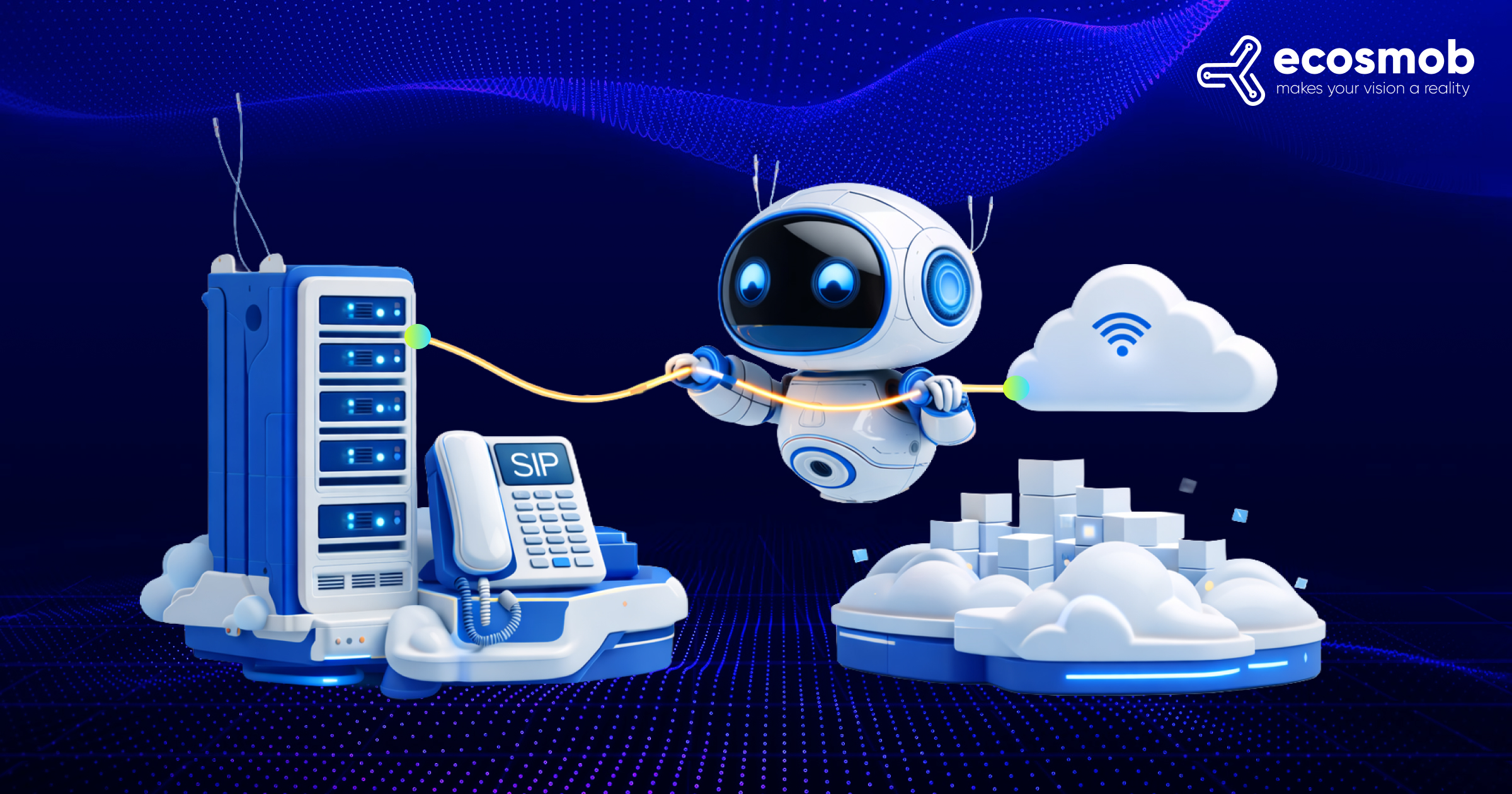
In a hybrid model, you leverage a white-label platform for the complex, compute-heavy UCaaS applications (like video conferencing and team chat) but build your own localized Session Border Controllers (SBCs) and SIP routing core to maintain control over your media traffic and carrier routing. You get to market fast while retaining the ability to optimize your highest-cost components.
Still letting third-party cloud PBX providers ride your network for free?
White-Label vs. Custom-Build vs. Hybrid ISP VoIP Deployment
| Dimension | White-Label | Custom-Build | Hybrid |
| Upfront CAPEX | Low | High | Medium |
| Brand Control | Moderate (portal, billing) | Full | High |
| Differentiation | Limited | Maximum | High |
| Ongoing Ops Burden | Low (vendor-managed) | High (in-house team) | Shared |
| Scalability | Vendor-dependent | Architecture-dependent | Flexible |
| Ecosmob Role | Consulting/migration | Full-stack build | Architecture + staff aug |
Architecture Essentials for ISP-Grade VoIP
If you decide to touch the infrastructure (Custom or Hybrid), you cannot treat voice traffic like standard HTTP data. Voice is ruthless. A dropped packet on a Netflix stream means a slight drop in resolution; a dropped packet in an RTP (Real-Time Transport Protocol) stream means a garbled sentence and a furious customer.
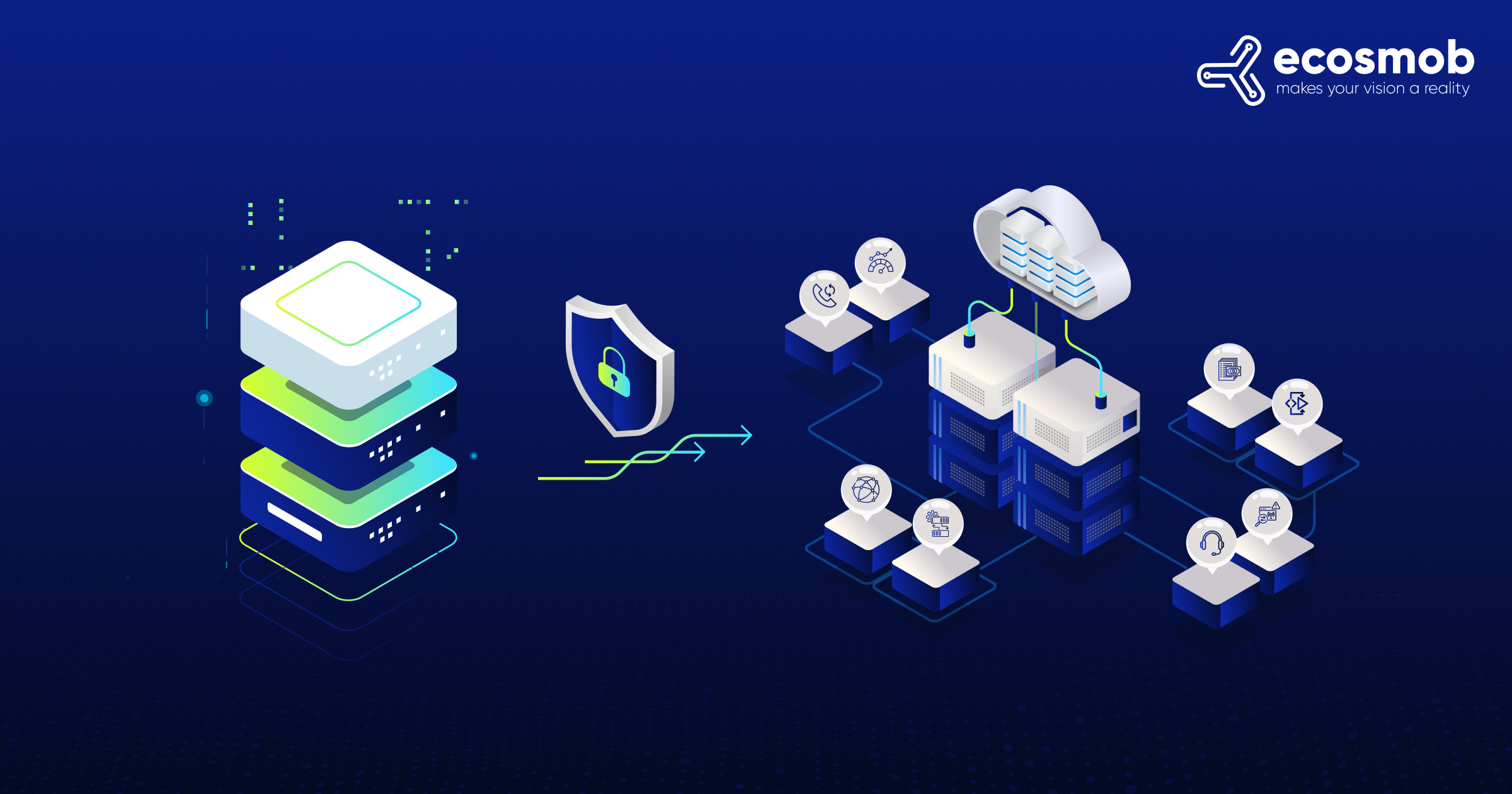
To deliver ISP-grade voice, your architecture must be built around these non-negotiable pillars:
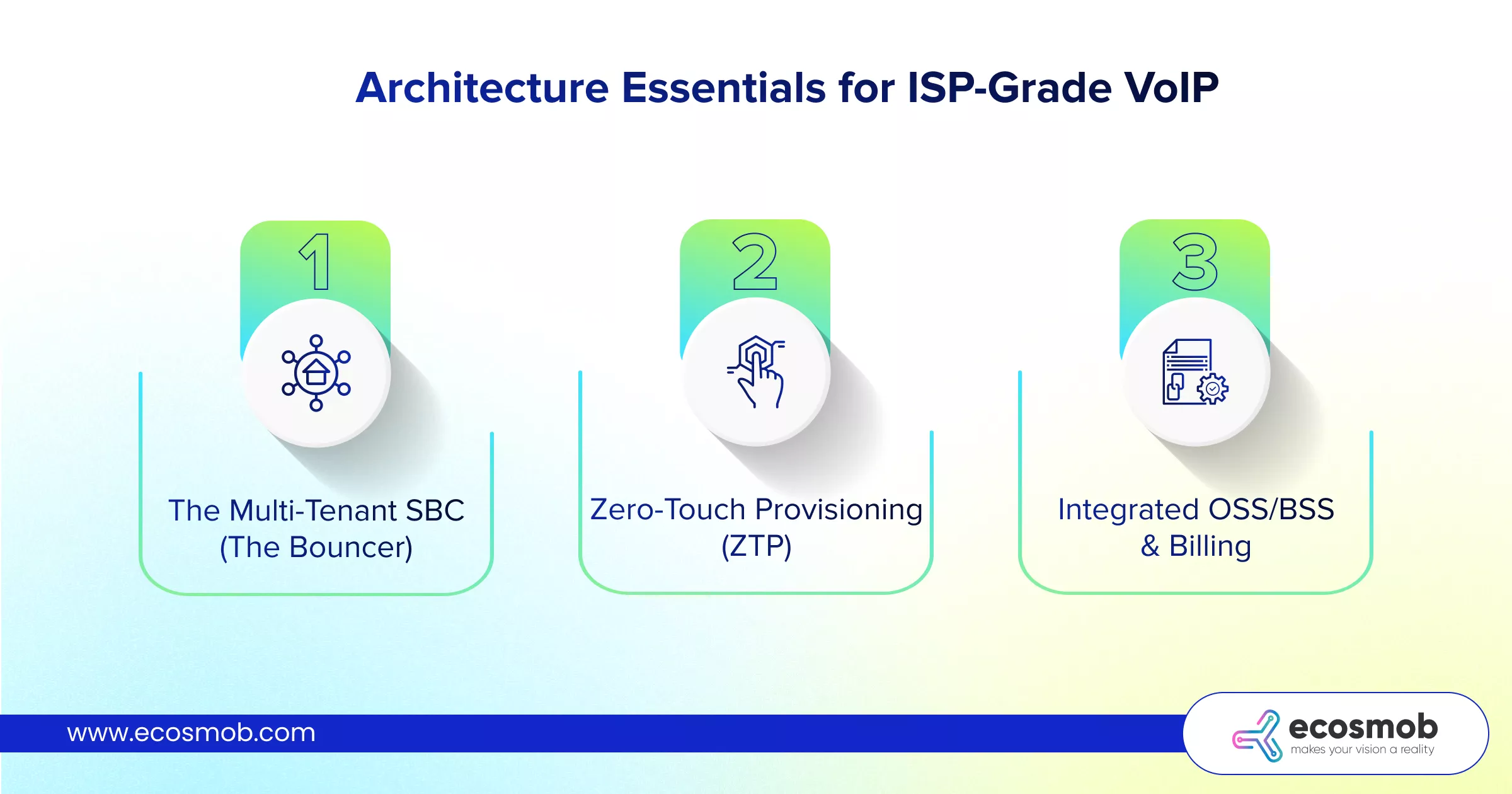
1. The Multi-Tenant SBC (The Bouncer)
Your Session Border Controller is the most critical piece of hardware (or virtual machine) in your voice network. In an ISP environment, you aren’t routing calls for one massive enterprise; you are routing calls for thousands of isolated small businesses and residential users.
A multi-tenant SBC (like Kamailio) acts as your SIP firewall. It handles topology hiding (so attackers can’t map your internal network), manages NAT traversal (so audio actually reaches phones sitting behind cheap office routers), and executes massive, high-speed routing rules to ensure Tenant A’s calls never cross into Tenant B’s environment.
2. Zero-Touch Provisioning (ZTP)
If your support team has to log into a web interface to manually configure every single Yealink, Polycom, or Cisco phone you ship to a customer, your operational expenses will obliterate your profits.
Your VoIP architecture must include an automated ZTP server. When a customer plugs a phone into your network, the phone should automatically reach out to your provisioning server, identify its MAC address, download its specific SIP credentials, and register itself within 60 seconds (zero human intervention!).
3. Integrated OSS/BSS & Billing
Telecom billing is notoriously complex. You are dealing with per-minute rating, international toll fraud limits, bundled minute packages, and complex local taxation.
Your VoIP core must integrate seamlessly with your existing ISP Operational Support Systems (OSS) and Business Support Systems (BSS). If your SIP core cannot fire accurate, real-time Call Detail Records (CDRs) into your billing engine, you will leak revenue immediately.
Ecosmob Expert Tip
When building a custom or hybrid platform, do not host your SIP signaling proxies and your media transcoding engines on the exact same physical servers.
Transcoding audio from G.711 to Opus is highly CPU-intensive. If a sudden spike in media traffic pegs your server’s CPU, it will start dropping incoming SIP REGISTER packets, taking your entire network offline. Always decouple your control plane (Kamailio) from your media plane (FreeSWITCH/Asterisk).
As an ISP, you are already heavily regulated. Adding voice services opens up an entirely new dimension of FCC compliance and network security mandates. You cannot launch until these are solved.
STIR/SHAKEN Compliance
The FCC mandates that all voice providers implement STIR/SHAKEN to combat robocalls and caller ID spoofing. You must cryptographically sign the SIP headers of every outbound call originating on your network to guarantee the caller’s identity. If you fail to implement this, downstream carriers will block your customers’ calls or label them as “Spam Risk,” rendering your service useless.
Dynamic E911 Routing
When a customer dials 911, the call cannot just route to a generic call center. It must route to the specific Public Safety Answering Point (PSAP) for their exact physical location, and it must transmit their dispatchable location data (e.g., “Floor 3, Suite 302”).
Because VoIP phones can be moved anywhere with an internet connection, your platform must support dynamic location tracking and rapid E911 database updates.
Toll Fraud and DDoS Protection
SIP networks are constantly under attack. Automated bots will scan your public IP addresses 24/7, trying to guess SIP passwords. If they break in, they will pump thousands of dollars of premium international traffic through your trunks over a single weekend.
Your SBC must have aggressive rate-limiting, geo-fencing (blocking all traffic from countries you don’t do business with), and deep integration with your ISP’s core DDoS mitigation appliances.
Need to deploy a carrier-grade, multi-tenant voice system?
The VoIP Go-to-Market (GTM) Checklist for ISPs
Launching a VoIP product requires tight alignment between your network engineers, your legal team, and your marketing department. You need a roadmap, and you need a checklist to ensure nothing slips through the cracks.
The Phased Rollout Roadmap
Phase 1: Strategy & Compliance
- Select your deployment model (White-Label, Hybrid, or Custom).
- File necessary paperwork with the FCC and local regulatory bodies (e.g., obtaining an interconnected VoIP provider classification).
- Register for STIR/SHAKEN tokens with the Secure Telephone Identity Governance Authority (STI-GA).
- Select your underlying SIP trunking and DIDs (phone numbers) origination partners.
Phase 2: Network Preparation & Build
- Deploy and cluster your core SBCs and Media Servers.
- Configure SIP trunks between your SBCs and your carrier partners.
- Establish strict Quality of Service (QoS) rules on your ISP edge routers to prioritize VoIP packets (DSCP EF) over standard web traffic.
- Integrate the VoIP core with your automated provisioning server.
Phase 3: Billing & System Integration
- Map the VoIP CDR outputs to your existing ISP billing software.
- Set up automated toll-fraud alerts (e.g., auto-suspending accounts that hit a $50/day international usage spike).
- Configure the E911 routing APIs.
- Finalize the LNP (Local Number Portability) workflows so your sales team can seamlessly transfer customers’ existing numbers to your network.
Phase 4: Beta Testing & Soft Launch
- Deploy physical phones and softphones to your internal staff. Run all internal ISP business on your new platform for two weeks.
- Execute penetration testing and SIP fuzzing attacks against your SBCs.
- Train your Tier 1 support desk on how to read basic SIP traces and troubleshoot audio quality issues.
- Launch to a small, friendly cohort of existing commercial internet customers.
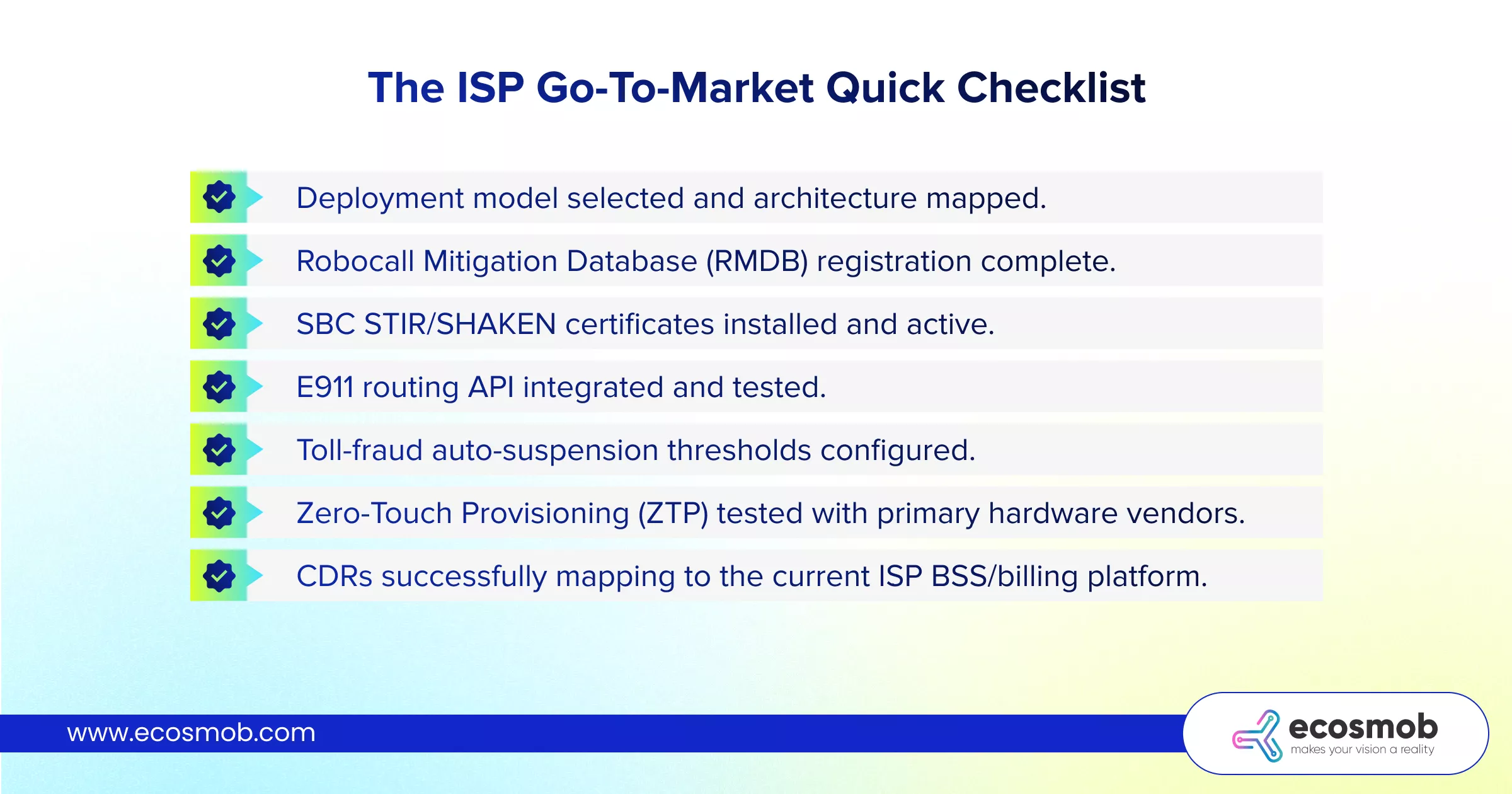
The ISP Go-To-Market Quick Checklist
Choosing the Right VoIP Engineering Partner
If you decide to touch the infrastructure (going Hybrid or Custom-Build), your biggest risk is the talent gap. Managing an ISP network (dealing with BGP, OSPF, and fiber routing) requires a completely different engineering skill set than architecting a real-time SIP and RTP voice core.
If you don’t have deeply experienced telecom developers on staff, attempting to build a multi-tenant FreeSWITCH or Kamailio cluster in-house is a recipe for blown budgets and delayed launches.
When evaluating a telecom engineering partner, look for these three traits:
- Open-Source Mastery: Do they have a proven track record of contributing to and scaling OpenSIPS, Kamailio, or Asterisk environments?
- Billing Integration Chops: Can they write the middleware required to seamlessly translate complex PBX CDRs into your existing ISP billing platforms?
- Scale Experience: Have they actually architected multi-tenant networks that handle tens of thousands of concurrent calls, or do they only build small enterprise PBXs?
So, which firms are known for delivering VoIP projects on time and within budget?
Well, we are!
At Ecosmob, we don’t have to learn telecom on your dime. Because our team houses one of the largest global benches of certified UCaaS and VoIP developers, we bring the architecture, the code, and the carrier-grade experience directly to your network.
Whether you need a complete end-to-end custom UCaaS build or simply need staff augmentation to integrate a white-label platform’s APIs into your ISP’s billing system, we get you to market fast, securely, and profitably.
As an ISP, you have a massive, unfair advantage in the UCaaS space: you own the underlying pipe. You can guarantee Quality of Service in a way that pure-cloud, Over-The-Top (OTT) VoIP providers simply cannot.
By strategically choosing your deployment model, locking down your SBC architecture, and partnering with proven telecom engineers to bridge your internal skills gap, you can rapidly transition from a pure connectivity provider into a high-margin, full-stack communications powerhouse.
Ready to build your ISP’s voice network? Let’s architect your competitive advantage!
FAQs
Should an ISP white-label VoIP or build a custom platform?
An ISP should white-label if its primary goal is immediate speed-to-market, and they want to avoid the operational overhead of managing voice servers.
An ISP should build a custom platform (or use a hybrid model) if they want to maximize its profit margins, retain full control over its feature roadmap, own its carrier relationships, and leverage its existing network infrastructure to offer highly differentiated, guaranteed-quality voice services.
What should ISPs look for in a VoIP engineering partner?
ISPs should look for partners with deep, proven expertise in carrier-grade open-source telecom stacks (Kamailio, OpenSIPS, FreeSWITCH). Crucially, the partner must understand the unique challenges of a service provider, specifically multi-tenant architecture, automated provisioning (ZTP), seamless billing integration, and STIR/SHAKEN implementation.
What is a multi-tenant SBC, and why do ISPs need one?
A Session Border Controller (SBC) is the secure router for voice traffic. A multi-tenant SBC is uniquely configured to handle thousands of logically separated business clients on a single piece of hardware. ISPs need this to safely route traffic, hide their internal network topology from attackers, manage complex NAT traversal for remote phones, and ensure that one client's high call volume doesn't crash the service for other clients.
What STIR/SHAKEN compliance steps must ISPs complete before launching VoIP?
ISPs acting as interconnected VoIP providers must implement the STIR/SHAKEN framework to mitigate robocalls. Steps include registering with the FCC’s Robocall Mitigation Database, obtaining a Service Provider Code (SPC) token from the STI-GA, and integrating cryptographic signing software into their SBCs to attach identity certificates to every outbound SIP call.
What are the hardware requirements for an ISP to host its own PBX?
The hardware required depends on the concurrent call volume, but modern ISP VoIP networks are highly virtualized. You need dedicated compute nodes for SIP signaling proxies (low CPU, high network I/O), separate nodes for media servers handling RTP transcoding (high CPU/DSP requirements), and highly available database clusters (like Redis and PostgreSQL) to manage routing state and configurations.