
Telecom operators lose millions every year not to lost customers, but to bad math.
When your Class 4 Softswitch is processing thousands of Calls Per Second (CPS), your billing system is the only thing standing between a profitable quarter and a massive revenue leak. If your system drops Call Detail Records (CDRs), fails to apply a complex tariff correctly, or allows a hacked PBX to rack up international charges over the weekend, your business eats the cost.
Standard SaaS billing tools are great for selling software subscriptions, but they completely fall apart in the real telecom world. They cannot process micro-transactions in real-time, they don’t understand fractional penny rounding, and they certainly cannot tell a softswitch to drop a call the exact millisecond a prepaid balance hits zero.
You need a dedicated advanced VoIP billing system for all that and more. But the market is flooded with options ranging from clunky legacy platforms to complex open-source frameworks. Let’s break down exactly how these systems work, what features matter for your specific operator segment, and how to choose the architecture that actually protects your margins.
What is a VoIP billing software?
VoIP billing software is a specialized financial engine that captures Call Detail Records (CDRs) from a telecom switch, applies complex rating rules based on destination prefixes, and generates real-time charges or recurring invoices.
At its core, a VoIP billing system translates raw network data into actual revenue. When a user picks up the phone and makes a call, the underlying network (your SBC or IP PBX) handles the audio routing. But the network doesn’t know what that call costs. The billing software sits alongside the network, pulling the data regarding who called whom, how long it lasted, and what rate applies, turning those network events into actionable financial data.
What Are the Top Telecom Billing Systems for VoIP Services?
The top telecom billing systems for VoIP services include commercial platforms like PortaBilling and TimelyBill, open-source options like ASTPP and CGRateS, and custom-built carrier-grade solutions from development partners (like Ecosmob!).
When searching for the best VoIP billing software, you are going to find a lot of generic listicles. But choosing a billing platform is an architectural decision. You generally have three paths: deploying an Open-Source framework, buying a Commercial Off-The-Shelf (COTS) license, or commissioning a Custom Build.
Here is the honest breakdown of how these paths actually compare in the real world:
| Approach | Examples | The Reality | Ideal For |
| Open-Source | ASTPP, A2Billing, CGRateS, Freeside | Highly flexible with zero licensing fees.
Requires significant internal engineering to maintain. |
Startups and technically heavy ITSPs with deep Linux expertise. |
| Commercial Off-The-Shelf (COTS) | PortaBilling, TimelyBill, Alepo, OneBill | Feature-rich with dedicated support.
Licensing is expensive, and core customization is limited. |
Mid-market ISPs needing a fast, standardized deployment. |
| Custom Build | Ecosmob’s Custom VoIP Billing Solutions | Offers exact architectural control and COTS performance without recurring per-subscriber fees. | Wholesale carriers, MVNOs, and scaling ITSPs with massive call volumes. |
If you are a wholesale provider pushing massive volume, paying a commercial vendor a percentage of your revenue or a per-seat license fee aggressively eats into your already thin margins. This is exactly why scaling carriers inevitably move toward custom builds or heavily supported open-source implementations.
How Is a VoIP Service Billed? (The 6-Step Pipeline)
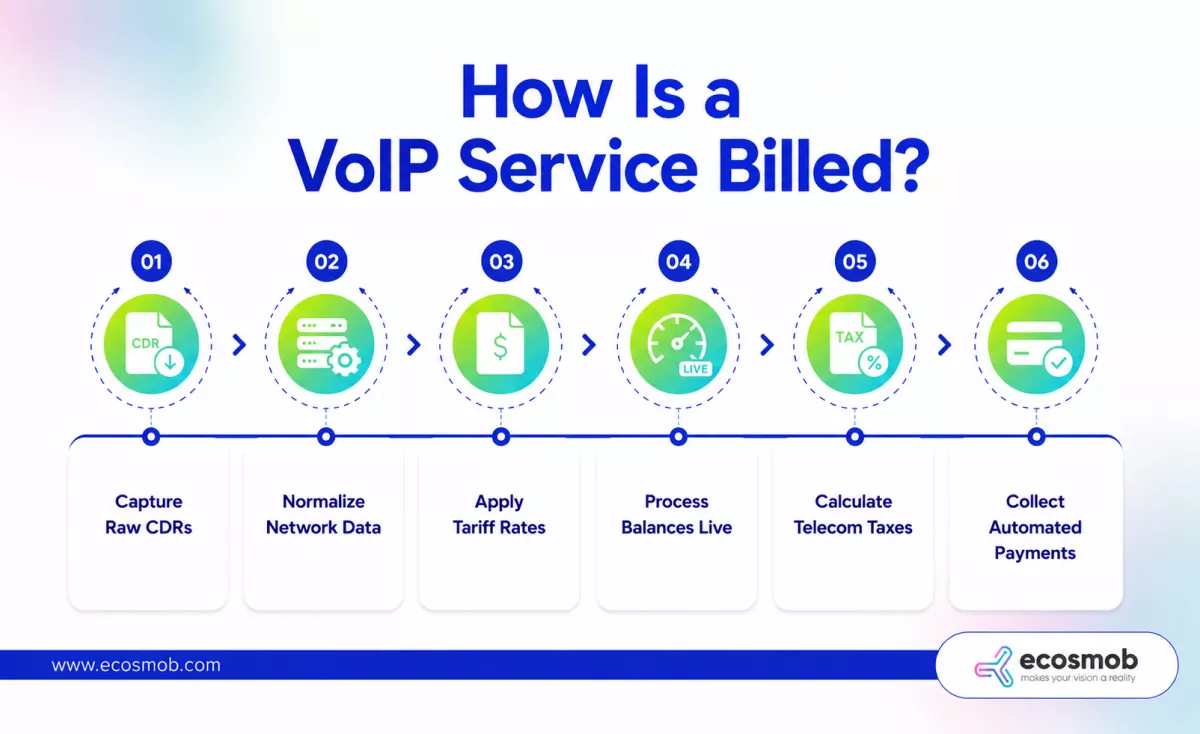
VoIP service is billed through a six-step pipeline: CDR capture from the softswitch, mediation to normalize the data, the rating engine for pricing, real-time charging via RADIUS/Diameter, invoice generation, and finally, payment collection.
To understand why standard software fails at telecom billing, you have to look under the hood. Here is the mechanical pipeline of how a phone call turns into money:
1. CDR Capture
Every time a call connects and disconnects, your softswitch (like FreeSWITCH, Kamailio, or an SBC) generates a Call Detail Record. This is a raw text or database entry containing the A-number (caller), B-number (callee), start time, end time, and SIP response codes. The billing system’s first job is to ingest this firehose of data without missing a single record.
2. Mediation
Not all switches speak the same language. A CDR from a Cisco gateway looks different than a CDR from a BroadSoft switch. Mediation is the data normalization layer. It parses the incoming records, strips out the junk, formats the timestamps into a unified standard, and prepares the clean data for the rating engine.
3. The Rating Engine
This is the mathematical brain of the operation. The rating engine takes the mediated CDR and asks: “What do we charge for this?” It looks at the B-number prefix (e.g., +44 for the UK), checks the specific customer’s assigned tariff, accounts for the day of the week or time of day (peak vs. off-peak), and applies the rate. It also handles fractional rounding (e.g., rounding up to the nearest 6-second increment).
4. Real-Time Charging (Prepaid) vs. Aggregation (Postpaid)
If the customer is prepaid, the billing system uses protocols like RADIUS or Diameter to actively communicate with the switch during the call. If the VoIP billing system calculates that the user’s $5.00 balance will run out in 30 seconds, it tells the switch to automatically drop the SIP session when the clock runs out. If the customer is postpaid, the system simply aggregates the rated CDRs into a database ledger for the end of the month.
5. Invoicing & Taxation
At the end of the billing cycle, the system compiles the aggregated charges, adds recurring subscription fees (like DID rentals or PBX seat licenses), calculates the incredibly complex jurisdictional telecom taxes, and generates a PDF or digital invoice.
6. Dunning & Collections
If the invoice isn’t paid, the dunning process begins. The system automatically sends payment reminders, retries credit cards, and, if necessary, automatically provisions the switch to suspend the user’s outbound calling capabilities until the balance is cleared.
Ecosmob Expert Tip
The most common silent revenue killer we see is timezone mismatching at the mediation layer. If your Class 4 switch is recording CDRs in UTC, but your billing server’s database is set to EST, your rating engine will apply off-peak weekend rates to calls that actually happened during peak Friday hours.
Hence, always standardize your entire architecture (from the SBC down to the billing database) to UTC, and only convert to local time at the final invoice presentation layer.
VoIP Service Billing Models | Prepaid vs. Postpaid VoIP Billing
VoIP service billing models are split into prepaid, requiring real-time balance checks to authorize SIP sessions, and postpaid, which aggregates monthly CDRs and subscription fees into a single billing cycle.
Choosing the right billing model dictates the architecture of the software you need.
The Prepaid Model (Real-Time Billing)
Prepaid is heavily utilized by calling card companies, retail B2C VoIP providers, and wholesale carriers dealing with high-risk international routes. The technical requirement for prepaid billing is immense. The software must maintain a persistent, low-latency connection to the core switch.
When a user initiates a call, the switch asks the VoIP billing server, “Does this user have enough credit to make a 1-minute call to this destination?” The VoIP billing server must lock the database row, check the balance, calculate the tariff, and respond within milliseconds.
If your VoIP billing software is slow, the call setup time drags, and the user experiences “dead air” before the ringtone.
The Postpaid Model (Cycle-Based Billing)
Postpaid is the standard for B2B UCaaS (Unified Communications as a Service), enterprise SIP trunking, and established MSPs. Because there is no risk of the call being dropped mid-sentence due to a zero balance, the VoIP billing system doesn’t need to communicate with the switch in real-time.
Instead, it relies on massive batch-processing power. On the 1st of the month, the VoIP billing software might need to rate 50 million CDRs simultaneously, generate 10,000 invoices, and hit an API to charge 10,000 credit cards. Postpaid VoIP billing systems require incredibly robust database structures to handle these end-of-month processing spikes without crashing.
Does your current billing pipeline drop records during peak traffic?
Our telecom engineers can help audit your architecture and plug the revenue leaks!
Best VoIP Billing Software Features (by Operator Segment)
A retail UCaaS provider and a wholesale SIP trunking provider are both “telecom companies,” but their VoIP billing requirements share almost zero overlap. When evaluating advanced VoIP billing systems, you must map the features directly to your operator segment.
Wholesale Carriers & SIP Trunking (Class 4)
Wholesale providers live and die by volume and margins. They are routing millions of minutes between different global carriers, making fractions of a cent on every call.
Must-Have Features:
- Least-Cost Routing (LCR) Integration: The billing system must actively talk to the routing engine. If Carrier A raises its rate to India by $0.001, the VoIP billing system must instantly update the routing table to push traffic to Carrier B.
- High-Performance CDR Processing: Wholesale systems must process tens of thousands of CPS without lagging.
- Multi-Tiered Vendor Reconciliations: You are not just billing customers; you are paying other carriers. The VoIP billing solution must automatically cross-check your outbound CDRs against the vendor’s invoice to spot discrepancies and dispute overcharges.
Retail ITSPs & UCaaS Providers (Class 5)
Internet Telephony Service Providers (ITSPs) and UCaaS platforms are selling to end-users and businesses. Their billing is less about minute-by-minute routing and more about complex packaging.
Must-Have Features:
- Subscription Bundling: The ability to bill “10 Hosted PBX seats + 5000 toll-free minutes + 10 leased physical IP phones” on a single, clean invoice.
- Proration Logic: If a business adds three new employees to their PBX system on the 14th of the month, the VoIP billing software must flawlessly prorate those seat licenses for the remainder of the cycle.
- Self-Service Customer Portals: End-users need a white-labeled dashboard to view their own CDRs, pay bills, and top up their balances without opening a support ticket.
MVNOs & ISPs
Mobile Virtual Network Operators (MVNOs) and Internet Service Providers have the most complex convergent billing requirements because they sell voice, SMS, and heavy data.
Must-Have Features:
- Convergent Billing: Rating gigabytes of 5G data alongside SMS segments and voice minutes on the same ledger.
- Dynamic Quota Management: Throttling data speeds or entirely cutting off SMS access the moment a user hits their monthly package limit.
- API-First Architecture: MVNOs heavily rely on mobile apps. The VoIP billing solution must have a robust REST or GraphQL API so the consumer mobile app can fetch real-time data balances instantly.
Telecom Tax & Regulatory Compliance for VoIP Billing Solutions
If you try to run a telecom business using standard SaaS billing software, you will quickly find yourself in the crosshairs of regulatory agencies.
Unlike a standard software subscription that might just incur a flat state sales tax, telecom services are subject to an incredibly convoluted web of jurisdiction-based taxes, surcharges, and regulatory fees.
In the United States, for example, a single VoIP invoice might need to calculate:
- Federal Universal Service Fund (USF) fees.
- State and Local E911 surcharges.
- Utility taxes.
- Specific telecom excise taxes depending on whether the call crossed state lines (intrastate vs. interstate).
Because these tax rates change constantly at the municipal level, a top-tier telecom billing system cannot rely on static tax tables. For businesses managing their broader tax obligations, tax compliance also requires keeping accurate records and meeting applicable filing requirements. It must natively integrate with specialized telecom taxation engines like SureTax or Avalara.
The VoIP billing system passes the rated CDRs and the customer’s physical service address to the tax engine via API, the tax engine calculates the exact jurisdictional fees down to the city level and returns the data so the billing system can generate a legally compliant invoice. If your VoIP billing software cannot handle this API handshake, your accounting department is going to spend weeks every month manually calculating regulatory remittances.
The Role of AI in Revenue Assurance & Fraud Detection
We cannot discuss modern VoIP billing solutions without addressing the elephant in the telecom room: Toll Fraud.
According to the Communications Fraud Control Association (CFCA), the telecommunications industry lost $38.95 billion in 2023 to schemes like Wangiri attacks, smishing, number spoofing, and International Revenue Share Fraud (IRSF). By 2025, that financial hemorrhage had only worsened, with global fraud losses surging by nearly $3 billion to hit a staggering $41.82 billion.
Historically, VoIP billing systems were reactive. You wouldn’t know a customer’s IP PBX was hacked until the end of the month when you tried to generate an invoice for $60,000 in calls to premium-rate international numbers. By then, the fraudsters are gone, the customer refuses to pay, and you still owe the upstream carrier the money. You eat the loss.
Today, advanced VoIP billing systems utilize Artificial Intelligence and Machine Learning for active Revenue Assurance.
Instead of just recording CDRs, the AI analyzes metadata in real time to establish a baseline of normal behavior for each SIP trunk or tenant. It understands that “Company X makes 500 calls a day, mostly to the US and Canada, exclusively between 8 AM and 6 PM.”
If the AI suddenly detects 40 concurrent calls hitting premium-rate numbers in Cuba at 2:00 AM on a Sunday (the classic signature of IRSF), it doesn’t wait for the billing cycle to end. The AI instantly flags the anomaly, halts the rating process, and triggers an API call to the Session Border Controller to aggressively kill the active SIP sessions and block the IP address, stopping the financial bleed in seconds.
Your VoIP billing system is not just an administrative tool. It is the financial heart of your network.
Whether you are struggling with a legacy system that requires manual spreadsheet reconciliations or an open-source platform that keeps crashing under your growing call volume, the cost of doing nothing is mathematically unsustainable. Every manual error, dropped CDR, and instance of uncaptured fraud is a direct hit to your bottom line.
By implementing an advanced VoIP billing system tailored to your specific operator segment (complete with real-time mediation, automated tax compliance, and AI-driven fraud detection), you remove the bottlenecks limiting your growth.
Ready to stop adapting your business to fit off-the-shelf software?
Connect with our engineers to build or integrate a custom billing solution that scales flawlessly with your network!
Frequently Asked Questions
The top systems include commercial platforms like PortaBilling, TimelyBill, and Alepo for quick deployments, open-source frameworks like ASTPP and CGRateS for high flexibility, and custom-built solutions by telecom integrators like Ecosmob for wholesale carriers requiring highly scalable, vendor-agnostic architecture.
For wholesale businesses, the best billing software must feature real-time Least-Cost Routing (LCR) integration, microsecond RADIUS/Diameter charging capabilities, and the capacity to process tens of thousands of Calls Per Second (CPS) without dropping Call Detail Records (CDRs). Custom integrations or heavy platforms are highly recommended over basic retail billing apps.
VoIP service billing methods primarily fall into three categories: usage-based billing (charging per minute or per SMS segment based on destination prefixes), flat-rate subscription billing (charging a recurring monthly fee for a bundle of services or PBX seats), and convergent billing (combining voice, data, and SMS usage onto a single unified invoice).
VoIP billing works by capturing raw Call Detail Records (CDRs) generated by a softswitch or SBC. The billing system mediates (cleans) this data, runs it through a rating engine to apply the correct tariff based on the dialed prefix, calculates the cost, applies jurisdictional telecom taxes, and finally generates an invoice or deducts the amount from a prepaid balance.
The two core models are prepaid and postpaid. Prepaid models require the billing server to authorize calls in real-time, instantly dropping the connection if the user’s balance hits zero. Postpaid models allow users to consume services throughout the month, with the system aggregating the rated CDRs and generating a comprehensive invoice at the end of the billing cycle.