

Three months ago, your VoIP platform handled peak loads of around a few thousand concurrent calls without breaking a sweat. Last week, you signed an enterprise client who needs triple that capacity. And the lead just asked how quickly you can scale infrastructure to support their launch date.
The honest answer? You’re not entirely sure.
Your current setup works reliably for existing clients. You’ve got SIP servers, media processors, database clusters, and trunk connections that deliver solid call quality day in and day out. But deliberately pushing those systems to handle significantly higher concurrency reveals uncomfortable unknowns.
Will your database keep up with authentication queries? Can your media servers process that many simultaneous RTP streams? What happens to existing clients if this new workload creates resource contention?
Some VoIP providers solve this by over-provisioning everything, like buying enough hardware to handle theoretical maximum loads that rarely materialize. Others accept that growth means periodic infrastructure crises where they scramble to add capacity while customers experience degraded service.
Neither approach makes sense when you’re trying to build a sustainable business.
The providers who scale successfully approach VoIP infrastructure scaling as an architectural problem with architectural solutions, not a hardware procurement problem with hardware solutions.
Why Most VoIP Infrastructures Fail at Scale
The fatal assumption that kills VoIP infrastructure scaling efforts is treating voice traffic like web traffic. Your website can queue requests, retry failed operations, and cache responses. A phone call happens in real-time or not at all.
The components that typically collapse first aren’t always obvious from looking at average utilization metrics.
Database query patterns change dramatically with scale.
At moderate concurrency levels, your database easily handles subscriber lookups, routing decisions, and CDR (Call Detail Record) writes. The queries execute quickly enough that call setup latency stays within acceptable ranges. But query load doesn’t grow linearly with concurrent calls. It grows faster than that because certain operations (like checking account balances for prepaid customers or validating feature flags) happen per-call-attempt, not per-successful-call. A failed call that immediately retries generates multiple database hits within seconds.
Eventually, individual queries that previously took single-digit milliseconds start taking longer. That latency compounds across the entire call setup process. Customers perceive “slow dial tone” even though your SIP servers show available CPU and memory.
Media processing consumes resources in ways that don’t scale linearly.
Passing RTP packets between endpoints is relatively cheap computationally. Transcoding between different codecs (converting G.711 to Opus, for example) is expensive. At low concurrency, transcoding happens occasionally when endpoints can’t negotiate compatible codecs. At higher concurrency, the percentage of calls requiring transcoding might stay constant, but the absolute number grows. Suddenly, your media servers spend significant CPU cycles on codec conversion instead of simply relaying packets.
Conference calls, call recording, DTMF processing, and other features each add computational overhead. These features work fine when they’re used sparingly. When concurrency grows and multiple clients simultaneously use these features, your media infrastructure hits limits that weren’t apparent during testing with synthetic call patterns.
Trunk capacity looks sufficient until geographic concentration happens.
You’ve provisioned trunk channels across multiple carriers with comfortable overall headroom. Your monitoring shows average utilization well below capacity. Then a major outbound campaign targets a specific region, or a large enterprise client’s call patterns shift, and suddenly a significant percentage of your calls concentrate on specific trunk routes. Individual carriers hit capacity limits even though your aggregate trunk utilization metrics look fine. Calls fail with “circuit busy” errors that don’t make sense when you’re looking at total available channels.
State management creates hidden dependencies.
Even in architectures designed to be stateless, some state inevitably exists somewhere. SIP registrations live in a registry database. Active call information gets tracked for billing purposes. Media server assignments need coordination so calls route correctly. When the systems managing this state become bottlenecks (whether through database locks, cache inconsistency, or coordination overhead), the impact cascades across your entire infrastructure. Components that should be independent suddenly become dependent on a shared chokepoint.
VoIP Architecture That Enables Scaling
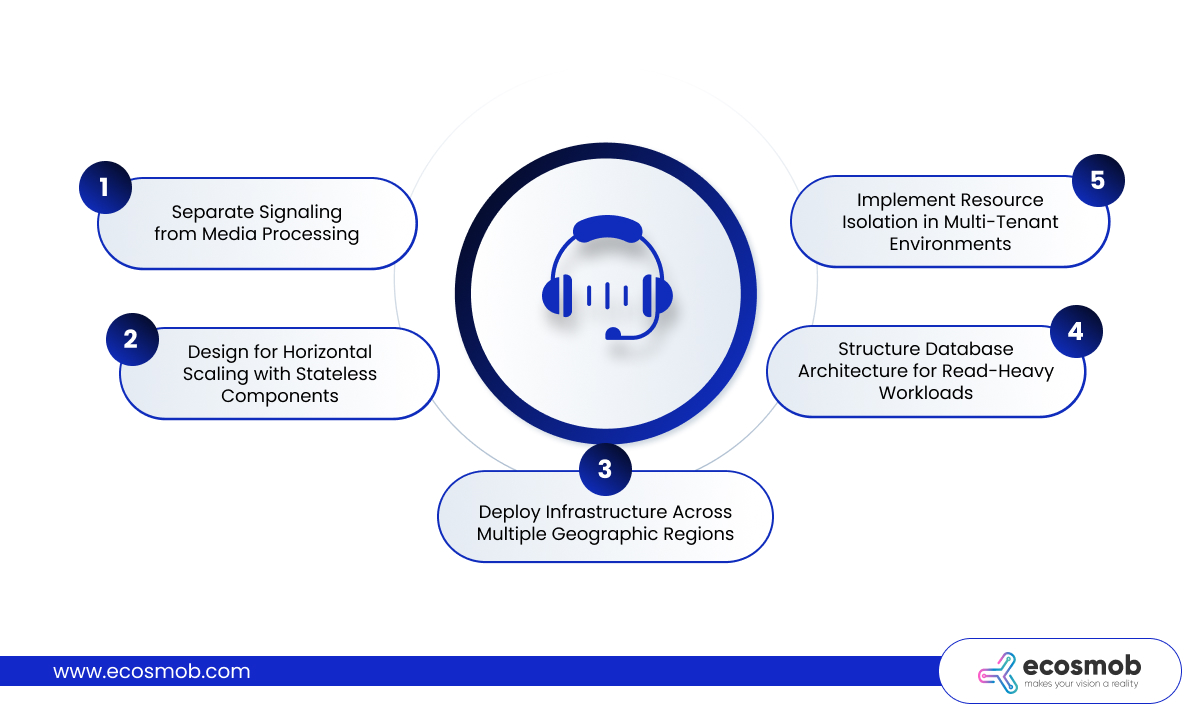 The difference between VoIP infrastructure scaling that works and scaling attempts that fail comes down to how you structure components and how they communicate. Below are the VoIP concurrency management decisions that directly impact whether you can double capacity without rebuilding your entire infrastructure.
Separate Signaling from Media Processing
Stateless proxy servers process each SIP request or response based solely on the message contents, with no information retained after messages are processed. This separation is fundamental: SIP proxies handling call setup need CPU for cryptographic operations and database queries, while media servers need network throughput for RTP packets and CPU for transcoding. Running both on the same hardware means you can’t scale them independently; adding media capacity forces you to provision signaling capacity you don’t need, and vice versa.
You need to:
- Deploy SIP proxies and media servers on separate infrastructure.
- When media becomes the bottleneck, add media server instances and update your load distribution logic to include them.
- When signaling is constrained, add proxy instances behind your load balancer.
- Configure your SIP proxies to assign media processing to available media servers dynamically based on current load, not static server lists.
Design for Horizontal Scaling with Stateless Components
Horizontal scaling means buying many of the same type of smaller hardware and distributing the load, with advantages over vertical scaling, which eventually hits limits. Stateless design makes sure any proxy can process any request because requests carry their own context.
You need to:
- Implement your SIP proxies to make routing decisions based only on the current request and configuration data retrieved from shared stores (database, cache).
- Avoid storing call state in proxy memory.
- Use load balancers that distribute requests across your proxy pool without session affinity.
- When adding capacity, deploy new proxy instances and add them to the load balancer (no state transfer required).
Deploy Infrastructure Across Multiple Geographic Regions
Latency fundamentally affects voice quality. Every millisecond of round-trip time increases the risk of perceptible delay and echo. Running everything in a single data center means distant users experience baseline latency before considering network congestion or processing delays.
You need to:
- Deploy SIP and media infrastructure in multiple geographic regions, not just for redundancy, but for performance.
- Route users to nearby servers using GeoDNS for initial connections.
- Keep RTP streams geographically close to endpoints by deploying media servers regionally while centralizing signaling and databases in fewer locations.
- Implement health-aware routing that automatically shifts traffic away from degraded regions without manual intervention.
Structure Database Architecture for Read-Heavy Workloads
Voice applications generate mostly read operations, like authentication queries on every call attempt, routing rule lookups, and configuration retrieval. Writes happen less frequently: CDR storage, registration updates.
You need to:
- Deploy a primary database for writes and multiple read replicas distributed geographically.
- Direct read queries (authentication, routing, configuration) to nearest replicas.
- Implement aggressive caching using Redis or Memcached for frequently accessed data (credentials, routing preferences, feature flags).
- Set appropriate TTL (Time To Live) values and implement cache invalidation when data changes.
- Separate CDR storage from operational databases, use dedicated time-series databases (InfluxDB, TimescaleDB) for call records and metrics to prevent write contention affecting call processing queries.
Implement Resource Isolation in Multi-Tenant Environments
Multi-tenant platforms serve multiple clients on shared infrastructure for economic efficiency, but shared resources create risks like one client’s surge or misconfigured application can affect others.
You need to:
- Create isolation through containerization or virtual machines that enforce CPU and memory boundaries.
- Implement network-level traffic shaping and QoS policies, preventing bandwidth exhaustion.
- Build application-layer rate limiting that tracks per-tenant resource consumption (maximum concurrent calls, new call attempts per second, burst allowances).
- Configure admission control that rejects additional traffic from clients exceeding their allocations while other tenants continue normally.
- Deploy monitoring that tracks per-tenant resource usage and alerts when clients approach their limits before they impact shared infrastructure.
Cloud-Based vs. Hybrid VoIP Architectures| Which Is Best for High-Volume VoIP?
Cloud platforms offer rapid capacity provisioning without hardware procurement delays, but voice workloads have specific characteristics that make deployment more nuanced.
The fundamental question isn’t cloud versus on-premise; it’s which components benefit from cloud elasticity and which need the predictability of dedicated infrastructure. For workloads that require predictable performance and isolated resources, a Dedicated Server can complement cloud-based infrastructure.
|
Approach |
Best For | Main Advantage |
Key Consideration |
| Cloud | Rapid growth, geographic expansion, variable workloads | Instant capacity provisioning, pay-as-you-go economics | Network performance variability requires multi-region deployment and intensive quality monitoring |
| Hybrid | Established providers with predictable baseline + variable peaks | Dedicated infrastructure for latency-sensitive signaling, cloud for elastic media scaling | Integration complexity between environments, consistent state management |
| On-Premise | Carriers with strict latency requirements, regulatory constraints | Complete control over network paths and performance variables | Capital investment, longer procurement cycles, and manual capacity planning |
Ecosmob Expert Tip
When implementing cloud-based VoIP concurrency management, deploy SIP proxies in every region but centralize your database with read replicas distributed geographically.
This architecture gives you low-latency call setup (proxies query local database replicas) while maintaining a single source of truth for subscriber data.
Use eventual consistency models with conflict resolution strategies for the rare cases where updates propagate slowly. Most VoIP operations (call routing, authentication) read data far more often than they write it, making this pattern highly effective.
Redundancy Strategies to Reduce VoIP Downtime
Redundancy in VoIP infrastructure scaling prevents downtime, but poorly implemented redundancy creates reliability problems through added complexity. The goal is designing systems where component failures don’t propagate into service failures.
Active-Active Over Primary-Backup
Active-active designs, where multiple systems simultaneously handle production traffic, are simpler than primary-backup patterns requiring failover procedures.
- Deploy multiple SIP proxies behind load balancers; all process calls concurrently, and when one fails, the load balancer automatically stops routing to it.
- Configure load balancers with health checks that verify actual functionality and automatically reintroduce components once they pass consecutive health checks.
Component-Level Redundancy
Component-level redundancy (multiple containers, multiple processes) protects against software failures, configuration errors, and resource exhaustion, which cause more outages than hardware failures.
- Deploy VoIP components as containers orchestrated by Kubernetes with health checks that automatically restart failed containers.
- Utilize resource limits to prevent individual components from consuming all available resources.
- Use pod anti-affinity rules to ensure replicas run on different physical nodes.
Fast Database Failover
For VoIP concurrency management, database failover must complete quickly because call processing depends on availability.
- Deploy database clustering with sub-second health checks, automatic replica promotion, and application-level connection handling that reconnects to the new primary automatically.
- Design your application layer to cache operational data so call routing continues during brief database unavailability and queue CDR writes in memory for later flushing.
Network Path Redundancy
Robust VoIP scaling demands that every critical network route be independently redundant.
- Connect servers to multiple switches and ensure at least two divergent network uplinks for failover scenarios.
- Deploy multiple SIP trunk providers and configure endpoints with several proxy addresses so calls can reroute instantly if one path fails.
- Implement dynamic routing protocols, combined with automatic failover algorithms, to shift traffic seamlessly during link/provider outages.
- Use multiple DNS servers, ideally in different geographical locations, to ensure SIP registrations and call routing never rely on a single point of resolution.
- Maintaining a DNS server overview helps track server roles, locations, and failover configurations for reliable call routing.
This layered redundancy ensures service continuity even during complex failures, maintaining optimal call quality for all users.
VoIP Failover Systems for Large-Scale Call Operations
Failover systems often get designed based on idealized failure scenarios and then encounter a more complex reality during actual outages. What works on paper needs to work under pressure when multiple things are breaking simultaneously.
Health Check Configuration
Effective health checks verify actual functionality, not just process existence (a SIP proxy health check should attempt test call routing, not just ping the service). Require multiple consecutive failures before marking components unhealthy (single failures might be transient), and use different thresholds for removal versus addition.
Gradual Traffic Shifting
Implement gradual traffic shifting rather than immediately redirecting all traffic to backup locations that might be overwhelmed. Start with a small percentage, observe for anomalies, and increase gradually. This provides opportunities to detect if backup systems are also experiencing problems before committing all traffic and allows auto-scaling systems to respond to increased load.
Regular Failover Testing
Route small percentages of traffic through backup infrastructure continuously, validating it works daily. You can also schedule maintenance windows where you deliberately trigger failover and verify that clients follow correctly.
VoIP Traffic Prioritization Strategies
When infrastructure approaches capacity limits, VoIP concurrency management requires deciding which calls get priority and which get delayed or rejected. Simply accepting all traffic when you’re at capacity degrades service for everyone.
Call Admission Control
- Track current utilization (calls, CPU, trunks).
- Reject new calls gracefully before full saturation. This maintains quality for active users and prevents system overload.
Priority-Based Admission
- Classify clients by priority.
- Always accept emergency/SLA-guaranteed calls; lower priority traffic is denied first during constraints.
- Configure routing logic to enforce priority tiers and autonomously adjust allocations.
Feature Degradation
- When near capacity, temporarily disable resource-intensive features (recording, transcoding, conferencing). This keeps base call connectivity up while conserving vital resources.
- Restore features when the load drops.
Per-Client Rate Limiting
- Assign strict per-client caps (concurrent calls, new call attempts per second). Excess traffic from any tenant is rejected early, preventing one client from impacting others.
- Adapt limits based on tier, usage, and system health.
These focused strategies will help any VoIP provider ensure consistent service quality, even under high-demand or resource-constrained scenarios.
VoIP infrastructure scaling comes down to architectural decisions made early that either enable growth or limit it. The providers who scale successfully don’t necessarily have bigger budgets or more advanced technology. They have infrastructure designed from the start to grow horizontally, fail gracefully, and adapt to changing loads.
Your clients care about one thing: that calls work reliably regardless of volume.
The infrastructure that delivers that reliability looks different from traditional telecom architectures and requires different thinking about how components should scale, fail, and recover.
Need infrastructure architecture that scales with your ambitions instead of limiting them?
Work with engineers who’ve built systems handling millions of concurrent calls!
Frequently Asked Questions
VoIP scaling best practices benefit organizations of any size; small businesses gain agility and cost savings, while larger enterprises achieve reliability and regional/global reach by implementing scalable infrastructure.
The best strategies that VoIP providers can apply are: leverage active-active load balancing, high-availability clustering, rapid database failover, redundant SIP trunks/providers, and direct monitoring/health checks for best-in-class reliability.
Cloud architectures offer fast, elastic scaling, but can face network variability. Hybrid systems mix predictable local performance with cloud elasticity, while on-premise solutions maximize control but require manual planning and investment.
VoIP providers can deploy infrastructure in multiple geographic regions, leverage real-time monitoring, and implement redundancy best practices to guarantee low latency and maximum uptime for users worldwide.
Network path redundancy means designing independent, backup routes for calls. This prevents single points of failure, allowing traffic to automatically reroute during outages for uninterrupted service.