
Imagine your client’s contact center needs call routing based not on queue length but on a proprietary risk score only available inside their CRM. Generic UCaaS platforms fumble here; they’re not built to flex. Delivering a custom feature that binds your platform directly into their unique workflows is THE golden ticket to new business and unprecedented client loyalty.
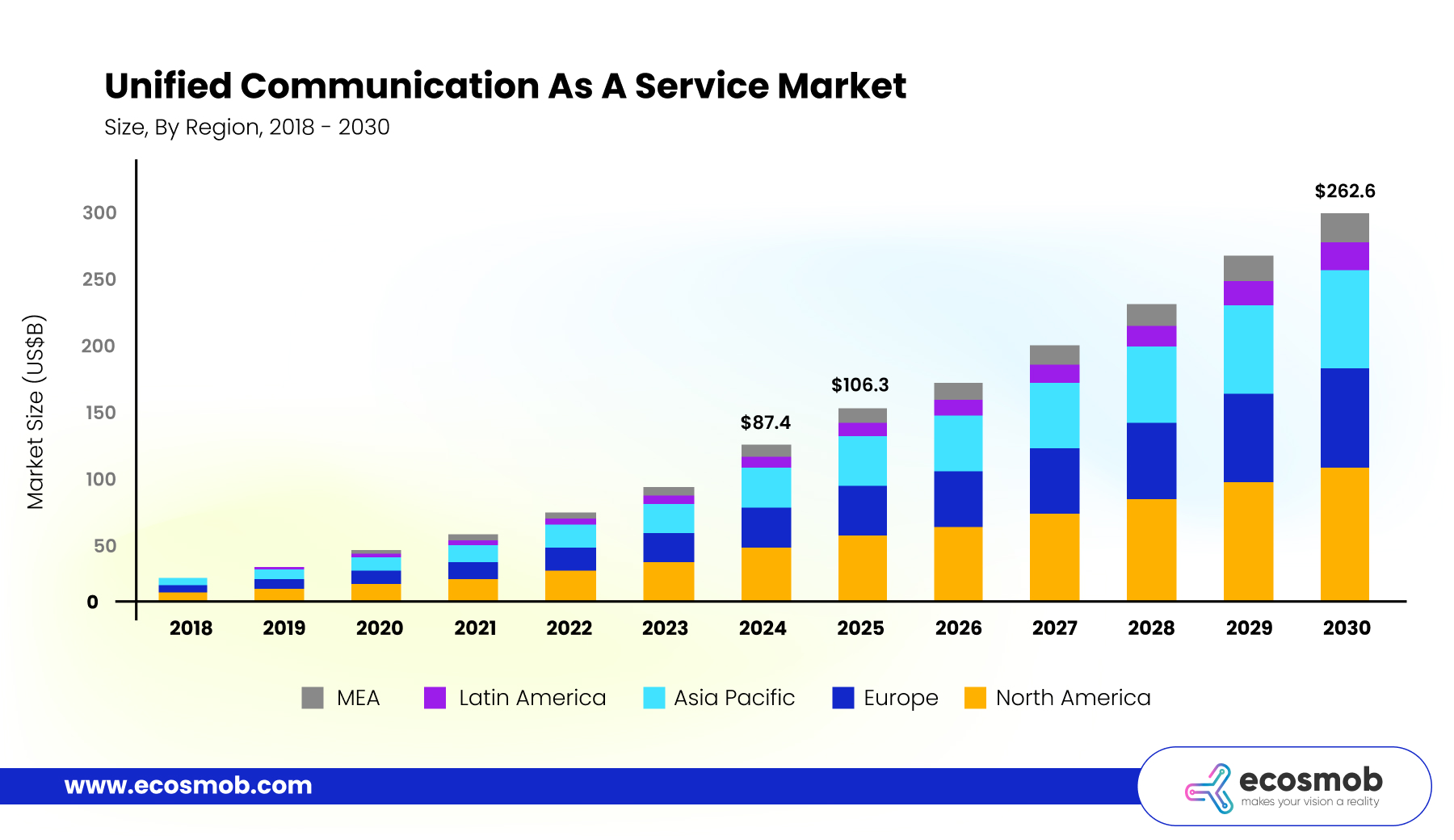
The UCaaS market is on track to hit $262 billion by 2030. Yet, the game’s changing. Buyers aren’t hunting checklists anymore; they want solutions tailored to their complex realities. Off-the-shelf simply won’t cut it.
Why Generic UCaaS Falls Short for Enterprise Workflows
It’s a universal truth: no two enterprises operate alike. The average business juggles more than 1000 specialized apps. While generic UCaaS platforms offer standard features (voice, messaging, video), they don’t seamlessly plug into domain-specific systems that drive critical workflows.
Healthcare clients demand HIPAA-compliant call recording with selective data masking. Financial institutions require ultra-secure voice archives adhering to SEC and FINRA regulations. Manufacturing entities rely on IoT data-driven triggers for emergency escalations. These needs extend far beyond basic conferencing or chat features.
When your platform can’t meet these, prospects see you as just one option among many price crushers.
How Custom Features Turn UCaaS Solutions Into Strategic Assets
Anyone can offer conferencing, messaging, and a baseline IVR, but enterprises demand platforms that solve business-specific challenges. Custom feature development positions your UCaaS solution as a mission-critical infrastructure integrated into workflows, compliance, and legacy IT systems.
This can create lock-in, drive up the perceived value, and make it nearly impossible for competitors to dislodge you. Custom work also generates reusable modules and integration templates that further speed up onboarding new clients in similar verticals.
Some key moves for turning your platform into a strategic asset include:
- Vertical-specific modules: Develop features tied to sector regulations (like healthcare call recording with PHI masking) that standard platforms can’t rapidly deploy.
- Deep integration hooks: Direct API-level integrations with CRMs, ERPs, or IoT platforms enable customers to automate their proprietary workflows end-to-end.
- Data-centric feature customization: Build analytics dashboards, custom reporting, or compliance-tracking tools based on individual enterprise KPIs.
- Event-driven automation: Let customers define triggers and automation logic (like alerts, escalations, or cross-channel coordination tailored to their ecosystem).
- Reusable integration IP: Document custom integration patterns, so future deployments become plug-and-play for prospects in the same industry.
How to Monetize Custom UCaaS Features Without Price Wars?
Maximizing ROI from custom UCaaS requires much more than a one-off development fee. The right strategy creates recurring, expanding, and sticky revenue. Providers that monetize features as services can outgrow competition anchored to standard “seat-based” models.
Here’s how leading UCaaS companies monetize:
- Premium feature bundles: Sell industry- or workflow-specific packs (compliance suite, healthcare integrations, smart routing) as high-value subscriptions.
- Consumption-based billing: Charge for usage (API calls, AI minutes, advanced analytics dashboards), tying revenue to delivered value, not just user count.
- Build–operate–transfer models: Develop custom modules, operate and incrementally improve them with the client, then license the code for ongoing use.
- Managed services add-ons: Offer ongoing tuning, compliance audits, analytics expansion, and support as monthly/annual contracts, turning custom work into recurring services.
- Early access/priority roadmap: Let customers pay for prioritized development of high-value features, or offer early-access “beta” programs for a fee.
This approach ensures every customization yields both immediate payout and long-term, margin-rich revenue streams.
The next question is: How do you identify features that move the needle?
Here’s how:
- Analyze feature usage data to spot gaps and demands.
- Mine support tickets for repeated requests revealing missing capabilities.
- Run customer workshops focused on articulating workflow pain points.
- Review industry RFPs thoroughly to discover unmet needs.
This data-driven approach ensures development investments hit high-value targets.
AI’s Role in Custom UCaaS Development
Artificial intelligence is now a lot more than hype. You can’t deploy applications without planning for AI integrations anymore. It’s THE foundation for next-gen customization.
- AI-driven routing optimizes every call by analyzing intent, sentiment, and historical data.
- Custom domain models accelerate accuracy (medical terms, financial jargon, manufacturing commands).
- Real-time compliance checks, automated escalation triggers, and behavioral analytics raise service quality dramatically.
Embedding AI early transforms your platform from passive to predictive, constantly refining based on live feedback loops.
What Custom Features Matter for Regulated Industries?
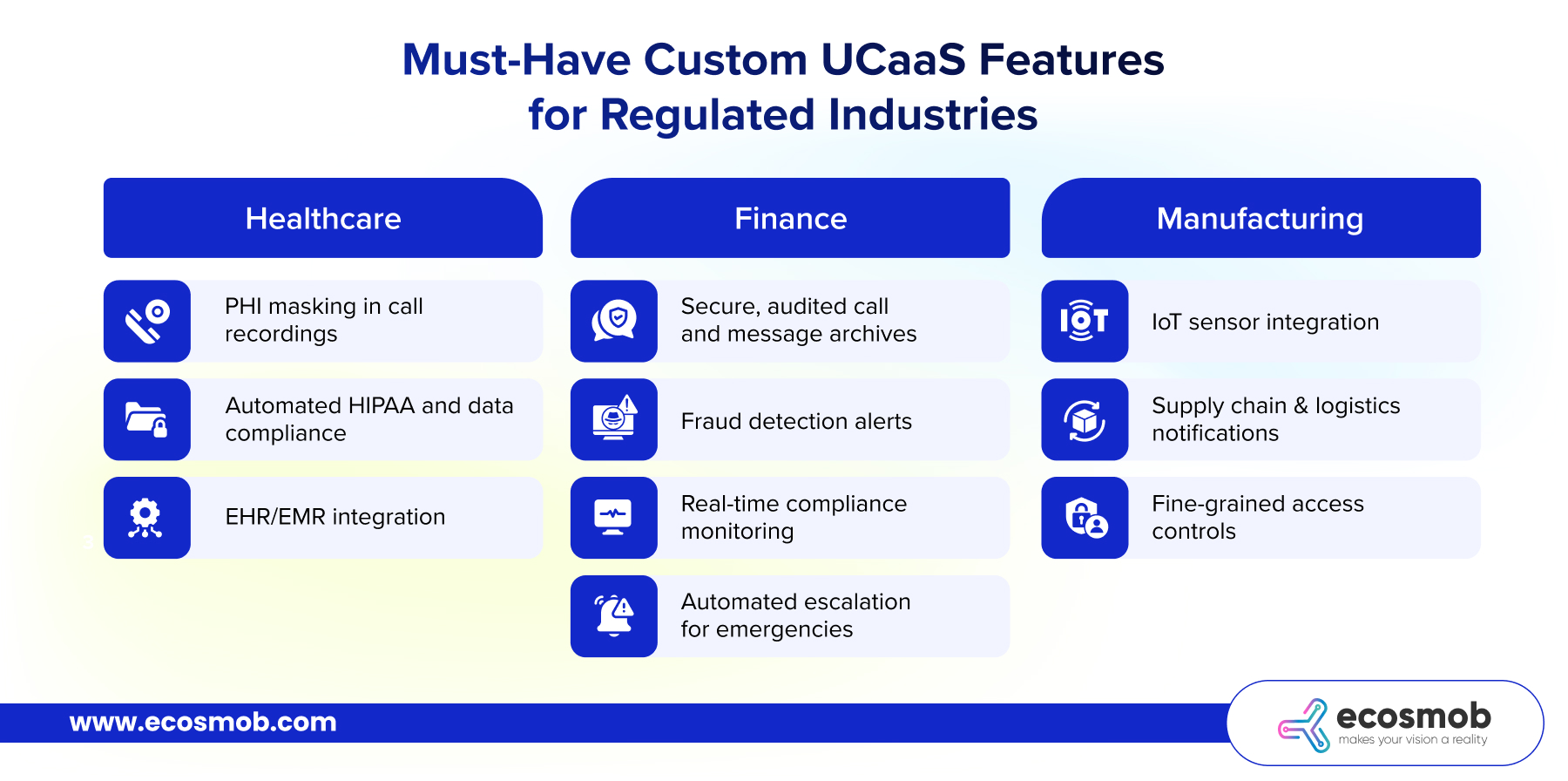
Regulated sectors (healthcare, finance, utilities, government, etc.) demand proactive regulatory compliance, traceability, and specialized workflow integration. Here, “compliance” is a competitive advantage that comes from automating what would otherwise be costly manual processes and providing real-time auditability.
Healthcare:
- HIPAA/HITECH voice compliance: Call recording with sensitive info redacted or isolated
- Automated PHI masking: NLP that detects and hides protected data in transcripts or databases
- EHR/EMR integration: Instant patient lookup, secure scheduling, and real-time care coordination
- Telehealth escalation features: Automated switching from standard call to secure video when needed
- Access control audits: Logs and permission checks for all actions, ready for regulatory review
Finance:
- SEC/FINRA-compliant call archiving: Automated retention triggers, tamper-proof logs, and easy export for audit
- Fraud/risk analytics tied to voice: AI models that flag suspicious language or transaction activity in real time
- Trade-floor voice channels: Ultra-low-latency communication—plus automated capture for trade confirmations
- Automated compliance alerts: Detecting and notifying of any deviation from required scripts or language
Manufacturing/Industrial:
- IoT/OT event integration: Voicebot workflows triggered by sensor readings or machine states
- Safety/EHS escalation: Auto-alerts and compliance documentation for workplace incidents
- Supply chain comms: Automated notifications tied to inventory, shipment status, or production bottlenecks
These features are fundamental for winning and keeping clients in regulated spaces.
Ecosmob Expert Tip
When building custom features for regulated industries, don’t wait for compliance review at the end. Engage compliance stakeholders from day one, document all decisions, and perform regular mini-audits during development. This approach prevents costly rework and accelerates time-to-market for even the most complex features.
Building a Strategy for Sustainable Custom Development
Long-term success in custom UCaaS development is grounded in technical and organizational best practices.
Start with a strong architectural foundation.
Customizable, API-first microservices architecture allows independent evolution and extension of features without disrupting core service delivery.
Multi-tenancy ensures that customizations for one enterprise don’t risk the security or reliability of others.
A shared library of validated, industry-specific modules enables fast, repeatable delivery for new customers.
Our suggestions for execution:
- Agile feedback loops: Short, responsive sprints ensure new features are tied to client needs and rapidly iterated
- Compliance-by-design: Build audit, security, and regulatory logic into every stage, so compliance costs don’t spiral late in delivery
- Shadow/blue-green deployment: Deploy features in a limited release for real-world safety and easy rollback
- Continuous documentation: Keep integration guides, workflow diagrams, and feature records up to date, making future expansion or support far smoother
Sustained leadership in custom UCaaS is the product of both tech and process discipline, so each new feature builds real, compounding business value.
Generic UCaaS commoditizes you; customization future-proofs you.
This isn’t about adding bells and whistles. It’s about crafting distinctive capabilities that solve client problems inscrutable to competitors.
Build with AI-infused insight; embed compliance where it matters; adopt architectures that scale with innovation.
The prize? Higher margins, less churn, and unwavering client loyalty.
You’re either commoditized or indispensable.
Choose wisely.
Choosing to be indispensable? You need a technology partner that’s been doing it for years.
Let’s make you stand out in this commoditized market!
Frequently Asked Questions
Custom features address unique client workflows and compliance needs, shifting conversations from price to value and locking in long-term partnerships.
The features that are the most in demand are: vertical-specific integrations, AI-powered workflows, industry-compliant recording, and real-time analytics top the list.
Custom UCaaS development, when built on modular and API-first principles, lets you scale features, integrations, and user bases independently, ensuring one client’s customization doesn’t affect overall platform performance or reliability.
Not at all. With reusable microservices and low-code frameworks, even mid-sized businesses can benefit from tailored workflows (often at a fraction of traditional custom software costs).
The monetization strategy that our experts trust the most includes combining premium subscriptions, API usage billing, AI-processing fees, plus professional service engagements.
You need a partner that understands both real-time communication and SaaS architecture. Ecosmob specializes in building unified platforms that combine SIP-based VoIP, WebSocket messaging, and WebRTC video into a single multi-tenant SaaS product.
A complete stack typically includes VoIP engine (e.g., SIP, Asterisk, FreeSWITCH), real-time messaging infrastructure (WebSockets), video conferencing (WebRTC), multi-tenant SaaS architecture with access control and billing.
The difficulty isn’t in building individual components, but in integrating them into a unified, scalable system where each customer has isolated data, branding, and workflows.
Generic platforms offer standard features but lack flexibility for deep integrations, custom workflows, and compliance needs required by enterprises.
Custom features allow businesses to integrate deeply with CRMs, ERPs, and internal systems, automate workflows based on business logic, build industry-specific capabilities and deliver unique customer experiences.