











QUICK SUMMARY
Struggling with voicebot integration challenges? This blog walks you through tested voicebot integration best practices (the ones we follow!), ensuring every aspect of your voicebot deployment delivers real results. Learn how to seamlessly integrate voicebots with CRM, contact centers, etc., and utilize the right tools for full operational impact.
Every transformative voicebot deployment begins with one promise: smarter automation that delivers immediate, personalized customer service. Yet, in the trenches, projects often stumble for the same reasons: brittle handoffs across systems, patchwork data sync, unscalable architecture, and poorly mapped customer journeys. These are voicebot integration challenges that demand smart engineering, not surface-level fixes.
Integration challenges can blindside organizations that focus on the AI capabilities while ignoring the operational complexities of production deployment.
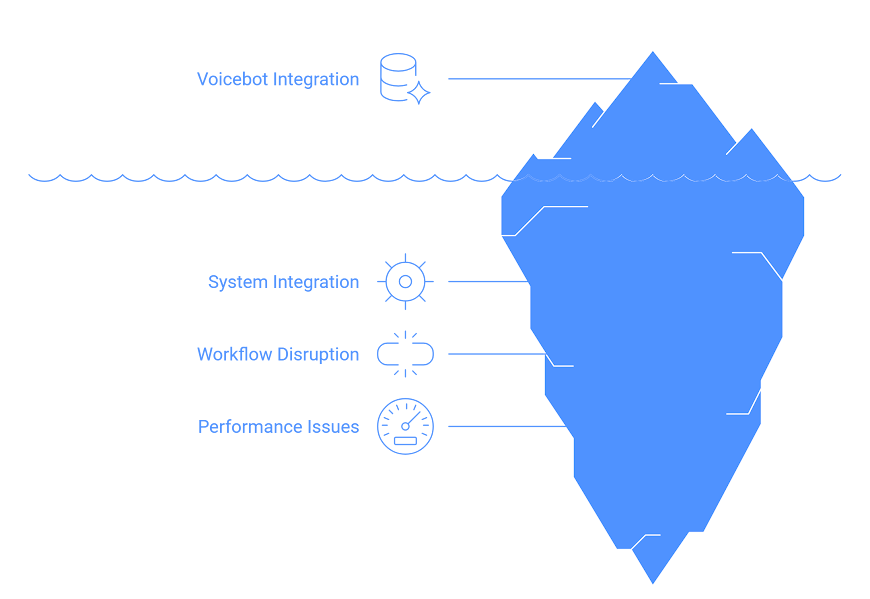
Voicebot integration challenges typically emerge in three critical areas: system integration complexity, operational workflow disruption, and performance requirements that testing environments often fail to reveal.
Organizations that address these systematically succeed.
Those that don’t end up with abandoned AI projects and damaged stakeholder confidence.
The Complexity of Voicebot Integration
 Most voicebot integration best practices focus on AI training and conversation design while completely overlooking the infrastructure and operational challenges that determine whether the deployment will actually work.
System Integration Complexity
- Legacy CRM systems that weren’t designed for real-time API calls and data synchronization
- Contact center platforms with complex routing logic that voicebots must navigate without human intervention
- Authentication systems that can’t handle automated access patterns and API rate limiting
- Database performance issues when voicebots query customer data thousands of times per hour
Operational Workflow Disruption
- Agent handoff processes that break down when voicebots can’t properly transfer context and call history
- Escalation procedures that fail when voicebots encounter edge cases not covered in initial training
- Quality assurance processes that don’t account for automated interactions and compliance recording
- Customer service metrics that become meaningless when mixing automated and human interactions
Performance and Scalability Issues
- Response time requirements that seemed reasonable in testing, but become unacceptable when handling real call volumes
- Network latency between voicebot processing and external systems that creates awkward conversation delays
- Concurrent user limits that nobody identified during pilot testing with limited user groups
- Failover and disaster recovery scenarios that weren’t tested with voicebot traffic patterns
Voicebot pilot worked in testing, but production deployment failed? We can help!
Voicebot Integration Critical Points
This is where most voicebot projects typically fail.
Understanding where failures commonly occur allows you to design solutions that prevent these issues rather than discovering them during high-stakes production rollouts. Let’s look at some examples:
CRM System Integration and Real-Time Data Access
Integrating voicebots with CRM systems creates performance bottlenecks and data consistency issues that can destroy customer experience if you don’t architect properly from the beginning.
Common CRM Integration Failures
- Database queries that time out during peak usage, leaving voicebots unable to access customer information
- Data synchronization delays that result in voicebots working with outdated customer records
- API rate limiting that throttles voicebot requests during high call volume periods
- Complex database schemas that require multiple queries to assemble complete customer profiles
Voicebot CRM Integration Solutions
- Implement caching layers that reduce database load while ensuring data freshness for critical customer information
- Design database views and stored procedures optimized specifically for voicebot query patterns
- Create dedicated API endpoints that return the complete customer context in a single request
- Deploy database read replicas that handle voicebot queries without impacting primary CRM performance
Contact Center Platform Integration and Agent Handoff
Voicebot integration with contact centers requires seamless coordination between automated and human agents, but most organizations underestimate the complexity of context transfer and workflow integration.
Common Voicebot Contact Center Integration Issues
- Conversation history that must be preserved and presented to human agents in an actionable format
- Customer emotional state and intent that needs to be communicated beyond simple transcript data
- Call routing logic that must account for voicebot interaction outcomes and customer preferences
- Quality assurance processes that need to evaluate both automated and human portions of customer interactions
Contact Center CRM Integration Solutions
- Implement structured data formats that capture customer intent, resolve issues, and address outstanding concerns
- Create agent dashboards that display voicebot interaction summaries alongside traditional call information
- Design routing rules that consider the voicebot assessment of customer needs and emotional state
- Deploy integration APIs that update contact center systems in real-time during voicebot interactions
This is exactly why many teams use a dedicated connector between their SIP infrastructure and AI bots. For example, our custom-built Voicebot Connector streams RTP audio directly from your IP PBX to the bot, handles escalations cleanly, and avoids rewrites or patchy workarounds. It’s the simplest way to get production-ready reliability.
Also read: Deploying AI Voice Agents to Improve Contact Center Efficiency
Authentication and Security Integration
Voicebot deployment must integrate with your existing authentication systems while maintaining security standards, but voice-based authentication creates unique challenges that traditional systems aren’t designed to handle.
Voice Authentication Challenges
- Caller ID spoofing can compromise security when voicebots rely on automatic number identification
- Background noise and call quality issues that interfere with voice biometrics and verification
- Multi-factor authentication processes that don’t translate well to voice-only interactions
- Privacy regulations that restrict how voice data can be processed and stored for authentication
Security Integration Solutions
- Implement multi-modal authentication that combines voice analysis with knowledge-based verification
- Design fallback authentication methods that maintain security when voice recognition fails
- Create audit trails that track authentication decisions and provide compliance documentation
- Deploy encryption and data protection that meets regulatory requirements for voice biometric data
💡 Ecosmob Expert Tip
- When adding voice biometrics, always combine it with fallback methods like PIN or SMS verification. Pure voice-only authentication often fails in noisy environments, and redundancy ensures both security and usability.
Voicebot Integration Performance Optimization
We can’t make a voicebot integration best practices list without addressing performance requirements. They are what give you success at scale, and so they shouldn’t become apparent only when your system operates under real-world load conditions.
Response Time Optimization and User Experience
Voicebot conversation flow depends on response times that feel natural to human callers, but voicebot integration complexity can introduce delays that destroy the conversational experience.
Response Time Requirements
- Initial greeting and recognition must occur within seconds to avoid caller confusion
- Database queries and API calls must also complete within a few seconds to maintain conversation flow
- Complex decision-making processes must provide interim responses to prevent awkward silence
- Error handling and recovery must happen quickly enough that customers don’t hang up
Architecture for Optimal Performance
- Deploy edge computing that processes voice recognition closer to callers for reduced latency
- Implement predictive caching that pre-loads likely customer data based on calling patterns
- Design asynchronous processing that allows voicebots to continue conversations while background tasks complete
- Create performance monitoring that identifies bottlenecks before they affect customer experience
Scalability Planning and Resource Management
Production voicebot implementation challenges also include handling usage patterns that pilot testing didn’t reveal, requiring infrastructure that can scale dynamically while maintaining performance standards.
Scalability Architecture Requirements
- Auto-scaling compute resources that handle peak call volumes without service degradation
- Database architecture that maintains response times as concurrent voicebot sessions increase
- Network infrastructure that supports multiple simultaneous voice processing streams
- Load balancing that distributes voicebot traffic across available processing resources
Resource Optimization Strategies
- Implement conversation state management that minimizes memory usage per active session
- Design efficient data structures that reduce processing overhead for common voicebot operations
- Create resource pooling that shares expensive operations (speech recognition, AI inference) across multiple conversations
- Deploy monitoring and alerting that provides early warning of resource constraints
Voicebot Integration Operational Success
Even the most technically sophisticated voicebot will fail if it doesn’t integrate properly with your existing operational procedures, compliance requirements, and business workflows.
Compliance and Quality Assurance Integration
Voicebot deployment in regulated industries must maintain existing compliance standards while creating new operational procedures for automated interactions.
Compliance Integration Requirements
- Call recording and retention that meets regulatory requirements for automated interactions
- Quality scoring systems that can evaluate voicebot performance against established standards
- Audit trails that document voicebot decisions and provide accountability for regulatory review
- Privacy protection that ensures customer data handling meets industry-specific requirements
Quality Assurance Adaptation
- Create evaluation criteria that assess voicebot performance using measurable business outcomes
- Implement sampling and review processes that identify improvement opportunities in automated interactions
- Design feedback loops that allow quality teams to influence voicebot training and optimization
- Deploy real-time monitoring that alerts supervisors to voicebot performance issues during live interactions
Business Process Integration and Change Management
Successful voicebot integration also requires careful coordination with your existing business processes and comprehensive change management that addresses both technical and human factors.
Process Integration Strategies
- Map current customer service workflows and identify specific points where voicebots add value without disrupting effective procedures
- Create standard operating procedures that define when and how voicebots should escalate to human agents
- Implement reporting and analytics that demonstrate voicebot impact on key business metrics
- Design continuous improvement processes that optimize voicebot performance based on operational feedback
Change Management Best Practices
- Provide comprehensive training that helps customer service teams understand voicebot capabilities and limitations
- Create communication plans that keep stakeholders informed about voicebot performance and optimization efforts
- Implement phased rollouts that allow teams to adapt to voicebot integration gradually
- Design feedback collection that captures both quantitative performance data and qualitative user experience insights
End voicebot integration challenges forever. Get reliable, production-ready solutions that scale easily!
Common Voicebot Integration Challenges & Solutions | A Summary
| Challenge | Impact | Solution |
| CRM query delays | Voicebot works with outdated or missing data | Caching, optimized API endpoints, and read replicas |
| Agent handoff breakdowns | Customers repeat themselves, agents lose history | Structured context transfer (intent, last action, sentiment) |
| Authentication gaps | Security risks, failed verifications | Voice biometrics + fallback MFA + encrypted data handling |
| Latency & response issues | Awkward pauses, poor experience | Edge compute + predictive caching + async processing |
| Scalability under load | Bots fail during call spikes | Auto-scaling + efficient session management + load balancing |
| Compliance blind spots | Regulatory failures & audit risks | Audit trails, retention policies, and QA scoring for bot traffic |
| Poor change management | Staff confusion, failed adoption | Phased rollout + clear SOPs + feedback loops & training |
Voicebot integration challenges are fundamentally systems integration problems that require the same rigorous planning, testing, and operational discipline as any other mission-critical business system deployment. The organizations that succeed treat voicebot projects as comprehensive integration initiatives that touch every aspect of customer interaction management.
The technical capabilities of modern AI voice technology are impressive, but they’re meaningless if your integration architecture can’t deliver them reliably.
Voicebot integration success requires understanding that voicebots aren’t standalone solutions, but components in complex operational systems that must work seamlessly together.
Your voicebot technology may be ready for production.
But the real question is whether your integration architecture can support it at the scale and reliability levels your business requires.
Need voicebot integration that works impeccably in your production environments?
FAQs
What are the most common voicebot integration challenges that cause project failures?
Voicebot integration challenges typically include CRM system performance bottlenecks during real-time data queries, contact center workflow disruption during agent handoffs, authentication system incompatibility with voice-based interactions, and scalability issues that aren’t always apparent during pilot testing but become critical under production load conditions.
What makes integrating voicebots with CRM challenging?
CRM systems were designed for human interaction patterns, not high-frequency automated queries. Success requires database optimization, API rate limit management, real-time data caching, and bidirectional synchronization that maintains consistency across systems.
How to successfully integrate voicebots with existing CRM systems?
Integrating voicebots with CRM requires implementing caching layers for frequently accessed data, creating dedicated API endpoints optimized for voicebot query patterns, designing graceful degradation for system unavailability, and deploying database read replicas to handle voicebot traffic without impacting primary CRM performance.
What are the best practices for voicebot deployment in contact center environments?
Voicebot deployment best practices include designing structured handoff processes that preserve conversation context, creating agent dashboards that display voicebot interaction summaries, implementing routing rules that consider voicebot assessments, and establishing feedback loops for continuous improvement based on agent and customer experience.
What security practices are essential for voicebot integrations?
To cover the basics, combine SIP over TLS, SRTP encryption, and multi-factor authentication with audit trails to meet compliance and protect sensitive voice data.