You searched for the best AI voicebots for banking. Most articles give you the same vendor lists and buzzwords: intelligent, scalable, compliant, and enterprise-grade.
But when you’re choosing a voicebot in banking, you need clearer answers. Will it integrate with your core banking systems? Meet regulatory requirements? Handle real conversations instead of scripted decision trees?
As call volumes grow, traditional IVRs struggle to deliver the speed and personalization customers expect. AI voicebot solutions can automate routine banking interactions while improving customer experiences.
In this guide, you’ll learn the key banking use cases, benefits, features, security considerations, and factors to evaluate before deploying a voicebot.
What is a Voicebot?
A voicebot in banking is an AI-powered virtual assistant that understands spoken requests, retrieves information from banking systems, and responds naturally over phone calls. It can automate routine customer interactions while transferring complex queries to human agents when needed.
How Does an AI Voicebot for Banking Work?
When you call a bank, the voicebot converts your speech into text, identifies your intent, and retrieves relevant information from connected systems such as core banking platforms, CRMs, and payment gateways. It then generates a response and delivers it through natural-sounding speech.
If human assistance is needed, the call can be transferred to an agent along with the conversation context.
Core Components of an AI Voicebot
An effective voice AI in banking combines several technologies:
- Automatic Speech Recognition (ASR) converts speech into text.
- Natural Language Understanding (NLU) identifies customer intent.
- Large Language Models (LLMs) generate contextual responses.
- Text-to-Speech (TTS) converts responses into natural speech.
- API integrations connect the voicebot with banking systems.
- Analytics tracks conversations, outcomes, and performance.
Together, these components allow AI voice agents for banking to handle conversations beyond fixed scripts.
Now that you know how the technology works, let’s look at where you can use it across banking.
What are the Use Cases of an AI Voicebot in Banking?
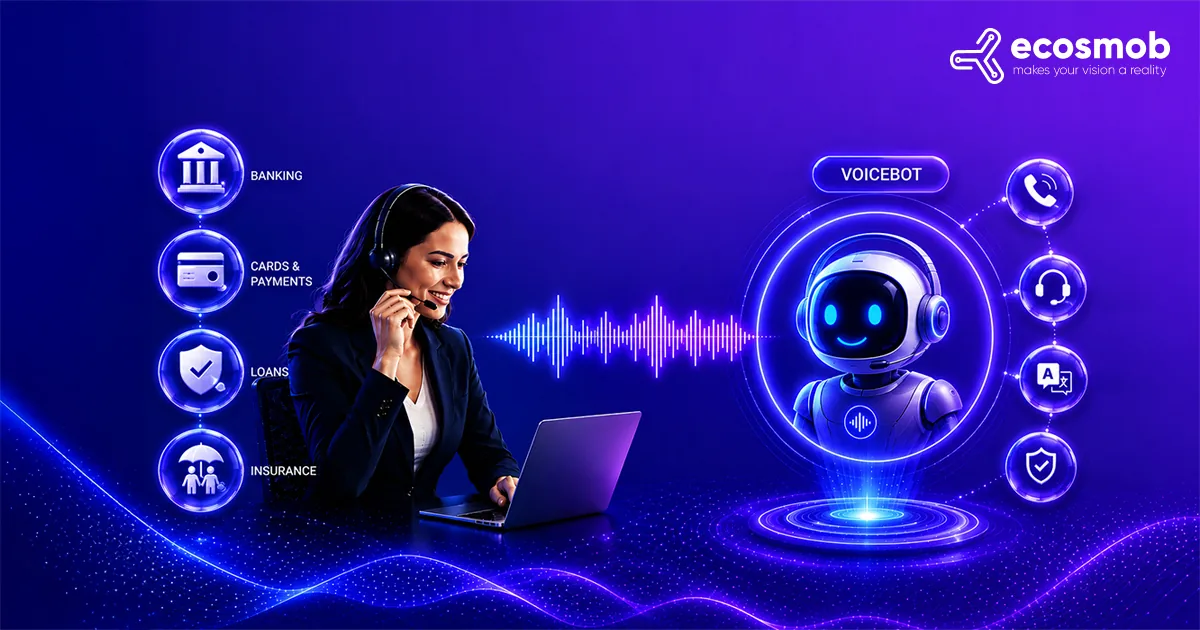
AI voicebots can handle routine, high-volume banking interactions through natural conversations, helping you reduce call-center workload while giving customers faster access to information and services.
1. Account and Transaction Inquiries
Customers can check account balances, recent transactions, account status, and other routine details without waiting for an agent.
2. Card Services
A voicebot can help customers report lost or stolen cards, check card status, request replacements, or get assistance with common card-related queries.
3. Loan and Mortgage Assistance
You can use AI voice agents for banking to answer loan inquiries, provide application updates, explain repayment schedules, and guide customers through basic loan processes.
4. Payment Reminders and Collections
Voicebots can make automated payment reminder calls, confirm payment information, and route customers to agents when a situation requires personalized assistance.
5. Fraud Alerts and Verification
When suspicious activity is detected, voice AI can notify customers, verify transactions, and direct high-risk cases to the appropriate banking team.
6. Customer Support
From product inquiries to service requests, custom voicebot solutions for intelligent customer conversations can resolve repetitive questions and provide 24/7 support without relying entirely on live agents.
7. Multilingual Banking Support
Banks can use voicebots to serve customers in multiple languages, making routine banking services more accessible across diverse customer groups.
Once you know where a voicebot fits, the next question is simpler: what should your banking voicebot be capable of?
What Features Should You Look for in a Voicebot for Banking?
The right AI voicebot for banking needs more than natural-sounding conversations. You should look for capabilities that help you deliver secure, reliable, and scalable customer interactions.
1. Natural Language Understanding
Your voicebot should understand different ways customers phrase the same request, handle follow-up questions, and maintain context throughout a conversation.
2. Banking System Integration
Look for seamless integration with your core banking systems, CRM, payment platforms, and other APIs. This allows your voicebot to access relevant information and complete tasks instead of simply answering questions.
3. Secure Authentication
Your voice AI in banking should support secure customer verification before handling sensitive account or transaction information. Authentication methods can include PINs, OTPs, voice biometrics, or existing banking authentication flows.
4. Human Agent Handoff
When a request is complex or sensitive, your voicebot should seamlessly transfer calls from the AI agent to human agents, keeping the relevant conversation context intact. This enables human escalation and helps transfer calls smoothly, so your customer does not have to repeat everything.
5. Multilingual Support
If you serve customers across different regions, support for multiple languages can make your AI voice agents for banking more accessible and useful.
6. Analytics and Monitoring
Your team should be able to track call outcomes, customer intents, resolution rates, failures, and other performance metrics to continuously improve the voicebot.
7. Scalability and Reliability
Choose a solution that can handle changing call volumes without compromising response time or call quality, especially during payment deadlines, outages, or sudden spikes in customer inquiries.
8. Security and Compliance Controls
Your voicebot should provide controls for data protection, call recording, access management, auditability, and other requirements relevant to your banking operations.
The next decision is whether to buy an existing platform, build a custom solution, or launch under your own brand.
Should You Buy, Build, or White Label an AI Voicebot for Banking?
The best approach depends on your timeline, customization needs, and compliance requirements. Buying works for faster deployment, white-labeling balances speed and flexibility, while custom development offers maximum control.
1. Off-the-Shelf Platforms
Pre-built AI voicebot platforms help organizations launch quickly with ready-made features and workflows. However, customization and deployment flexibility may be limited.
2. White-Label Solutions
White-label voicebots allow organizations to launch under their own brand while reducing development effort. They offer more flexibility than off-the-shelf platforms without the cost of building from scratch.
3. Custom Development
Custom AI voicebot development provides complete control over integrations, workflows, compliance controls, and deployment environments, including the flexibility to build a custom AI Voicebot connector for specialized systems. It is often preferred by banks and insurers with specialized operational requirements.
Which option is right for you?
| Option | Best for | Trade-off |
| Buy | Fast deployment | Less flexibility |
| White Label | Branding + faster launch | Moderate customization |
| Build | Full control | Higher investment |
The right choice comes down to how much speed, control, customization, and ownership you need.
Top 10 AI Voicebot Solutions for Banks
Here are 10 AI voicebot solutions that can support banking customer service, automation, and conversational experiences.
1. Ecosmob
Ecosmob provides custom AI voicebot solutions for banks that need tailored workflows, deep integration with core banking and telecom infrastructure, and flexible cloud, on-premises, or hybrid deployment.
2. Kore.ai
 Kore.ai offers an enterprise conversational AI platform with banking-focused use cases, workflow automation, omnichannel support, and analytics. It is suited to banks looking for prebuilt capabilities with room for enterprise customization.
3. Yellow.ai
Yellow.ai combines voice and digital conversational AI with multilingual support, workflow automation, CRM integrations, and analytics. It can suit banks seeking faster deployment across multiple customer-interaction channels.
4. Amelia
Amelia focuses on conversational AI and workflow automation for complex customer service operations. Its enterprise integrations and analytics capabilities can support banks handling high volumes of service interactions.
5. Cognigy
Cognigy combines voice AI with contact center automation, workflow orchestration, agent handoff, and real-time analytics. It is suited to banks that want to integrate conversational AI with existing customer service operations.
6. PolyAI
PolyAI takes a voice-first approach to conversational AI, helping automate customer service calls through natural-language interactions. Its focus on high-volume voice automation makes it relevant for banks prioritizing phone-based self-service.
7. Nuance
 Nuance provides enterprise conversational AI and speech technologies for customer self-service, authentication, and contact center automation. Its capabilities include advanced speech recognition, voice biometrics, and enterprise security controls.
8. IBM watsonx Assistant
 IBM Watson Assistant supports conversational AI across voice and digital channels, with workflow automation and enterprise integrations. It can be particularly relevant if your bank already operates within the IBM technology ecosystem.
9. Genesys Cloud AI
 Genesys Cloud AI combines AI-powered self-service with contact center automation, agent assistance, and customer journey analytics. It fits banks looking to connect voice automation with a broader contact center environment.
10. Five9 Genius AI
 Five9 Genius AI combines conversational AI, agent assistance, workflow automation, and contact center integration. It can help banks automate routine interactions while keeping human agents involved when additional support is needed.
Choosing a platform is only half the decision. The next step is understanding how we evaluated these.
How We Evaluated AI Voicebot Solutions for Banks
We evaluated each solution against the factors you need to consider when deploying voice AI in banking, including banking use cases, AI capabilities, integrations, security, scalability, and customization.
1. Banking Use Case Support
We assessed support for common banking use cases such as customer service, account inquiries, loan servicing, payment collections, and fraud-related interactions.
2. AI and Conversational Capabilities
We evaluated how well each platform understands intent, maintains context, and handles multi-turn conversations beyond rigid call flows.
3. Integration Capabilities
We reviewed integration with core banking platforms, voicebot integration with CRM systems, payment gateways, and contact center environments.
4. Compliance and Security
We considered data privacy, security controls, deployment flexibility, and requirements relevant to regulated banking environments.
5. Scalability and Deployment Options
We assessed deployment models, concurrent call handling, reliability, and the ability to support growing customer volumes.
6. Customization and White-Label Support
We examined flexibility for custom workflows, banking-specific requirements, branding, and white-label deployments.
These factors help you distinguish a feature-rich voicebot from one that is ready for real banking operations.
You now know what a voicebot in banking can do, what to look for, and how to evaluate your options. Let’s bring it together.
The Bottom Line?
A voicebot in banking can help you automate routine interactions, improve customer support, and connect voice experiences with your existing banking systems.
With expertise in VoIP, AI, and telecom infrastructure, Ecosmob, a custom VoIP development company, helps you build customized AI voicebot solutions around your banking workflows and integration needs.
The goal is simple: move from automated calls to more useful, natural customer conversations.
Frequently Asked Questions
The best AI for banking depends on your use cases, integration requirements, security needs, deployment model, and scalability goals. You should evaluate solutions based on how well they fit your existing banking infrastructure and customer service operations.
Yes, banks use voice recognition for customer authentication, identity verification, fraud prevention, and voice-based services. Voice recognition can help you verify customers and provide secure access to selected banking services through phone or digital channels.
Popular voice banking apps include banking applications that let customers use voice commands for tasks such as checking balances, reviewing transactions, and making inquiries. Availability and supported voice features vary by bank, application, and region.
Yes, a voicebot can access relevant customer information when securely connected to banking systems through APIs. Authentication and authorization controls should be applied before the voicebot retrieves or shares sensitive account information with your customer.
Voicebots are designed primarily to automate routine and repetitive interactions rather than replace bank call center agents completely. They can handle common requests and transfer complex, sensitive, or exception-based conversations to human agents when required.