Building an AI prototype on a laptop takes an afternoon. Getting that same system to hold a natural, sub-500-millisecond phone conversation across live carrier trunks without dropping calls or blowing up your cloud token budget is an entirely different story.
Most enterprise AI initiatives stall before ever reaching production because teams treat real-time voice like static text. Bridging that divide requires specialized AI consulting for real-time communication platforms with engineering advisory built specifically around the unforgiving physics of live telephony, packet jitter, and instant conversational turn-taking.
This exact gap is why engineering and product leaders are asking: what is AI consulting when applied to real-time communication?



Voicebot nailed the demo on Wi-Fi, but completely choked on a 4G cellular call?

What Is AI Consulting in Real-Time Communication?
AI consulting for real-time communication is specialized technical and strategic advisory that helps telecom carriers, contact centers, and communication platforms plan, architect, integrate, and scale artificial intelligence (across live voice, video, and messaging) without degrading call quality or breaking latency budgets.
Unlike a general AI consultancy that focuses on internal document search or back-office automation, RTC-focused AI consulting operates directly at the intersection of carrier telecommunications protocols and streaming machine learning.
It bridges low-level media transport (Session Initiation Protocol (SIP), Real-time Transport Protocol (RTP), and WebSockets) with real-time Automatic Speech Recognition (ASR), Large Language Models (LLMs), and Text-to-Speech (TTS) synthesis.
Strategy-Only vs. Build-and-Run AI Consulting
When evaluating AI consulting, you will encounter two distinct engagement models:
| Consulting Dimension | RTC AI Strategy Consulting | Build-and-Run RTC AI Consulting |
| Primary Output | Executive slide decks, vendor matrices, high-level ROI models | Production architecture, media bridges, deployed voice pipelines |
| Telephony Involvement | Reviews business requirements and call volume forecasts | Tunes FreeSWITCH/Kamailio, configures SIPREC media forks, optimizes codecs |
| Latency Ownership | Recommends target latency goals on paper | Engineers sub-500ms turn-taking and tunes Voice Activity Detection (VAD) |
| Post-Launch Support | Ends once the strategic roadmap is delivered | Provides 24/7 Network Operations Center (NOC) monitoring and drift prevention |
For RTC platforms, strategy without media-plane execution rarely survives live traffic. The highest-performing engagements follow a disciplined three-step loop:
- Assess existing telephony debt.
- Pilot a tightly scoped streaming pipeline on real trunks.
- Scale with automated observability and cost guardrails.
What AI Consulting Covers (Strategy, Architecture, and Governance)
Effective RTC AI strategy consulting covers far more than picking a foundation model. It aligns your network infrastructure, security compliance, and unit economics before a single customer dials in:
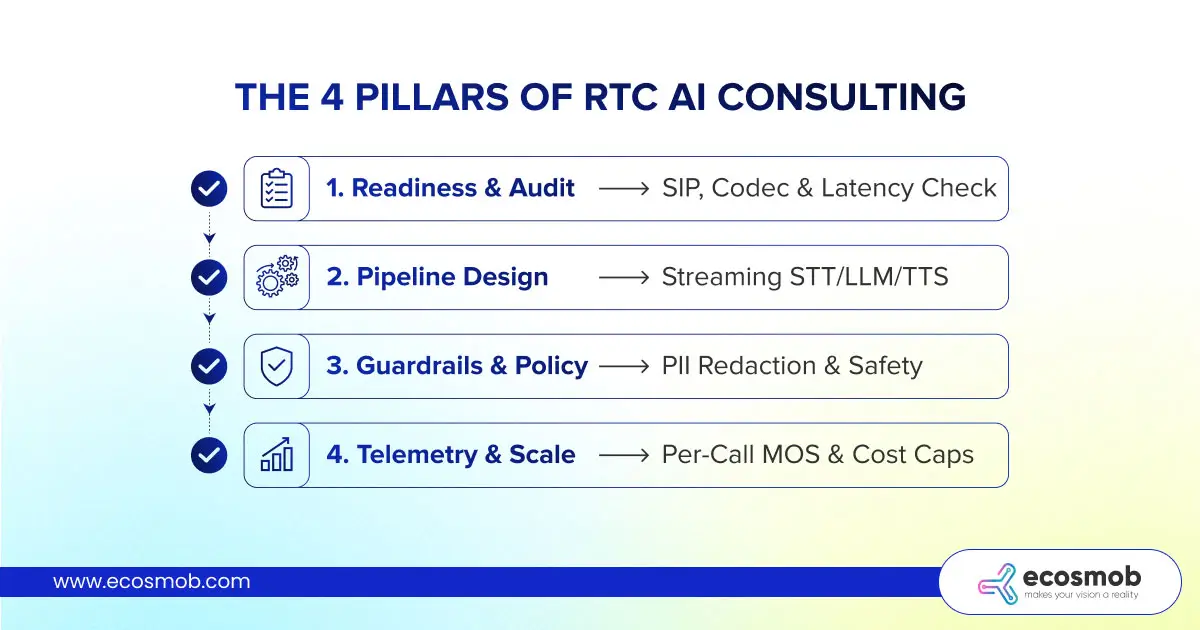
1. Infrastructure Readiness & Use-Case Prioritization
Auditing your Session Border Controllers (SBCs), Private Branch Exchanges (PBXs), and cloud trunks to verify whether they can stream full-duplex audio without packet drops, while ranking use cases by containment ROI.
2. Low-Latency Architecture Design
Replacing sluggish REST API polling with persistent WebSocket streams and model cascading (routing simple intents to fast, lightweight models and reserving heavy LLMs for complex reasoning).
3. Responsible AI, Compliance & Security
Designing deterministic guardrails so live bots never hallucinate pricing or policies, while enforcing strict Personally Identifiable Information (PII) redaction, HIPAA/GDPR compliance, and Lawful Intercept hooks.
4. Unit Economics & Cost Governance
Structuring prompt caching, token caps, and speech-to-text efficiency tuning so high call concurrency does not trigger runaway cloud bills.
What Does an AI Consultant Do for RTC Platforms?
While an AI engineer focuses strictly on writing model code, a specialized RTC AI consultant translates messy business and telecom constraints into working architecture.
They map out call-flow state machines, run live packet captures to isolate whether a 600ms delay comes from jitter buffers or LLM Time to First Token (TTFT), and establish release gates before production cutovers (backed by hands-on AI development services for real-time communication when it is time to ship production code).
AI Consulting Use Cases in Real-Time Communication
Enterprise adoption of AI for telecom and customer communications is accelerating rapidly, driven by measurable reductions in handle time and operational overhead. According to Gartner’s forecast on conversational AI in contact centers, conversational AI deployments within contact centers will reduce agent labor costs by $80 billion in 2026 as automation handles routine inquiries end-to-end.
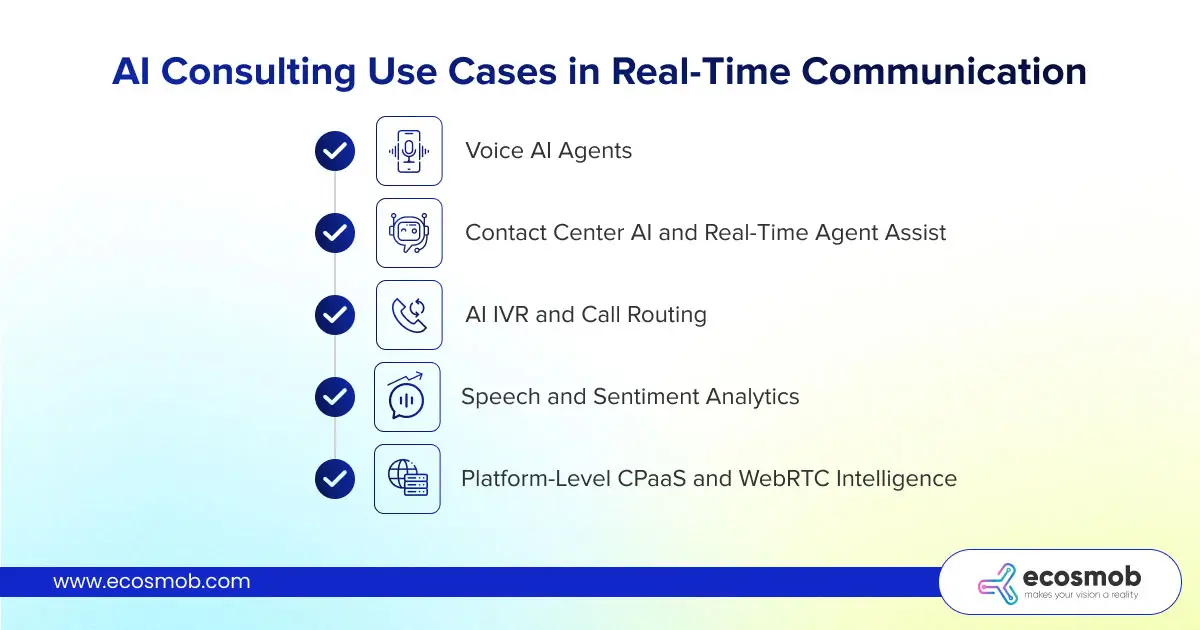
Here are the five highest-impact use cases consultancies implement today:
Voice AI Agents
Unlike rigid legacy phone trees that force callers through endless numeric menus, modern AI voicebot development enables autonomous voice AI agents to handle complex inbound and outbound conversations end-to-end.
They recognize natural phrasing, let callers interrupt mid-sentence without losing their place, and execute live CRM or billing transactions while keeping conversational pacing under half a second.
Contact Center AI and Real-Time Agent Assist
Transforming AI in contact center environments means equipping live representatives with split-second intelligence rather than making them dig across six browser tabs during a tense call.
By deploying real-time agent assist for contact centers, systems monitor dual-channel audio streams, track sudden topic switches on the fly, and surface objection rebuttals or compliance alerts on the rep’s screen in under 800 milliseconds (dramatically cutting after-call wrap-up times across high-volume AI in contact centers).
AI IVR and Call Routing
Legacy Interactive Voice Response (IVR) systems frustrate callers with endless “Press 1 for billing, Press 2 for support” menus. Upgrading to an AI IVR replaces rigid keypad trees with conversational intent routing.
Callers state their issue in plain language, and the system authenticates their identity, extracts key entities, and routes the call (along with full context) to the exact specialist queue needed.
Speech and Sentiment Analytics
Every customer call holds early warning signs of churn or compliance risk, yet most teams only audit a random 2% sample. Automated AI speech analytics scores 100% of live calls, using voice call sentiment analysis to detect caller frustration mid-conversation so supervisors can intervene before an account is lost.
Platform-Level CPaaS and WebRTC Intelligence
As raw voice and SMS margins tighten, cloud communication providers are baking native intelligence straight into their APIs and browser sessions.
Consultancies help providers roll out automated meeting transcription, live translation, and fraud screening by unlocking AI capabilities for CPaaS providers and building low-latency AI and WebRTC communication applications that expand traditional AI use cases in telecom.
Ecosmob Expert Tip
When a voicebot feels sluggish or keeps interrupting callers, most teams immediately rewrite their LLM system prompts or switch foundation models. Nine times out of ten, that solves nothing.
In real-time telephony, lag usually hides in the media layer: oversized audio chunk buffers, uncalibrated Voice Activity Detection (VAD) hangover timers, or forced G.711-to-Opus transcoding loops.
Always profile your SIP/RTP media path and WebSocket frame sizes before spending a dime on prompt engineering.
When Do You Need AI Consulting?
Not every project requires external AI business consulting. If your internal team is simply adding an asynchronous text summary feature to a web app using standard cloud APIs, you already have the tools you need.
However, bringing in specialized AI business consulting becomes critical when you spot these operational warning signs:
- Your Voice Pilot Stalled Before Production: Your voicebot works great in a quiet room over a laptop mic, but falls apart when real customers call from noisy highways over compressed 8kHz mobile networks.
- Turn-Taking Latency Exceeds 800 Milliseconds: Callers experience awkward dead air, repeat themselves, and collide with the bot’s delayed responses, and your developers cannot pinpoint which pipeline stage is causing the bottleneck.
- Legacy Telephony Integration Roadblocks: You need to connect modern streaming AI models to on-premises PBX hardware, proprietary Session Border Controllers, or unmanaged SIP trunks without ripping out your core network.
- Unpredictable Token and Carrier Costs: Your per-minute operating costs spike unpredictably under concurrent load because every conversational turn hits an expensive frontier LLM without caching or intent routing.
- Strict Regulatory and Security Mandates: You must deploy private, self-hosted models inside a Virtual Private Cloud (VPC) to satisfy HIPAA, PCI-DSS, or Lawful Intercept rules.
Before committing budget, run through an AI readiness assessment and align your engineering milestones with a proven AI adoption framework for real-time communications.
When you are ready to vet specific personnel and contract structures, check out our guide on how to hire an AI consultant for your RTC solution.

Tired of wasting sprints while your carrier SIP trunks and LLMs refuse to talk?
Why Choose Ecosmob as Your RTC AI Consultant?
Most consulting firms treat real-time communication as just another software integration. They know how to wire up Python APIs, but they have never debugged a dropped SIP ACK packet at 2:00 AM or tuned a FreeSWITCH jitter buffer under 5,000 concurrent calls.
At Ecosmob Technologies, we built our AI consultancy service from the media plane up. With nearly two decades of open-source telecommunications and carrier VoIP engineering behind us, our architects bridge the exact gap that generalist agencies struggle with:
- Deep Media & Signaling Mastery: Direct integration with FreeSWITCH, Asterisk, Kamailio, OpenSIPS, and WebRTC media servers.
- Sub-500ms Conversational Engineering: Full-duplex audio streaming, dynamic VAD calibration, and intelligent model cascading engineered for natural human pacing.
- 24/7 Telecom NOC & Reliability Ops: Per-call observability tracking Mean Opinion Scores (MOS), packet loss, and model drift, backed by carrier-grade SLAs.
If you are comparing vendors across the broader market, explore our breakdown of the top AI consulting companies for RTC.
When you are ready to move past stalled pilots and wire carrier-grade intelligence directly into your live network, contact Ecosmob to map out your deployment with our telecom architects!
Frequently Asked Questions
AI consulting for RTC is specialized technical and strategic advisory that helps telecom providers, contact centers, and communication platforms design, integrate, and scale AI across live voice, video, and messaging networks. It focuses on connecting streaming speech and language models to telephony protocols (SIP/RTP/WebRTC) while maintaining sub-500ms conversational latency and carrier-grade reliability.
Communication teams turn to specialized AI consulting because generic web engineers rarely possess low-level telephony expertise. Integrating AI into live phone calls introduces complex challenges (such as narrowband 8kHz audio distortion, packet jitter, barge-in interruption handling, and runaway token costs) that require veteran telecom and AI systems architects to solve.
An RTC AI consultant audits existing telephony infrastructure, prioritizes high-ROI automation use cases, designs low-latency streaming pipelines (STT, LLM, TTS), establishes safety and PII-redaction guardrails, and benchmarks end-to-end call quality (MOS and turn-taking latency) before production launch.
While large global firms handle broad enterprise IT transformations, specialized telecom engineering consultancies like Ecosmob Technologies focus specifically on real-time communication.
We combine nearly 20 years of carrier VoIP, FreeSWITCH, Kamailio, and WebRTC expertise with modern conversational AI engineering to deliver sub-500ms voice pipelines.
AI strategy consulting focuses on high-level roadmaps, feasibility studies, and vendor selection. Build-and-run consulting goes further by embedding hands-on engineers to write the media-plane connectors, integrate the speech and language models, stress-test concurrency, and monitor live production performance.