
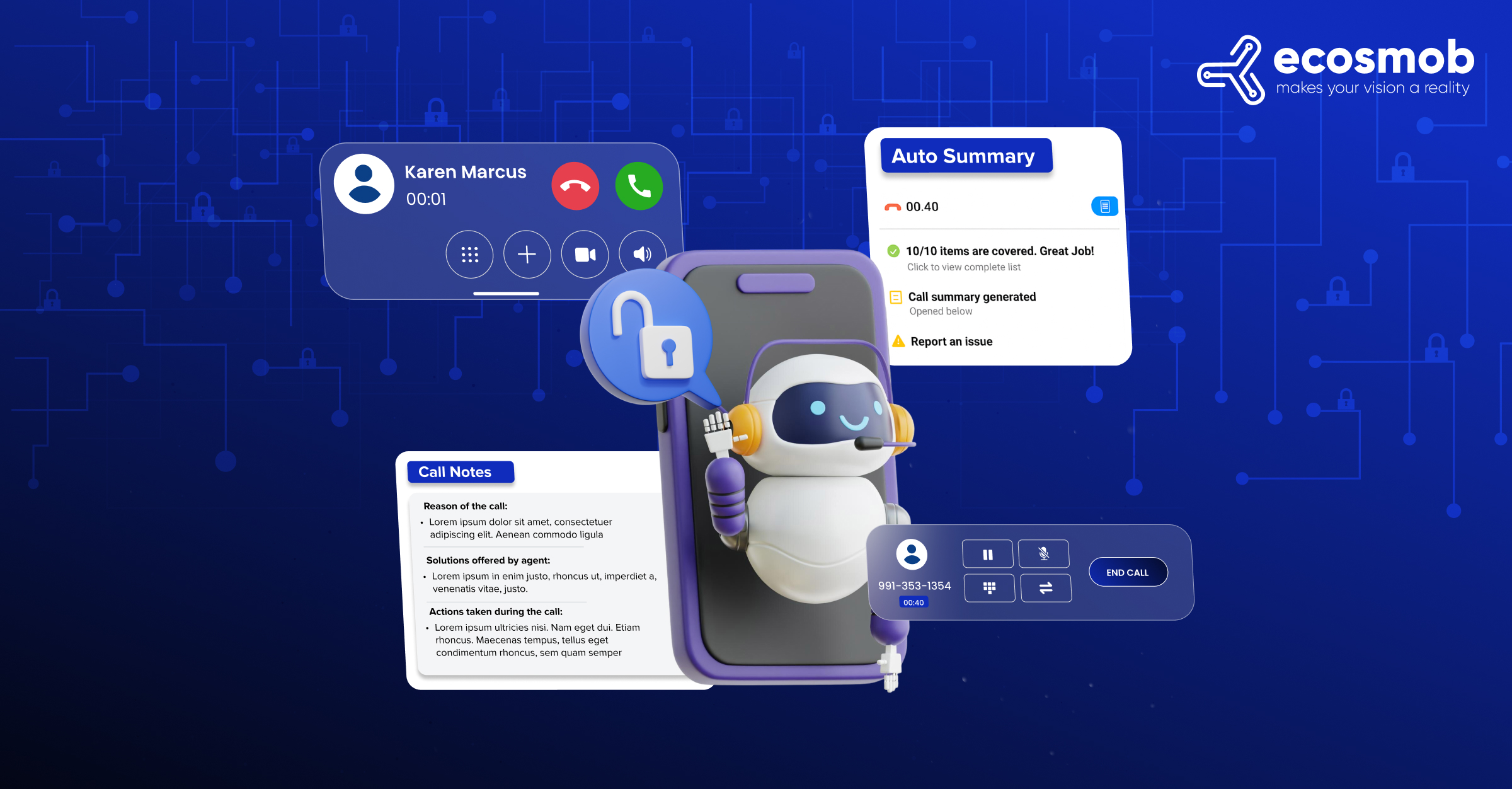
AI in contact center is rapidly becoming essential for modern customer service. Businesses that fail to adopt AI face rising operational costs, slower response times, and declining customer satisfaction. By implementing AI strategically, organizations can automate workflows, enhance agent productivity, and deliver faster, more personalized customer experiences.
Every CFO fears wasted money. But here’s the tricky part!
In contact centers, the money doesn’t always leak from big-ticket items; it drips away through inefficiency. Longer calls, extra hires to handle volume, and rising turnover.
That’s where AI contact center solutions were designed to make a difference, streamlining tasks and keeping operations lean. Yet when there’s a slow rollout of AI for contact centers, the savings don’t materialize.
Instead, hidden costs quietly pile up, chipping away at profitability month after month. And by the time leadership notices, the damage has already been done.
So, where do those hidden costs show up first?
Let’s start with impact, the metric every boardroom watches closest.
Did You Know?
By 2026, conversational AI is expected to save contact centers around USD 80 billion in labor costs.
How Does Delaying AI Adoption Impact Contact Center Profitability?
 Contact centers today aren’t just answering machines for customers; they’re the heartbeat of brand loyalty. And here’s where the conversation shifts: the role of AI in contact centers is no longer optional; it’s inevitable.
Profitability in contact centers is a balancing act: keeping operational costs low while maximizing customer-driven revenue. Delaying the automation of AI in contact centers disrupts both sides of this equation.
That hesitation comes with a price tag. The longer businesses delay, the greater their risk of losing money, customers, and ground in the competition.
Here’s how that plays out on the front lines:
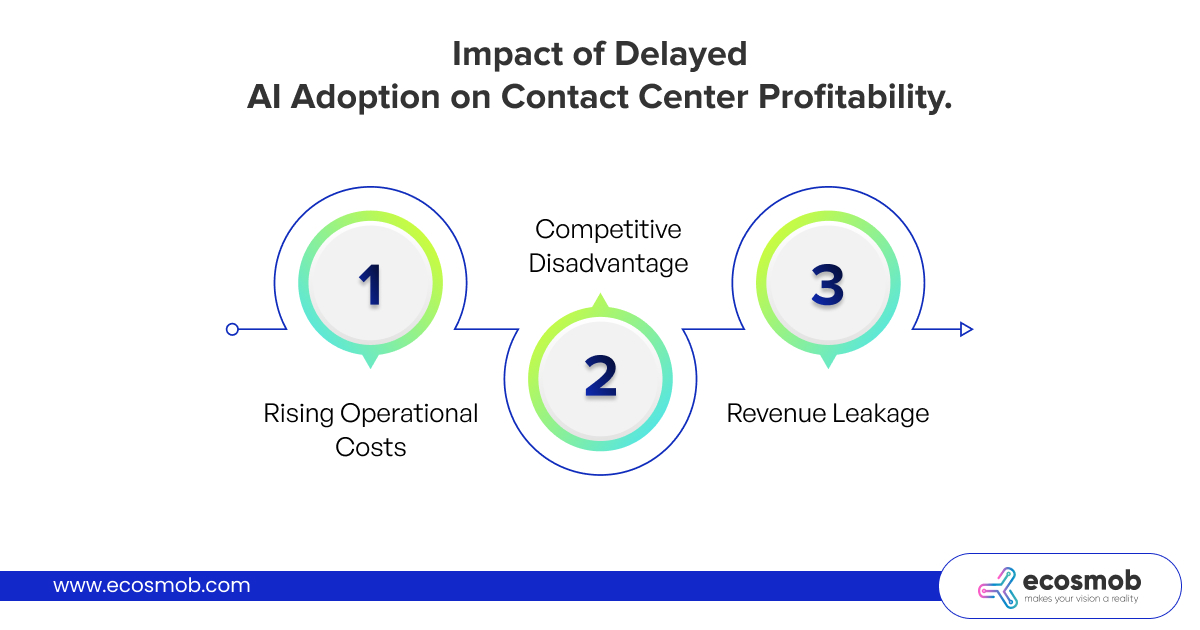
1. Rising Operational Costs
Without AI automation, contact centers remain dependent on manual workflows, from call routing and data entry to ticket tagging and report generation. This increases agent workload, prolongs handle times, and drives up labor expenses.
2. Competitive Disadvantage
While you wait, competitors implementing AI for contact centers gain structural savings. They reinvest those savings into extended hours, better tools, or improved wages, strengthening their customer experience while your costs remain static.
3. Revenue Leakage
Customers today expect sub-30-second response times across voice, chat, and social. When you delay AI, response cycles stay slow. Run a profitability simulation. Compare AHT, churn, and cost per contact with and without AI. In most cases, the cost of delaying AI even a year outweighs the cost of full adoption.
But profit isn’t the only casualty. What happens when your customers feel the lag?
15 Proven AI Use Cases in Contact Centers
AI isn’t just a buzzword in contact centers anymore — it’s doing real work. From answering customer calls to coaching agents in real time, AI is actively solving problems that contact centers have struggled with for decades.
Here are 15 proven use cases showing exactly what changes when AI enters the picture.
1 . AI Virtual Agents & Chatbots
AI-powered virtual agents resolve routine questions like order tracking, password resets, and address updates instantly across voice, chat, SMS, and WhatsApp, around the clock. Customers get answers in seconds instead of waiting in long queues. Human agents only handle the conversations that truly need them. Wait times drop, costs shrink, and customer satisfaction climbs. AI-powered virtual agents resolve routine questions like order tracking, password resets, and address updates instantly across voice, chat, SMS, and WhatsApp, including WhatsApp AI, around the clock. Businesses can further enhance customer support by integrating the best WhatsApp chatbots to deliver faster, more personalized, and always-available assistance.
2. Intelligent Interaction Routing
AI reads the customer’s intent, history, sentiment, and language in milliseconds then connects them to the exact right agent on the first try. A billing dispute goes to a billing specialist. A frustrated VIP customer goes to a senior agent trained in de-escalation. Fewer transfers, faster fixes, happier customers.
3. Real-Time Agent Assist
AI listens to the live conversation and instantly surfaces relevant answers, suggests next steps, and flags compliance reminders right on the agent’s screen. No hold time, no guessing, no waiting for a supervisor. New hires and experienced agents alike perform at their best because the right information appears exactly when they need it.
4. Live Sentiment Detection
AI tracks vocal tone, word choice, and speaking pace in real time during every customer interaction. The moment frustration spikes, supervisors get an instant alert. They can jump in, coach the agent mid-call, or take over before a small issue becomes a lost customer. Problems are caught in seconds, not days.
5. Automated Quality Management (Auto-QA)
AI evaluates 100% of all interactions voice, chat, and email against your exact quality criteria. Every conversation is scored for accuracy, compliance, tone, and resolution. Supervisors see patterns instantly, coach with precision, and catch compliance risks before auditors do. No more relying on random 1–2% call sampling.
6. Automated After-Call Work
AI generates a complete, accurate call summary the moment the conversation ends. It updates the CRM, tags the ticket, and queues follow-up actions automatically. Agents move to the next customer immediately instead of spending 5–10 minutes on manual notes. Records are cleaner, nothing gets missed, and the next agent who handles that customer has full context.
7. Conversational IVR
Customers simply say what they need “I need to change my flight” or “My payment didn’t go through.” AI understands, responds naturally, and either resolves the issue or routes directly to the right place. No rigid menus, no button-pressing, no frustration. Just a natural conversation that gets customers where they need to go.
8. Omnichannel Context Preservation
AI carries the full conversation history including transcripts, intent, and what’s already been tried across every channel seamlessly. When a customer switches from chatbot to phone call, the agent sees everything. The conversation continues exactly where it left off. Zero repetition, zero frustration — no matter how many times the customer switches channels.
9. Predictive Analytics & Demand Forecasting
AI analyzes historical patterns, real-time signals, and external factors holidays, product launches, weather events, outages to predict exactly what’s coming. Managers know how many agents they’ll need, which skills are required, and what issues will trend days or weeks before it happens. No more scrambling when volume spikes hit unexpectedly.
10. Real-Time Compliance Monitoring
AI monitors every interaction live. If an agent misses a required disclosure or skips an authentication step, the system prompts them instantly during the call, not after. Post-call, AI flags remaining risks for review. Contact centers shift from hoping they’re compliant to knowing it on every single call.
11. AI-Powered Agent Coaching
AI analyzes every agent’s conversations and automatically generates personalized coaching insights highlighting exactly what to improve, what they’re doing well, and what training they need next. Some systems deliver daily coaching packets directly to each agent. Ramp-up time for new hires drops dramatically, and experienced agents keep growing without waiting for a supervisor’s calendar to open up. Some systems deliver daily coaching packets directly to each agent and include a calendar maker for scheduling coaching sessions, training plans, and follow-ups.
12. Proactive Customer Outreach
AI identifies the right customer, the right message, the right channel, and the right time then reaches out automatically. Appointment reminders go via SMS. Payment alerts go via voice. Renewal offers go via email. Businesses can also pair outreach automation with a social media post generator to keep customer communication consistent across digital channels. When customers respond, AI handles the conversation. Outreach becomes helpful, timely, and personal instead of generic mass blasts that get ignored.
13. Revenue & Sales Signal Detection
AI listens for buying signals, competitor mentions, and upsell opportunities in every conversation. It alerts the agent in real time with a suggested offer or next step. Support interactions quietly become revenue opportunities. The contact center transforms from cost center to growth engine without a single pushy sales pitch.
14. Multilingual Support at Scale
AI voice agents and chatbots communicate fluently in 30+ languages with real-time translation, accent handling, and cultural awareness. A customer in Tokyo, São Paulo, or Berlin gets the same instant, high-quality experience without the contact center needing a single multilingual agent for that language. Global support becomes scalable overnight.
15. AI-Optimized Workforce Management
AI builds optimized schedules automatically based on predicted volumes, agent skills, performance history, and individual preferences. When conditions change mid-day, it adjusts in real time. Unexpected spike? Extra agents are activated. Quiet afternoon? Staffing scales down. Agents get fairer schedules, managers save hours, and the contact center runs at peak efficiency every hour of every day.
How Can Slow AI Implementation Affect Customer Satisfaction Scores?
CSAT (Customer Satisfaction) and NPS (Net Promoter Score) are the lifeblood of brand loyalty. Slow AI rollout chips away at both. In modern contact centers, customer satisfaction is directly tied to response speed, personalization, and resolution quality, all of which depend heavily on AI-driven automation.
The truth is simple: the cost of waiting on AI for contact centers is far greater than the investment itself.
Here’s how that slow AI implementation is reflected in real-world performance:
1. Slower Response & Resolution Times
Without AI chatbots and self-service, customers wait longer. Even a 90-second increase in wait time can significantly impact your CSAT. AI can instantly deflect repetitive queries, freeing human agents for complex issues.
2. Inconsistent Experiences
AI standardizes quality by offering real-time prompts, knowledge-base suggestions, and compliance nudges. Without it, experiences vary wildly between agents. Customers notice.
3. Repetition Fatigue
Few things frustrate customers more than having to repeat themselves. AI in contact centers integrates data across channels, so customers don’t have to start from scratch each time. Without this, CES (Customer Effort Score) takes a hit.
Customer trust takes a hit, but that’s just one side of the equation.
Let’s talk about the hidden costs of moving too slowly.
What are the Hidden Costs of Delaying Automation in Call Centers?
The scariest part of delaying AI isn’t the obvious costs; it’s the hidden ones that bleed budgets silently. Below are the aspects that you probably missed out on:
1. High Agent Attrition
Agents stuck with repetitive work (password resets, basic queries) burn out fast. AI removes that burden, keeping morale higher. Every replacement can cost up to $10k–20k in recruitment and training. Delaying AI = paying that bill over and over.
2. Lost Revenue Opportunities
AI sentiment analysis flags when a customer is open to upselling. Without it, countless upsell and cross-sell opportunities disappear. For sales-driven centers, that’s money slipping through the cracks.
3. Integration Debt
Legacy systems age quickly. The longer you wait, the more brittle your stack becomes, and the harder (and more expensive) it is to integrate modern AI. This “integration debt” compounds every year AI is postponed.
4. Abandoned Calls
Every abandoned call (when customers hang up due to wait times) is both a cost and a lost opportunity. Virtual AI agents can absorb peak call spikes. Without them, abandonment rates rise and loyalty erodes.
Build a cost-of-delay model that factors attrition, churn, missed revenue, and integration challenges, present AI as a cost-avoidance strategy, not just a shiny upgrade.
Therefore, it’s crucial to use AI Voice Agents to boost contact center productivity. If slow adoption is expensive, the obvious question is, how do you speed it up without breaking things?
Let’s understand it.
What are the Best Practices for Accelerating AI Rollout in Contact Centers?
From managing call volumes to predicting customer moods, AI is reshaping how modern contact centers operate. Yet many organizations still hesitate.
Rushing headfirst into AI isn’t the answer. The smartest path lies in a structured, incremental rollout.
Here are some of the best AI Call center practices for fast, effective AI Deployment:
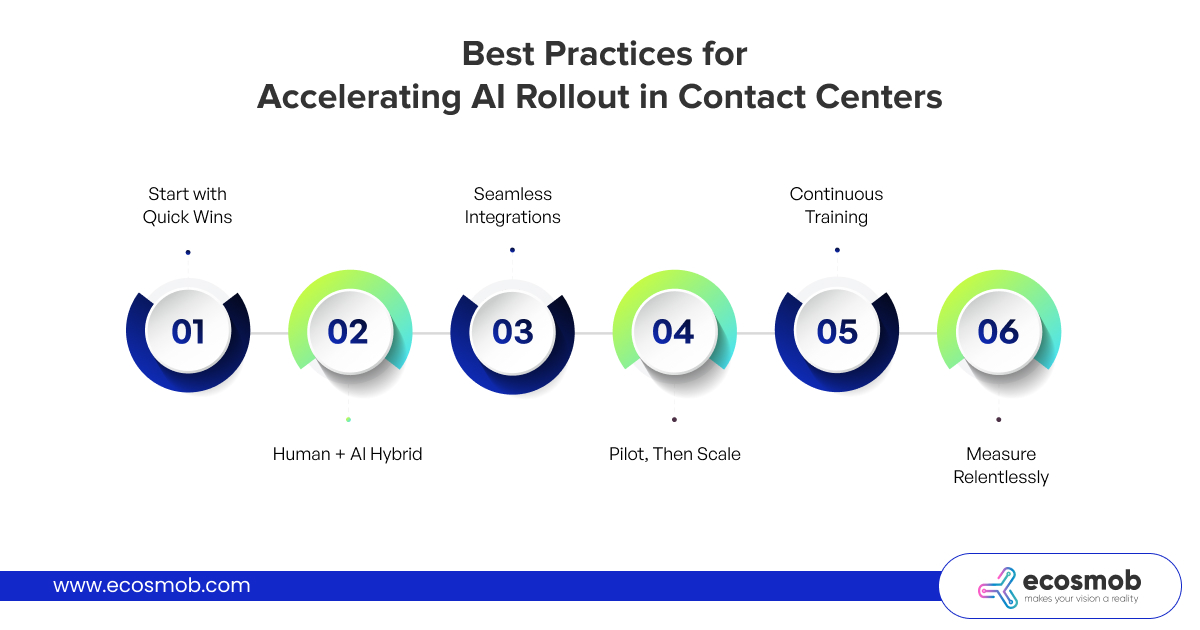
- Start with Quick Wins – Deploy AI that creates instant impact, like chatbots, call summaries, and intelligent routing, to prove value early.
- Human + AI Hybrid – Let AI handle routine Tier-1 queries while agents focus on empathy and complex issues for balanced efficiency.
- Seamless Integrations – Don’t leave AI in silos. Connect it with CRMs, ticketing systems, and even advanced VoIP billing systems so data flows across the ecosystem.
- Pilot, Then Scale – Roll out AI in one department, learn, then expand. Early wins fuel executive buy-in.
- Continuous Training – Agents should see AI as a partner, not a threat. Ongoing training ensures adoption sticks.
- Measure Relentlessly – Track AHT, FCR, CSAT, and agent productivity weekly during rollout. Adjust quickly.
Successful AI adoption also depends on aligning technology with broader go-to-market priorities rather than treating it as a standalone initiative. Frameworks such as GTM AI can help organizations connect AI implementation with customer experience, operational goals, and measurable business outcomes, making adoption more strategic and sustainable.
Here’s your 90-Day AI Rollout Plan:
| Day Range | Action / Initiative | Goal / Outcome |
| Days 1–30 | Deploy AI chatbot for FAQs + auto-call summarization | Reduce repetitive queries, speed up responses |
| Days 31–60 | Integrate AI with CRM for faster customer history retrieval | Enable agents to access customer data instantly, improve first-contact resolution |
| Days 61–90 | Roll out real-time coaching and AI routing | Provide agents with live guidance, optimize call routing, and enhance overall efficiency |
| End of 90 Days | Measure gains in AHT, CSAT, and agent productivity | Evaluate impact, quantify improvements, and plan next steps |
Break AI adoption into phases to avoid overwhelm. Demonstrate ROI quickly with “low-hanging fruit” before scaling deeper capabilities. Rolling out AI faster is one thing, but how do you actually prove it’s working?
It’s easy, let’s understand.
How Do We Measure AI-Driven ROI in Contact Centers?
Measuring ROI from AI in contact centers isn’t just about crunching numbers on a spreadsheet. It’s about connecting technology improvements to real, human outcomes, both for customers and for agents.
Here’s how you can frame ROI without getting lost in decimals:
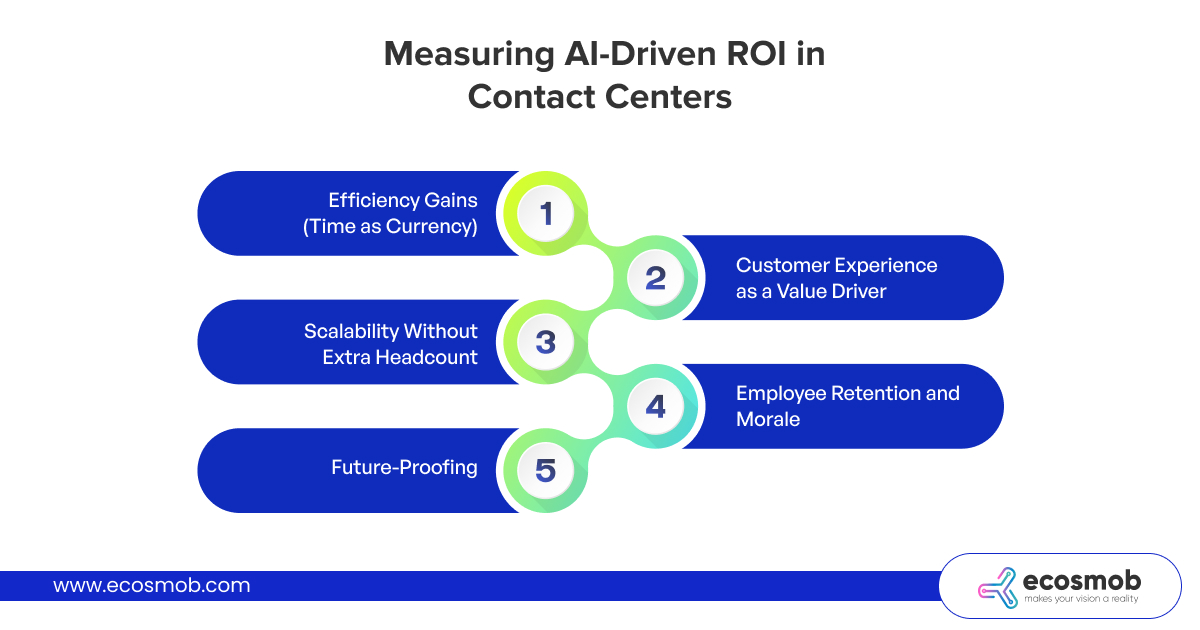 1. Efficiency Gains (Time as Currency)
The most straightforward ROI is the time your team gets back. AI in contact centers automates repetitive tasks such as verifying account details, routing calls, and handling FAQs. Instead of agents burning minutes on low-value work, they spend that time solving complex issues. The ROI shows up as reduced call handling times and fewer escalations, both of which free up your human talent for the conversations that actually matter.
2. Customer Experience as a Value Driver
AI for contact centers pays off when customers feel heard, not hurried. Faster resolutions, proactive updates, and consistent answers turn frustration into loyalty. While you may not attach a dollar amount to every “thank you” a customer says, you can measure ROI by tracking how AI lifts your CSAT, NPS, or customer retention rates over time. The longer customers stay with you, the stronger the return on investment.
3. Scalability Without Extra Headcount
In the past, scaling meant more agents, more desks, and more budget. AI flips that equation. A well-trained virtual assistant can handle thousands of interactions at once, something no human team could match without doubling payroll. The ROI here is clear: growth without proportional costs.
4. Employee Retention and Morale
AI doesn’t just help customers, it helps your people. When repetitive questions don’t bog down agents, their jobs become more engaging. Happier employees tend to stay longer, reducing costly turnover and retraining costs. That’s ROI hiding in plain sight.
5. Future-Proofing
Finally, ROI isn’t always immediate. Think of AI as planting seeds. Each process automated today is one less bottleneck tomorrow. Each dataset trained today makes your AI smarter for the next challenge. That long-term readiness is a form of ROI that keeps paying back as market expectations evolve.
Closing Thought
Here’s the real question: can you afford not to adopt AI? The cost of waiting isn’t abstract. It’s higher churn, wasted labor, missed revenue, and mounting integration debt. Competitors embracing AI for contact centers today are building efficiency, loyalty, and profit that late adopters may never catch up to.
The smarter move?
Start small, measure fast, and scale confidently. Because the hidden cost of delay isn’t just dollars, it’s your competitive edge.
AI in contact centers isn’t just a technology upgrade; it’s a way to transform your customer experience, empower your agents, and safeguard your profitability. If your contact center is ready to move faster, smarter, and more efficiently, Ecosmob can help you make it happen.
Let’s explore how AI for contact centers can optimize workflows and drive tangible outcomes for your business. Talk to Ecosmob Today!
Frequently Asked Questions
AI automates repetitive tasks like call routing, data entry, and FAQs, helping agents focus on complex issues and reducing overall handle time.
Delaying AI leads to higher operational costs, slower response times, and lower customer satisfaction, ultimately hurting profitability.
Yes. AI handles routine queries, easing agent workload and improving job satisfaction, which lowers attrition rates.
ROI can be tracked through metrics like reduced average handle time (AHT), higher CSAT scores, improved agent productivity, and lower churn.
Begin with quick wins, like chatbots and call summarization, then integrate with CRMs and scale gradually for maximum impact.