
Let’s be honest about managing a contact center: looking at historical dashboard metrics at the end of the week is like reading a post-mortem report. It tells you exactly where things went wrong, but it does absolutely nothing to save the customer who is currently frustrated on an active line.
If your supervisors can’t see, hear, and interact with live conversations as they happen, you are managing blindly.
A modern live call monitoring solution changes the game entirely. It moves your quality assurance (QA) from a reactive, historical chore to a real-time intervention strategy. But if you are a technical leader or a telecom product manager, you don’t just need a list of high-level management benefits. You need to know how these systems actually handle real-time audio streams, how they interface with open-source engines like Asterisk, and how to scale them without introducing latency or breaking compliance rules.
Let’s break down everything you need to know about real-time monitoring infrastructure in 2026.
What is Live Call Monitoring?
A live call monitoring solution is a software capability that allows supervisors to listen to active phone conversations, whisper coaching tips to agents, or barge directly into calls in real time. It serves as the core framework for quality control, regulatory compliance, and live agent training in modern contact centers.
Operational Benefits of Live Call Monitoring
The operational benefits of call center live monitoring revolve around active risk mitigation, immediate escalations, and structural cost containment. While static call recordings allow you to analyze past failures, real-time monitoring turns your supervisor tier into an active line of defense.
Implementing real-time monitoring across your telephony architecture unlocks three critical operational advantages:
- Slashed Average Handle Time (AHT) and Customer Churn: When agents fumble through complex scripts or legacy software systems, call times skyrocket. Live whispering allows a supervisor to act as an immediate human co-pilot, feeding the agent technical answers or system paths on the fly. This prevents dead air, reduces lengthy customer holds, and reduces frustration-driven churn.
- Proactive Compliance and Leak Protection: In highly regulated verticals (such as BFSI and healthcare), an unvetted live agent is a multi-million-dollar liability. Live monitoring enables compliance officers to audit active calls for mandatory scripts (such as HIPAA disclosures or loan term disclosures) and immediately use call barging to intervene before a catastrophic regulatory breach occurs.
- Instant First-Call Resolution (FCR) Elevation: Instead of scheduling a follow-up call when an agent encounters an obstacle, a manager can barge into the live SIP session, resolve the issue directly with the customer, and close out the ticket in a single interaction.
What Is the Difference Between Call Monitoring, Whispering, and Barging?
The difference between call monitoring, whispering, and barging lies entirely in how the audio packets are routed between the customer, the agent, and the supervisor.
While a manager sees these simply as three distinct buttons on a dashboard, a telecom engineer views them as separate real-time transport protocol (RTP) stream configurations. Understanding this distinction is crucial when building or scaling a call center live monitoring setup.
1. Call Monitoring (Silent Listening)
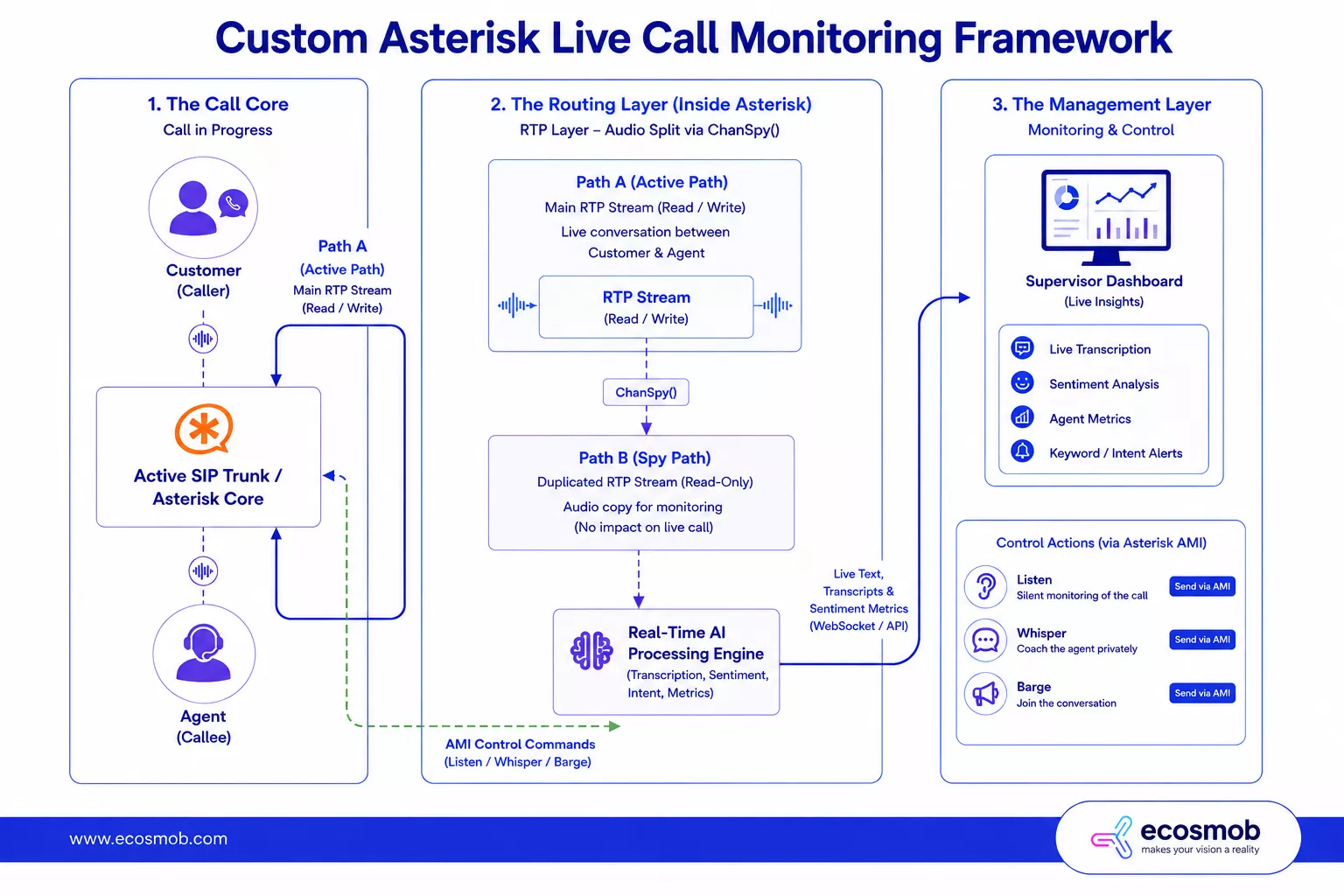
In this mode, the supervisor acts as a passive, invisible observer. The system taps into the active conversation and duplicates the audio packets, routing a read-only stream to the supervisor’s headset. Neither the agent nor the customer can hear the supervisor, allowing for pure, unadulterated quality auditing.
2. Call Whispering
This is the ultimate real-time coaching tool. The audio pipeline is dynamically split so that the supervisor can hear both parties, but the supervisor’s microphone input is routed strictly to the agent’s audio channel. The customer remains completely unaware that a third party is speaking, preventing any awkwardness while the agent receives live guidance.
3. Call Barging
When a call is spiraling out of control or an agent is stuck in a complex compliance deadlock, the supervisor hits the barge button. This action instantly converts a standard two-party call into a three-way conference call. All three participants can hear each other, allowing the supervisor to take complete control of the conversation and resolve the issue on the spot.
RTP Audio Stream Routing Matrix
| Monitoring Mode | Can Supervisor Hear Customer? | Can Supervisor Hear Agent? | Can Supervisor Hear Agent? | Can Customer Hear Supervisor? |
| Silent Monitoring | Yes | Yes | No | No |
| Call Whispering | Yes | Yes | Yes | No |
| Call Barging | Yes | Yes | Yes | Yes |
How Does Asterisk Support Live Call Monitoring?
Asterisk supports live call monitoring natively through highly efficient internal application modules (primarily ChanSpy and the Asterisk Manager Interface (AMI)), which manipulate audio channels directly at the core engine level.
If your team is evaluating an Asterisk live call monitoring deployment, you aren’t stuck buying restrictive SaaS user licenses. You have full access to the underlying telecom plumbing:
- The ChanSpy Application: This is the workhorse of Asterisk monitoring. By executing the ChanSpy() application within your dialplan, you tell Asterisk to target a specific active channel. Adding options like w enables whispering, while B enables barging.
- AMI and ARI Control: The Asterisk Manager Interface (AMI) and Asterisk Restful Interface (ARI) allow your developers to trigger these spy sessions programmatically via external software applications. A supervisor clicks a button on a web page, an AMI action is fired, and Asterisk immediately links the supervisor’s SIP channel to the agent’s active call.
Ecosmob Expert Tip
Scaling Oversight via AI-Assisted Monitoring
A major technical gap in standard contact center setups is human bandwidth; a team of five supervisors cannot listen to 500 simultaneous active calls. This is where AI-assisted live monitoring bridges the operational divide.
Instead of a human sitting on a ChanSpy session waiting for an error, modern custom architectures pipe duplicate real-time RTP audio streams through low-latency AI pipelines (such as the Whisper or Deepgram APIs) that run concurrently in the background.
- Real-Time Sentiment Tracking: The AI listens to both channels, measuring voice modulation and phrasing. If the customer’s sentiment score drops rapidly into a “critical frustration” zone, the system triggers an automated webhook to a supervisor’s dashboard, prompting them to open a live whisper session immediately.
- Automated Redaction Alerts: If an agent forgets to trigger a pause API when a customer begins reading a PCI-regulated credit card or a CVV code, the AI detects the pattern in real time, immediately masks the audio stream going to the live listener, and flags the timestamp for automated scrubbing.
Talk to Our Asterisk Experts!
Why Boxed SaaS Solutions Fail in High-Volume, Complex Ecosystems
Choosing between an off-the-shelf SaaS monitoring tool and a custom-built Asterisk solution depends entirely on your compliance needs, infrastructure complexity, and scaling economics. While boxed software offers speed, custom engineering provides ultimate data sovereignty and financial control.
Off-the-shelf software tools are designed for uniform, low-complexity environments. The moment your contact center introduces legacy on-premise components, proprietary CRMs, or multi-site dynamic routing logic, packaged software breaks down. Custom Asterisk-native monitoring solutions outperform boxed SaaS tools for three fundamental reasons:
1. Elimination of SIP Forking Latency: Many third-party SaaS monitoring tools require you to fork your SIP signaling to an external cloud platform to run their listening features. This adds massive network travel distance, causing severe audio delay and packet drops. A custom solution taps the RTP streams natively inside your local Asterisk instance, introducing zero network latency.
2. Unrestricted API Freedom: With a SaaS platform, you are completely limited by their pre-built UI and strict API rate limits. If you build your own monitoring core, your developers can link Asterisk AMI hooks directly to any custom internal portal, seamlessly trigger localized screen-recording streams, and automate routing rules based on your exact proprietary operational flows.
3. Total Cost Optimization at Scale: SaaS providers charge a premium per-user license for every supervisor seat. In an enterprise contact center with hundreds of QA managers, this turns an administrative tool into a massive monthly financial drain. With an open-source, custom-developed architecture, your software cost is flat; you own the intellectual property completely and only pay for raw infrastructure compute.
Can Supervisors Monitor Omnichannel Interactions?
Supervisors can absolutely monitor both live voice calls and active digital chat sessions simultaneously from a single, unified interface. Modern customer behavior demands an omnichannel approach, which is why a complete live call-monitoring solution must extend beyond traditional telephony.
A high-priority industry trend highlights the demand for environments in which contact center software supervisors can monitor live calls and chat sessions from a unified dashboard. At the engineering layer, this requires merging your real-time WebSocket connections (which stream live web chat text pixel-by-pixel) with your RTP audio packets.
By unifying these pipelines, a manager can review a live screen-share, track a WhatsApp chat session, and listen to a phone call simultaneously, providing complete oversight across every customer touchpoint.
Is Live Call Monitoring Legal?
Yes, live call monitoring is legal globally, but its execution is strictly bound by regional data privacy frameworks, wiretapping laws, and explicit disclosure requirements. You cannot deploy these tools in a legal vacuum. Your architecture and operations must satisfy these primary compliance pillars:
- One-Party vs. Two-Party Consent: In jurisdictions like the US (state-by-state rules) and the UK, you must ensure your system plays a compliant call-recording disclaimer (e.g., “This call may be monitored or recorded for quality purposes”) before the audio channels are established.
- Data Protection Mandates (GDPR, HIPAA, PCI-DSS): If your supervisors are silently listening while a customer reads a credit card number or health history, that data is traversing your internal network in real time. Your monitoring system must support automatic mute/pause APIs that block the supervisor’s audio stream and scrub call recordings during sensitive data-entry moments.
Relying on old-school, static call recording (where managers manually review a tiny sample of random audio files days after the fact) is a silent budget drain.
If an agent misinterprets a policy, inputs incorrect data, or fails to de-escalate an angry user, the damage is done long before a quality analyst ever listens to the tape. This lag leads to ballooning customer churn, high repeat call volume, and massive compliance risks.
By shifting to an active, live call-monitoring solution, you stop diagnosing post-mortem errors and start preventing them in real time.
Need help auditing your routing paths, implementing strict TLS/SRTP encryption, and building automated compliance controls into your monitoring platform?
Frequently Asked Questions
It is a real-time software capability that allows supervisors to listen to active agent-customer calls, whisper private coaching notes to the agent, or barge directly into the conversation to handle critical escalations or compliance errors instantly.
Call whispering works by programmatically splitting the real-time audio channels. The supervisor’s voice stream is mixed exclusively into the agent’s inbound audio path. The system purposefully isolates this stream from the customer’s outbound audio path, keeping the supervisor invisible to the caller.
Call monitoring is completely silent, passive listening where neither party hears the supervisor. Call whispering lets the supervisor speak privately to the agent while remaining muted to the customer. Call barging bridges the supervisor fully into the line, creating a three-way conference call.
It depends entirely on the location of both the caller and the business. In many regions, failing to state that a call may be monitored constitutes illegal wiretapping. To remain 100% compliant, always integrate an upfront automated IVR announcement disclosing your monitoring and quality control practices.
Yes. Enterprise contact center software can unify real-time text streams (via WebSockets or REST APIs) and real-time voice streams (via SIP/RTP) into a singular supervisor dashboard. This allows quality managers to audit omnichannel customer interactions synchronously without switching between different software tools.