
Wiring artificial intelligence into real-time communication (RTC) is fundamentally different from adding an AI chatbot to a static website. In RTC environments (spanning carrier voice, WebRTC video conferencing, Session Initiation Protocol (SIP) trunking, and high-throughput contact centers), traditional API request-response mechanics fall apart.
A three-second Large Language Model (LLM) inference delay is barely noticed in an asynchronous chat, but across an active phone call, that delay results in awkward dead air, user interruptions, and broken calls.
To navigate these challenges, enterprises turn to specialized AI consulting companies. Generalist AI consulting firms often excel at building internal text copilots or document search engines, but they frequently stumble when handling low-level media planes, Real-time Transport Protocol (RTP) packet jitter, acoustic echo cancellation, and sub-500ms voice turn-taking.
Picking the right partner means finding engineers who live and breathe both signaling packets and neural tokens.
This breakdown evaluates the leading AI consulting companies equipped to take your voice, video, and unified communication systems from experimental lab demos to rock-solid production.



Stuck between a cool AI prototype and a broken, high-latency phone line?

What to Look for in the Best AI Consulting Firms for RTC Platforms?
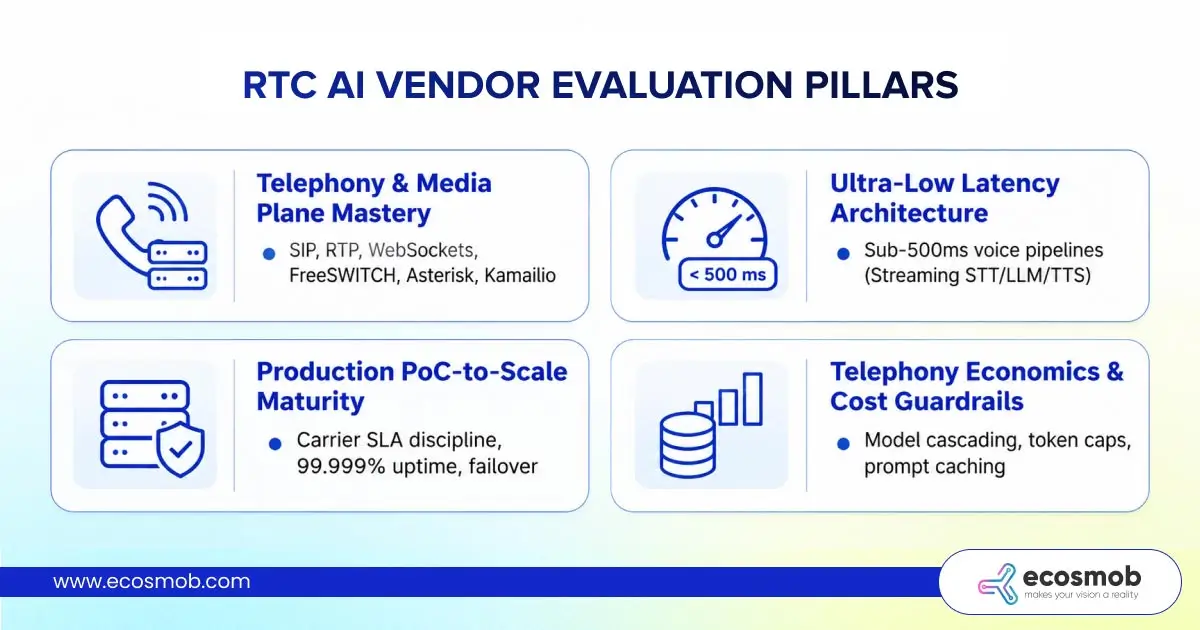
Before comparing vendors, it is critical to understand the criteria that separate high-performing RTC consultancies from generalist software agencies. Choosing among the best AI consulting firms requires looking beyond basic Python or model-tuning portfolios and focusing on live media transport:
-
- Telephony and Media Plane Mastery: Does the firm understand SIP signaling, codec negotiation (Opus, G.711), RTP packet health, and media engines like FreeSWITCH, Asterisk, and Kamailio?
- Sub-Second Latency Architecture: Can their engineering team build streaming Speech-to-Text (STT), low-latency LLM inference, and Text-to-Speech (TTS) pipelines that keep end-to-end voice latency strictly under 500 to 800 milliseconds?
- PoC-to-Production Reliability: Most voice AI initiatives stall after the initial proof-of-concept because models degrade under live network conditions. Top firms demonstrate a track record of scaling platforms to millions of live minutes without dropped calls or runaway token costs.
- Telephony SRE & Monitoring Rigor: Real-time platforms require 24/7 telemetry tracking Mean Opinion Scores (MOS), packet discards, and model drift at the individual session level.
Top RTC AI Consulting Companies
Here is an in-depth breakdown of the top AI consulting companies and specialized AI consulting firms, examining their technical capabilities, real-time communications pedigree, and operational trade-offs.
1. Ecosmob Technologies
Ecosmob Technologies occupies a unique position among modern AI consulting companies. While most software agencies pivoted to artificial intelligence from standard web apps or corporate IT, Ecosmob has spent nearly two decades working with open-source telecommunications and VoIP systems engineering.
When conversational intelligence took off, Ecosmob built its practice directly on top of carrier telephony stacks. Rather than treating voice as an afterthought, their engineers design voice AI architectures from the media plane upward. They specialize in wiring streaming speech models directly into Session Border Controllers (SBCs), media servers (FreeSWITCH, Asterisk), and SIP proxies (Kamailio) using full-duplex WebSockets. One live example is the Commbox project, where Ecosmob built a Twilio SIP bridge so Commbox’s LLM could run real-time inbound and outbound voice calls.
Their consultative approach covers the entire product lifecycle: starting with an in-depth AI readiness assessment to evaluate network topology and telephony debt, progressing through rapid AI proof-of-concept development, and executing real-time communication development designed for high concurrent call volumes.
- Best For: Telecommunications carriers, MVNOs, CCaaS/CPaaS providers, and enterprise voicebot platforms requiring sub-second, carrier-grade voice AI.
- Headquarters: Ahmedabad, India (with US & global delivery centers)
- Founded: 2007
- Primary Specialties: Carrier-grade VoIP, WebRTC streaming, FreeSWITCH/Asterisk customization, SIP signaling, conversational AI consulting, and 24/7 AI Network Operations Center (NOC) management.
Key RTC capabilities:
- Carrier Voicebot Engineering: Deploying resilient AI voicebot solutions capable of barge-in interruption handling, dynamic silence ladders, and natural conversational cadence.
- Contact Center Modernization: End-to-end AI contact center automation that links real-time agent assist cards to legacy CRM systems without adding desktop latency.
- Platform-Level AI Capabilities: Enabling telecom-grade AI capabilities for CPaaS providers and UCaaS engines, including automated fraud mitigation, compliance redaction, and call analytics.
- Latency & Infrastructure Hardening: Specialized engineering to fix voicebot latency in real-time voice AI, keeping end-to-end turn-taking below 500 milliseconds.
Considerations:
Ecosmob is an engineering-first telecom consultancy. If your company only needs high-level slide decks for board meetings without hands-on infrastructure execution, traditional management consulting firms may offer a broader non-technical fit.
2. LeewayHertz
LeewayHertz has established itself as one of the prominent boutique AI consulting firms for custom software and generative models. They excel at evaluating enterprise data foundations, selecting suitable model architectures, and fine-tuning open-source LLMs alongside commercial APIs.
For real-time communications, LeewayHertz frequently builds conversational copilots, multimodal AI interfaces, and text-based agentic workflows. Their development maturity ensures that customer-facing generative applications integrate cleanly with enterprise authentication, vector databases, and modern cloud microservices.
- Best For: Mid-market to enterprise companies building custom generative AI web and mobile applications from scratch.
- Headquarters: San Francisco, California, USA
- Founded: 2007
- Primary Specialties: Generative AI solutions, custom LLM fine-tuning, agentic AI systems, computer vision, and cloud data platforms.
Key RTC offerings:
- Multi-agent conversational systems using custom agentic frameworks.
- Real-time semantic retrieval systems (RAG) for internal desktop copilots.
- End-to-end model fine-tuning and deployment on AWS Bedrock, Google Cloud Vertex AI, and Microsoft Azure.
Considerations:
While highly proficient in web software, LLMs, and cloud APIs, LeewayHertz is not a native telecommunications engineering firm. Organizations requiring low-level SIP trunking, FreeSWITCH kernel tuning, or legacy PBX hardware integrations will need to manage the underlying carrier transport separately.
3. Accenture
Accenture is an established systems integrator with an expansive enterprise AI and cloud engineering practice. For Global 2000 enterprises operating contact centers with 20,000+ distributed seats, Accenture possesses the global scale, security clearances, and change-management resources required to execute multi-year digital overhauls.
Their RTC initiatives generally center around enterprise CCaaS migrations, transitioning on-premises Avaya, Cisco, or Genesys footprints to cloud-native platforms like Amazon Connect, NICE CXone, or Google Cloud Contact Center AI (CCAI).
- Best For: Multinational corporations modernizing massive global contact centers and legacy on-premises telecom infrastructure.
- Headquarters: Dublin, Ireland
- Founded: 1989
- Primary Specialties: Global enterprise transformation, large-scale systems integration, cloud migrations, and managed enterprise operations.
Key RTC offerings:
- Strategic contact center roadmap planning and vendor procurement governance.
- Large-scale integration of commercial AI platforms across SAP, Salesforce, and ServiceNow ecosystems.
- Global enterprise compliance, data sovereignty, and responsible AI governance frameworks.
Considerations:
Engaging Accenture involves significant capital investment, formal governance structures, and longer delivery cycles. For startups, mid-market platforms, or engineering teams looking to deploy custom real-time voice infrastructure within weeks, Accenture’s engagement model can be cost-prohibitive.
4. BCG X
BCG X operates as the technology build and design arm of the Boston Consulting Group. They blend top-tier management consulting with a bench of deep-tech data scientists, human-centered UI/UX designers, and software engineers.
In real-time communications, BCG X is typically engaged when a telecommunications carrier, satellite provider, or logistics conglomerate wants to invent a new revenue-generating product line. Rather than optimizing individual call flows, they build commercial business models, design bespoke algorithm suites, and help clients launch proprietary communication software ventures.
- Best For: Executive leadership seeking proprietary AI-driven business models and corporate venture incubation.
- Headquarters: Boston, Massachusetts, USA
- Founded: 2022 (Consolidation of BCG Digital Ventures, GAMMA, and Platinion)
- Primary Specialties: Proprietary machine learning product design, digital business incubation, and executive technology strategy.
Key RTC offerings:
- Corporate venture creation centered on intelligent conversational platforms.
- Strategic evaluation of operational cost structures and automation feasibility across global support operations.
- Algorithmic customer journey mapping and predictive churn modeling for telecom subscribers.
Considerations:
BCG X focuses on board-level strategy and high-impact proprietary builds. They typically do not handle ongoing PBX maintenance, SIP bug troubleshooting, or day-to-day telephony Network Operations Center tasks.
5. Bain & Company
Bain & Company expanded its technology footprint through a global strategic partnership with OpenAI, giving its strategic consultants early access to foundational models and enterprise developer tooling.
Bain approaches real-time communication primarily through the lens of organizational efficiency and customer lifetime value. They assist corporate clients in evaluating whether conversational agents can safely deflect tier-1 interactions, reduce average handle time (AHT), and free human representatives for high-value sales negotiations.
- Best For: Enterprise leadership looking to incorporate OpenAI enterprise capabilities into overarching commercial operations.
- Headquarters: Boston, Massachusetts, USA
- Founded: 1973
- Primary Specialties: Corporate strategy, private equity due diligence, commercial business design, and OpenAI enterprise deployment.
Key RTC offerings:
- High-level economic feasibility and ROI modeling for conversational AI investments.
- Strategic integration roadmaps linking OpenAI enterprise models to core corporate databases.
- Post-merger technology consolidation for telecom operators and unified communications providers.
Considerations:
Bain is a strategic advisory firm. While their teams design effective commercial transformation strategies, they partner with third-party software engineering shops or internal client IT departments to write the production code, configure SIP switches, and maintain production media servers.
6. Markovate
Markovate specializes in taking businesses from zero to a functional Minimum Viable Product (MVP) using modern machine learning stacks. They have adapted to the generative AI ecosystem, helping software companies evaluate LLM architectures, build vector-search retrieval systems, and embed conversational agents into consumer-facing mobile applications.
For communications companies, Markovate provides product design, API orchestration, and frontend integration. Their team helps mid-market businesses build conversational assistants that ingest customer context and suggest contextually relevant responses to support reps in real time.
- Best For: Mid-market platforms and venture-backed SaaS startups that need to prototype and launch generative conversational applications quickly.
- Headquarters: San Francisco, California, USA
- Founded: 2015
- Primary Specialties: Generative AI prototyping, adaptive machine learning, mobile app development, and vector database retrieval architectures.
Key RTC offerings:
- Rapid prototyping of conversational interfaces across iOS, Android, and web platforms.
- RAG system design for fast knowledge retrieval on internal help desks.
- Continuous evaluation frameworks to benchmark intent classification accuracy.
Considerations:
Markovate’s primary background is in digital product development and web/mobile engineering. They typically rely on third-party CPaaS APIs (such as Twilio, Agora, or Daily) for real-time transport rather than deploying custom open-source telephony switches.
7. SCAND
With over two decades of custom software engineering experience, SCAND brings deep software discipline to machine learning projects. Their engineering teams are comfortable working close to the hardware level, possessing strong capabilities in languages like C++, Java, .NET, and Python.
In the real-time space, SCAND’s deep systems programming background allows them to build media processing pipelines, desktop-integrated softphones, and low-latency digital signal processing (DSP) modules. They assist clients in integrating machine learning models into existing enterprise software without degrading overall system performance.
- Best For: European and North American enterprises seeking seasoned custom software engineering teams for bespoke application development.
- Headquarters: Warsaw, Poland
- Founded: 2000
- Primary Specialties: Custom software engineering, enterprise application modernization, embedded C/C++ development, and applied machine learning.
Key RTC offerings:
- Low-level C/C++ development for media encoding, decoding, and client-side audio filtering.
- Enterprise application refactoring to integrate cloud-based AI services.
- Desktop and web-based unified communication dashboards with integrated analytics.
Considerations:
While SCAND possesses systems programming skills, they operate primarily as a custom engineering outsourcing firm rather than a dedicated telecommunications consultancy. Clients must supply their own telecom architectural leadership or carrier relationships.
8. Azati
Azati has focused for decades on building analytical algorithms, document comprehension pipelines, and predictive engines for regulated industries. They excel at transforming unstructured conversational records, such as recorded telephone claims, customer support transcripts, and signed contracts—into structured, auditable enterprise data.
For RTC applications, Azati is suited for post-call intelligence and compliance monitoring. They build analytical pipelines that ingest call audio, run high-accuracy transcription, evaluate agent compliance with industry regulations, and extract structured business insights directly into enterprise data warehouses.
- Best For: Organizations in heavily regulated sectors (insurance, healthcare, financial services) automating document-heavy communication workflows.
- Headquarters: Livingston, New Jersey, USA
- Founded: 2002
- Primary Specialties: Machine learning for insurance and finance, natural language processing (NLP), optical character recognition (OCR), and legacy enterprise automation.
Key RTC offerings:
- Automated post-call compliance scoring, sentiment auditing, and legal redaction.
- Intelligent insurance claims intake workflows utilizing voice transcription.
- Custom natural language models trained on domain-specific legal and financial terminology.
Considerations:
Azati’s core technical strength lies in asynchronous data processing, NLP, and document analytics. They are less focused on live, in-flight media manipulation or sub-second voicebot turn-taking over carrier SIP lines.
Comparison of the Top AI Consulting Companies for RTC Platforms
| Company | Primary Focus | Core RTC Strength | Best Fit For |
| Ecosmob Technologies | Carrier Voice, FreeSWITCH/Asterisk, RTC AI | Deep VoIP engineering + low-latency AI pipelines | Telecom carriers, CCaaS/UCaaS/CPaaS platforms, Voice AI SaaS |
| LeewayHertz | Enterprise Generative AI & Agentic Workflows | Full-stack custom model development & Web3 | Enterprises needing end-to-end custom generative AI applications |
| Accenture | Global Enterprise Transformation & Cloud AI | Massive systems integration & vendor ecosystem | Fortune 500 enterprises modernizing multi-million-seat systems |
| BCG X | Corporate AI Strategy & Deep Tech Incubation | Executive strategy linked to bespoke machine learning | Global enterprises building proprietary AI business lines |
| Bain & Company | Commercial AI Strategy & OpenAI Enterprise Builds | High-level operations, commercialization, and M&A | Executive boards aligning AI roadmaps with business valuation |
| Markovate | Generative AI, Adaptive ML & Product Prototyping | Rapid MVP creation and mobile-first integrations | Mid-market product teams and funded AI startups |
| SCAND | Custom Software Engineering & Enterprise ML | Core software development with embedded ML features | European enterprises needing dedicated software engineering teams |
| Azati | Industrial Data Science & Workflow Automation | Rule-based automation and predictive analytics | Regulated financial, legal, and insurance workflows |
What Do AI Consulting Companies and AI Consulting Services Do for RTC Platforms?
Hiring a firm for specialized AI consulting services is mainly about acquiring seasoned systems engineers to merge carrier telecom protocols with streaming machine learning models.
Before kicking off an implementation, it helps to understand the foundational principles covered in our detailed guide: What Is AI Consulting for RTC (explained with use cases)
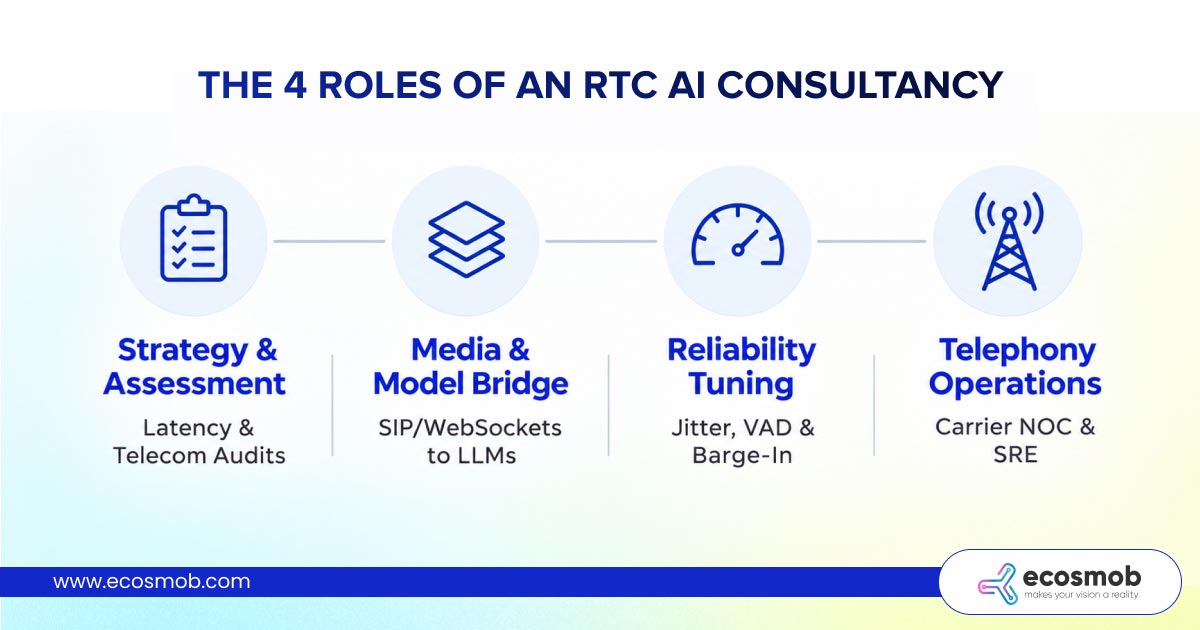
When building real-time communications platforms, specialized AI consulting companies deliver four primary operational capabilities:
- AI Readiness and Architecture Assessments: Evaluating whether your existing SIP trunking, Session Border Controllers, and PBX switches can support real-time audio streaming without packet degradation.
- Low-Latency Pipeline Engineering: Stitching together streaming speech recognition, intent evaluation, model cascading, and speech synthesis into a unified pipeline that keeps latency under human conversational thresholds.
- Conversational Policy & Guardrail Design: Building deterministic safety rails and conversational AI consulting workflows that prevent real-time voicebots from hallucinating, leaking proprietary data, or breaking regulatory compliance during live telephone interactions.
- Telephony SRE & Operational Oversight: Implementing 24/7 monitoring frameworks that trace individual SIP Call-IDs down to RTCP QoS metrics and model inference tokens, isolating bugs whether they occur in the carrier network or the AI inference layer.
To understand how to prepare your organizational roadmap for these technical changes, explore our companion guide on the AI adoption framework for real-time communications.
Key Real-Time Communication Use Cases for AI Consulting
Modern enterprises engage AI consulting firms to implement specific, high-ROI communication workflows across three core pillars:
Voice AI Agents
Autonomous voice AI agents manage complete phone interactions without human intervention. Unlike basic Interactive Voice Response (IVR) systems that rely on rigid DTMF keypad trees, intelligent voice AI agents handle natural conversational interruptions, pause gracefully when the customer speaks (barge-in), and resolve complex inquiries by querying enterprise databases in real time. Consultancies ensure that acoustic echo cancellation and Voice Activity Detection (VAD) thresholds are dialed in so the agent never talks over the caller.
Contact Center AI
Implementing contact center AI modernizes high-volume customer service operations. In a modern AI call center, this technology powers two core capabilities:
- Real-Time Agent Assist: Software that silently listens to an active call between a human agent and a customer, understands conversational context shifts, and pushes relevant knowledge cards, pricing calculators, or objection rebuttals to the agent’s screen in under 800ms.
- Automated Post-Call Summarization: Generating structured summaries, sentiment scores, and CRM field updates the second a call disconnects, eliminating up to five minutes of manual agent after-call work (ACW).
AI for CPaaS and UCaaS Platforms
As the telecommunications landscape shifts, modern CPaaS and UCaaS providers face commoditization on raw voice and SMS transport. Consultancies help these providers integrate native AI microservices directly into their software development kits (SDKs) and communication APIs (such as automated meeting transcription, conversational routing, live language translation, and automated fraud mitigation).
Ecosmob Expert Tip
Many development teams spend weeks fine-tuning LLM system prompts to reduce response delays, only to discover their voicebot still feels slow and unresponsive. In almost every live deployment, the real culprit isn’t the model; it’s an inefficient audio bridge.
If your media server is buffering audio in 200ms blocks before sending it over WebSockets, or your Voice Activity Detection (VAD) engine takes 400ms to detect a pause, your bot is already half a second behind before inference even begins.
Always benchmark your telephony media plane and audio frame sizes before touching a single prompt parameter.
How to Choose an AI Consulting Company for Your RTC Platform?
Selecting the wrong partner can lead to stalled pilots, budget overruns, and fragile prototypes that cannot handle live phone traffic. For a deeper step-by-step breakdown on vetting personnel and contracts, refer to our complete walkthrough on how to hire an AI consultant for your RTC solution.
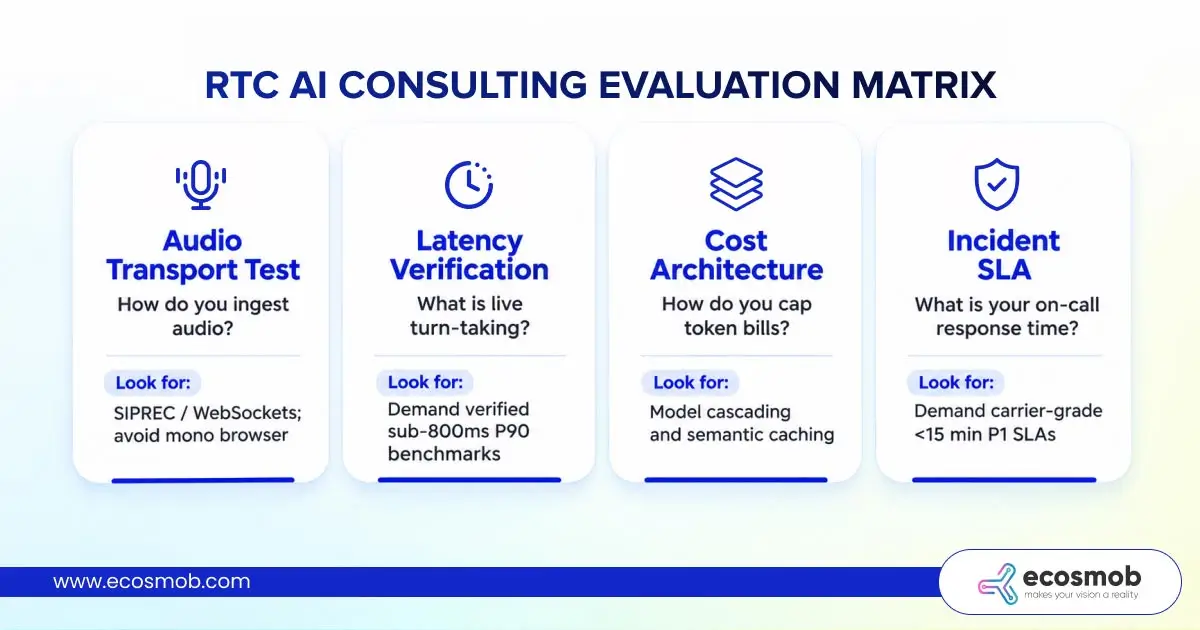
Here are some critical questions you need to ask before signing with an AI consulting company:
- “How do you ingest live audio into your AI inference models?”
-
- Red Flag: The consultancy suggests capturing audio via a client-side browser extension or desktop audio loopback.
- Green Flag: They demonstrate direct media forking at the telephony switch level using SIPREC, FreeSWITCH media bugs, or Asterisk AudioSocket, ensuring pristine, dual-channel audio separation.
- “What end-to-end turn-taking latency have you achieved in production calls?”
-
- Red Flag: They talk about LLM Time to First Token (TTFT) but ignore Speech-to-Text and Text-to-Speech synthesis delays.
- Green Flag: They measure latency from the caller’s acoustic trailing edge to the first synthesized audio packet, guaranteeing a P90 round-trip latency under 800 milliseconds.
- “How do you prevent runaway token bills during high-volume spikes?”
-
- Red Flag: Every single conversational turn is routed directly to an unconstrained, expensive frontier model (like GPT-4o or Claude 3.5 Sonnet).
- Green Flag: They implement intelligent model cascading, routing transactional intents to lightweight, sub-billion-parameter local models and reserving large models for complex reasoning.
- “What happens when an upstream model provider suffers a service degradation?”
-
- Red Flag: The system fails silently, leaving callers stranded in dead air.
- Green Flag: They build automated multi-provider fallback runbooks, instantly routing traffic to secondary providers or triggering graceful DTMF fallbacks.


Ready to wire sub-second conversational AI straight into your carrier trunks?
What Drives the Cost of RTC AI Consulting Projects?
Fees charged by AI consulting companies for real-time communications reflect the specialized nature of telecom engineering. Unlike simple web software builds, real-time voice and video budgets are driven by several distinct operational factors:
- Telephony Infrastructure Complexity: Connecting modern cloud APIs (like Twilio or Telnyx) to an AI pipeline is relatively straightforward. But if your project requires integrating with legacy on-premises PBX hardware, proprietary SBCs, or unmanaged carrier SIP trunks, engineering costs rise to accommodate custom protocol bridging and hardware testing.
- Concurrency and Scale Requirements: Designing an AI pipeline for 20 simultaneous calls requires straightforward server resources. Architecting a carrier-grade system capable of handling 5,000 concurrent audio streams across multi-region active-active clusters requires advanced state synchronization, dynamic load balancing, and dedicated media routing nodes.
- Data Privacy, Compliance, and Self-Hosting: Running audio through public cloud APIs is cost-effective initially. However, if your business operates under strict healthcare (HIPAA), payment (PCI-DSS), or telecom privacy mandates requiring local model weights inside your own Virtual Private Cloud (VPC), engineering private containerized inference pipelines adds considerable development time.
- Post-Launch Telemetry and Model Maintenance: Real-time AI is never a “set it and forget it” deployment. Budgeting must account for ongoing 24/7 incident response, model drift monitoring, knowledge base synchronization, and carrier minute auditing to prevent billing discrepancies.
The biggest hurdle in conversational AI is keeping the system fast, accurate, and cost-efficient when thousands of customers call in simultaneously from noisy cars, bad cellular connections, and unpredictable networks.
That kind of reliability doesn’t happen by accident. It takes a specialized engineering foundation where the media plane, carrier signaling, and machine learning models work as one continuous, fault-tolerant pipeline.
At Ecosmob, our engineering teams have spent nearly two decades building and maintaining carrier-grade voice infrastructure. We help telecom carriers, contact centers, and modern communication platforms deploy responsive, production-ready conversational systems with sub-500ms turn-taking, active-active failover, and predictable per-minute costs.
If you are evaluating how to architect your real-time conversational platform or need experienced telecom engineers to harden your media pipeline, explore our specialized AI consulting for real-time communication platforms or contact us today to get started.
Frequently Asked Questions
The top AI consulting companies specializing in real-time communication include Ecosmob Technologies (specializing in carrier-grade VoIP, FreeSWITCH/Asterisk customization, and low-latency voice pipelines), LeewayHertz (focused on custom enterprise generative AI models), and global systems integrators like Accenture (specializing in large-scale contact center migrations). Selecting the right company depends on whether your project requires low-level telephony engineering or high-level enterprise software integration.
An AI consulting company evaluates network readiness, designs low-latency media architectures, integrates streaming speech models with telephony switches (SIP/RTP), builds custom conversational logic and safety guardrails, and provides ongoing 24/7 monitoring to prevent model drift and audio degradation during live calls.
Companies like Ecosmob Technologies specialize directly in voice AI, contact center AI automation, and telecom infrastructure. We focus on the complex media layer, connecting open-source telephony engines like FreeSWITCH and Kamailio with streaming STT, LLM, and TTS pipelines to deliver sub-500ms conversational turn-taking.
AI consulting costs vary based on concurrency, custom telephony requirements, and compliance standards. Typically, projects are structured around hourly technical advisory for architectural reviews, fixed-price milestones for proof-of-concept (PoC) builds, or ongoing monthly engineering retainers for full-lifecycle development and 24/7 telecom operations management.
Standard AI models struggle with phone calls due to latency and audio fidelity constraints. Web-based models process text asynchronously, whereas telephone calls require end-to-end turn-taking in under 800 milliseconds to avoid conversational collisions.
Furthermore, telephone audio is compressed into narrowband 8kHz audio (G.711), which degrades speech recognition accuracy unless models are tuned specifically for telephony acoustics.