
If you have spent any time building or deploying conversational AI, you already know that launching a voicebot to handle basic FAQs or look up delivery statuses isn’t the hardest part of the project. The real test of an enterprise system is how cleanly it handles its limitations.
Most voice automation pilots hit a wall when a conversation veers off script. If your system triggers the voice AI-to-human handoff too early, you end up wasting expensive agent time on queries that should have been automated. But if it holds onto the caller too long, the customer gets frustrated and hangs up.
Managing this boundary requires an intentional, multi-signal fallback engine that treats data routing and telephony signaling as a single, unified pipeline.
What Is Smart Escalation Logic for AI Voice Systems?
Smart escalation logic is an algorithmic decision engine that evaluates real-time conversational, acoustic, and behavioral signals to seamlessly transition a call from an AI agent to a human representative. This process ensures zero loss of conversation context and minimizes latency during the transfer leg.
An AI voice agent escalation to human trigger should initiate when the system detects clear operational boundaries:
- Confidence drops below your established thresholds over consecutive conversational turns.
- The customer explicitly requests a live representative using specific phrases or verbal overrides.
- Negative sentiment shifts signal high caller frustration through acoustic stress markers.
- Strict business policy rules dictate immediate manual validation for high-risk transactions or VIP account handling.
Many organizations learn this lesson the hard way. An IBM CEO study highlighted a glaring mismatch between technology adoption and real-world value: only about 25% of corporate AI initiatives actually deliver their expected ROI, and a mere 16% successfully scale across the entire enterprise. This struggle happens because AI projects often start as casual experimentation first, with actual value realization treated as an afterthought.
When you scale an AI voicebot from a small test group into high-density production traffic, you quickly realize that an unoptimized voice AI human handoff strategy is the exact bottleneck holding back your ROI. If your voicebot cannot gracefully hand off complex or high-stakes scenarios, it remains stuck in the experimentation phase forever.
Why Single-Trigger Handoffs Fail and How Multi-Signal Engines Fix Them
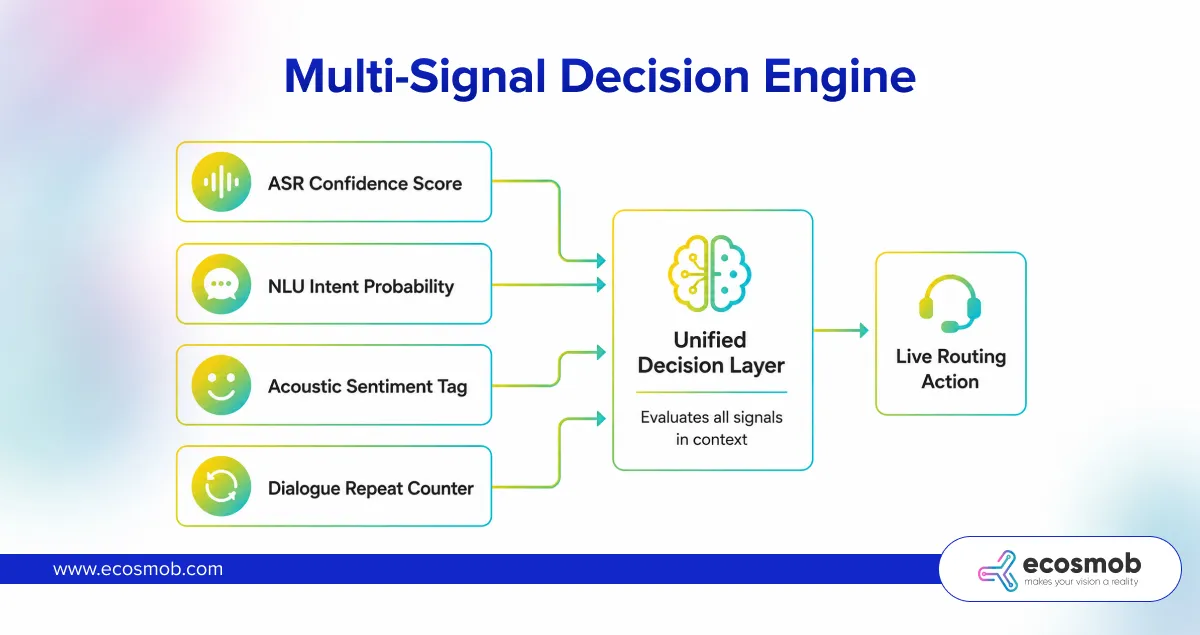 If your infrastructure relies on a single metric (like a Speech-to-Text (STT) confidence score) to trigger an AI-to-human handoff, your system will frequently misroute calls. A simple background cough, a transient cellular drop, or an unusual accent can artificially tank an accuracy score. If that single drop causes the bot to immediately abandon the conversation, your containment rate plummets.
To build a resilient platform, your AI decision layer must look at a combined matrix of distinct operational signals:
Instead of letting a single bad score trigger a transfer, a production-grade system evaluates these inputs collectively. For example, if a customer’s speech recognition score is low, but their sentiment tag is completely calm, and they are cleanly advancing through your billing steps, the system should keep the call automated.
However, if the system registers a conversational repetition loop (meaning the user has had to restate their problem twice without moving forward), the engine needs to synthesize that frustration immediately and initiate an AI-to-human handoff before the user has a chance to get angry.
How to Preserve Context During AI-to-Human Handoff?
You can preserve conversation context during an AI agent-to-human handoff by packaging the active session data, intent tags, historical transcripts, and validation states into a structured JSON payload that hits the agent’s CRM simultaneously with the phone call. This pattern prevents the caller from having to repeat their information from scratch.
While global service organizations are actively running automated AI agents, the ultimate success of the program relies heavily on how cleanly the hybrid system passes data back and forth between human and digital agents.
To make this transition invisible to the end user, your custom connector middleware should push a unified metadata packet across a high-speed message bus (like Redis) the exact millisecond the telephony leg initiates the transfer:
By presenting this payload as an instant screen-pop on your agent’s dashboard, the representative can answer the line by saying, “I see you’re looking at the $45 late fee on your June statement. Let me reverse that for you right now.” This completely changes the dynamic of an escalated call.
Ecosmob Expert Tip
Hardcode a fail-safe bypass loop inside your core Kamailio or Asterisk dialplan, completely separate from your primary LLM application engine.
If a customer repeatedly shouts “human” or “representative,” your system should trigger an immediate channel redirection based on local, lightweight Voice Activity Detection (VAD). Never let a delayed API tool call or a slow LLM inference cycle trap an unverified user inside an unresolvable automated loop.
Telephony Layer Mechanics for Warm and Cold AI-to-Human Handoffs
Once your decision engine determines that a human needs to step in, your underlying telecom core must execute the physical routing path. Depending on your business model and infrastructure constraints, you will design your AI agent human handoff to follow either a cold or a warm signaling path.
When building your own escalation engine on a self-hosted FreeSWITCH, Asterisk, or Kamailio stack, you cannot rely on simple webhooks. Your orchestration layer must hook directly into the telephony server’s event sockets (such as FreeSWITCH ESL or Asterisk AMI) to programmatically handle the underlying channels.
The Cold Transfer Model (SIP REFER)
If your main priority is freeing up expensive application threads and media streaming resources on your AI servers, a cold transfer using a standard SIP REFER message is your cleanest option. Your AI framework commands your Session Border Controller (SBC) to send a REFER request back to your originating carrier trunk, pointing directly to the inbound agent queue extension.
The moment the carrier accepts the transfer, your AI server tears down its media paths and disconnects entirely, leaving the carrier to route the remaining call duration.
The Warm Transfer Model (SIP re-INVITE and Bridging)
For premium enterprise experiences where a customer cannot be dropped blindly into a holding queue, you must maintain control over the media leg. Your system architecture handles this by issuing an in-flight SIP re-INVITE to transition the customer channel into a secure internal conference bridge.
While the customer hears local comfort noise or Music on Hold, your middleware automatically launches a second outbound call leg to your human agent group. This allows your system to deliver an active audio whisper directly to the live agent before dropping the AI engine out of the bridge.
If your current SIP trunk infrastructure struggles to maintain call stability during real-time media transitions, it is often a sign of underlying signaling friction.
Our core telecom integration teams can help optimize your SIP routing paths!
Managing the Latency Budget to Prevent Call Dropouts
In live voice environments, processing delays will ruin your customer retention. If your handoff architecture introduces extended periods of complete silence while your APIs process state changes, the caller will assume the line has died and hang up.
To ensure your system remains production-grade, your optimization milestones must tightly align with these precise, verified p95 telemetry targets compiled from live open-source infrastructure deployments:
| Pipeline Stage | Measured Target (p95) | Telemetry Optimization Focus |
| Telephony Ingress | 40ms – 60ms | Fast packet routing via edge proxy layers like Kamailio. |
| Turn Detection (VAD) | 80ms – 120ms | Local noise-canceling algorithms to pinpoint speech ends. |
| Speech-to-Text | 100ms – 150ms | Low-latency streaming chunks running over WebSockets. |
| LLM Generation | 180ms – 240ms | Small, highly optimized token-streaming inference models. |
| Text-to-Speech | 60ms – 100ms | Immediate audio buffer playback to eliminate dead air loops. |
| End-to-End Processing | Sub-600ms Total | (Standard benchmark required to mimic natural human speech gaps.) |
To stay safely inside an acceptable conversational window, your software must stream audio packets continuously. Keep your speech-to-text pipeline alive even while your telephony layer is executing a mid-call SDP renegotiation. This guarantees that if a customer speaks while the call is physically moving to an agent headset, their words are cached and delivered cleanly to the agent dashboard without an audio dropout.
Common Failure Modes in AI-to-Human Escalation Logic
When you move your intelligent voice core out of a local staging environment and expose it to thousands of live daily interactions, you will inevitably run into real-world behavioral edge cases. Your architecture should include native guardrails for these common failure modes:
- Escalation Flapping
This occurs when a call rapidly bounces back and forth between the automated AI logic and human queues because an input signal is hovering right on your threshold line.
To prevent this, add mathematical hysteresis to your decision loops. Require your multi-signal confidence matrix to stay below your threshold for a continuous window of two or three turns before initiating a permanent transfer sequence.
- The Confidently Wrong Loop
Generative AI models occasionally experience hallucinations where they output inaccurate data but attach an exceptionally high internal confidence score to the prediction. Because the score looks clean, your standard safety triggers are bypassed.
You can counteract this by running a separate, lightweight text validation model in the background. Have it scan all outbound responses for compliance violations or negative user phrases before the text ever reaches your text-to-speech engine.
- Queue Dead Ends and Observability Tuning
A beautifully executed channel redirection is useless if your physical call center has closed for the evening or is buried under a major traffic spike.
Your custom connector middleware must query your real-time Workforce Management (WFM) or Automatic Call Distribution (ACD) APIs before it executes a telephony transfer. If the system flags that no human specialists are active, it must intercept the call and route the user to an intelligent voicemail or a guaranteed callback option instead.
Ultimately, your escalation rates, re-escalation percentages, and overall time-to-transfer metrics shouldn’t just exist as vanity dashboard numbers. Treat them as a continuous engineering feedback loop.
By analyzing your post-handoff outcomes weekly, your team can systematically fine-tune your signal weights, reducing your operational overhead while safeguarding caller trust.
Optimizing your communication stack means designing a framework where your AI and telephony layers work as a single, fully integrated tool. If your current off-the-shelf software models limit your network visibility or introduce unmanaged audio gaps during handoffs, building a custom event-driven orchestration tier is your most reliable path forward.
We specialize in designing carrier-grade, open-source telecom architectures that handle live traffic transitions seamlessly. If you are aiming to eliminate dead air, lower your call abandonment rates, and build a voice AI engine tailored entirely to your business rules, our development team can help you build the right foundation.