
Your customer calls at 9 AM with a billing question. Your IVR greets them with: “Press 1 for sales, press 2 for support, press 3 for billing…” Fifteen seconds later, they’re still listening. They press 3. Another menu: “Press 1 for current charges, press 2 for payment history, press 3 to speak with an agent.” They press 3. “All agents are busy. Your estimated wait time is 12 minutes.”
Your competitor’s system picks up the same call with: “Hi, how can I help you today?” The caller says, “I have a question about my last invoice.” The conversational AI IVR instantly pulls their account, identifies the invoice, and asks, “I see your March invoice for $347. What would you like to know?” Resolution happens in 90 seconds, zero transfers, zero frustration.
The gap between these experiences isn’t about budget or technology access. It’s about architecture. Traditional IVRs were designed for the rotary phone era when touch-tone menus were revolutionary.
AI Voicebots and Voicebot Connectors rebuild this foundation entirely, turning every inbound call into a natural conversation backed by real-time data access and intelligent decision-making.
The Core Problems With Traditional IVR Systems
Legacy IVR platforms operate on a fundamentally broken premise: force callers to navigate your organizational structure rather than solving their actual problems. Here’s what happens under the hood and why it fails:
Rigid menu trees lock callers into predetermined paths.
Every option must be mapped manually. If your caller’s issue doesn’t fit neatly into “billing,” “technical support,” or “account changes,” they’re stuck guessing which button might eventually reach someone who can help. Menu depth averages 3-5 levels deep in enterprise deployments, meaning callers spend 45-90 seconds just navigating before any assistance begins.
Zero contextual awareness creates repetitive questioning.
Your IVR collects the account number, verifies identity, and routes the call. Then your agent asks for the account number again, re-verifies identity, and starts from scratch. The system has no memory, no integration with your CRM, and no ability to pass context forward. Customers repeat themselves 2-3 times per call on average.
Touch-tone input limits complexity.
Try explaining “I was charged twice for the same service, but only one charge appears on my online statement” using a 12-button keypad. Traditional IVR can’t handle nuance, multi-part questions, or anything requiring explanation. The moment the caller’s needs exceed simple navigation, the entire system collapses into “press 0 for an agent.”
Static routing ignores real-time conditions.
Your IVR routes “technical support” calls to the tech queue regardless of current queue depth, agent expertise, or caller priority. If your top-tier customer with a critical outage gets the same treatment as a password reset request, you’re routing by org chart, not by business value.
Maintenance becomes a recursive nightmare.
Every product launch, every process change, every new department requires re-recording prompts, rebuilding menu logic, and testing every possible navigation path. Changes that should take hours stretch into weeks because the system lacks flexibility at its core.
The result?
Most callers abandon IVR systems before reaching resolution, and those who persist rate the experience as their least favorite customer service channel.
How Voicebot Connectors Fundamentally Change Call Handling
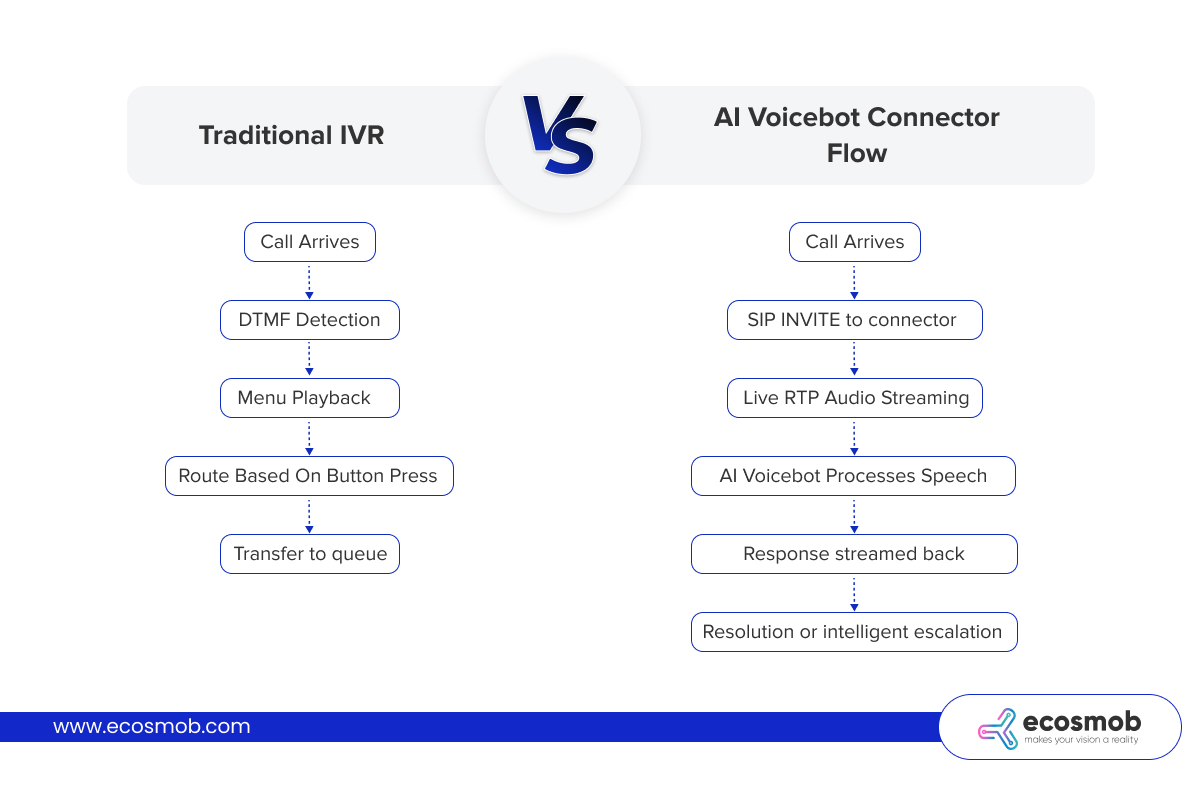
Voicebot Connectors eliminate the menu tree entirely by converting every call into a bidirectional conversation. Instead of forcing callers through predetermined paths, these Voicebot Connectors bridge your existing IP PBX system with AI voicebot platforms, streaming live audio, processing responses, and handling escalations without disrupting your SIP infrastructure.
Here’s the architectural difference:
 How Do Voicebot Connectors and Conversational AI IVRs Work Together?
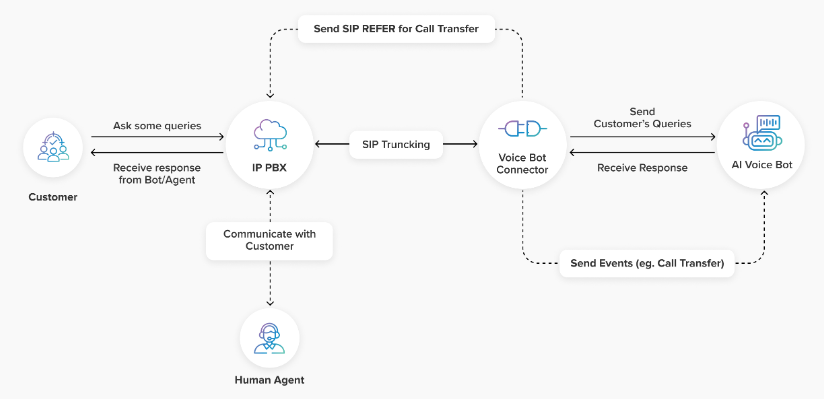
A voicebot connector for IVR sits between your Asterisk, FreeSWITCH, or commercial IP PBX system and your AI voicebot platform. It handles the protocol translation that neither system can do alone:
- SIP signaling control manages call setup, teardown, and transfers.
- Real-time audio streaming captures RTP packets from your telephony system and streams them to the voicebot via WebSocket.
- Bidirectional communication receives AI-generated responses and plays them back through your existing phone infrastructure.
- Call control logic processes webhook events from the voicebot to trigger transfers, recordings, or routing decisions.
For inbound calls:
- Your IP PBX receives the call.
- It sends SIP INVITE to the voicebot connector.
- The voicebot connector streams live audio to the AI engine.
- The AI voicebot analyzes speech and generates responses.
- The voicebot connector plays responses back to the caller.
- If escalation is needed, the voicebot connector transfers to human agents using your existing routing logic.
For outbound calls:
- Your telephony system dials the customer.
- Once answered, it sends SIP INVITE to the voicebot connector.
- The voicebot handles the entire interaction.
- Based on the conversation outcome, the voicebot connector routes to the next action (transfer, callback, or completion).
This architecture preserves your existing SIP infrastructure completely.
No dial plan rewrites.
No middleware complexity.
Just a clean bridge that speaks both SIP and AI fluently.
Ecosmob Expert Tip
The most critical success factor in voicebot deployment isn’t the AI model itself; it’s preserving the complete interaction context when escalating to human agents.
And that is why we configure your voicebot connector to capture customer identity, issue details, and resolution attempts during every call, then pass this data directly to your agent’s screen before the transfer completes. This eliminates repetitive questioning and transforms potential escalation frustration into seamless problem-solving continuity.
AI Voicebot Peak Call Volume Handling That Traditional IVR Can’t Match
When Black Friday hits or a service outage triggers thousands of support calls, traditional IVR systems collapse under pressure. Every additional caller joins the lengthening queue times, and your human agents become the bottleneck.
AI voicebots and Voicebot Connectors eliminate this constraint entirely.
The same connector that handles 50 concurrent calls scales instantly to manage 5,000 without performance degradation. Cloud-native architecture dynamically allocates processing power, while your existing IP PBX routes calls to the voicebot connector exactly as it would to any other destination.
During peak events, AI voicebots absorb the initial call volume surge, resolving routine inquiries instantly while intelligently escalating complex issues to available human agents. This prevents system overload and maintains service quality when your business needs it most.
Real-Time Integration That Traditional IVR Can’t Match
The voicebot connector architecture enables integrations that legacy IVR systems simply cannot support because they operate in isolation from your business systems.
CRM Integration for Instant Personalization
Your AI IVR queries Salesforce, HubSpot, Zendesk, or custom CRMs via REST APIs the moment a call connects:
- Greets callers by name without asking
- References their last interaction proactively
- Addresses known issues before the caller explains, for example: “Hi Sarah, I see you called yesterday about your shipment delay. Good news, your order just shipped and will arrive on Thursday.”
This level of personalization is impossible with traditional IVR because it lacks the integration layer and conversational intelligence to deliver context naturally.
Ticketing System Synchronization
When your conversational AI IVR creates a support ticket, updates case status, or logs interaction notes, this data flows bidirectionally:
For the caller:
- Can reference ticket numbers naturally: “I’m calling about ticket 847293”
- Receives instant status updates without waiting for email
- Gets resolution confirmation and next steps automatically
For your agents:
- See complete voice interaction transcripts
- Access conversation history with sentiment analysis
- Inherit full context when escalation occurs: caller identity, verification status, issue details, and attempted resolutions
Payment Gateway Connections
PCI-compliant voicebots process payments without transferring to agents.
For example:
Caller: “I’d like to pay my balance.”
Bot: “Your current balance is $156.80. Would you like to pay in full?”
Caller: “Yes.”
Bot: “I’ll process payment using the card ending in 4732. Please say or enter your CVV.”
Secure, voice-authenticated transactions with confirmation sent via SMS can be that simple (no agent needed!).
Appointment and Scheduling APIs
Integration with calendaring systems lets your AI IVR handle complex scheduling:
- Check availability across multiple calendars
- Book appointments with specific service providers
- Send confirmations via SMS/email
- Handle rescheduling naturally: “I need to move my Tuesday appointment to later in the week.” → “I have openings Thursday at 2 PM and Friday at 10 AM. Which works better?”
Traditional IVR is dying because it was never designed for conversational customer service. AI voicebots and Voicebot Connectors don’t patch legacy systems. They replace the entire interaction model with something callers actually want to use.
Every day you force callers through menu trees is a day you’re training them to prefer whoever answers with “How can I help you?”
Your callers shouldn’t navigate menus designed for your org chart. They should have conversations that solve problems. And your existing IP PBX shouldn’t need replacement to make that happen.
Ready to retire your button-pushing relic?
Let’s build your custom voicebot connector that bridges SIP and AI seamlessly!
Frequently Asked Questions
AI Voicebot Connectors scale instantly to handle thousands of concurrent calls through cloud-based processing, while traditional IVR systems queue callers for limited human agents. During peak periods, voicebots absorb volume surges without performance degradation or increased wait times.
Yes, Voicebot Connectors integrate with any system that supports REST APIs or webhooks. They can query databases, create CRM tickets, process payments through secure gateways, and update customer records in real-time during conversations, enabling complete issue resolution without human intervention.
Customers want to speak naturally instead of using menu options and button sequences. AI voicebots understand context, maintain conversation flow, and access real-time account information to provide personalized responses, eliminating the frustration of repeating information across multiple menu levels.
The integration is straightforward because Voicebot Connectors use standard SIP protocols that work with any IP PBX system, including Asterisk, FreeSWITCH, etc. The custom voicebot connector appears as a standard SIP endpoint to your telephony system, requiring no changes to existing dial plans or infrastructure.
AI voicebots and Voicebot Connectors eliminate wait times by handling unlimited concurrent calls simultaneously. Unlike traditional IVRs that queue callers for human agents, voicebots process requests instantly through natural language understanding, resolving issues in real-time rather than routing through menu systems.