










QUICK SUMMARY
By 2026, delaying AI in UCaaS is an existential threat to UCaaS providers, leading to massive customer churn and unmanageable operational costs. This blog details the non-negotiable architectural moves that unlock massive ROI and ensure your platform thrives in the new cognitive communication landscape.
AI voicebots for UCaaS providers are transforming how telecom platforms handle customer support, call overflow, and SLA performance. As call volumes rise and support costs increase, UCaaS operators need intelligent voice automation that integrates seamlessly with SIP, VoIP, and PBX systems. AI-powered voice agents help automate Tier-1 queries, reduce call wait times, improve first-call resolution, and protect customer retention without expanding support teams.
If you’re running a UCaaS platform (without AI), you are selling yesterday’s technology with today’s pricing pressures. Your competitors are no longer just selling call minutes; they are selling cognitive intelligence, instant resolution, and architectural efficiency driven entirely by AI.
The market has fundamentally changed. Customers who once tolerated static IVRs and long hold times now expect immediate, frictionless service. AI voicebots in UCaaS have started pivoting from being a feature to being a basic survival requirement.
Delaying it is a strategic liability that translates directly into unmanageable costs and customer migration to faster, smarter, and cheaper services.
This blog details the architectural imperative: why immediate AI adoption is mandatory, how it delivers massive ROI, and the technology required to integrate voice AI for unified communications at scale, seamlessly.
4 Reasons Providers Need Voice AI for Unified Communications
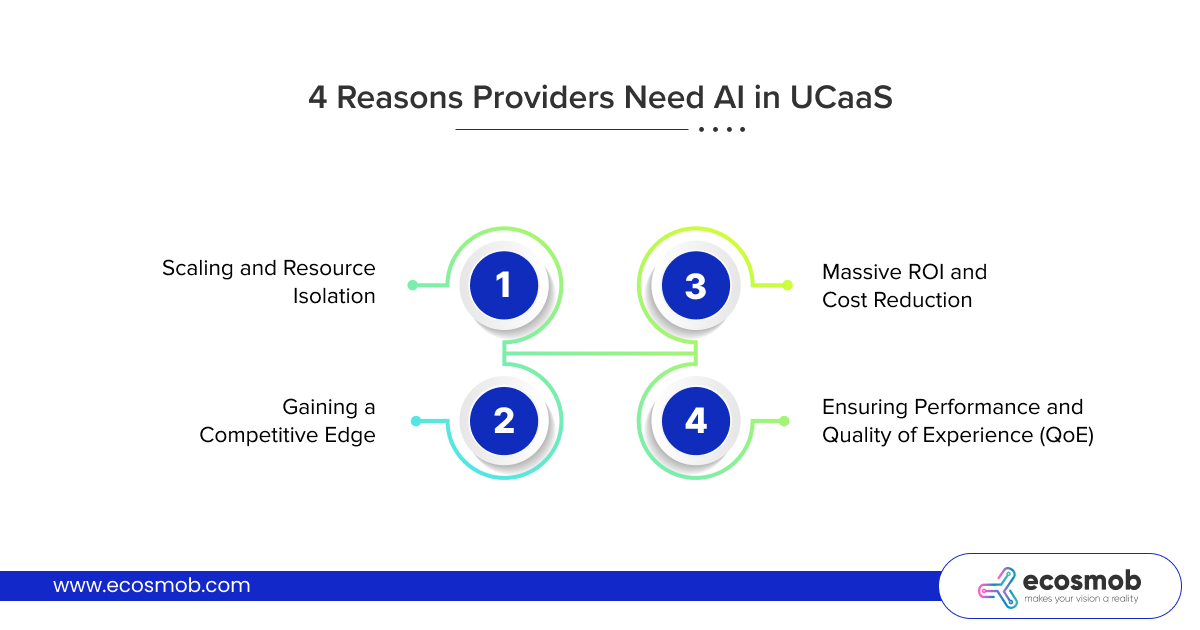
- Massive ROI and Cost Reduction
- Ensuring Performance and Quality of Experience (QoE)
- Scaling and Resource Isolation
- Gaining a Competitive Edge
Massive ROI and Cost Reduction with AI in UCaaS
Delaying AI in unified communications disrupts profitability by keeping operational costs high and failing to leverage available cost-saving automation. This is a direct competitive inhibitor.
L1 Deflection and Operational Savings
The core ROI for voice AI for unified communications lies in automating low-value, high-volume tasks. So, how much can AI voicebots reduce support load for UCaaS?
- L1 Query Deflection: AI voicebots excel at automating routine customer inquiries and tasks, often referred to as L1 deflection. This instantly offloads human agents, allowing the AI bot to handle calls instantly. This aligns closely with modern AI-powered call center automation strategies that focus on reducing Tier-1 load without expanding support teams.
- Cost Reduction Statistics: According to Gartner, by 2029, AI will be capable of resolving 80% of common customer issues (without human intervention), which will reduce operational costs by 30%.
- Reduced Infrastructure Expense: By eliminating high-cost, repetitive manual workflows, AI voicebots help UCaaS providers reduce infrastructure expenses by reducing the need for vast pools of agent-dedicated resources, optimizing resource allocation.
Ensuring Performance and Quality of Experience (QoE) with Voicebots
The stability of your UCaaS platform hinges entirely on speed. AI must be fast enough to meet human conversational expectations, which is only possible with specialized architecture.
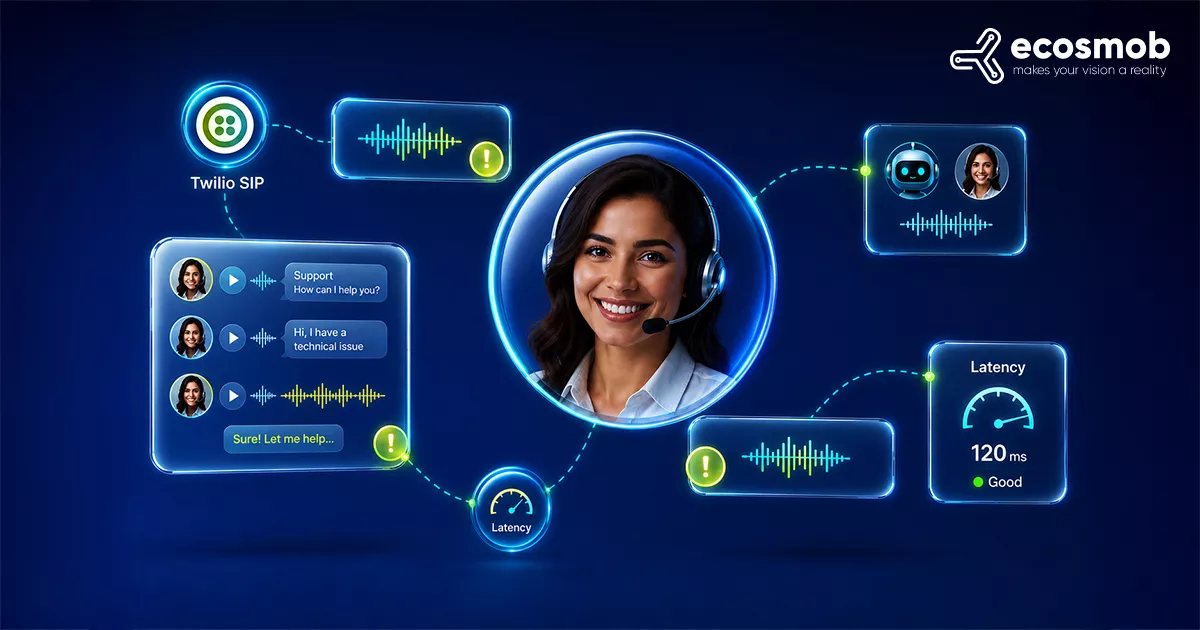
- The Latency Standard: Production AI agents must aim for 800ms or lower total voice-to-voice latency (the time from the user finishing speaking until the AI’s response begins playback). Any delay beyond 1000ms makes the service feel unnatural and frustrating.
- Streaming STT and Parallel Processing: Scaling requires predictive speed. Streaming Speech-to-Text (STT) produces partial transcriptions as audio arrives, allowing the Large Language Model (LLM) to begin processing and generating a response before the user has finished speaking. This predictive processing can save 200–400ms in a typical interaction.
- Prompt Caching for Stability: Implementing advanced caching policies is essential for sustaining speed under peak load. Prompt caching yields significant cost savings and dramatically improves tail latency (P90 and P95), ensuring that the worst-case response times remain stable during traffic spikes.
Ecosmob Expert Tip
Start with Prompt Caching on your top 20% of call flows (billing inquiries, password resets, account status checks). These high-volume, repetitive interactions deliver the fastest ROI. You’ll see improvements within the first week, giving you proof-of-concept data to justify broader rollout to your stakeholders.
Scaling and Resource Isolation with AI
Your multi-tenant platform cannot afford the “noisy neighbor” problem. AI provides the tools to enforce resource isolation dynamically.
Here’s how AI reduces resource contention:
- Intelligent Resource Allocation: AI-powered multi-tenant software offers Instant Resource Allocation during high-demand periods, ensuring resources scale up during peak times and reduce during slower periods, minimizing passive structural costs.
- AIOps for Stability: The multi-tenant architecture must utilize automated failover and predictive maintenance tools (AIOps) to automatically resolve incidents, preventing local component failure from impacting the entire platform.
- Resource Isolation: The architecture must enforce resource isolation, For platforms already running SBC infrastructure, scaling SBCs for UCaaS and CCaaS with AI-driven bottleneck control becomes critical to maintain stability. preventing one client’s surge (the “noisy neighbor” problem) from contaminating the service for others. This is achieved using techniques like defining usage quotas via the Token Bucket algorithm for rate limiting.
Losing Competitive Edge Without AI Voicebots
The most immediate risk of ignoring AI in unified communications is the exponential gap created by your competitors’ structural savings and superior customer experience.
What Risks Do UCaaS Providers Face if They Delay AI Voicebot Adoption?
By 2026, delaying AI adoption means facing an insurmountable competitive gap:
- Rising Costs and Churn: Your operational costs remain static and high, while competitors gain structural savings. Customers will migrate due to slow response cycles, leading to severe revenue leakage and massive customer churn.
- Higher Barrier to Entry: You face a higher barrier to entry as competitors gain expertise, build the right skills, and establish proven use cases, making it harder for you to recover the massive ground lost.
- Strategic Liability: Your delay is a strategic risk that directly impacts the survival of the business. You will be unable to compete on cost, quality, or speed with competitors whose automated services are simply faster and more economical.
A Quick Summary of Why Providers Need AI in UCaaS
| Reason for AI in UCaaS | Core Challenge | Solution | Outcome |
| Massive ROI and Cost Reduction | High operational costs from manual workflows and agent pools. | L1 Query Deflection via AI voicebots automating routine inquiries. | Reduced infrastructure expenses and optimized resource allocation. |
| Ensuring Performance and QoE | Conversational delays damage user experience and engagement. | Streaming STT with parallel processing and Prompt Caching for peak stability. | Sub-800ms latency and stable response times during traffic spikes. |
| Scaling and Resource Isolation | Multi-tenant platforms vulnerable to “noisy neighbor” resource contention. | Intelligent Resource Allocation, AIOps, and Token Bucket rate limiting. | Elastic scaling with guaranteed tenant isolation and platform stability. |
| Gaining a Competitive Edge | Competitors gaining structural cost and speed advantages. | Immediate AI adoption to match competitor efficiency and customer experience. | Retention of customers and prevention of revenue leakage from migration. |
Stop losing ground to automated competitors.
Redaction Middleware and Deterministic Guardrails for AI in UCaaS
Security in an AI-native platform is about controlling the probabilistic nature of Large Language Models (LLMs). You cannot simply “trust” an LLM with patient data or credit card numbers. You must architect a layer of deterministic control.
Here’s how to architect zero-trust AI voice streams:
The PII Redaction Middleware
You cannot send raw audio transcripts containing Sensitive PII (like SSNs or credit card numbers) directly to a public LLM provider. The architecture requires a Redaction Middleware layer that sits between your STT (Speech-to-Text) engine and the LLM.
- The Mechanism: This layer identifies and replaces sensitive entities (e.g., swapping a credit card number for [CREDIT_CARD_REDACTED]) before the prompt reaches the LLM. This ensures that sensitive tenant data never enters the training or inference logs of third-party AI providers, satisfying HIPAA and PCI requirements by design, not just policy.
Deterministic Guardrails
LLMs are creative, which is a liability in compliance-heavy sectors. A banking bot cannot “hallucinate” a refund policy.
- The Solution: Implement a Guardrail Layer (using frameworks like NeMo or specific logic gates) that validates every LLM output against a strict set of rules before it is synthesized into speech. If the AI generates a response that violates a business rule, the Guardrail catches it and substitutes a pre-approved fallback response in milliseconds, ensuring 100% compliance with business logic.
Sovereign State Management
In a multi-tenant environment, the AI’s “memory” (context window) must be ephemeral and isolated. The architecture must ensure that the conversation state is stored in your secure tenant database, not in the LLM’s cache. Once the call ends, the context is flushed from the inference engine, preventing data leakage between tenants.
Need to integrate AI without breaking your SIP stack?
The Voice AI Integration Question (Bridging SIP and AI)
Integrating voice AI for unified communications into a legacy SIP or WebRTC core is complex and requires specialized expertise in protocol translation and telecom-grade scaling. Understanding SIP scalability best practices ensures your core signaling architecture remains stable while layering AI services.
The Best Way to Integrate a Voicebot Engine
Now that you know why your UCaaS solution needs an AI voicebot, let’s answer the next question: what is the best way to integrate a voicebot engine into an existing SIP or UCaaS stack?
The optimal method is enhancement, not replacement, of your existing stable SIP infrastructure.
This is achieved by using a specialized, custom-built bridge:
- Protocol Translation: Ecosmob’s Voicebot Connector acts as a crucial bridge, converting the high-speed RTP audio stream into the WebSocket/JSON format required by the AI pipeline. This ensures the complex media conversion is handled cleanly and efficiently. similar to modern voicebot connectors in telecom architectures that handle RTP-to-AI translation at scale.
- Preserving the SIP Core: This Voicebot Connector ensures that the complex task of media conversion and state management is handled outside the core stack, allowing your AI to focus on conversation and your UCaaS platform to focus on stability.
In simple words, the Voicebot Connector makes sure you maintain your existing SIP logic while unlocking advanced AI automation.
The transition to AI in UCaaS is the defining architectural requirement of 2026. Your platform must evolve from being a simple call switch into a cognitive intelligence engine.
What happens if a UCaaS provider does not adopt AI voicebots by 2026?
The answer is stark: you will be unable to compete on cost, quality, or speed. Your competitors are already building the intelligent communication stack that leverages AI for massive efficiency gains.
Your choice is clear: build that stack now, or risk being marginalized by competitors whose automated services are simply faster and more economical. The future of your UCaaS platform depends on making this move immediately.
Secure the future of your platform.
Reach out to our experts and master AI in unified communications!
FAQs
What risks do UCaaS vendors face if they delay AI voicebot adoption?
UCaaS vendors face massive risks, including rising operational costs (due to dependence on manual workflows), revenue leakage from slow response times, and a higher barrier to entry as competitors gain structural savings, making it harder to catch up.
What is the best way to integrate a voicebot engine into an existing SIP or UCaaS stack?
The best way is to use a dedicated custom Voicebot Connector that acts as a bridge. This solution converts the RTP audio stream into the WebSocket/JSON format required by the AI pipeline, preserving the stability and routing logic of the existing SIP core.
How can UCaaS providers scale voicebots during peak call loads without quality loss?
Scaling requires parallel processing (Streaming STT) to save 200–400ms per interaction, and architectural methods like prompt caching to stabilize response time (tail latency) under heavy load.
How does Prompt Caching help manage costs at scale?
Prompt caching saves massive costs by reusing conversation context, reducing the need for repeated LLM inference, and simultaneously improving the stability of response times under high load.
What new technologies are key for AI in unified communications?
Key technologies include Streaming STT (for predictive processing), Prompt Caching (for cost and latency optimization), and AIOps (for automated incident response and proactive maintenance).