













QUICK SUMMARY
Most UCaaS providers lose big enterprise contracts because they treat compliance as an afterthought instead of a foundational architecture decision.
This blog reveals the exact technical requirements and architectural patterns needed to build UCaaS solutions that meet HIPAA, GDPR, and SOC 2 from launch day. It will help you turn compliance from a roadblock into your competitive advantage for regulated markets.
Every UCaaS startup faces the same crushing realization: that promising enterprise deal just died because your platform can’t handle their compliance requirements.
Healthcare systems need HIPAA-compliant voice communications. Financial services demand SOC 2 Type II attestations. European customers won’t touch anything without GDPR compliance. And retrofitting compliance into existing UCaaS solutions isn’t just expensive, it’s often technically impossible without rebuilding core architecture.
The reality check is straightforward: UCaaS solutions for regulated industries aren’t just regular platforms with extra encryption. They require fundamentally different architectural decisions around data handling, access controls, audit logging, and system boundaries that must be baked into your foundation, not bolted on later.
If you’re building UCaaS solutions for enterprise customers, compliance isn’t optional, especially as buyers now expect UCaaS platforms to have enterprise-grade security compliance by 2026 rather than retrofitted add-ons. It’s your gateway to the markets that pay premium prices for platforms they can trust with sensitive communications.
Why Should UCaaS Solutions Prioritize Compliance-First Architecture for Revenue Growth?
Building UCaaS solutions with compliance as an afterthought is the fastest way to lose enterprise deals and waste development cycles. The business impact of getting this wrong extends far beyond technical debt.
Enterprise Market Access and Revenue Multipliers
As enterprise buyers compare vendors, one of the first questions they ask is which UCaaS platforms support enterprise-grade security and compliance, because this directly influences long-term risk, audit readiness, and procurement approval.
The technical trust established through compliance certifications accelerates enterprise buying decisions and creates pricing power that non-compliant platforms can’t match.
Healthcare systems will pay significantly more for UCaaS platforms with built-in security and compliance features, including HIPAA compliance, audit logging, and data residency controls, rather than risk regulatory violations with cheaper alternatives.
Competitive Differentiation Through Technical Trust
Legal organizations face similar regulatory pressure. Firms increasingly seek secure UCaaS for legal industry use cases, solutions that offer privileged-communication protection, discovery-safe data retention, and encrypted collaboration workflows. Any provider offering these capabilities instantly stands apart from general UCaaS competitors.
Healthcare systems follow the same pattern. They prefer platforms explicitly designed for UCaaS in healthcare, including PHI-safe workflows, compliant call recording, and real-time risk monitoring. As demand grows for purpose-built UCaaS for healthcare compliance, vendors with compliance-ready architectures capture larger multi-clinic and multi-hospital deployments.
Market Expansion Through Regulatory Confidence
Compliance-ready architecture opens geographic markets that would otherwise remain closed. GDPR compliance isn’t just about European customers. It’s about demonstrating architectural sophistication that builds trust with privacy-conscious enterprises worldwide.
Teams selling into healthcare often need clear answers to complex buyer questions like “what embedded integration solutions offer HIPAA and SOC 2 compliance baked in so we can sell into healthcare?” Healthcare procurement teams now expect vendors to demonstrate compliance readiness at the integration layer, not just the platform layer.
This is why healthcare administrators actively evaluate vendors based on their ability to deliver the best UCaaS tools for healthcare communication compliance, including PHI-safe call routing, HIPAA-aligned data flows, encrypted collaboration, compliant call recording, and audit-ready logging. Vendors who can demonstrate this through transparent architecture consistently win the largest multi-site deployments.
Core Technical Requirements for HIPAA-Compliant UCaaS Architecture
HIPAA compliance for UCaaS solutions requires specific technical safeguards that go far beyond basic encryption. These requirements must be embedded in your platform architecture from the initial design phase, not added as security layers later.
Protected Health Information (PHI) Data Flow Architecture
HIPAA-compliant UCaaS platforms must implement strict data segregation where PHI never mingles with non-PHI data streams. This requires:
- Dedicated processing pipelines that isolate health information from general business communications
- Separate database schemas with enhanced field-level encryption specifically for PHI-containing data
- Isolated network segments that prevent cross-contamination between regulated and non-regulated data flows
Your architecture must support automatic PHI detection and classification during real-time communications. Voice streams, chat messages, screen shares, and file transfers need real-time analysis to identify potential health information and route it through compliant processing paths.
Database architecture becomes critical here. PHI-containing communications require separate storage with enhanced encryption at rest (AES-256), field-level encryption for particularly sensitive data elements, and strict access controls that log every data access attempt with contextual information about why the access occurred.
Access Control and Authentication Framework
HIPAA’s minimum necessary standard requires your UCaaS solutions to implement role-based access controls (RBAC) that limit users to only the PHI necessary for their specific job functions.
Technical implementation requires:
- Multi-factor authentication (MFA) as a basic requirement for all users accessing PHI
- Single sign-on (SSO) integration with healthcare organizations’ existing identity providers
- Session management that automatically terminates inactive sessions and requires re-authentication for sensitive functions
The access control system must generate detailed audit logs showing who accessed what PHI, when they accessed it, what actions they performed, and the business justification for that access. These logs must be tamper-evident and stored in append-only systems that prevent modification after creation.
Encryption and Data Protection Standards
HIPAA demands encryption both in transit and at rest, but UCaaS solutions for regulated industries need more sophisticated approaches than standard TLS/SSL implementations.
Voice communications require:
- End-to-end encryption using SRTP (Secure Real-time Transport Protocol) for voice streams
- Perfect forward secrecy to prevent historical decryption if keys are compromised
- Separate encryption keys for different types of data (voice, chat, files, metadata)
Data at rest encryption requires AES-256 encryption with healthcare-appropriate key management. This means implementing Hardware Security Modules (HSMs) or FIPS 140-2 Level 3 validated key management systems that maintain encryption keys separately from encrypted data.
Strong encryption is the backbone of compliant UCaaS platforms. The table below compares the standard algorithms and key-management approaches you need for voice, chat, and file data.
| Data Type | In-Transit Encryption | At-Rest Encryption | Key Management |
| Voice | SRTP (AES-128/SHA-1) | AES-256 | HSM or KMS with FIPS 140-2 Level 3 |
| Chat | TLS 1.3 | AES-256 (field-level optional) | Tenant-scoped keys with rotation logs |
| Files | HTTPS with TLS 1.3 | AES-256 + envelope encryption | Customer-managed keys via HSM |
| Metadata | TLS 1.3 | AES-256 | Central KMS with audit logging |
UCaaS Encryption Standards: In-Transit vs At-Rest
Audit Logging and Monitoring Requirements
HIPAA audit requirements for UCaaS platforms extend beyond basic access logs to include detailed forensic capabilities. Your system must log every action that could potentially expose PHI, including:
- Failed access attempts and configuration changes that could affect security
- Data exports and system administrative activities
- Real-time monitoring that detects potential HIPAA violations as they occur
Audit logs must be immutable (preventing post-hoc modification), searchable across multiple dimensions (user, time, data type, action), and capable of generating reports that demonstrate compliance during regulatory audits. The logging system itself must be HIPAA-compliant, with encrypted log storage and controlled access to audit data.
Stop losing enterprise deals to compliance gaps in your UCaaS platform.
Core Technical Requirements for GDPR-Compliant UCaaS Architecture
GDPR compliance for UCaaS solutions requires architectural decisions that affect data residency, processing workflows, and user rights management. These requirements are particularly complex for real-time communications platforms that process personal data across multiple jurisdictions.
Data Residency and Processing Location Controls
GDPR’s data residency requirements mean your UCaaS architecture must provide granular control over where personal data is processed and stored. This goes beyond simply hosting servers in Europe. It requires ensuring that all data processing, including temporary processing during calls, happens within approved jurisdictions.
Your platform architecture must implement:
- Geo-aware routing that makes real-time decisions about which data centers process specific communications
- Data location tracking at the packet level to ensure compliance throughout the communication lifecycle
- Automated data movement controls that prevent non-compliant cross-border transfers
Technical implementation requires data residency controls that route communications based on participant locations and organizational policies. European users’ voice data, chat messages, and call metadata must remain within GDPR-compliant regions throughout the entire communication lifecycle, including during transcription, recording, and analysis processes.
Privacy by Design Implementation
GDPR requires privacy by design, meaning UCaaS solutions must implement data protection as a core architectural principle rather than an added security layer.
Your platform must implement:
- Data minimization principles where only necessary personal data is collected and processed
- Privacy-friendly defaults that require users to opt into data collection rather than opt out
- Granular controls over what communication data is logged, recorded, or analyzed
This requires building privacy controls into every system component. User interfaces must clearly explain what data is being collected and why, provide simple controls for limiting data collection, and make privacy-friendly options the default choice rather than requiring users to opt out of data collection.
Individual Rights Management System
GDPR grants individuals specific rights over their personal data that your UCaaS platform must support through automated systems, not manual processes. These rights include data access, rectification, erasure, portability, and objection to processing.
Your architecture must implement:
- Self-service systems where individuals can request, download, correct, or delete their personal data
- Portable data formats that allow users to transfer their information to other platforms
- Cross-participant data management that handles scenarios where personal data appears in multiple users’ communication histories
Implementing this becomes complex because UCaaS data often involves multiple parties. When someone requests data deletion, your system must handle scenarios where their personal data appears in other users’ communication histories, recordings that include multiple participants, and shared workspaces where complete deletion might affect other users’ data access.
Cross-Border Data Transfer Compliance
GDPR restricts transferring personal data outside the European Economic Area unless specific safeguards are in place. For UCaaS solutions for regulated industries, this creates complex architectural requirements around international communications and data processing.
Your platform must implement Standard Contractual Clauses (SCCs) or rely on adequacy decisions for any cross-border data transfers. This requires:
- Automated systems that evaluate whether data transfers are permitted based on participant locations
- Dynamic routing decisions that ensure GDPR compliance during international conference calls
- Real-time regulatory framework awareness that adapts to changing international data protection agreements
Core Technical Requirements for SOC 2-Compliant UCaaS Architecture
SOC 2 compliance demonstrates your UCaaS solutions have appropriate internal controls for security, availability, processing integrity, confidentiality, and privacy. Unlike HIPAA and GDPR, which focus on specific data types, SOC 2 evaluates your entire operational framework.
Security Controls and Incident Response Framework
SOC 2 Type II audits evaluate the effectiveness of your security controls over time, not just their existence on paper. For UCaaS platforms, this requires implementing comprehensive security monitoring, automated incident response, and documented remediation procedures.
Your security architecture must include:
- Automated threat detection that monitors for unauthorized access attempts and unusual data access patterns
- System vulnerability monitoring that identifies and escalates potential security incidents
- Automated containment procedures that begin immediately without manual intervention
Incident response capabilities must include automated forensic data collection, communication templates for customer notification, and integration with external security services for advanced threat analysis. Your UCaaS solutions must maintain detailed incident logs that demonstrate how quickly threats were detected, contained, and resolved.
Availability and Business Continuity Architecture
SOC 2 availability criteria require your UCaaS platform to maintain agreed-upon service levels through redundant infrastructure, automated failover, and comprehensive disaster recovery capabilities.
Your architecture must implement:
- Multi-region redundancy where critical services continue operating even if entire data centers become unavailable
- Real-time data replication that maintains data consistency across distributed systems
- Stateless application design that enables seamless failover without service interruption
Business continuity planning must include automated backup procedures, tested recovery processes, and communication systems that continue functioning during infrastructure failures. Your platform must demonstrate the ability to recover from various failure scenarios within documented time frames.
Processing Integrity and Data Accuracy Controls
SOC 2 processing integrity focuses on whether your UCaaS solutions process communications accurately and completely. For real-time communications platforms, this includes voice quality assurance, message delivery confirmation, and data synchronization across distributed systems.
Your architecture must implement:
- End-to-end quality monitoring that tracks voice quality metrics and message delivery success rates
- Data consistency validation across all platform components
- Automated error detection and correction with detailed performance logging
Data accuracy controls require implementing checksums and validation processes that ensure communication data isn’t corrupted during processing, storage, or transmission. Your platform must detect data corruption, implement automated correction procedures, and maintain audit trails showing data integrity throughout the communication lifecycle.
Change Management and Configuration Controls
SOC 2 evaluates how your organization manages changes to systems that process customer data. For UCaaS solutions for regulated industries, this requires formal change management processes, automated testing procedures, and rollback capabilities for failed deployments.
Your development and deployment architecture must implement:
- Automated testing that validates security controls, performance requirements, and compliance features
- Infrastructure as code practices, where all system configurations are version-controlled and auditable
- Configuration management that prevents unauthorized changes and detects configuration drift
It’s 2025. Your customers deserve enterprise-grade compliance architecture.
How Do You Scale UCaaS While Maintaining Compliance?
Building UCaaS solutions that maintain compliance while scaling requires architectural patterns that don’t sacrifice performance for regulatory requirements.
Microservices with Compliance Boundaries
Microservices architecture allows you to isolate compliance-sensitive functions while maintaining performance for non-regulated features. Design services with clear compliance boundaries where regulated data handlers implement stricter controls than general communication processors.
Service mesh architecture manages inter-service communications through encrypted channels, service-to-service authentication, and audit trails across distributed services.
Automated Data Classification
Implement real-time data classification that identifies sensitive information and routes it through appropriate processing pipelines. Your UCaaS solutions must make millisecond decisions about regulatory data without impacting user experience.
- Regulated data flows through enhanced logging, encryption, and monitoring pipelines
- General communications use performance-optimized processing
- Machine learning systems identify PHI, PII, and confidential information automatically
Ecosmob Expert Tip
Implement ‘compliance shadowing’ during development. Run parallel compliant and non-compliant data flows in testing environments. This lets you benchmark performance impact before production and identify compliance bottlenecks that could kill user experience later.
Zero-Trust Security Model
Zero-trust architecture requires authentication and authorization for every access request, aligning with compliance requirements while preventing security breaches. IAM systems evaluate requests based on user identity, device trust, location, and resource sensitivity through network microsegmentation.
How Do You Future-Proof UCaaS for New Regulations?
UCaaS solutions must anticipate regulatory evolution rather than reactively implement new compliance requirements.
Modular Compliance Architecture
Design UCaaS platforms with pluggable compliance modules that implement new regulatory requirements without core architecture changes. Policy engines separate compliance logic from communication functionality, enabling configuration updates without extensive recertification.
API-driven compliance architecture integrates with emerging regulatory technology solutions and automated monitoring services.
AI Compliance Integration
The EU AI Act came into effect in February 2025 with specific requirements for AI systems in regulated industries. UCaaS solutions for regulated industries should incorporate privacy-enhancing technologies like differential privacy and homomorphic encryption.
The EU AI Act prohibits AI systems that manipulate decisions or evaluate people based on social behavior. UCaaS platforms using AI for call routing, transcription, or analytics must ensure compliance with emerging AI regulations through transparent, auditable AI decision-making processes.
Regulatory Intelligence Monitoring
Build automated systems that track regulatory changes across all operational jurisdictions. Regulatory intelligence identifies emerging requirements months before implementation, providing time for necessary architectural changes.
Configuration management systems automatically adjust compliance controls based on changing requirements through configuration updates rather than code modifications.
The UCaaS market increasingly rewards platforms that treat compliance as a competitive advantage rather than a regulatory burden.
The technical requirements for a compliant UCaaS architecture may be complex, but they’re well-defined. And most importantly, compliance-ready UCaaS architecture opens revenue opportunities that far exceed the development investment required.
UCaaS solutions for regulated industries consistently generate higher customer lifetime value, command premium pricing, and create barriers to entry that protect market position over time.
Your competitors are already building compliance capabilities.
You can either be one of those who lead the market or spend years catching up.
Don’t let another enterprise deal slip away because of compliance gaps. Let’s start building your competitive advantage today!
FAQs
Why must UCaaS platforms be architected for compliance from the start?
HIPAA, GDPR, and SOC 2 require core controls like encryption, audit logging, and access governance. These can’t be added later without major redesign, so building compliance from day one prevents rework and supports enterprise clients from launch.
What compliance-driven features are essential in a UCaaS architecture?
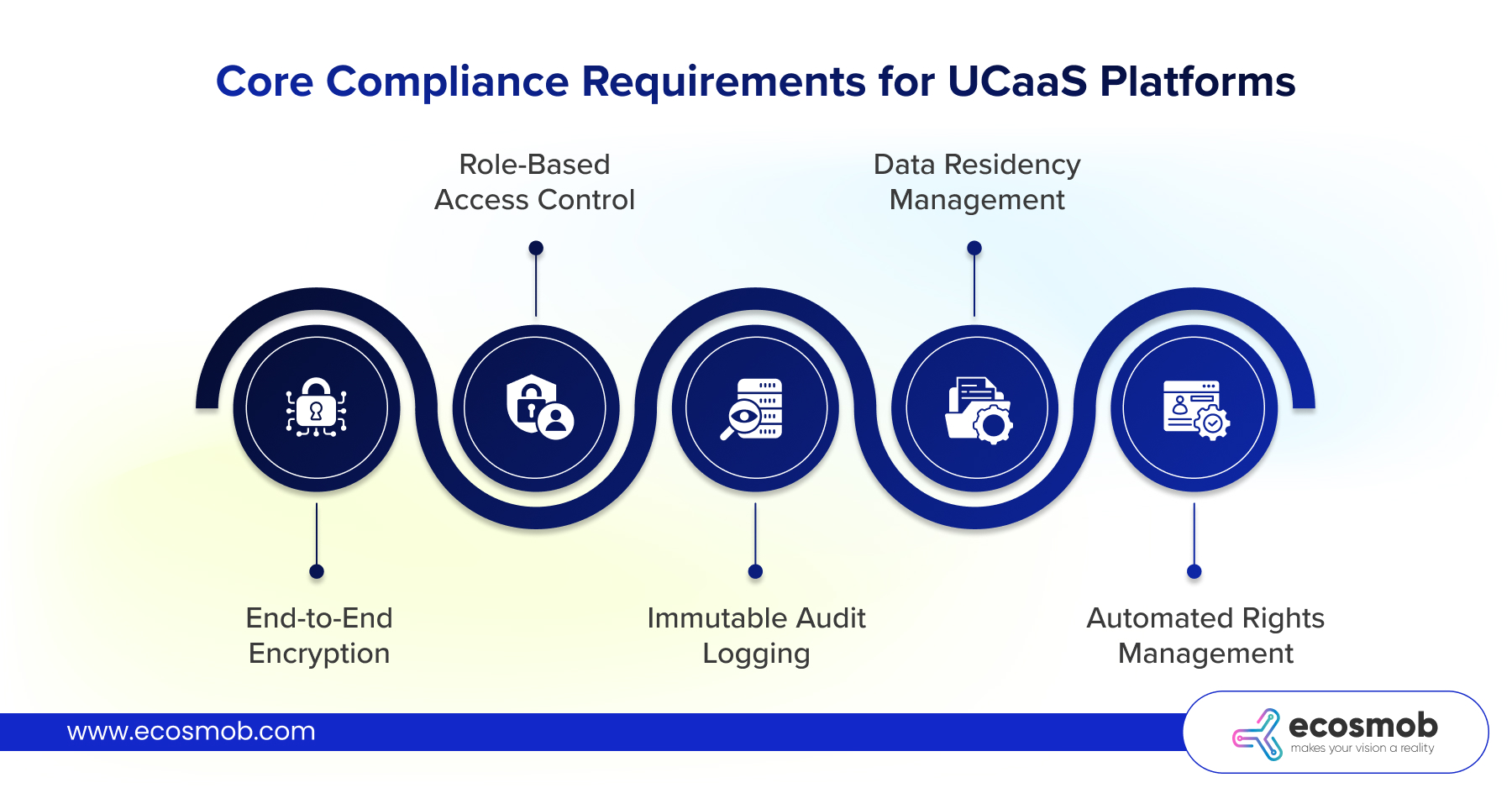
End-to-end encryption, RBAC, immutable audit logs, data residency controls, and automated monitoring—all needed to protect communications and meet regulatory expectations.
How does compliance-ready architecture strengthen enterprise sales?
Enterprises only buy platforms with proven compliance. Built-in controls and certification readiness reduce procurement barriers, speed evaluations, and increase win rates in regulated sectors.
How does microservices architecture support compliant UCaaS scalability?
Microservices isolate regulated data flows while keeping general traffic fast. This separation preserves performance, maintains compliance boundaries, and supports scalable growth.
What ensures a UCaaS platform remains compliant as regulations evolve?
Modular compliance components, policy-driven controls, and automated regulatory monitoring help platforms adapt quickly to new laws without rebuilding core systems.