












QUICK SUMMARY
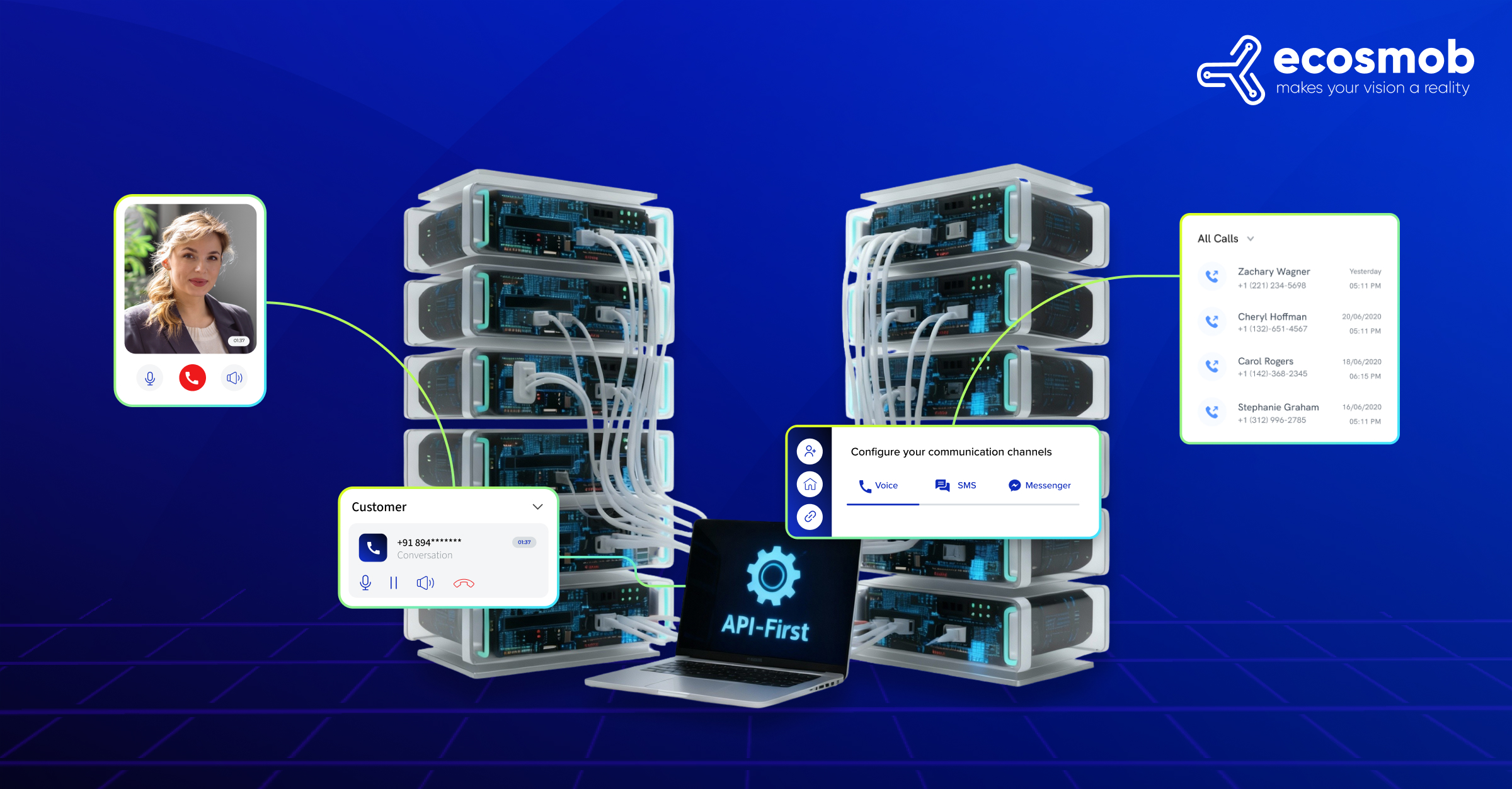
API-first UCaaS turns every call, chat, and video into actionable business data by making APIs the core architecture, not an add-on. This blog shows how API-driven platforms integrate effortlessly with CRM, ERP, and AI tools, automate workflows in real time, and scale without friction, giving telecom providers and enterprises a decisive edge as UCaaS spending rockets toward $175 billion by 2030.
Enterprise IT teams are tired of communication platforms that exist in silos.
Your CRM doesn’t know when important calls happen.
Your helpdesk can’t see the communication history.
Sales teams manually log call outcomes instead of having them automatically sync.
Support agents waste time switching between windows to piece together the customer context that should have been unified from the start.
This fragmentation is annoying, expensive, and costing enterprise growth.
Modern enterprises run on dozens of interconnected systems, and communication platforms that can’t integrate seamlessly get replaced by those that can.
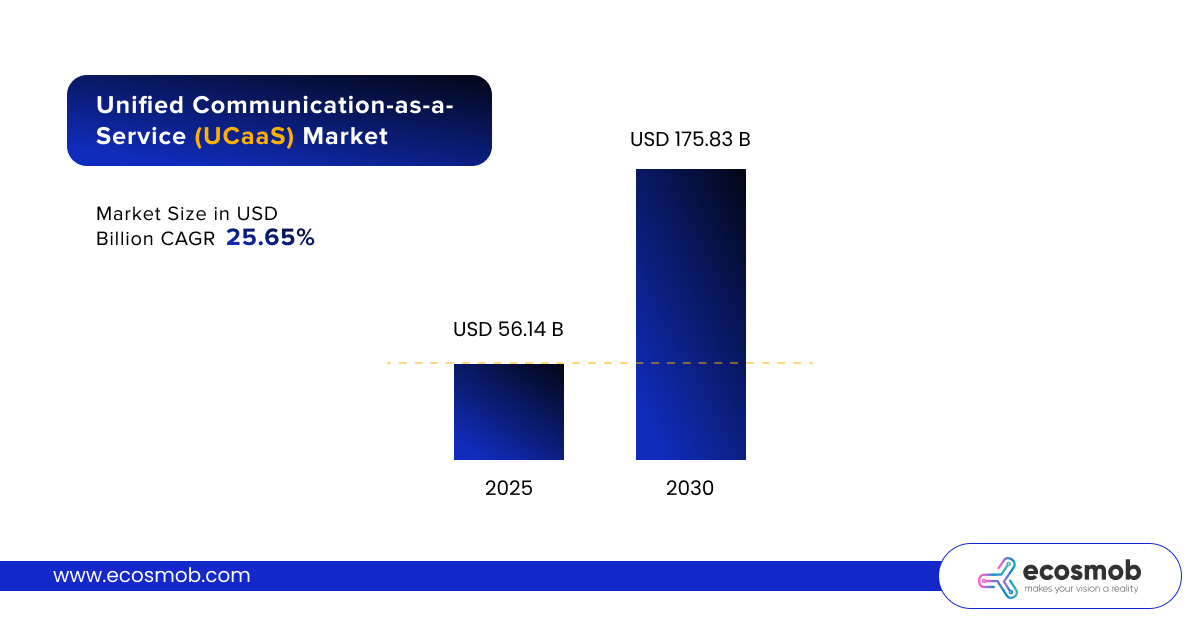 The future of enterprise UCaaS solutions belongs to platforms built with APIs as their foundation, not as an afterthought. The global UCaaS market, valued at USD 56 billion in 2025, is expected to grow to USD 175.83 billion by 2030.
But market size alone doesn’t tell the story. It’s the shift toward API-first UCaaS platforms that’s driving this explosive growth.
Companies that architect their UCaaS solutions with APIs as the central design principle will capture the majority of enterprise deals by 2030.
And those that don’t may find themselves competing on price in the shrinking market of businesses that still think communication platforms should work in isolation.
Why Do API-First Platforms Matter in UCaaS Architecture?
API-first UCaaS is about designing every platform feature to work seamlessly with other business systems. This architectural philosophy transforms communication from an isolated function into an integrated business capability.
The UCaaS Enterprise Integration Challenge
Today’s enterprises need communication capabilities that enhance existing workflows. The average enterprise uses over 1,000 different applications, and communication touches nearly every business process.
When your UCaaS platform can’t integrate with existing systems, you face a painful choice:
- Accept operational inefficiency with manual data entry and context switching
- Rebuild workflows around communication platform limitations
- Choose a different vendor that understands integration requirements
API-First vs. API-Enabled
Many UCaaS providers claim to support integrations through APIs, but there’s a fundamental difference between API-enabled and API-first platforms:
API-enabled platforms add APIs to existing functionality, often creating integration challenges:
- Limited data access through restrictive API endpoints
- Integration capabilities that feel bolted-on rather than native
- Performance issues when multiple integrations access the same resources
- Inconsistent API design that complicates development efforts
API-first platforms design every feature with integration in mind:
- Comprehensive data access through well-designed REST and GraphQL APIs
- Real-time event streaming that enables immediate workflow automation
- Consistent API architecture that accelerates integration development
- Performance optimization that maintains quality during high-integration usage
The difference determines whether your UCaaS platform becomes central to enterprise operations or remains a peripheral communication tool.
Market Demand for Integration-Ready Solutions
The shift toward remote and hybrid work has accelerated demand for integrated communication solutions. Enterprises can no longer afford communication platforms that operate independently from their digital ecosystems.
The future of UCaaS platforms must support:
- Automatic call logging and outcome tracking in CRM systems
- Dynamic routing based on customer data and interaction history
- Real-time analytics that combine communication data with business metrics
- Workflow automation that triggers based on communication events
This integration requirement has become a primary evaluation criterion for enterprise UCaaS purchases, often outweighing traditional factors like call quality or pricing.
Benefits of API-First UCaaS Solutions
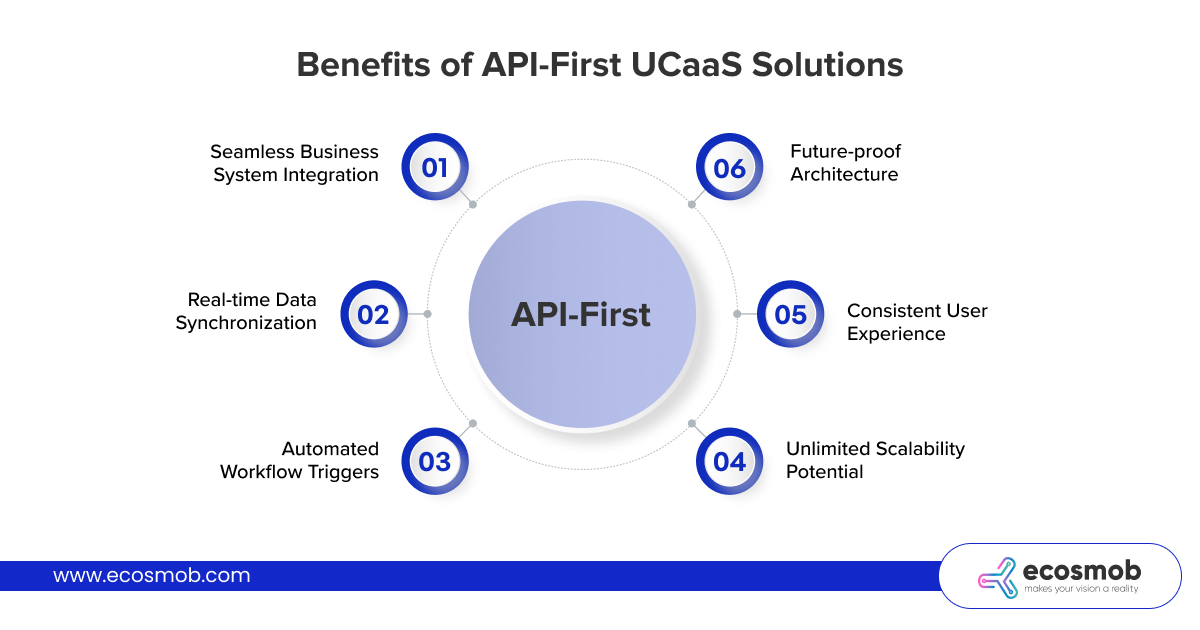
- Seamless Business System Integration
- Real-time Data Synchronization
- Automated Workflow Triggers
- Unlimited Scalability Potential
- Consistent User Experience
- Future-proof Architecture
Stop patching features. Start scaling with true API-first communications.
Why Should VoIP Companies Choose API-Driven UCaaS?
VoIP companies face a strategic inflection point. The old playbook of competing on cost savings and call quality is failing because enterprises now evaluate communication solutions based on business impact, not just features.
Today’s enterprises don’t want simple, efficient voice services.
They want communication capabilities that enhance existing workflows. They don’t care about PBX replacement; they care about VoIP CRM integration. They don’t evaluate based on per-minute pricing; they evaluate based on business impact and operational efficiency.
Traditional VoIP value propositions that no longer differentiate:
- Cost savings compared to legacy phone systems (now table stakes)
- Basic calling features and voicemail functionality (commoditized)
- Standard reliability and call quality metrics (expected, not impressive)
Modern enterprise requirements that favor API-driven platforms:
- Seamless integration with existing business workflows
- Custom communication experiences matching industry requirements
- Real-time analytics demonstrating measurable business value
- Platform extensibility that grows with changing business needs
VoIP companies that continue focusing on voice features rather than API capabilities will find themselves competing primarily on price in a shrinking market segment. But if you make the architectural transition to API-first UCaaS platforms, you’ll be one of those who will capture disproportionate market share and command premium pricing.
Traditional vs API-First UCaaS Comparison Table
| Aspect | Traditional UCaaS | API-First UCaaS |
| Architecture | Monolithic, closed system | Modular, open architecture |
| Integration Approach | Point-to-point connections | Centralized API hub |
| Data Access | Limited, restrictive endpoints | Comprehensive, flexible access |
| Customization | Vendor-dependent modifications | Self-service configuration |
| Scaling | Manual provisioning required | Automated, on-demand scaling |
| Development Speed | Sequential, waterfall approach | Parallel, agile development |
| Vendor Lock-in | High dependency, difficult migration | Platform agnostic, portable |
| Third-party Integration | Complex, expensive custom work | Native, straightforward connections |
| Workflow Automation | Limited, pre-built workflows | Unlimited, custom automation |
| User Experience | Inconsistent across touchpoints | Unified across all interfaces |
| Future-proofing | Rigid, update-dependent | Flexible, extensible foundation |
| Developer Experience | Poor documentation, complex APIs | Rich documentation, intuitive design |
How to Integrate UCaaS with CRM and Other Business Systems?
A successful enterprise UCaaS deployment must transform how your business operates by enabling integration scenarios that were previously impossible or expensive. Anything less would not be worth the money.
Let’s see how UCaaS is integrated with the most common business tools.
Ecosmob Expert Tip
Before implementing any UCaaS integration, map out your existing business workflows and identify the specific data handoff points where manual work currently happens. These handoff points are exactly where your APIs should connect systems.
This simple exercise prevents over-engineering integrations you don’t actually need while ensuring you don’t miss critical automation opportunities.
CRM Integration
UCaaS CRM integration transforms sales performance metrics.
Screen pops display complete customer context when calls arrive, automatic call logging captures outcomes and next steps, and opportunity stage updates happen based on call disposition.
Here’s how to implement UCaaS CRM integration:
- Use webhook APIs to trigger automatic contact record updates when calls begin
- Configure bidirectional sync APIs to pull customer data into communication interfaces
- Set up call disposition APIs that automatically update opportunity stages in CRM
- Implement click-to-dial functionality through REST API calls from CRM interfaces
- Deploy automatic call logging via API endpoints that capture duration, outcome, and next steps
ERP Integration
UCaaS ERP integration turns communication into business intelligence.
Real-time inventory availability during sales calls prevents overselling, automatic order status updates keep customers informed, and payment dispute resolution includes the complete financial context.
Here’s how to implement UCaaS ERP integration:
- Connect inventory APIs to display real-time stock levels during sales conversations
- Use order management APIs to automatically update customers on shipping and delivery status
- Integrate payment system APIs to provide the complete billing context during support calls
- Set up automated purchase order workflows through communication-triggered API calls
- Deploy financial reporting APIs that include communication costs and ROI analysis
Help Desk and Support System Integration
UCaaS help desk integration helps with exceptional customer experiences.
Post-call surveys automatically trigger based on interaction type, while predictive support routing directs customers to agents with the highest historical success rates for similar issues.
Here’s how to implement UCaaS help desk integration:
- Use transcription APIs to automatically convert voicemails into support tickets
- Deploy customer history APIs that attach complete interaction records to new tickets
- Configure escalation APIs that trigger based on call duration, customer satisfaction scores, or issue complexity
- Set up knowledge base APIs that suggest relevant articles based on call content analysis
- Implement post-call survey APIs that automatically collect feedback based on interaction type
AI and Automation Integration
UCaaS AI integration is now unignorable and what makes you a future-ready organization.
Sentiment analysis during calls, predictive routing based on customer behavior, and automated follow-up sequences triggered by conversation outcomes are THE formula to happier, loyal customers.
Here’s how to implement UCaaS AI integration:
- Deploy real-time sentiment analysis APIs that monitor call tone and escalate when needed
- Use machine learning APIs for predictive call routing based on historical success patterns
- Implement natural language processing APIs for automatic call categorization and tagging
- Set up chatbot integration APIs that seamlessly hand off conversations to human agents with full context
- Configure predictive analytics APIs that identify upsell opportunities during customer interactions
Own the API-first advantage before your competitors do.
How Do APIs Improve UCaaS Workflows and Automation?
APIs serve as the fundamental building blocks that enable enterprise UCaaS solutions to participate actively in business processes rather than functioning as isolated communication tools.
Real-Time Data Synchronization
Modern enterprises require immediate data consistency across all business systems.
Here’s how bidirectional data flow ensures information stays current:
- Contact updates in CRM systems immediately reflect in the communication platform directories
- Call outcomes automatically update opportunity stages and customer records
- Support ticket resolution triggers follow-up communication workflows
- Inventory changes immediately affect sales team communication (routing and scripting)
And here’s how event-driven architecture enables instant workflow automation:
- Webhook notifications trigger business processes based on communication events
- Real-time call analytics update dashboards as communications occur
- Automated follow-up sequences begin immediately after call completion
- Priority escalation workflows activate based on communication patterns
Advanced Analytics and Business Intelligence
APIs enable UCaaS platforms to contribute data that enhances overall business intelligence. It does this through:
- Revenue attribution tracking the communication’s influence on deal closure
- Customer lifetime value analysis that includes communication interaction costs and outcomes
- Marketing campaign effectiveness measurement that measures post-campaign communication results
- Team productivity analysis that relates communication efficiency to business outcomes
How Does API-First UCaaS Help You Scale Faster?
Whether you’re expanding call center operations, onboarding new enterprise clients, or rolling out communication capabilities across global offices, API-first UCaaS platforms eliminate the traditional bottlenecks that slow business growth.
This is particularly evident when asking, ‘How does API-first UCaaS help call centers scale faster?’ where the combination of high-volume requirements and complex integrations creates the perfect storm for scaling challenges.
Eliminating Traditional Scaling Bottlenecks
Traditional scaling involves painful manual processes like:
- Individual agent setup across multiple systems takes hours per user
- Manual skill-based routing configuration requires IT involvement
- Separate training on each integrated platform extends onboarding timelines
- Performance monitoring setup that delays productivity tracking
API-driven provisioning eliminates these bottlenecks:
- Single API calls that create user accounts across all integrated systems in seconds
- Automatic skill-based routing configuration based on agent profiles and historical performance
- Real-time training system integration that tracks readiness and certifications
- Performance monitoring that begins tracking metrics from day one without manual configuration
Dynamic Capacity Management
Intelligent scaling becomes easier than ever with API automation:
- Auto-scaling infrastructure that adds communication capacity based on real-time demand patterns
- Intelligent call routing that maximizes existing agent utilization before adding new capacity
- Predictive staffing models that optimize hiring timing based on integrated business forecasts
- Seasonal adjustment automation that scales operations up and down without manual intervention
Omnichannel Expansion Without System Rebuilds
API-first platforms enable organizations to expand communication channels without rebuilding core systems:
- Consistent customer context regardless of communication channel choice
- Seamless agent handoffs between voice, chat, email, and social media interactions
- Single dashboard management for supervisors overseeing omnichannel operations
- Advanced automation that includes chatbot handoffs with complete conversation context
This scalability advantage only compounds over time.
While competitors struggle with manual processes and system limitations, your API-first UCaaS platform will fuel exponential growth (with linear effort increases).
The future belongs to the connected.
The communication platforms that dominate by 2030 won’t win on voice quality or feature lists. They’ll win by becoming so deeply integrated into business operations that replacing them becomes unthinkable.
This is no longer just about technological innovation. It’s about recognizing that communication has evolved from a cost center to a revenue accelerator.
And API-first UCaaS platforms don’t just facilitate conversations, they enable the workflows, automation, and intelligence that turn every customer interaction into a competitive advantage.
Your competitors are already building API-first platforms.
They’re capturing enterprise deals not because they have better voice quality, but because they solve integration challenges that traditional UCaaS providers can’t address. They’re commanding premium pricing not for communication features, but for business capabilities that deliver measurable ROI.
All of that is within reach for you, too.
What you need is a development partner who understands the ins and outs of building an API-first UCaaS architecture that will enable you to not only connect but also integrate, automate, and accelerate growth.
And doing that is exactly what has made Ecosmob indispensable to clients worldwide.
Connect with us today, let’s evolve how you deliver communication in 2025 and beyond!
FAQs
What is an API-first solution?
An API-first solution is software designed with Application Programming Interfaces (APIs) as the primary foundation rather than a user interface. Every feature is built to be accessible and controllable through APIs first, with user interfaces built on top of these same APIs, ensuring consistent functionality across all access points.
Can UCaaS integrate with existing CRM and ERP systems?
Yes, modern API-first UCaaS platforms provide comprehensive integration capabilities with CRM, ERP, help desk, and other business systems through REST APIs, webhooks, and real-time data synchronization.
What are the main challenges when migrating to UCaaS?
The biggest challenges include legacy system integration, user adoption resistance, network bandwidth requirements, security concerns, and data migration complexity.
How does API-first UCaaS help businesses scale faster?
API-first platforms enable single API calls to provision users across all systems, automatic skill-based routing, real-time training integration, and dynamic capacity management that scales infrastructure based on demand.
What integrations are most important for UCaaS success?
The most critical integrations include CRM systems (for customer context), help desk platforms (for support workflows), ERP systems (for business intelligence), and AI tools (for sentiment analysis and automation).