













QUICK SUMMARY
By the end of this blog, you’ll know how to spot if your current VoIP system is slowing your growth, how to modernize it without a full rebuild, and how a future-ready setup enhances reliability, scalability, and performance.
You wouldn’t build a skyscraper on a decade-old foundation, yet that’s exactly what many growing businesses do with their communication systems.
When you start scaling with more teams, more clients, more channels, that old VoIP infrastructure scalability that once ran smoothly suddenly starts showing cracks.
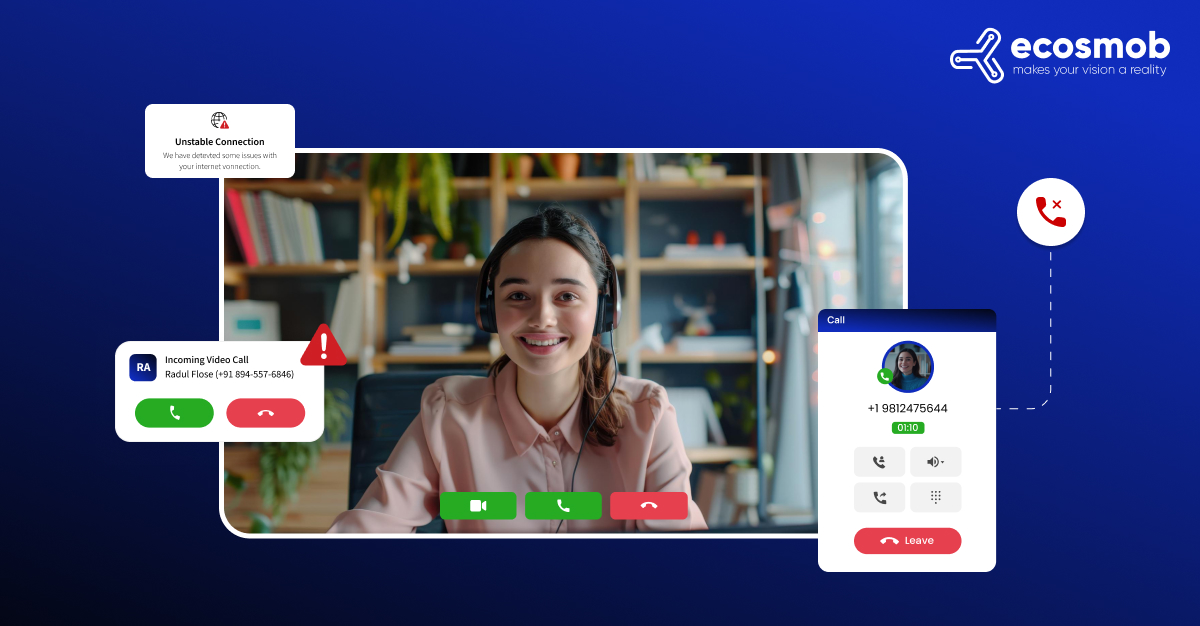
❌ Calls drop mid-meeting,
❌ voice quality fluctuates,
❌ integrations crawl, and
❌ remote teams struggle to stay connected.
The truth is, those legacy VoIP infrastructures were perfect then, but they’re bottlenecks now. They weren’t built for hybrid work, cloud integration, or the kind of scalability modern businesses demand.
And if you’re seeing these cracks already, it’s not just random tech hiccups; it’s your infrastructure telling you it’s time to evolve.
So, before you can fix what’s slowing your communication down, you need to recognize the signs your VoIP system is holding you back.
5 Signs Your Business is Facing VoIP Growth Challenges
These five warning signs aren’t just performance hiccups; they’re early indicators that your VoIP setup can’t keep pace with modern business demands.
Each one reveals a gap that, if ignored, can quietly chip away at efficiency and scalability.
Spot them early, and you’ll know exactly when it’s time to modernize before communication becomes a bottleneck.
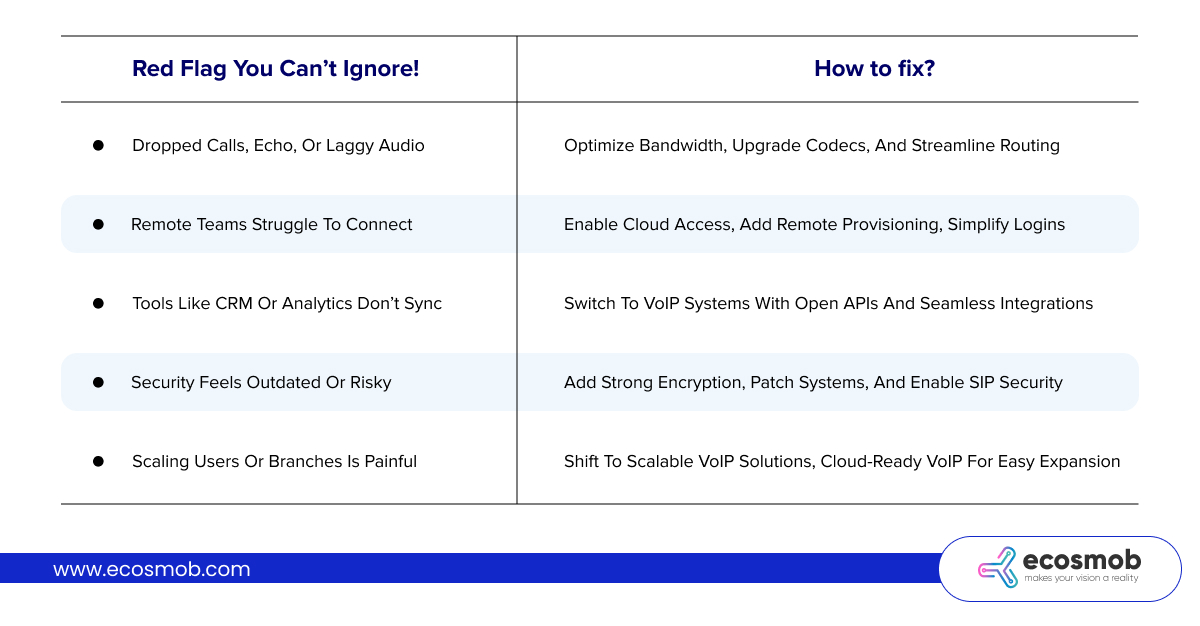
1. Call Quality and Reliability Are Inconsistent 🚩
If your business calls sound choppy, delayed, or full of echo, it’s not just a one-off technical glitch, it’s your VoIP system struggling to breathe. Traditional infrastructures often lack modern bandwidth management, still depend on old codecs, and use inefficient routing. These cracks show up as dropped calls, distorted audio, and frustrated conversations that leave customers questioning your professionalism.
And when communication, your primary business lifeline, starts faltering, it quietly eats into customer trust and potential deals.
2. Remote and Hybrid Teams Face Connection Issues 🚩
The way we work has changed, but your VoIP system probably hasn’t. Older VoIP setups were built for desk phones and office walls, not for remote logins or hybrid teams spread across locations. If your people need complicated VPN access or IT assistance just to join a call, that’s a serious bottleneck. Modern businesses thrive on flexibility, and a system that locks your team to one location simply can’t support long-term growth.
3. Tools and Systems Don’t Work Well Together 🚩
If every time you try to connect your VoIP with your CRM, helpdesk, or ticketing system, it feels like wrestling outdated tech, that’s a problem. Most legacy VoIP platforms weren’t built for today’s API-driven ecosystem. They don’t “talk” to other tools easily, leading to broken data flows and constant manual entry. That not only slows your operations but also weakens the customer experience; your team can’t see complete interaction histories or act on insights in real time.
And when your communication tools can’t collaborate, neither can your people.👎
4. Security and Compliance Feels Weak and Outdated 🚩
This one’s easy to overlook, until it’s too late. Outdated VoIP systems often lack modern encryption, miss critical patches, and don’t meet evolving compliance standards like HIPAA or GDPR. That means every call, voicemail, or stored record could become a potential vulnerability. In a time when data breaches can destroy credibility overnight, relying on unprotected communication tools is like leaving your front door unlocked.
5. Scaling Your VoIP System Gets Difficult and Expensive 🚩
If every new office or user addition feels like another IT project, your VoIP infrastructure isn’t scaling, it’s resisting. Traditional setups often demand new hardware, manual configuration, and higher maintenance just to support basic growth. And the more your business expands, the more those hidden inefficiencies pile up in downtime, complexity, and cost. Scalability should be seamless, not a tradeoff between performance and progress.
If a few of these signs felt familiar, your VoIP system isn’t failing; it’s just outgrown its original purpose, and that’s where modernization steps in.
The good news? Upgrading doesn’t mean starting from scratch!
VoIP Modernization
VoIP modernization is about upgrading your existing infrastructure to improve scalability, reliability, and security while keeping your current setup intact. It focuses on enhancing performance through better hardware, optimized routing, improved codecs, and smarter integrations.
Modernization might sound complex, but it doesn’t mean replacing everything overnight. Here’s how to start upgrading what you already have.
What’s your next step after spotting these warning signs? Ecosmob’s experts can guide your VoIP modernization roadmap.
Steps to Modernize Your VoIP System
Modernizing your existing VoIP infrastructure doesn’t always mean replacing everything.
With the right approach, you can upgrade your system’s performance, VoIP performance optimization and reliability without disrupting daily operations.
Here’s how to get started:
Step 1. Assess Your Current VoIP Environment
Start with a complete audit of your system, bandwidth usage, call performance, latency issues, and integration points.
This helps identify bottlenecks and outdated components that are slowing things down.
Without a clear baseline, modernization efforts are just guesswork.
Step 2. Upgrade Core Hardware and Software Components
Older routers, switches, or PBX hardware often limit performance even if your software is current.
Upgrading to newer codecs, optimizing SIP trunk configurations, and applying the latest firmware updates can instantly improve call clarity and stability.
Step 3. Strengthen Network and Security Controls
As VoIP traffic grows, network vulnerabilities expand too.
Implement firewalls, session border controllers (SBCs), and end-to-end encryption.
Security modernization ensures consistent uptime and protects sensitive voice data from evolving threats.
Step 4. Enable Better Integration Capabilities
Seamless integration is where most legacy systems fall behind.
Modern VoIP platforms support APIs and unified communication tools that connect your CRM, ERP, and analytics platforms.
Upgrading your integration layer ensures smoother workflows and real-time data exchange.
Step 5. Implement Cloud and Hybrid Flexibility
You don’t have to move everything to the cloud overnight.
A hybrid approach lets you gradually adopt cloud capabilities, scalability, remote provisioning, and centralized management, while retaining control of critical on-prem elements.
This gives your business the agility to grow without sacrificing reliability or VoIP performance optimization.
Once your modernization plan is in motion, the payoff isn’t just technical, it reshapes how your business communicates, collaborates, and grows.
Your customers expect clarity, but does your VoIP deliver it? Ecosmob’s custom optimization ensures every call counts.
Business Benefits of a Modernized VoIP Infrastructure
When your VoIP setup is modernized, communication stops being a background utility and becomes a true business asset. It impacts not just how your teams talk, but how efficiently they work, how securely they operate, and how easily you can scale.
Here’s what a well-planned VoIP modernization can deliver:
1. Consistent Reliability and Call Quality
Outdated systems often struggle with dropped calls, lag, or poor voice clarity, especially when user volume spikes.
A modernized VoIP infrastructure minimizes these disruptions through optimized bandwidth management, updated codecs, and intelligent routing that automatically redirects calls through the best available paths.
The result? Clearer calls, fewer complaints, and uninterrupted customer interactions, even during peak hours or network congestion.
2. Simplified Management and Lower IT Overheads
Legacy systems demand constant manual upkeep, software patches, version updates, and troubleshooting hardware dependencies.
Modern VoIP platforms consolidate all that through centralized dashboards, automated updates, and cloud-based monitoring tools.
Your IT teams can manage performance, add users, or troubleshoot remotely, reducing maintenance costs and freeing them to focus on strategic initiatives instead of firefighting technical issues.
3. Scalability That Matches Business Growth
As your workforce or customer base grows, traditional systems usually can’t keep up, you hit bandwidth limits, or you need new physical lines.
Modern VoIP architectures are designed for elasticity. You can scale up or down instantly, adding remote teams, new locations, or seasonal agents without any major infrastructure changes.
This flexibility keeps you agile, ready to handle VoIP growth challenges, and manage VoIP infrastructure scalability confidently.
4. Stronger Security and Data Protection
Voice data is as critical as any digital asset, and legacy systems are often easy targets for breaches.
Modern VoIP setups incorporate advanced encryption, secure SIP protocols, SBCs (Session Border Controllers), and real-time threat monitoring to keep conversations private and compliant with data regulations.
This not only protects your business from costly downtime or leaks but also strengthens customer trust.
5. Seamless Integration Across Business Tools
Modern communication systems no longer exist in isolation.
By integrating VoIP with your CRM, ERP, ticketing, and analytics platforms, you enable smarter workflows in which every call, ticket, or customer touchpoint is connected.
Agents can view customer histories before answering calls, sales teams can log interactions automatically, and managers get unified analytics to improve decisions.
Integration turns your communication network into a data-rich hub that drives efficiency and customer satisfaction.
6. Enhanced Remote and Hybrid Work Experience
As flexible work models become the norm, your communication infrastructure must support seamless collaboration from anywhere.
Modernized VoIP systems enable remote provisioning, mobile extensions, and unified communication apps that let employees stay connected across devices and time zones.
Whether your teams are in the office, on the road, or working from home, they experience the same reliability, voice quality, and security, without needing complex VPNs or hardware setups.
7. Future-Ready Agility
Technology evolves fast, and so do customer expectations.
A modern VoIP infrastructure ensures your system can adapt to new features, integrations, and AI-driven capabilities without another full-scale migration.
From intelligent call routing to speech analytics and automation, modernization lays the groundwork for continuous innovation with scalable VoIP solutions that grow with your business.
A modern VoIP setup doesn’t just upgrade your communication system; it strengthens your entire operational backbone. It reduces friction, scales with growth, and positions your business for the digital-first future that’s already here.
Of course, realizing these benefits takes more than technology, it takes the right strategy and expertise to make modernization seamless.
If downtime costs you deals, your VoIP needs a rethink. We help you rebuild resilience from the ground up.
How Does Ecosmob Help?
At Ecosmob, we help businesses future-proof their communication ecosystem through modernized, custom, scalable VoIP Solutions and infrastructure migration services.
Our experts assess your current environment, identify performance and scalability gaps, and deliver tailored solutions that align with your business goals, not just your tech stack.
From network optimization to VoIP migration, we design systems that evolve as you grow, ensuring your communication stays consistent, secure, and future-ready.
With Ecosmob’s tailored VoIP solutions, modernization isn’t just an upgrade, it’s a transformation built around your growth goals.
The Bottom Line?
Ignoring the warning signs of outdated VoIP infrastructure can quietly cost your business in downtime, inefficiency, and missed opportunities.
Modernization isn’t a luxury anymore; it’s a long-term strategy to keep your communication reliable, scalable, and competitive in a fast-changing world.
Key Takeaways:
- Modernization enhances your existing VoIP system; migration rebuilds it for the future.
- You can modernize in stages without switching your entire infrastructure.
- A future-ready VoIP setup delivers scalability, reliability, and security, all in one ecosystem.
Ready to upgrade your communication without disrupting business continuity? Talk to Ecosmob’s VoIP experts and discover how a smarter, modernized infrastructure can drive your next phase of growth.
FAQs
What does it mean when a VoIP system is “not ready for growth”?
It means your current VoIP setup can’t keep up with expanding teams, higher call volumes, or modern business tools. You’ll notice signs like poor call quality, lag, or trouble integrating with CRMs and remote setups, all of which slow down scalability and productivity.
How can I tell if my business needs VoIP modernization?
If you frequently deal with dropped calls, outdated interfaces, limited integrations, or difficulty supporting remote teams, it’s a clear sign your system needs modernization. These are early indicators that your VoIP infrastructure is falling behind your business growth curve.
What is the difference between VoIP modernization and VoIP migration?
VoIP modernization means upgrading your existing infrastructure, improving bandwidth, updating codecs, adding better integrations, and enhancing security.
VoIP migration, on the other hand, involves moving to a new or cloud-based VoIP environment entirely. Both aim for better scalability and performance, but modernization lets you build on what you already have.
Can I modernize my VoIP system without replacing it completely?
Absolutely. With a structured approach, assessing your current setup, upgrading core components, and strengthening integrations, you can modernize your VoIP system without full replacement. This minimizes downtime and ensures continuity while improving performance.
Why does VoIP modernization matter for remote and hybrid teams?
Legacy VoIP systems were designed for office-based setups, not distributed teams. Modernized VoIP solutions support cloud access, remote provisioning, and device flexibility, ensuring your teams stay connected and productive from anywhere.