
A customer calls your support line with a simple billing question. Your voicebot confidently mishears “account balance” as “count balanced” and launches into inventory management options. After three increasingly frustrated attempts to course-correct, the customer hangs up, tweets about your terrible service, and calls your competitor instead.
Here’s what really happened: It wasn’t background noise or the customer’s accent. It was a poorly chosen AI model that you thought might be “good enough” during testing, but crumbles under real-world conditions. And this single model decision is now bleeding customers, revenue, and reputation in ways that compound daily.
Most businesses deploy intelligent voicebots expecting to slash support costs while boosting customer satisfaction. Instead, they’ve accidentally created expensive customer experience disasters that need more human babysitting than old-school phone trees ever did.
The difference between voicebots that lift your business and those that torpedo it?
One critical factor: accuracy of intelligent voicebots.
Let’s break down exactly how this plays out, and what you can do about it.
What Happens When Voicebot Accuracy Fails?
When your voicebot misunderstands customer intent, it doesn’t just serve up the wrong answer. It triggers a psychological and technical cascade that destroys the entire interaction.
The Initial Misfire
Your customer says “billing issue,” but your model’s acoustic processing decides they said “building lease.” Your bot confidently launches into property management options, immediately confusing someone.
The Confidence Score Spiral
Now the customer repeats themselves, speaking slower and more deliberately. But this actually makes your acoustic model perform worse because it’s trained on natural speech patterns. Your system’s confidence scores plummet, triggering generic fallback responses like “I didn’t understand that, could you rephrase?”
The Final Straw
Frustrated, the customer tries completely different words: “I need help with my monthly charges.” But your intent classification wasn’t trained for this variation, so it maps the request to yet another wrong category.
Game over. The customer has now burned three minutes in a misunderstanding loop.
Unlike text chatbots, where users can easily rephrase or clarify, voice interactions happen in real-time with no simple correction mechanism. When the customer faces conversational AI accuracy issues, there’s no graceful recovery, just mounting frustration that human agents inherit along with the original problem.
Why Do Customers Abandon Voicebots for Human Agents?
The voicebot market is forecasted to reach USD 54.64 billion by 2034 from USD 8.69 billion in 2025. And yet, customers often abandon frustrating conversations with voicebots for human agents.
Customer confidence in automated systems works like a switch. One accurate interaction builds trust; one failure destroys it completely.
The Binary Trust Problem
When your voicebot nails the first request, customers willingly engage with complex queries and share information. But when voice AI challenges occur early? They immediately shift into “this doesn’t work”.
Predictable Behavioral Patterns
Watch your call analytics for these telltale signs of accuracy-driven frustration:
- Customers speaking slower, louder, or using overly simplified language (which paradoxically makes AI models perform worse)
- Immediate use of phrases like “representative,” “agent,” or “human” within seconds of the first accuracy failure
- The dreaded “press 0” reflex, where customers preemptively avoid voicebots altogether after one bad experience
The Context Loss
Here’s what really burns customers: when they get transferred to human agents, they must restart their entire story. The voicebot’s confusion didn’t just waste their time; it forced them to repeat problem descriptions to multiple systems.
This violation of “seamless service” expectations creates lasting negative associations with your brand.
The Ripple Effect
These frustrated customers don’t just leave quietly. They share voicebot horror stories in online reviews, social media posts, and casual conversations, creating negative brand associations that influence prospects who’ve never even used your system.
How Do You Know Your Voicebot Model Is Failing?
Early detection requires monitoring both customer behavior patterns and technical symptoms that predict major accuracy breakdowns.
Models that perform beautifully in controlled testing environments often collapse when deployed at scale with diverse customer populations. Real-world voice input includes accents, background noise, emotional speech patterns, and domain-specific terminology that laboratory conditions miss entirely.
 Customer Behavior Warning Signs
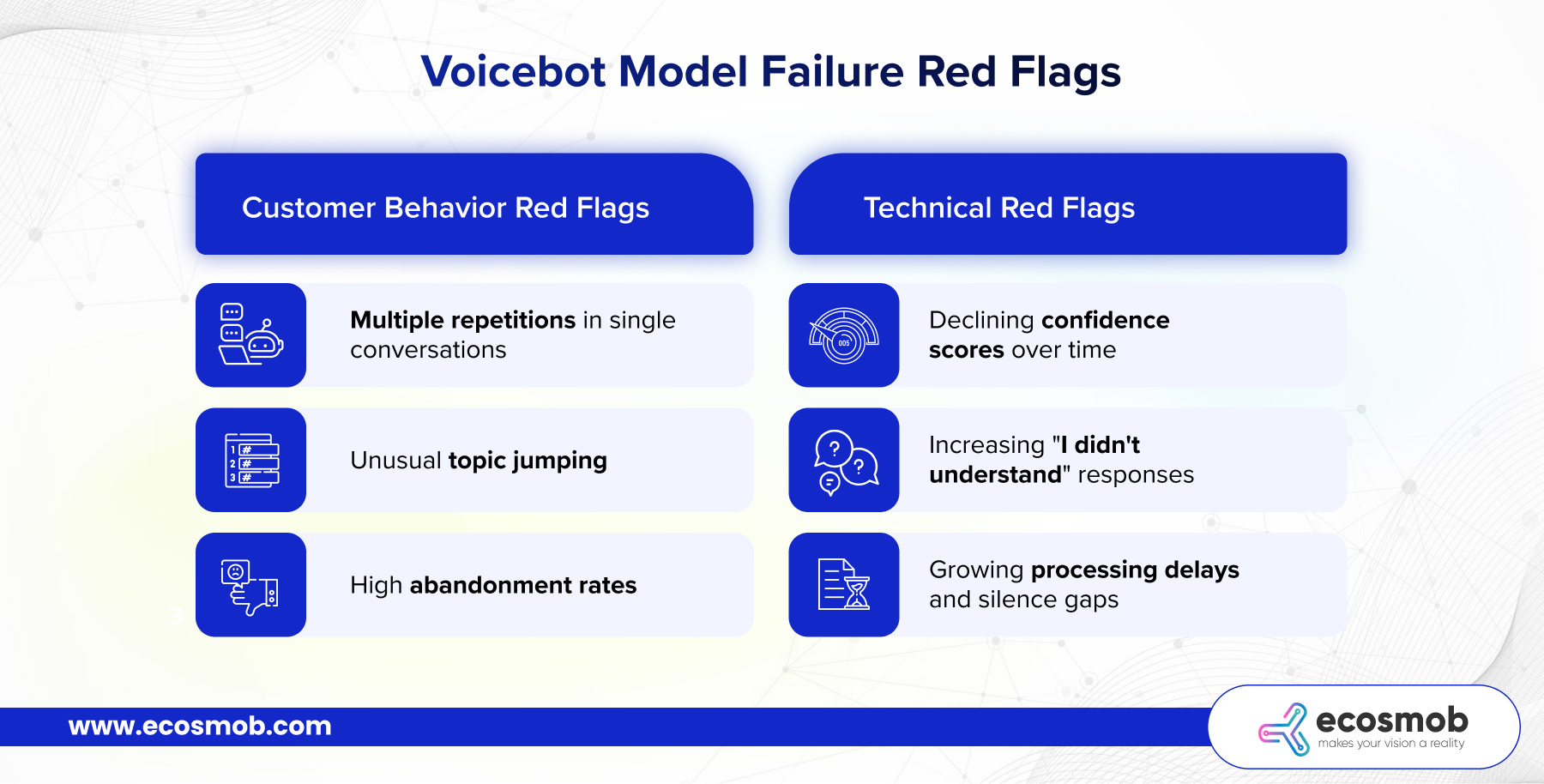
- Repetition Loops: Customers repeating themselves multiple times in single conversations (indicates intent recognition accuracy is lower than confidence scores suggest)
- Topic Jumping: Unusual conversation flows where customers jump between unrelated subjects (signals bot responses don’t match expectations)
- Branch Abandonment: High dropout rates in specific dialog paths (reveals systematic accuracy problems in certain domains)
Technical Warning Signs
- Declining Confidence Scores: Intent recognition confidence dropping over time (classic model drift indicator)
- Increasing Fallback Responses: More “I didn’t understand that” responses (system encountering inputs it can’t process)
- Processing Delays: Growing silence gaps as algorithms struggle with acoustic processing or intent classification
Ecosmob Expert Tip
Before testing your voicebot’s accuracy, create a matrix of your most common customer requests using actual call transcripts from the past 6 months. Test your AI model specifically against these real-world variations.
This reveals accuracy gaps that standard testing misses and prevents the costly surprise of model failure after deployment.
The Business Impact of Voice AI Accuracy Challenges
Voice AI challenges generate measurable business damage across multiple departments and revenue streams.
Brand Reputation Takes the Hit
Digital channels amplify voicebot failures faster than traditional complaints ever could. Customers experiencing accuracy problems are significantly more likely to leave reviews specifically mentioning “terrible phone system” or “useless voicebot”, directly linking your automation failures to broader service quality perceptions.
The Silent Customer Exit
Here’s the scary part: most frustrated customers don’t complain. They just quietly reduce their business with you or switch to competitors entirely.
And these are often efficiency-focused clients who expect your technology to work seamlessly.
Agent Workload Spike
When voicebot accuracy fails, it multiplies agent workload:
- More escalated calls from already-angry customers
- Longer calls due to context reconstruction
- Increased pressure to resolve problems that automation should have handled
- Higher turnover rates and decreased job satisfaction
The Bad Feedback Loop
Poor voicebot interactions create negative customer experiences, which generate negative sentiment in recorded calls, which becomes contaminated training data if fed back into your model improvement process. Without careful data curation, the accuracy of your intelligent voicebots actually degrades as you attempt to improve it.
These impacts interconnect and multiply. Customer churn drives up acquisition costs, negative reviews tank conversion rates, and agent turnover inflates training expenses.
How Wrong AI Model Choices Cost You
Poor model selection doesn’t just fail to reduce costs; it creates expensive operational problems that can exceed human-only customer service expenses.
Organizations typically choose AI models based on initial accuracy benchmarks or flashy vendor demos rather than real-world performance characteristics. A model achieving 95% accuracy on standardized datasets might perform 20% worse on your specific customer inquiries, regional accents, or industry terminology.
Teams often try fixing accuracy problems by throwing more training data at fundamentally inappropriate models. This burns significant engineering resources while producing minimal improvement because the underlying architecture can’t effectively utilize additional information.
Cost Multiplication Mechanics
- Extended Call Times: Poor accuracy forces customers through incorrect response paths and repetition cycles
- Human Escalation Overload: You’re paying for both automated systems AND increased human labor
- Training Cycles: Ongoing investment in data collection, model retraining, and quality assurance testing
- Customer Replacement: Marketing spend to acquire new customers, replacing those lost to bot failures
Such poor model performance forces architectural band-aids like workarounds, fallback mechanisms, and additional monitoring systems. These modifications create technical debt that makes future improvements exponentially more expensive and time-consuming.
Also, learn about Call Center Automation with AI Voicebot.
Why You Should Continuously Evaluate Your AI Model
Model drift represents the most underestimated risk in production voicebot deployments. Your AI models naturally degrade as real-world conditions evolve beyond original training parameters.
Voicebot accuracy isn’t static. It’s constantly influenced by:
- Seasonal language variations and trending terminology
- New product launches introducing unfamiliar vocabulary
- Demographic shifts in your customer base
- Evolving customer service expectations and communication styles
Models performing excellently six months ago may now struggle with requests they would have handled perfectly at launch.
The Multi-Dimensional Evaluation Framework
You need to measure several performance aspects simultaneously:
- Intent Accuracy: Does the bot correctly identify what customers want to accomplish?
- Entity Extraction: How well does it identify specific information like account numbers, dates, and product names?
- Conversation Completion: Are customers actually achieving their goals through bot interactions?
- Response Relevance: Do bot answers actually address customer questions?
- Speed Metrics: Are accurate responses arriving quickly enough to maintain conversation flow?
These metrics can diverge significantly. Your bot might understand someone wants billing information, but fail to extract their account number correctly.
Building Effective Feedback Loops
Successful evaluation requires systematic collection and analysis of:
- Interaction transcripts and confidence scores
- Customer satisfaction ratings and behavioral patterns
- Human agent notes about transferred calls
- Processing times and system performance metrics
This data must be processed and acted upon regularly. Waiting for customer complaints means discovering accuracy issues weeks or months after they start damaging customer experience.
Preventive vs. Reactive Approaches
Smart organizations establish baseline metrics, set alert thresholds, and implement regular performance reviews before problems surface. Reactive approaches that depend on customer feedback consistently discover major issues too late to prevent significant business impact.
Ecosmob’s Custom AI Voicebot Solutions
Most teams obsess over training data quantity when addressing voicebot accuracy problems. Our breakthrough insight?
Conversational AI accuracy issues usually stem from domain mismatch, not just insufficient model sophistication. Your voicebot needs to understand how your customers talk about your products and services, not achieve high scores on general language benchmarks.
Instead of adapting generic systems to your business, we build AI voicebots for your customers that scale and integrate as easily as they resolve customer issues.
With your custom AI voicebot, you can:
- Handle Inbound Support Calls
- Replace Old IVRs
- Capture Voicemails & Route Them Smartly
- Train & Coach Your Agents
- Route to Human Agents or Extensions
- Run Outbound Campaigns
- Book Appointments by Voice
Building Voicebot Systems That Actually Work
Sustainable voicebot accuracy starts with architectural principles that prioritize monitoring, flexibility, and continuous improvement over initial deployment speed.
API-First Architecture Essentials
Your infrastructure must support:
- Real-time accuracy measurement and alert systems
- A/B testing capabilities for model updates
- Seamless model switching without system downtime
- Comprehensive logging of conversations, confidence scores, and performance metrics
Model Selection Beyond Accuracy Scores
Successful implementations prioritize models that:
- Perform well on your specific customer language patterns (not just benchmark datasets)
- Integrate effectively with your existing technology stack
- Support necessary customization for your industry vertical
- Maintain accuracy and stability over time, not just peak performance
Integration Planning That Prevents Problems
Your voicebot requires:
- Integration with CRM systems for customer information
- Product databases and inventory status
- Transaction histories and account details
- Support ticket records and interaction logs
Poor integration architectures force voicebots to operate with incomplete information, creating accuracy problems that appear to be AI failures but actually stem from data accessibility issues.
Deployment Best Practices
- Test with actual customer service transcripts, not synthetic data
- Assess performance across different demographic groups and accent patterns
- Analyze computational requirements for expected call volumes
- Implement shadow mode testing before full deployment
- Plan gradual rollout strategies that limit exposure to potential regressions
Have You Heard About Voicebot Connector Technology?
Most companies building AI voicebots focus on the AI models, but few address the critical integration gap between existing telephony infrastructure and modern AI platforms.
And that is why we’ve built a Voicebot connector!
We’ve designed it as a specialized middleware that streams live RTP audio directly from your telephony system to third-party voicebot platforms and routes responses back seamlessly. This eliminates the complex integration work that typically delays voice AI deployments by months.
Using a proper Kubernetes management tool helps you monitor usage, optimize costs, and make sure every resource is working for you, not against your budget.
What qualifies your voicebot as a good fit for your business is simple.
Your voicebot should enhance customer experience while reducing operational costs.
For that, you need to choose appropriate AI models, implement comprehensive monitoring systems, and maintain optimization processes that keep accuracy aligned with customer expectations.
Your customers expect seamless automated experiences.
And your competitors are implementing accuracy-first voicebot strategies that deliver those experiences. It’s time you implement it, too, before really discovering how much customer churn can cost your business.
Ready to build AI voicebot solutions that serve their purpose instead of accidentally driving customers away? Let’s start!
Frequently Asked Questions
Voicebot misunderstandings typically stem from poor acoustic processing, inadequate training data, background noise interference, or intent classification failures. When AI models aren’t trained on your specific industry terminology, customer accents, or typical conversation patterns, they struggle to accurately interpret requests and provide relevant responses.
Monitor conversation abandonment rates, escalation patterns to human agents, and customer satisfaction scores, specifically after voicebot interactions. Declining Net Promoter Scores combined with increasing “press 0” requests within 30 seconds of call start indicate accuracy-driven customer frustration that leads to churn.
Watch for increasing fallback responses, growing silence gaps during processing, customers jumping between unrelated topics in single conversations, and rising escalation rates to human agents. These patterns indicate systematic accuracy problems that will worsen as call volume increases and customer diversity expands beyond your initial testing parameters.
Generic models offer faster deployment but may struggle with industry-specific terminology, regional accents, or unique business workflows. Custom models require longer development time but deliver better accuracy for your specific customer base, terminology, and use cases. Consider your accuracy requirements, budget, and timeline constraints.
Look for declining confidence scores, increasing fallback responses, growing customer frustration patterns, and rising escalation rates to human agents. If accuracy problems persist despite optimization efforts, or if your business requirements have significantly evolved, model replacement may be necessary.