
Conversation is a two-way street. Definitely.
Now imagine calling customer support, explaining your problem, and hearing only the same automated response: Beep. Press 1. Press 2. Over and over again.
Frustrating, right?
This is the type of experience that businesses aim to improve with conversational AI, including modern AI voicebot solutions designed to understand spoken language and respond more intelligently.
In this guide, we’ll explore real-world examples of conversational AI from companies that have implemented these technologies, along with how they are using them to improve customer interactions and business processes.
Let’s first see what conversational AI actually is.
What is Conversational AI?
Conversational AI combines technologies such as natural language processing (NLP), speech recognition, machine learning, and generative AI to understand human language, identify intent, and generate relevant responses across voice and text interactions.
For your business, this can mean handling customer questions, guiding users through processes, scheduling appointments, or providing support without requiring a human agent for every interaction. Depending on your use case, conversational AI can work across chat, messaging, websites, mobile apps, and voice channels such as contact centers.
So, where can conversational AI make the biggest difference for your business?
Why Businesses are Investing in Conversational AI
Conversational AI helps you manage high interaction volumes, automate repetitive tasks, deliver consistent responses, support customers across channels, engage leads, and reduce your support team’s workload without compromising the customer experience.
1. High Interaction Volumes
Your customers may reach you through websites, apps, messaging platforms, and phone calls. Conversational AI helps you handle these interactions simultaneously without overwhelming your support team.
2. Repetitive Task Automation
Many of your customer queries involve routine tasks such as order tracking, account information, or appointment scheduling. Conversational AI can handle these interactions while your agents focus on more complex requests.
3. Consistent Customer Responses
Your customers expect accurate information every time they interact with your business. Conversational AI can provide consistent responses across interactions, regardless of call or message volume.
4. Omnichannel Communication
Your customers may switch between chat, voice, mobile apps, and messaging platforms depending on their needs. Conversational AI helps you maintain connected conversations across these channels while preserving context.
5. Lead Engagement and Qualification
You can use conversational AI to engage website visitors, answer product questions, qualify leads, and guide prospects toward the information or solution they need.
6. Agent Workload Reduction
When conversational AI handles your routine customer interactions, your agents have more time to focus on complex issues that require human judgment and attention.
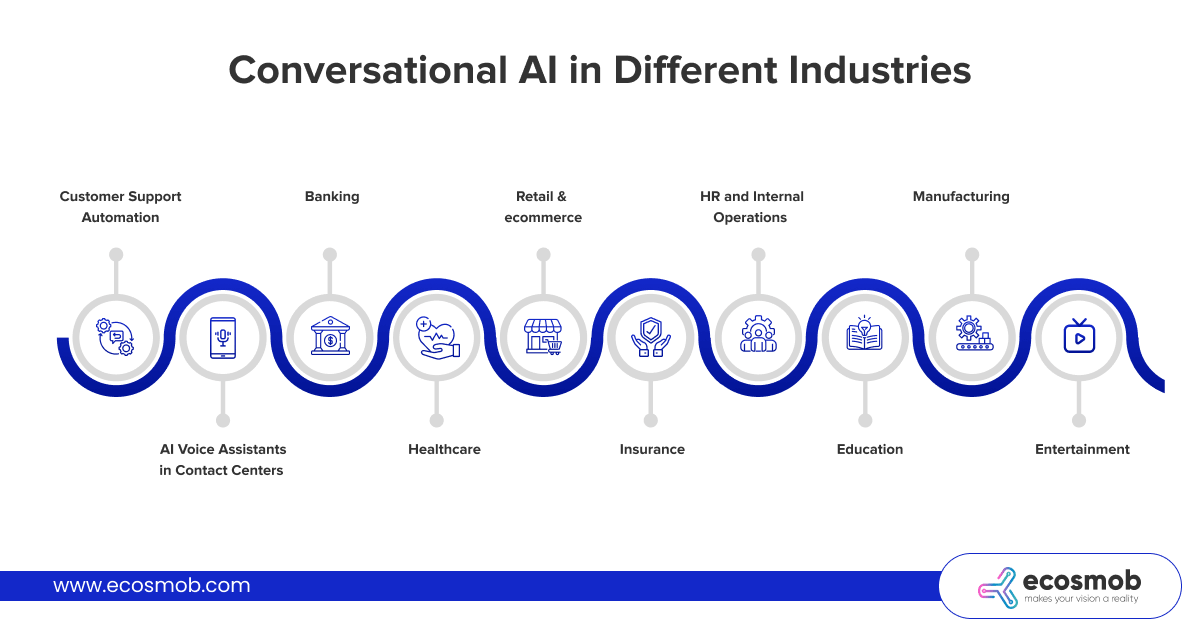
From customer support to banking and healthcare, let’s look at how businesses are using conversational AI in the real world.
1. Customer Support Automation
One of the most common examples of conversational AI is customer support automation.
Many businesses receive thousands of repetitive support questions like:
- “Where is my order?”
- “How do I reset my password?”
- “What are your working hours?”
Instead of making customers wait for human agents, conversational AI chatbots handle these queries instantly.
These bots can:
- Answer FAQs
- Provide order tracking updates
- Guide users through troubleshooting steps
- Escalate complex issues to human agents
For companies, this significantly reduces support workload while improving response time.
Real-world example: One of our legal-sector clients uses conversational AI to streamline customer interactions and automate routine support requests. The solution helps users get relevant information through a conversational interface while reducing the need for human intervention in repetitive interactions. This shows how conversational AI can support service-heavy businesses where customers often need quick answers before moving to more complex assistance.
2. AI Voice Assistants in Contact Centers
Another powerful conversational AI example is the AI voicebot used in customer call centers.
Traditional IVR systems often frustrate users because they follow rigid menu structures. Conversational AI changes that.
Instead of pressing buttons, users can simply say things like:
“Check my account balance.”
“I want to change my booking.”
“I need help with my internet connection.”
The AI system understands the request and either resolves it or routes the call to the right department.
Industries using this heavily include:
- Telecom providers
- Airlines
- Banks
- Insurance companies
Voicebots help reduce call wait times and improve overall customer experience.
Real-world example: DoorDash uses generative AI to enhance its voice-based customer support experience. Its solution builds on an existing self-service conversational AI IVR and uses generative AI to help users resolve common support issues without immediately transferring to a live agent. According to AWS, the system was designed specifically for Dashers who often prefer phone support while on the road, with low response latency being an important requirement. The solution reached response times of 2.5 seconds or less during testing and was designed to handle the high volume of support requests received by DoorDash each day.
3. Conversational AI Use Cases in Banking
Banks are among the earliest adopters of conversational AI.
Digital banking assistants are now integrated into mobile apps and websites to help customers perform routine tasks quickly.
Common conversational AI use cases in banking include:
- Checking account balances
- Viewing recent transactions
- Transferring funds
- Blocking lost cards
- Detecting suspicious transactions
- Answering financial queries
For example, many banks provide AI assistants that allow customers to simply type or speak commands instead of navigating complex menus.
This makes digital banking faster and more user-friendly.
Real-world example: ABN AMRO uses its conversational AI assistant, Anna, to help customers with common banking questions and service requests. The assistant can provide information about products, payments, and other routine banking needs, allowing customers to get answers without always relying on a human representative. This shows how conversational AI can make banking support more accessible while handling high volumes of repetitive customer interactions.
4. Conversational AI Use Cases in Healthcare
Healthcare is another industry where conversational AI is making a major impact. Hospitals and healthcare providers use AI assistants to handle routine patient interactions.
Some common conversational AI use cases in healthcare include:
- Booking medical appointments
- Answering health-related questions
- Reminding patients about medication
- Guiding patients through pre-visit instructions
- Providing post-treatment follow-ups
Virtual health assistants help reduce administrative workload while making healthcare services more accessible to patients.
Real-world example: Humana uses conversational AI to help healthcare providers get answers to routine questions about member eligibility, benefits, claims, authorizations, and referrals. Its conversational voice assistant understands the intent behind a provider’s request and delivers the relevant information without requiring a live agent. The solution handled more than 7,000 voice calls per business day from 120 providers, showing how conversational AI can support high-volume healthcare interactions while reducing pressure on contact-center teams.
5. Conversational AI in Retail and E-commerce
Online retailers are increasingly using conversational AI to improve the shopping experience.
AI-powered shopping assistants help customers find products faster and make better purchase decisions.
Examples include bots that:
- Recommend products based on user preferences
- Help customers locate items in online catalogs
- Provide shipping updates
- Assist with returns and refunds
These assistants act like a digital sales representative, guiding customers through the buying process.
For e-commerce businesses, this often leads to higher conversion rates and better customer engagement.
Real-world example: Carrefour uses conversational AI to help customers make purchasing decisions through natural-language interactions. Its Hopla chatbot can recommend products based on a customer’s budget, dietary preferences, or meal ideas, and can connect those conversations to relevant products on Carrefour’s website. This shows how conversational AI can move beyond customer support to guide product discovery and make the shopping journey more personalized.
6. Conversational AI in Insurance
Insurance providers deal with complex processes like claims, policy renewals, and customer inquiries. Conversational AI helps simplify these interactions.
Common conversational AI for insurance use cases include:
- Answering policy-related questions
- Guiding customers through claims submission
- Providing claim status updates
- Reminding users about policy renewals
- Helping customers compare coverage options
This reduces processing time while improving transparency for policyholders.
Real-world example: Zurich Insurance has used conversational AI to provide customers with 24/7 support for routine insurance requests. Its virtual assistant, Zuri, helps customers manage policies, get answers to common questions, and handle tasks such as modifying personal details and submitting claims or withdrawal requests. The solution also routes more complex queries to human experts, showing how conversational AI can automate routine insurance interactions while keeping human support available when needed.
7. Conversational AI for HR and Internal Operations
Conversational AI isn’t only used for customer interactions. Many organizations also use it internally. Companies deploy AI assistants to help employees access information quickly.
Some HR-related conversational AI use cases include:
- Answering HR policy questions
- Managing leave requests
- Helping employees with onboarding
- Assisting with payroll queries
- Providing IT support guidance
These internal assistants reduce repetitive HR workload and help employees find answers without waiting for support teams.
Real-world example: Unilever uses conversational AI to support employees with routine HR queries. Its Unabot acts as a personalized HR assistant, helping employees find information about topics such as allowances and performance appraisal forms. The chatbot was designed to handle transactional questions at scale, reducing the time HR teams spent responding to repetitive requests and allowing them to focus on higher-value activities.
8. Conversational AI in Education
Educational institutions are also exploring conversational AI to support students and educators.
AI assistants in education can help with:
- Answering course-related questions
- Guiding students through enrollment processes
- Recommending learning resources
- Reminding students about deadlines
- Assisting with exam preparation
Some universities even deploy AI tutors that provide personalized learning support.
This makes education more interactive and accessible for students.
Real-world example: Georgia State University uses its AI-powered chatbot, Pounce, to provide students with 24/7 support through text messaging. Students can ask questions about financial aid, registration, immunization records, housing, and other enrollment requirements. When Pounce cannot answer a question, it can route the query to university staff. During its first summer of implementation, the chatbot delivered more than 200,000 answers and helped Georgia State reduce summer melt by 22%, showing how conversational AI can extend student support beyond traditional office hours.
9. Conversational AI in Manufacturing
Manufacturing companies are using conversational AI in ways that many people don’t expect.
Factories often rely on complex machinery and technical procedures. AI assistants help workers access information quickly.
Some conversational AI use cases in manufacturing include:
- Troubleshooting equipment issues
- Providing maintenance instructions
- Guiding technicians through repair processes
- Offering safety instructions
- Assisting with training
Instead of searching through manuals, technicians can simply ask the AI assistant for guidance.
This improves efficiency and reduces downtime.
Real-world examples: BMW Group uses an AI maintenance assistant called Factory Genius to help production employees troubleshoot manufacturing equipment. Employees can describe a machine problem in natural language, and the assistant searches internal equipment manuals, fault reports, quality data, and planning documents to suggest relevant solutions. By making this information accessible through a conversational interface, BMW aims to reduce the time needed to diagnose equipment faults and get production systems running again.
10. Conversational AI in Entertainment
Conversational AI is also appearing in the entertainment industry.
Streaming platforms, gaming companies, and media services use conversational interfaces to improve user engagement.
Examples include:
- AI-powered content recommendations
- Interactive characters in video games
- Virtual companions
- Chat assistants on streaming platforms
These experiences create more personalized and immersive entertainment environments.
Real-world example: Next up is probably a favorite of yours and mine: Spotify, a brand that always strikes the right chord. Spotify is exploring conversational AI to make music discovery more interactive. Its conversational recommendation agent lets users describe what they want in natural language, refine their requests during the conversation, and ask follow-up questions about recommended artists or songs. In a 2026 A/B test across approximately 15 million users, Spotify reported a 14% increase in additional listening and a 5% increase in weekly active users after introducing the conversational experience.
Here’s a quick overview of how conversational AI is used across industries.
| Industry | Conversational AI Example | Key Use Case |
| Banking | Digital banking assistant | Balance inquiries and transactions |
| Healthcare | Virtual health assistant | Appointment scheduling |
| Retail | AI shopping assistant | Product recommendations |
| Insurance | Claims chatbot | Claims processing |
| Customer Support | Helpdesk chatbot | Automated support |
| HR | Employee assistant | HR policy queries |
| Education | AI tutor | Student guidance |
| Manufacturing | Technician assistant | Equipment troubleshooting |
This table highlights how versatile conversational AI has become across business sectors.
How Companies Build Conversational AI Systems
Building a conversational AI system involves more than simply launching a chatbot. Businesses typically need a combination of technologies and integrations.
A typical conversational AI solution includes:
Language Understanding Technology – At the core of conversational AI are language models that interpret what users are asking. These systems analyze queries, identify intent, and determine the most relevant response.
Voice Processing Capabilities – For voice-based interactions, conversational systems rely on speech recognition and text-to-speech technologies. These enable AI voice assistants and automated phone systems to understand spoken commands and respond naturally.
Conversation Flow Design – Effective conversational systems are carefully designed to guide users through interactions smoothly. Conversation design helps AI systems maintain context, ask follow-up questions, and deliver responses that feel intuitive rather than robotic.
Enterprise System Integrations – To provide meaningful responses, conversational AI platforms often connect with various backend systems, such as:
- CRM integration and customer data platforms
- Payment and billing systems
- Knowledge management systems
- Helpdesk and ticketing platforms
- Internal databases and enterprise tools
These integrations allow the AI system to retrieve real-time information and perform tasks on behalf of users.
Multi-Channel Deployment – Modern conversational assistants are designed to operate across multiple communication channels. Businesses can deploy them on:
- Company websites
- Mobile applications
- Messaging platforms
- Voice assistants
- Customer support contact centers
By supporting multiple channels, conversational AI enables businesses to deliver consistent, connected interactions wherever customers choose to engage.
This allows businesses to deliver consistent conversational experiences across all communication channels.
Challenges in Conversational AI Development
While conversational AI offers many benefits, implementing it successfully comes with challenges.
Some of the most common challenges include:
Training With Quality Data – Conversational AI systems rely on large volumes of real interaction data. Without properly trained datasets, the system may struggle to understand user intent or respond accurately.
Handling Unstructured Conversations – People ask questions in different ways, often using incomplete sentences, slang, or multiple requests at once. Designing AI systems that can interpret these variations reliably can be complex.
Maintaining Context in Conversations – Users frequently ask follow-up questions that depend on earlier responses. Ensuring the system can retain and use conversational context is essential for delivering meaningful interactions.
Enterprise System Integration – Conversational AI often needs to connect with internal systems such as CRM platforms, databases, or support tools. Integrating these systems securely while maintaining real-time responses can be technically challenging.
For voice assistants, even a slight delay in response can break the flow of conversation. Understanding how to fix latency in voice-enabled conversational AI systems is key to delivering smooth interactions.
Overcoming these challenges requires careful design, training, and continuous optimization.
Future of Conversational AI and Road Ahead
Conversational AI is evolving rapidly. New advancements in generative AI and large language models are making AI assistants more intelligent and capable of handling complex conversations.
Some emerging trends include:
- AI assistants capable of deeper contextual understanding
- Multimodal conversational interfaces combining voice, text, and visuals
- Hyper-personalized AI interactions
- Real-time voice AI for contact centers
- AI assistants integrated directly into enterprise workflows
As technology improves, conversational AI will likely become a core interface between businesses and customers.
The Bottom Line?
From banking and healthcare to retail and manufacturing, conversational AI is transforming how organizations communicate with users.
These real-world conversational AI examples show that the technology is no longer experimental. It is already helping businesses automate support, improve customer experiences, and streamline operations.
As conversational systems continue to advance, Ecosmob works with businesses to develop conversational AI solutions that improve response speed, automate interactions, and enhance customer engagement.
Frequently Asked Questions
Traditional chatbots often rely on predefined rules and conversation flows, while conversational AI uses technologies such as natural language processing, machine learning, speech recognition, and generative AI to understand user intent and respond more dynamically.
Common use cases include customer support automation, voice-based contact-center assistance, appointment scheduling, lead qualification, product recommendations, employee support, and information retrieval. These applications are particularly useful for repetitive, high-volume interactions.
Yes. Conversational AI can support voice interactions by combining speech recognition, natural language processing, AI models, and text-to-speech technology. This allows businesses to build AI voice assistants for contact centers, customer support, and other phone-based interactions.
Conversational AI systems typically combine natural language processing, machine learning or generative AI, speech recognition, text-to-speech, conversation management, and integrations with business systems such as CRMs, databases, and support platforms.
Conversational AI can be applied across industries such as banking, healthcare, retail, insurance, education, manufacturing, entertainment, and customer service. The specific use case depends on the volume and type of interactions your business needs to manage.