










QUICK SUMMARY
Build Voicebots That Understand Arabic the Way People Speak. This blog breaks down why custom Arabic voicebot development is essential for telecom providers, covering real-world challenges, high-impact use cases, build vs buy decisions, and a practical roadmap to deploy a solution that actually survives live call center pressure.
Arabic is not a single language; it consists of multiple dialect ecosystems.
“If you talk to a man in a language he understands, that goes to his head. If you talk to him in his own language, that goes to his heart.” — Nelson Mandela
In the Arabic context, this is often used to explain Diglossia. MSA is the language of the “head” (news, books, formal education), but the “ecosystems” (dialects) are the language of the “heart” (family, jokes, emotion).
Modern Standard Arabic works in newsrooms.
But what about telecom support calls? Customers don’t speak like broadcasters.
They speak in Gulf slang. Egyptian rhythm. Levantine shortcuts. Maghrebi compression.
And often, half the sentence is English!!!
In telecom conversations:
- Requests are short and urgent.
- Customers mix Arabic and English naturally.
- Calls happen from cars, streets, malls, not quiet rooms.
A customer might say:
“Activate roaming bukra, bas cheaper package law samaht.”
That’s multi-intent. Mixed language. Spoken in background noise.
And it has to be resolved in seconds.
This is exactly where generic voicebots fail for Arabic-speaking telecom customers, and where Arabic voicebot development built specifically for telecom becomes critical.
Because what telecom providers truly need isn’t translation.
They need a custom voicebot solution engineered for dialect complexity, real-time transactions, and telecom-grade scale.
Why Telecom Providers Need Custom Arabic Voicebot Development
Telecom providers operating in MENA(Middle East and North Africa) markets need a custom Arabic voicebot for telecom that goes beyond basic language support and is built specifically for high-volume, high-risk customer interactions.
Now let’s simplify that.
Telecom is not like retail. It’s not like banking. It runs on constant, repetitive, time-sensitive interactions.
Every day, thousands, sometimes millions, of customers call for:
- Balance checks
- Recharge issues
- SIM activation
- Roaming requests
- Network complaints
These are not optional conversations. They’re operational pressure points.
And here’s the reality:
1. Call Volume
Telecom providers handle high daily call volumes, where even small automation gains can significantly reduce costs and increase capacity. However, automation delivers results only when it accurately understands how customers actually speak. A custom Arabic voicebot for telecom enables the conversational precision required to cut costs and handle more calls with a scalable AI Voicebot strategy.
2. Service Availability
Network problems don’t wait for business hours. Roaming issues happen at airports. Data runs out at midnight. Customers expect instant resolution, not call queues. A custom approach ensures the bot isn’t just available 24/7, but actually capable 24/7.
3. Customer Retention
In telecom, frustration converts fast. If a customer can’t recharge easily or resolve a billing dispute quickly, switching providers is easy. Especially in competitive MENA markets. A properly designed Arabic voicebot reduces friction in the moments that matter most.
4. Regulatory Compliance
Telecom providers in MENA must ensure voice automation systems comply with telecom, data protection, and cybersecurity regulations. A voicebot handling customer conversations, identity verification, or call recordings must meet lawful interception and privacy requirements enforced by regional regulators.
Key frameworks include:
- ETSI Lawful Interception (TS 101 331, TS 102 232) and 3GPP standards (TS 33.106, TS 33.107, TS 33.108) for authorized monitoring.
- Saudi Arabia PDPL, UAE PDPL, and Qatar PDPPL governing personal data processing and storage.
- National Cybersecurity Authority (NCA) guidelines in Saudi Arabia and Telecom Regulatory Authority (TRA) frameworks across the region.
- Data localization and retention regulations requiring telecom data and call recordings to remain within national borders.
To manage these requirements efficiently, organizations often use automated compliance platforms such as Drata, which help monitor controls, collect audit evidence, and maintain alignment with frameworks like SOC 2, GDPR, and HIPAA.
5. Regional Variation
A provider operating in the Gulf and North Africa cannot assume linguistic uniformity. Dialects vary. Tone expectations vary. Even phrasing for simple requests changes regionally. And hence, a voicebot for an Arabic call center must be approached as a strategic initiative, not as an afterthought.
And that leads naturally into the next question:
If customization is necessary, what does “custom” actually mean in technical terms, and why are call centers adopting AI-powered custom bots?
Let’s go deeper next.
If your voicebot struggles after “Marhaba,” it’s time to rethink the architecture.
Features of Custom Arabic Voicebot Development
When we talk about Arabic voicebot development for telecom providers, we are not referring to simply adding Arabic language support to an existing system. Custom development means building the voicebot around how telecom customers actually speak, what they typically request, and how telecom systems operate BEHIND THE SCENES.
1. Dialect-Specific ASR Training
Automatic Speech Recognition (ASR) must be trained on region-specific Arabic dialects rather than relying solely on Modern Standard Arabic (MSA).
This includes:
- Custom speech datasets collected from real telecom interactions
- Accent modeling to improve recognition across Gulf, Levantine, Egyptian, and Maghrebi variations
- Noise handling optimization for mobile environments, including background traffic, public spaces, and low-signal calls
Without dialect-aware ASR training, recognition accuracy declines significantly in real-world telecom scenarios.
2. Telecom-Specific NLU
Natural Language Understanding (NLU) must be structured around telecom service workflows rather than generic conversational intents.
Key components include:
- Intent modeling for telecom use cases, such as billing inquiries, recharge requests, roaming activation, network complaints, and SIM replacement
- Multi-intent handling, where customers combine multiple requests within a single utterance
- Recognition of transactional commands that require immediate backend execution
Telecom conversations are often short and directive, requiring precise intent classification and entity extraction.
3. Backend Integration
A telecom-grade voicebot must integrate directly with operational systems to execute transactions in real time.
Critical integrations include:
- Customer Relationship Management (CRM) systems
- BSS/OSS infrastructure for account management and service provisioning
- Recharge and payment gateways
- Number portability and SIM management systems
Without direct system integration, a voicebot remains informational rather than transactional.
4. Voice Persona Design
Interaction design influences user acceptance and engagement levels.
This includes:
- Voice gender preferences based on regional expectations
- Tone configuration, whether formal or conversational
- Cultural alignment in phrasing, politeness structures, and response patterns
A technically accurate system can still underperform if the interaction style does not align with regional communication norms.
These elements collectively determine whether Arabic voicebot development becomes a scalable telecom solution or remains a limited automation layer.
Workflow Architecture of a Custom Voicebot System
Once the voicebot is tailored for telecom-grade complexity, its internal workflow must be equally structured. Below is a simplified architectural view of how each layer works together to deliver reliable, real-time Arabic interactions at scale.
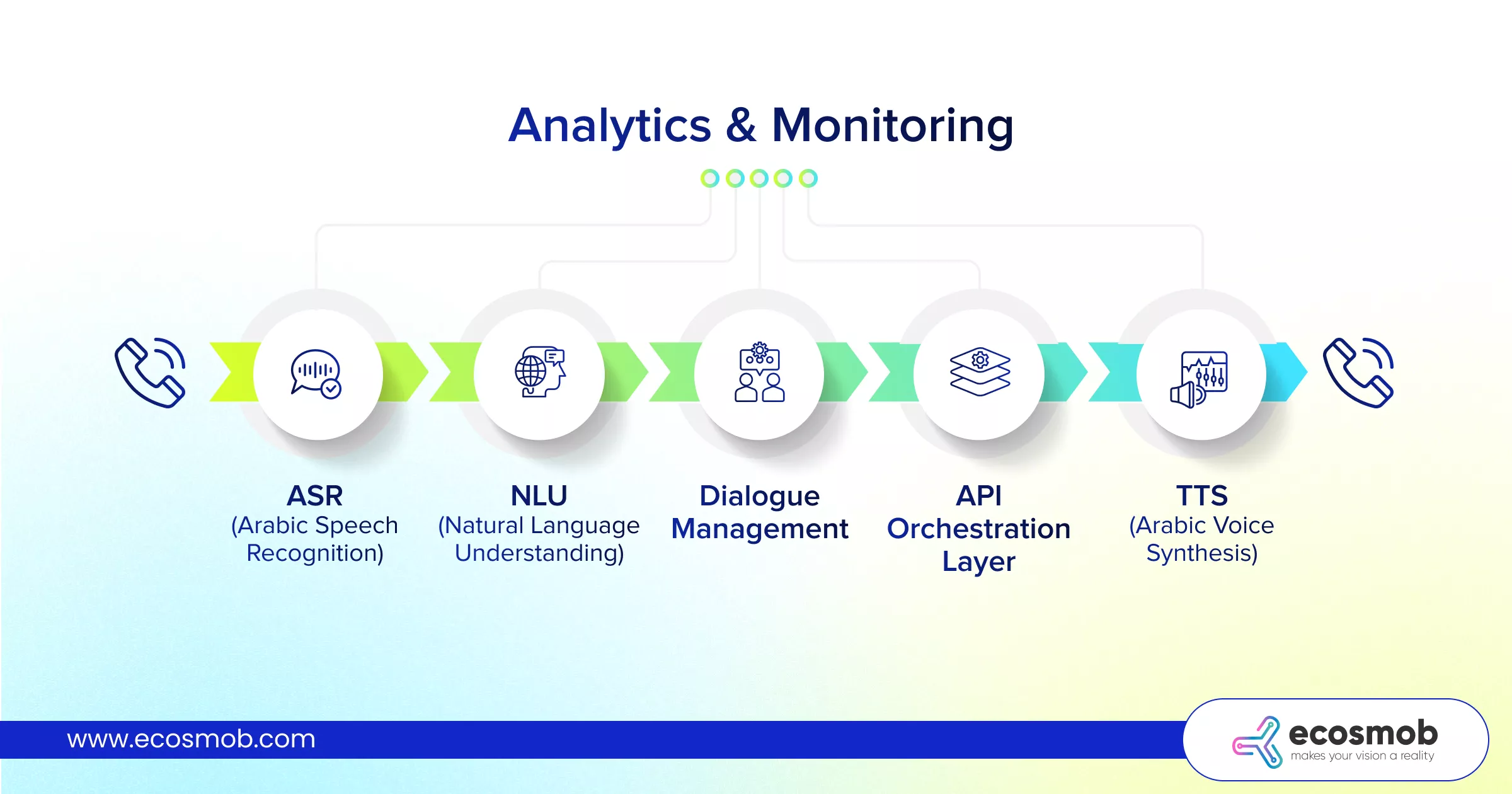 ASR (Arabic Speech Recognition) – Converts spoken Arabic, including dialect variations and noisy mobile input, into structured text.
NLU (Natural Language Understanding) – Identifies telecom-specific intents such as balance inquiry, roaming activation, SIM swap, or billing disputes, even in multi-intent sentences.
Dialogue Management – Controls conversation flow, manages context, handles clarifications, and ensures logical progression across complex telecom workflows.
API Orchestration Layer – Connects securely to backend systems like CRM, BSS/OSS, recharge gateways, and number portability databases.
TTS (Arabic Voice Synthesis) – Generates natural, region-appropriate Arabic voice responses aligned with selected persona preferences.
Analytics & Monitoring – Tracks intent accuracy, resolution rates, fallback frequency, and performance metrics for continuous optimization.
But on paper, the architecture looks structured and predictable.
In reality, an Arabic voicebot system becomes significantly more complex the moment real users start speaking.
Customers switching between Arabic and English mid-sentence?
Key Challenges in Arabic Voice Bot Development
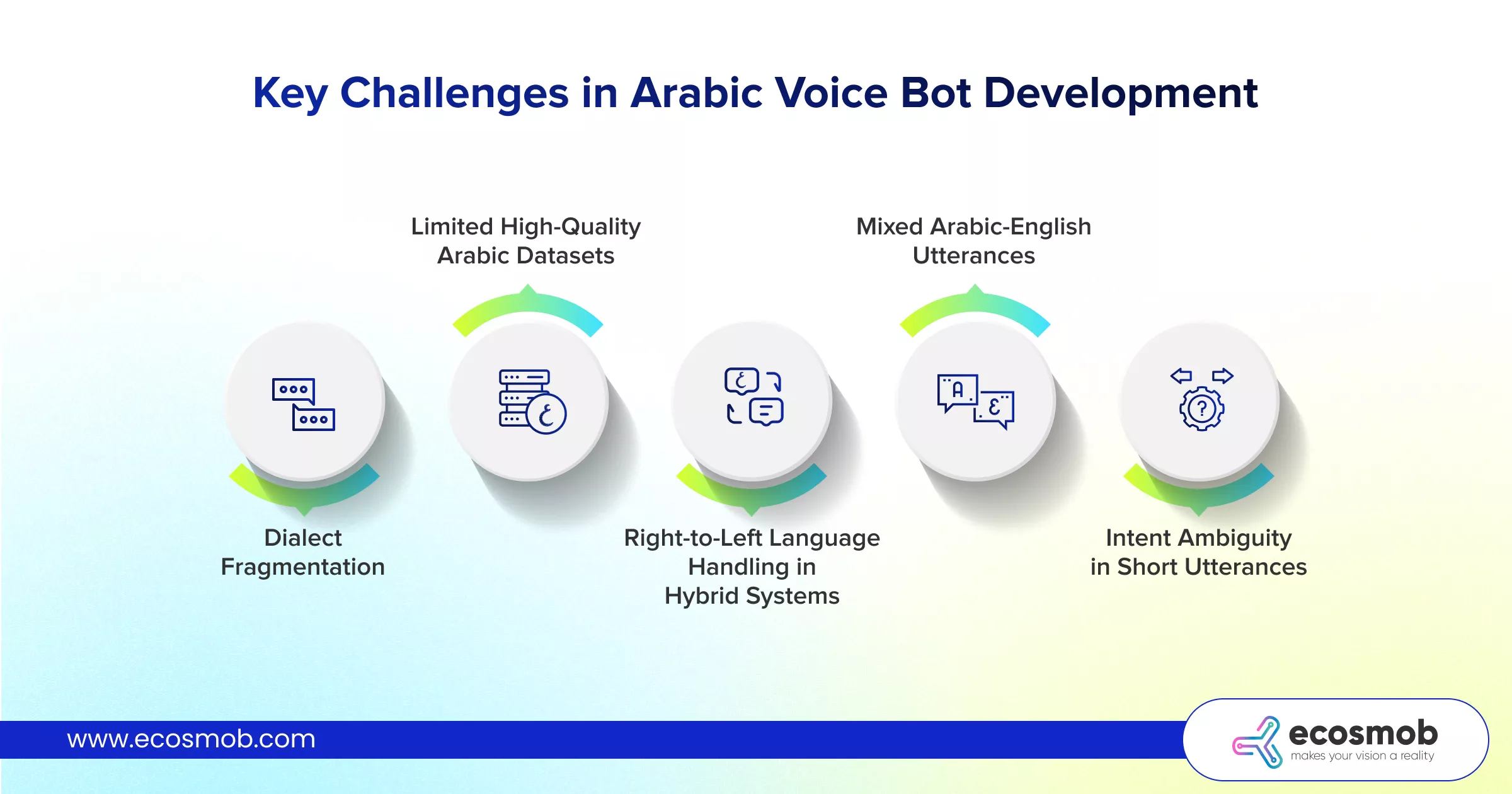 If you look at examples of conversational AI in real-world deployments, most of them perform well because the language environment is relatively stable. Arabic is different. The complexity is not theoretical, it shows up in live calls, unclear speech, regional phrasing, and unpredictable sentence structures.
Building reliable Arabic conversational AI means dealing with challenges that are structural, not cosmetic.
1. Dialect Fragmentation
Arabic varies widely across regions. The same request can be phrased differently in Saudi Arabia, Egypt, or Morocco. Vocabulary, pronunciation, and even sentence flow shift significantly.
A model trained on one dialect may struggle with another. For a telecom provider operating across multiple countries, this becomes a continuous tuning process rather than a one-time setup.
2. Limited High-Quality Arabic Datasets
Compared to English, Arabic has fewer large, high-quality speech and intent datasets available for training. Many datasets lack dialect balance or real telecom conversation samples.
Without relevant data, recognition accuracy drops. And in a telecom environment, even small recognition errors can break the flow of a transaction.
3. Right-to-Left Language Handling in Hybrid Systems
Arabic script runs right to left, while many backend systems and development frameworks are built primarily for left-to-right languages.
This creates formatting, logging, and interface alignment challenges, especially in hybrid environments where Arabic and English appear together. These technical inconsistencies can affect reporting, analytics, and integration layers.
4. Mixed Arabic-English Utterances
Customers frequently switch between Arabic and English in the same sentence, especially when referring to plans, services, or technical terms.
A typical caller might mix local dialect with English keywords like “data,” “upgrade,” or “package.” A voicebot for Arabic call center operations must recognize and interpret this blending without breaking intent classification.
5. Intent Ambiguity in Short Utterances
Telecom calls are often brief and direct. Customers may speak in fragments rather than full sentences.
For example, a caller might say only a few words, indicating urgency without a clear structure. Interpreting these short inputs accurately requires strong contextual modeling and fallback logic.
These challenges are not edge cases. They are daily realities in Arabic telecom environments. Addressing them properly is what separates a functional deployment from one that consistently performs under real-world pressure.
And this is usually the point where the decision becomes unavoidable.
You either adjust your expectations to fit a ready-made platform or build something designed to handle these complexities from the ground up.
Build vs Buy: Why Custom Development Wins
So, should a telecom provider adopt a ready-made voicebot platform or invest in building a custom solution?
Buy typically means deploying an existing platform with limited configuration.
Building involves developing a voicebot aligned with telecom workflows, regional dialect needs, and backend infrastructure.
The right decision depends on long-term operational goals, integration depth, and control over performance optimization.
| Criteria | Buy (Ready-Made Platform) | Build (Custom Development) |
| Deployment Speed | Faster initial setup | Longer initial build phase |
| Dialect Adaptability | Limited customization | Trained for specific regional dialects |
| Telecom Workflow Alignment | Generic intent models | Designed around telecom use cases |
| Backend Integration | Surface-level API connections | Deep CRM and BSS/OSS integration |
| Scalability | Configuration-based expansion | Architecture-level scalability |
| Data Control | Vendor-managed | Full ownership and optimization control |
| Long-Term Flexibility | Vendor roadmap dependent | Independent iteration and upgrades |
A common concern is whether existing VoIP infrastructure supports a custom Arabic voicebot without a full rebuild. In most cases, it does, when integration is planned correctly.
Another practical question is how long does it takes to build and deploy a custom Arabic voicebot for a telecom provider. Timelines depend on scope, but phased development allows controlled rollout without disrupting operations.
For telecom providers operating at scale, customization is not a preference; it is a requirement for sustained performance and adaptability.
Once the decision is made to build, the focus shifts to how that custom Arabic voicebot is planned, developed, and deployed in a structured way.
Telecom conversations aren’t scripted. Your voicebot shouldn’t be either.
Implementation Roadmap for Telecom Providers
Deciding to build a custom Arabic voicebot is one step. Implementing it without disrupting live telecom operations is another.
A structured rollout plan ensures the system goes live in phases, delivers measurable results early, and scales without operational risk.
Below is how telecom providers typically approach implementation.
Phase 1: Define Scope and Business Targets
Before development begins, the objective must be clear.
- Which call volumes are targeted for automation?
- What cost reduction percentage is expected?
- What containment rate defines success?
This stage aligns business, operations, and technology teams around measurable outcomes.
Phase 2: Pilot Deployment
Instead of a full-scale launch, deployment begins with a limited use case set and controlled traffic exposure.
For example:
- Balance inquiry automation only
- Roaming activation for a single region
- After-hours support automation
This minimizes risk and provides real-world performance data.
Phase 3: Infrastructure Alignment
Telecom providers often ask whether their existing VoIP infrastructure supports a custom Arabic voicebot without a full rebuild. In most cases, integration can be achieved through SIP-based connectivity or API layers.
A Voicebot Connector can act as an intermediary between the conversational engine and telecom switching systems. This approach avoids deep infrastructure changes while enabling phased adoption.
Phase 4: Gradual Expansion
Once performance stabilizes:
- Additional use cases are introduced
- More dialect coverage is added
- Traffic share increases incrementally
This prevents service disruption and allows ongoing optimization.
Phase 5: Optimization and Scale
After full deployment, performance monitoring becomes continuous.
Metrics such as containment rate, escalation frequency, and resolution time guide model refinement. Over time, automation expands from transactional flows to predictive and retention-focused interactions.
Telecom providers often evaluate how long it takes to build and deploy a custom Arabic voicebot. With a phased rollout, initial use cases can go live within a defined timeline, while optimization continues post-launch.
Ecosmob manages the process from planning to VoIP and BSS/OSS integration, without requiring system replacement. A Voicebot Connector solution can further simplify deployment by layering automation onto existing infrastructure.
Implementation is not a feature launch; it is a controlled integration into live telecom operations with measurable impact.
With implementation established, the focus naturally shifts to how Arabic voicebots will evolve within telecom ecosystems in the coming years.
Future of Arabic Voicebots in Telecom
Arabic voicebots in telecom are moving beyond handling routine service requests. The next phase focuses on predictive support, proactive issue resolution, and personalization at scale.
Future deployments will increasingly include:
- Predictive assistance, where the system anticipates recharge needs or data exhaustion before the customer calls
- Emotion-aware routing, analyzing sentiments, and adjusting responses or escalation paths
- Personalized plan recommendations based on usage patterns
- Deeper integration with 5G and digital service ecosystems, enabling voice-led self-service journeys
As models mature, Arabic voicebots will shift from reactive support tools to intelligent service layers embedded directly into telecom infrastructure.
The Bottom Line?
According to Market Research Future, the global voicebot market was valued at $7.09 billion in 2024 and is projected to grow from $8.69 billion in 2025 to $66.24 billion by 2035, expanding at a CAGR of 22.51% during the forecast period.
Arabic is not a single, uniform language, and telecom is not a simple service environment. When customers speak in dialect, mix languages, and expect instant resolution, generic automation falls short.
Custom Arabic voicebot development is not about adding language support. It is about designing a system that understands real conversations, integrates with telecom infrastructure, and scales across regions.
For telecom providers operating in Arabic-speaking markets, the objective is clear: build automation that matches the complexity of the environment it serves.
FAQs
What data residency and compliance requirements affect Arabic voicebot deployment in MENA markets like Saudi Arabia and UAE?
Telecom providers in markets like Saudi Arabia and the UAE must comply with country-specific data protection and telecommunications regulations. These often include data residency requirements, meaning certain customer data must be stored and processed within national borders. Voice recordings, identity verification data, and transaction logs may also fall under strict regulatory oversight. Deployment architecture must therefore align with local hosting policies, lawful interception rules, and sector-specific compliance standards.
Can existing telecom infrastructure support a custom Arabic voicebot?
In most cases, yes. Custom voicebots can integrate with existing VoIP, SIP, CRM, and BSS/OSS systems through APIs or middleware layers. A full infrastructure rebuild is typically not required if integration is planned properly.
How long does it take to build and deploy a custom Arabic voicebot for a telecom provider?
Timelines depend on scope, dialect coverage, integration depth, and the number of use cases. A phased rollout approach allows initial high-volume use cases to go live within a controlled timeframe, while broader optimization continues post-deployment.
Why can’t telecom providers use generic Arabic voicebots?
Generic systems are often trained on Modern Standard Arabic and lack telecom-specific intent modeling. They may struggle with dialect variation, code-switching, multi-intent requests, and real-time transaction handling, all common in telecom call flows.
How does dialect variation impact performance?
Arabic dialects differ significantly in vocabulary, pronunciation, and structure. A model trained on one dialect may underperform in another. Effective deployment requires dialect-aware speech recognition and continuous model tuning.