














QUICK SUMMARY
This blog explains why SMB growth becomes a breaking point for many VoIP platforms, where legacy backends start failing, and how smart VoIP modernization fixes the foundation without disrupting customers.
For most VoIP providers, SMB growth doesn’t fail because of demand.
By the time SMBs become a serious focus, you usually already have customers, live traffic, and a telephony setup that works. New accounts are coming in, and usage is increasing. On the surface, everything looks fine.
The problems show up behind the scenes.
As SMB volume grows, the backend starts to strain. Onboarding takes longer. Simple configuration changes feel risky. Call flows that worked earlier become harder to manage. Teams spend more time keeping the system stable than improving it.
That’s not a market issue. It’s an infrastructure one.
Many telephony backends were built to get a custom VoIP business running, not to support steady SMB growth at scale. Over time, those limits become hard to ignore.
This blog explores why backend modernization becomes unavoidable as SMB growth stops being a goal and becomes a reality.
Why SMB Growth Creates Scaling Problems for VoIP Platforms?
As SMB adoption grows, many VoIP platforms hit friction that isn’t immediately visible in dashboards. Revenue climbs, customer counts rise, but the backend starts showing stress. This is where scaling stops being a sales problem and becomes an infrastructure one, and where VoIP modernization for service providers shifts from a strategic idea to an operational necessity.
❌ Myth: SMBs are easier to scale than enterprise customers.
✅ Reality: At scale, SMBs create more configuration variation, less predictable traffic, and higher incident sensitivity, without enterprise-level margins to absorb mistakes.
What SMB growth exposes in your backend:
- Small issues multiply fast – a minor outage or misconfiguration impacts dozens of tenants at once.
- Traffic comes in bursts, not averages – peak hours, campaigns, and seasonal demand strain systems built for steady load.
- Tenant-level changes don’t stay small – routing tweaks and custom flows accumulate, making updates slower and riskier.
- Support effort scales faster than usage – more tickets, longer root-cause analysis, and increasing manual intervention.
SMB growth isn’t what breaks VoIP platforms. Legacy assumptions do.
To scale without introducing instability, providers need to rethink how their telephony backends are designed, operated, and evolved.
Scaling SMBs shouldn’t make your platform fragile. Let’s talk about fixing the backend first.
Hidden Costs of Legacy Telephony Backends at SMB Scale
Legacy VoIP backends don’t usually break overnight. They hold up just long enough to make you believe everything is fine, until SMB growth starts putting real pressure on the system. That’s when the hidden costs begin to show up.
Everything is too tightly connected
Most legacy setups were built as a single large system in which call control, routing, media, and logic are deeply intertwined. Early on, this feels efficient. At the SMB scale, it becomes fragile. A small change or issue in one area can affect many others. Instead of isolating problems, the system spreads them. This is the opposite of what you need when aiming for a modern VoIP solution.
Manual work turns into operational risk
Provisioning customers, adjusting call flows, and managing configurations often require hands-on effort. When SMB numbers are low, this works. As they grow, every manual step increases the chance of error. Fixing one customer’s issue can accidentally affect another. Over time, teams slow down because they no longer fully trust the system, a clear signal that VoIP modernization is overdue.
More hardware doesn’t mean more stability
Adding servers might help with capacity, but it doesn’t fix reliability. The same architectural limits remain. Even when failures occur, they still affect large parts of the platform. Costs go up, but confidence doesn’t.
Failures hit too many customers at once
In legacy backends, failure zones are large. A single crash or misconfiguration can affect dozens or hundreds of SMBs. Small issues quickly turn into major incidents, pulling engineering and support into constant firefighting.
Did You Know?
Most SMB VoIP traffic spikes are driven by business behavior, not system load, sales hours, support windows, marketing campaigns, and regional work patterns.
When Stability Stops Improving with Growth
This is the moment most providers don’t see coming.
- The platform worked well at 1,000 customers, so everyone assumes it will scale smoothly.
- At higher volumes, small issues start triggering bigger incidents.
- Recovery takes longer, and root causes become harder to find.
Eventually, growth stops feeling safe. The system hasn’t collapsed, but it has reached an operational ceiling.
That’s the real cost of legacy telephony backends at SMB scale: not just higher infrastructure spend, but slower teams, riskier changes, and a platform that resists growth rather than supporting it. This is why VoIP modernization becomes less about innovation and more about survival.
Once you see that the problem isn’t traffic or customers but the foundation itself, the real question becomes what modernizing the telephony backend actually looks like in practice.
Stop guessing where your backend will break.
How to Modernize Telephony Backend to Support SMB Scale
Modernizing the telephony backend isn’t about chasing new technology for its own sake. It’s about removing the architectural constraints that turn SMB growth into operational risk. As platforms scale, many providers reach a point where VoIP migration becomes necessary, not because the system is failing, but because it can no longer adapt safely to change.
Here’s how that usually starts.
What effective telephony backend modernization involves:
- Decoupling core functions like call control, signaling, media processing, and management logic so changes in one area don’t destabilize the rest of the platform.
- Moving toward elastic infrastructure that can handle unpredictable SMB traffic patterns without excessive overprovisioning or manual intervention.
- Replacing one-off customizations with API-driven extensibility, allowing flexibility for tenants while keeping the core stable and maintainable.
- Designing the system to expect change, not just handle peak call volume—new features, evolving use cases, and customer-specific requirements should be routine, not disruptive.
When done right, modernization restores control. Providers can scale, adjust, and improve their platform without fear that every update could affect live traffic or the customer experience.
The remaining challenge is execution. The next section examines how leading VoIP providers modernize their telephony backend incrementally, minimizing risk, protecting customers, and avoiding disruption while making meaningful architectural progress.
Bitter but true
SMB scale doesn’t demand perfection; it demands isolation.
How Leading VoIP Providers Modernize Without Disrupting Customers
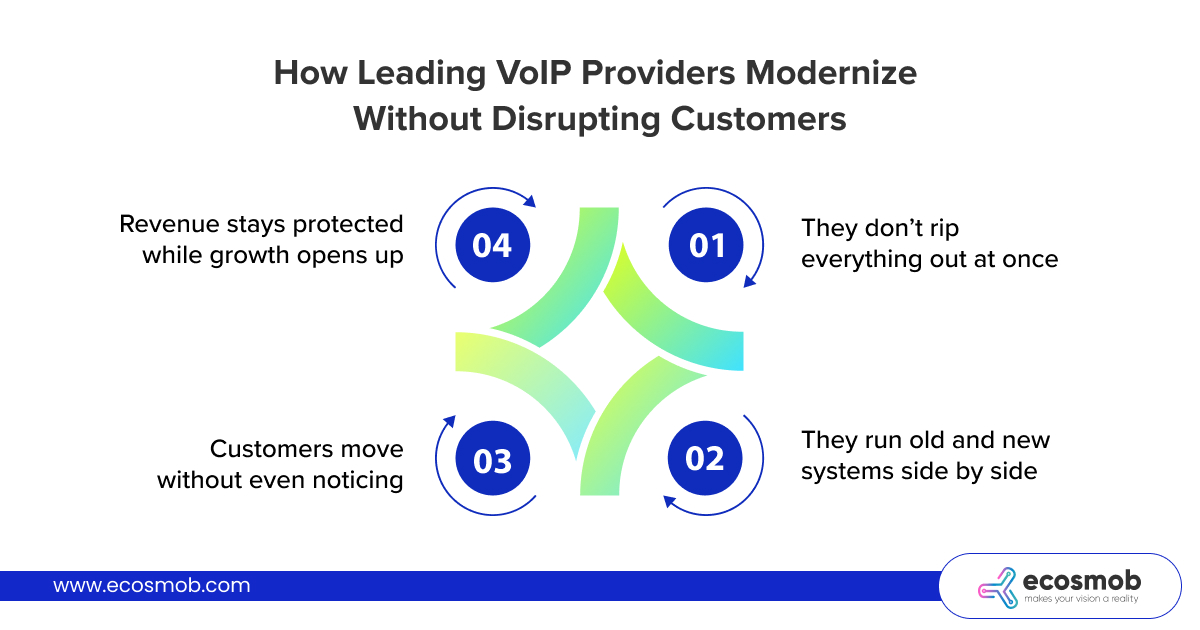 If you’re thinking, “This all sounds great, but we can’t afford to break what already works,” you’re not being cautious, you’re being realistic. Leading VoIP providers are also concerned about this. The difference is that they don’t let that fear stop them from modernizing.
Start Small
One of the biggest myths around VoIP modernization is that it requires a full rebuild. In reality, the most successful providers modernize in steps. They start with the parts under the most pressure, call routing, provisioning, or traffic handling, and improve those first. This reduces risk and lets teams learn as they go, instead of betting the business on a single massive change.
Parallel Operations
Instead of forcing an overnight switch, providers often run their legacy stack alongside the modern one. New customers might go on the modern VoIP solution, while existing customers stay where they are until migration makes sense. This approach keeps the business stable while the backend quietly evolves in the background.
Quiet Migration
From the customer’s point of view, nothing should feel different. No downtime. No retraining. No changes to daily workflows. Leading providers migrate customers gradually, often during low-traffic windows, and validate everything before and after the move. If customers don’t notice the migration, it’s been done right.
Revenue First
VoIP Modernization isn’t about risking current revenue for future gains. It’s about protecting what you have while making room to grow. By modernizing the backend in phases, providers keep existing services stable while continuing to onboard new SMBs with confidence. Over time, the platform becomes easier to operate, scale, and extend.
This is what smart VoIP modernization looks like in practice. Not disruption. Not big-bang changes. Just steady improvements that lead to a modern VoIP solution, without customers ever feeling the shift.
Fix the foundation before scaling further.
Wrapping It Up
This blog walks through why SMB growth often creates more pressure than progress for VoIP providers. We covered how legacy telephony backends struggle as customer volume increases, why stability stops improving after a point, and how VoIP modernization helps platforms scale without breaking what already works.
Key Takeaways:
- SMB growth exposes backend limits faster than enterprise growth
- Legacy architectures increase risk, cost, and operational drag at scale
- A modern VoIP solution makes growth predictable instead of painful
Ecosmob helps VoIP providers modernize their telephony backend without disrupting customers or revenue. Our VoIP modernization approach focuses on building scalable, flexible platforms that support long-term SMB growth with confidence.