











QUICK SUMMARY
Advanced video and voice solutions for ISPs can be strategic platforms that transform connectivity providers into unified communication companies. This blog breaks down the carrier-grade architecture, network integration strategies, and competitive differentiation tactics that successful ISPs use to recapture revenue from OTT communication providers.
Is your ISP watching subscribers migrate to communication providers like Zoom, Teams, and WhatsApp?
While you provide the network infrastructure that makes these services possible, third-party platforms are capturing the revenue and customer relationships that should belong to you. Your subscribers pay for internet access, then pay again for communication services that run on top of your network.
The solution isn’t just adding basic VoIP to your service portfolio.
Modern ISP communication solutions development requires building integrated video calling, voice conferencing, and unified communication platforms that leverage your network advantages while delivering enterprise-grade features that keep both residential and business customers engaged.
Let’s look at how ISPs are successfully developing and deploying advanced communication solutions that transform them from connectivity providers into comprehensive communication platforms.
What Are Advanced Video and Voice Solutions for ISPs?
Advanced video and voice solutions for ISPs include integrated communication platforms that combine high-definition video calling, VoIP telephony, conferencing capabilities, and unified messaging, all delivered through the ISP’s own infrastructure.
Unlike basic VoIP add-ons, these solutions provide carrier-grade reliability, seamless integration with existing ISP billing and customer management systems, and advanced features like call recording, screen sharing, virtual meeting rooms, and API-driven integrations that compete directly with enterprise communication platforms but serving a different primary purpose — is an OTT solution for internet service providers. While advanced voice and video platforms focus on real-time communication services (VoIP and conferencing), an OTT solution for internet service providers enables ISPs to deliver streaming television, video-on-demand (VOD), and live TV services directly over their broadband infrastructure. Both models leverage the ISP’s network control and billing systems, but OTT focuses on media content delivery, whereas advanced voice and video solutions center on interactive communication.
The core advantage for ISPs lies in network control and quality assurance.
While communication platform providers deliver “best effort” service over the public internet, ISPs can guarantee bandwidth allocation, prioritize communication traffic, and provide SLA-backed performance metrics that enterprise customers demand.
Modern ISP video calling and voice integration solutions typically include:
Residential Features
- HD video calling with family sharing capabilities
- Voicemail-to-email transcription and mobile app integration
- Smart home device integration and voice control
- Emergency services integration with location accuracy
Business Features
- Multi-party video conferencing with screen sharing and recording
- SIP trunk integration with existing business phone systems
- CRM integration and call analytics dashboards
- API access for custom application development
Network-Level Advantages
- QoS prioritization for communication traffic
- Direct peering with PSTN gateways and SIP providers
- Reduced latency through edge computing deployment
- Integration with ISP authentication and billing systems
💡Ecosmob Expert Tip
- Tie QoS policies directly to subscriber tiers.
- For example, business customers can get guaranteed low-latency queues for conferencing traffic, while residential users still enjoy smooth calls without over-provisioning. This creates a clear upsell path and prevents “one-size-fits-all” congestion issues.
The ISP Communication Stack
Layer 3
Subscriber Applications & Services
(Mobile apps, business portals, smart-home voice)
Layer 2
Advanced Voice & Video Platform
(VoIP, conferencing, UC features)
Layer 1
Network Infrastructure
(Fiber, broadband)
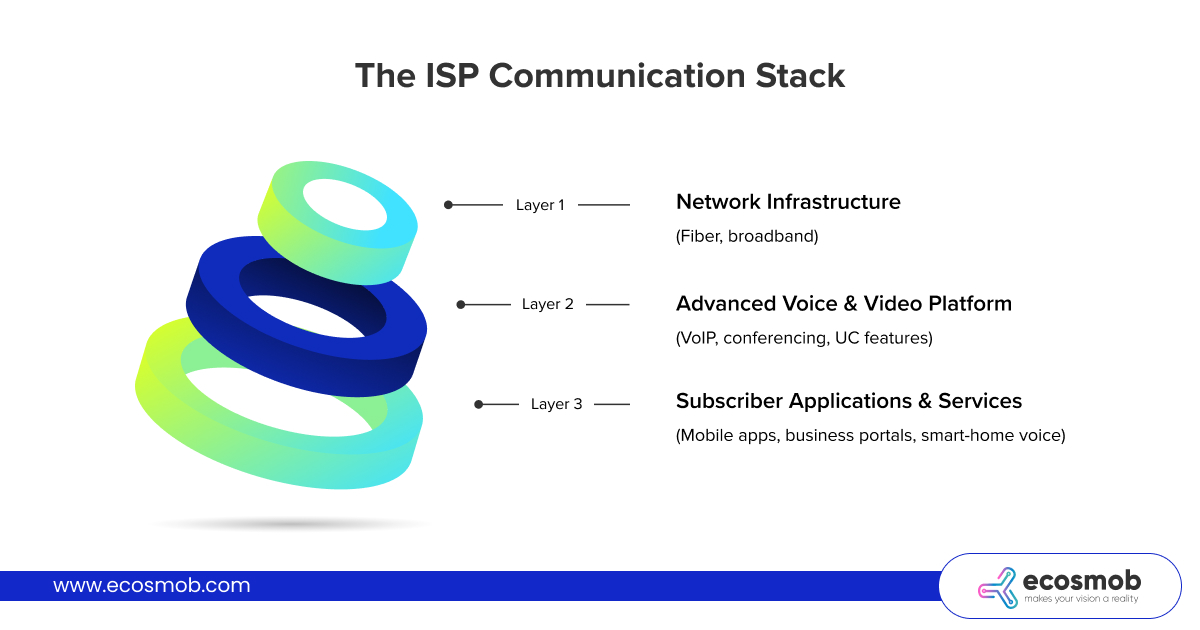 You’re at Layer 1. Move up to Layer 2 to deliver Layer 3.
From pipes to platforms to services subscribers actually use.
Subscribers paying you for the internet and others for meetings? Build solutions that capture both revenue streams! Reclaim Your Revenue.
Core Technologies Behind ISP Communication Solutions Development
Building scalable ISP VoIP and video conferencing solutions requires understanding both telecommunications infrastructure and modern software architecture. The technical complexity stems from handling real-time media at scale while maintaining carrier-grade reliability.
WebRTC and SIP Protocol Integration
Modern ISP communication platforms rely heavily on WebRTC for browser-based video calling, combined with SIP for traditional telephony integration.
WebRTC provides peer-to-peer media transmission with built-in encryption, while SIP handles signaling, presence, and integration with existing telephone networks.
The challenge for ISPs lies in implementing WebRTC gateways that can bridge browser-based communication with traditional SIP infrastructure. This requires:
- TURN/STUN servers for NAT traversal and firewall handling
- Media relay servers (RTP proxies) for enterprise deployments
- Signaling gateways that translate between WebRTC and SIP protocols
- Session Border Controllers (SBCs) for security and media control
Real-Time Media Processing and Codec Management
ISP video solutions must handle multiple video codecs, resolution scaling, and bandwidth adaptation in real-time. Enterprise customers expect automatic quality adjustment based on network conditions, while residential users need simple plug-and-play experiences.
Key technical components include:
Media Servers and Mixing Units
- Selective Forwarding Units (SFUs) for efficient multi-party video distribution
- Multipoint Control Units (MCUs) for legacy system integration
- Transcoding engines for codec compatibility across diverse endpoints
Bandwidth Management
- Adaptive bitrate streaming according to real-time network conditions
- Quality prioritization algorithms for voice vs. video traffic
- Bandwidth reservation and QoS marking for guaranteed performance
Database Architecture for Call Detail Records and Analytics
ISP communication services generate massive amounts of Call Detail Records (CDRs), session logs, and performance metrics that must be processed in real-time for billing, analytics, and network optimization.
Effective database architecture typically includes:
- Time-series databases for call quality metrics and network performance
- Relational databases for subscriber management and billing integration
- NoSQL solutions for session state management and presence information
- Data warehousing systems for long-term analytics and reporting
One bill. One provider. One seamless experience.
Using The ISP Infrastructure for Competitive Advantage
This is where advanced video and voice solutions for ISPs can truly differentiate from OTT providers: by capitalizing on network ownership and infrastructure control that third-party platforms simply cannot replicate.
Edge Computing and Network-Aware Processing
Deploy communication processing at network edge locations to dramatically reduce latency while improving scalability. This approach moves media mixing, transcoding, and routing closer to end users, resulting in superior quality and reduced core network bandwidth consumption.
Distributed Media Processing
- Local video mixing for multi-party conferences reduces backbone traffic
- Edge-based codec transcoding optimizes bandwidth usage for different subscriber tiers
- CDN integration for recorded meetings leverages existing ISP content delivery infrastructure
Direct Carrier Peering and Quality Assurance
ISP VoIP providers with extensive peering relationships can provide superior call quality and reduced costs compared to OTT providers who rely on public internet routing.
Peering Advantages
- Direct routing to major carriers bypasses public internet congestion for consistently high voice quality
- Settlement-free peering arrangements reduce per-minute costs for voice and video traffic
- Integration with carrier-grade emergency services that OTT providers cannot provide
- SLA-backed performance guarantees through controlled network paths
Unified Operations and Customer Experience
Rather than creating parallel systems, successful ISP video calling and voice integration platforms integrate deeply with existing ISP infrastructure.
Seamless Authentication and Provisioning
- Leverage existing RADIUS authentication systems for automatic subscriber access
- User provisioning based on current subscriber service tiers eliminates separate account management
- Integration with existing customer portals provides unified service management
Integrated Billing and Support
- Real-time usage processing through existing ISP mediation systems
- Unified billing presentation showing communication services alongside internet usage
- Customer support tools that correlate communication issues with network infrastructure problems
Our experts design a tailored video and voice strategy for your ISP, including architecture, timeline, and cost.
ISP VoIP Solutions Production Requirements | Security, Compliance, and Scalability
Building carrier-grade ISP communication services means meeting regulatory and security standards that OTT providers can sidestep. However, these requirements also create competitive differentiation opportunities.
Telecommunications Regulatory Compliance
ISPs operating communication services must navigate complex regulatory environments that vary by jurisdiction and service type. These requirements affect everything from data retention to emergency services integration.
Emergency Services Integration
- E911/E112 compliance with accurate location information for all VoIP calls
- Integration with Public Safety Answering Point (PSAP) infrastructure
- Automatic location updates based on subscriber premise equipment and mobile GPS data
- Backup power and redundancy requirements ensuring emergency call availability during outages
Data Protection and Privacy
- Call detail record retention policies complying with telecommunications regulations
- Lawful intercept capabilities with proper judicial oversight and privacy protection
- GDPR and privacy regulation compliance for communication metadata
- Cross-border data transfer compliance for international calling features
Security Architecture
ISP VoIP and video conferencing solutions must implement security controls that integrate with existing ISP infrastructure while meeting elevated threat protection standards.
Network-Level Security
- DDoS protection leveraging existing ISP network security infrastructure
- SBCs providing protocol-level security for SIP and WebRTC traffic
- Network segmentation isolating communication services while maintaining performance
Application Security Controls
- End-to-end encryption for voice and video streams with ISP-managed key distribution
- API security with comprehensive logging and rate limiting for third-party integrations
- Multi-factor authentication integration with existing subscriber authentication systems
Performance Monitoring and Capacity Planning
Unlike OTT providers with limited network visibility, ISPs can implement comprehensive monitoring that correlates application performance with infrastructure status.
Real-Time Quality Assurance
- Integration with existing network monitoring systems for performance correlation
- Voice quality scores and video resolution metrics with automated alerting
- Customer-facing quality dashboards providing service performance transparency
The ISPs succeeding in this space understand that communication services aren’t just another revenue stream. They’re the foundation for transforming from a connectivity provider into a comprehensive communication platform that captures revenue at every layer of the customer relationship.
Your network infrastructure already provides the competitive advantages needed to win against OTT providers. The question is whether your communication platform architecture can use them effectively.
Ready to build communication solutions that use your network advantages?
We architect ISP platforms that turn infrastructure control into revenue control.
FAQs
What are advanced video and voice solutions for ISPs?
Advanced video and voice solutions for ISPs include integrated HD video calling, multi-party conferencing, unified messaging, and API-driven business features that use ISP network control for guaranteed quality of service.
Can ISPs integrate video and voice platforms with existing billing and CRM systems?
Yes. Modern ISP communication services integrate with RADIUS authentication, mediation systems, and CRM platforms to provide unified billing, automated provisioning, and seamless subscriber management.
How can ISPs guarantee call quality and low latency for video and voice services?
ISPs can utilize QoS prioritization, edge processing, bandwidth reservation, and real-time adaptive codecs. These mechanisms help deliver clarity and reliability at carrier-grade levels.
What common VoIP and video conferencing issues do ISPs face, and how can they be avoided?
The most common challenges include network outages, bandwidth constraints, power failures, emergency calling incompatibilities, and security threats. These can be mitigated with redundancy, load monitoring, backup power, reliable routing, and hardened infrastructure.
How can ISP communication solutions utilize the existing network infrastructure?
ISP communication solutions development makes the best of the network ownership through QoS prioritization for communication traffic, edge computing deployment for reduced latency, direct carrier peering for superior call quality, and seamless integration with existing subscriber management, billing, and authentication systems.