










QUICK SUMMARY
Call analytics is what turns raw call data into real business decisions. This blog breaks down what it actually does, how it works, and how it’s different from just logging calls or listening to recordings. You’ll leave with a clear path for evaluating tools, setting them up, and using analytics to improve CX, agent performance, and revenue.
You don’t need more data.
You need answers.
Why are your first-call resolutions dropping?
Why are certain agents burning out faster than others?
Why do some customers churn even after a “successful” support call?
That’s where call analytics comes in. Not just to track what’s happening, but to explain why it’s happening, and what to do next.
Every business records calls. But not every business knows what’s in them, or what they’re missing. Call analytics closes that gap by turning audio, metadata, and interaction patterns into real, usable insights. It’s how companies figure out what went wrong, what’s working, and what’s coming next.
And in 2025, the tools are smarter, the insights deeper, and the ROI faster than most businesses realize. Let’s break it down.
What Is Call Analytics?
Most businesses already log call volumes and durations. But call analytics goes deeper. By integrating process intelligence software, organizations can extend these insights beyond calls to visualize workflows and optimize business operations. It extracts intelligence from every interaction by analyzing the content, context, and patterns within those calls.
Call analytics helps capture and analyze customer call data, both structured (like duration, hold time, resolution) and unstructured (like voice tone, silence, or keywords) for better decision making.
This can include:
- Call metadata like duration, outcome, agent, and routing path
- Agent behavior, such as talk-to-listen ratio, hold time, and transfer patterns
- Speech analytics to detect tone, keywords, or sentiment
- AI transcripts and tagging for post-call insights and summaries
In short, it’s about building a feedback loop that connects frontline interactions with business outcomes. Whether you’re using call center data analytics to improve NPS (Net Promoter Score) or automating compliance monitoring, it can optimize your systems by a lot.
What Is Call Center Voice Analytics?
Call center voice analytics is a specialized layer within call center analytics software that focuses on the spoken content, like tone, emotion, pacing, keyword usage, silence gaps, and more.
Unlike basic call data, call center voice analytics interprets how things were said, not just what was said.
This helps you:
- Detect frustration, anger, or confusion from vocal cues
- Flag compliance risks or scripted language deviations
- Identify moments of silence that correlate with poor outcomes
- Generate transcripts and tag key parts of the call
It’s often deployed via automated call monitoring software with speech analytics, especially in regulated industries (like finance, healthcare, insurance, etc.).
Lost calls, missed trends, underperforming agents? Let’s build your analytics layer.
Types of Call Analytics (and What They Tell You)
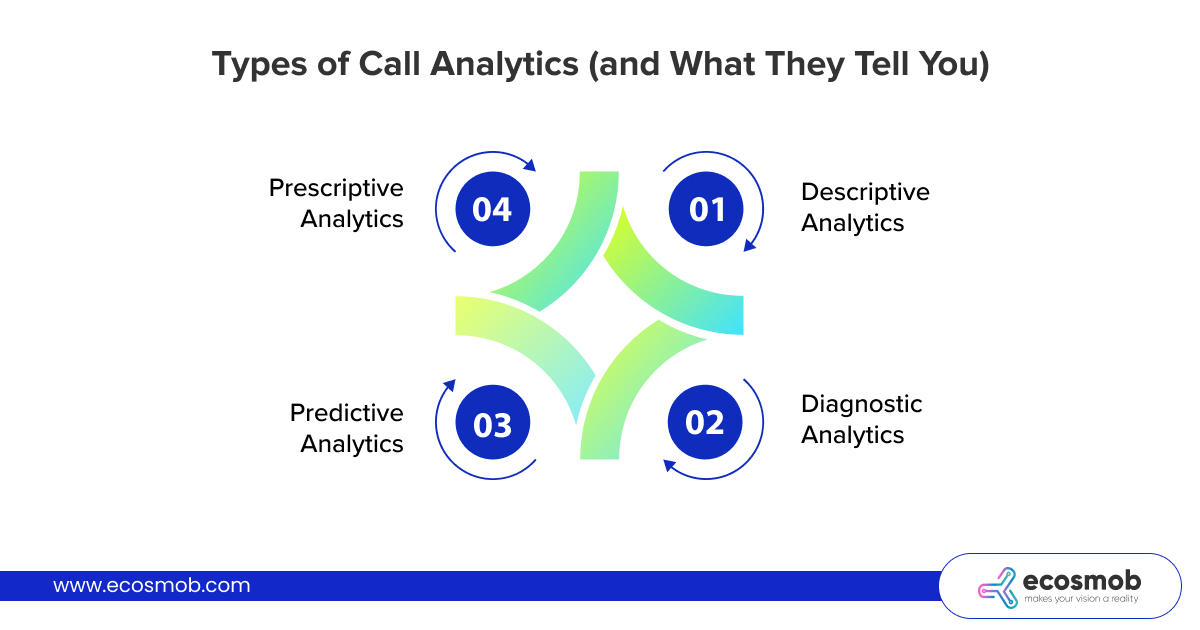 Different types of call center predictive analytics are used at different stages of the communication lifecycle. And knowing what to use when makes all the difference.
📞 Descriptive Analytics
Gives a snapshot of what has happened historically.
E.g., “How many calls came in last week?” or “What was the average handle time?”
📞 Diagnostic Analytics
Digs into the reasons behind those trends.
E.g., “Why are call abandon rates higher on Fridays?” or “Which IVR step is losing callers?”
📞 Predictive Analytics
Uses past data to predict what might happen next.
E.g., “Which customers are likely to escalate?” or “When do we expect high call volumes?”
📞 Prescriptive Analytics
Suggests actions to take in real time or in planning.
E.g., “Which agents need coaching?” or “What script variation improves outcomes?”
The most advanced systems integrate all four types, providing both real-time and historical perspectives.
Why Is Call Analytics Important in Business Communication?
Most business conversations happen over the phone, but few companies analyze those conversations in depth. That’s a missed opportunity.
Call analytics solves that gap by turning every customer interaction into a learning opportunity. Whether you run a support center, sales team, or internal helpdesk, having structured insight into calls helps you move from reaction to prediction.
Here’s what you can do with it:
- Reduce churn by detecting frustration early
- Coach agents using real examples flagged by sentiment or silence
- Shorten resolution times by identifying bottlenecks in call flows
- Ensure compliance using automated call monitoring software with speech analytics
- Identify training needs by pinpointing where scripts fall apart
This isn’t just for large call centers. Even a 5-person support team can unlock valuable improvements with the right call center metrics, analytics, and reporting.
Want better ROI from every call? Let’s optimize your setup with call center analytics!
Features to Look for in Call Center Analytics Software
Choosing the right call center analytics software is less about finding the most features and more about finding the right fit. The right solution for your business depends on your goals, existing tech stack, and team size.
But strong platforms will typically offer:
- Live dashboards with real-time alerts
- Integrated voice analytics
- Historical reports with filters by agent, department, or timeframe
- Automated transcription with keyword detection
- Sentiment analysis for emotion scoring across calls
- Call center predictive analytics to flag churn or escalation
- Helpdesk, dialer, and CRM integrations
- Custom report builders for teams, QA, and compliance
Also, remember to avoid platforms that lock you into rigid templates or only provide surface-level data that your team can’t even act upon.
How to Set Up Call Analytics in Your Business?
This doesn’t need to be a giant IT project, and you don’t need a full-time data science team to get started.
Here’s a simple deployment roadmap on how to set up call analytics in your business, even if you’re starting from scratch:
- Define your KPIs
What do you want to improve: NPS, AHT (Average Handle Time), call resolution, compliance?
- Choose the right software
Use a platform that supports your call volume, analytics goals, and integrations.
- Integrate systems
Connect your contact center, CRM, and QA tools.
- Train your team
Ensure managers and agents know how to use the data, not just look at it.
- Start small
Begin with one department, then expand once workflows are validated.
- Review weekly, improve monthly
Build regular rhythm around analytics reviews and action plans.
Call Analytics and Compliance
Analyzing voice data comes with legal responsibilities. Whether you’re working in finance, healthcare, or B2C sales, you need to consider the following:
- Consent laws: Understand single-party vs. two-party consent rules by region
- Data retention: Set appropriate rules for how long data is stored
- PII (Personally Identifiable Information) masking: Redact sensitive info in transcripts
- Access control: Limit who can view full conversations
- Audit trails: Log every review or report export for compliance reporting
Any analytics provider worth using should support these needs by default, not as add-ons.
How to Choose the Right Call Analytics Partner?
Anyone can sell you software. But you need a partner who understands how call analytics fits into your business, and how to make it sustainable.
Look for:
- Experience with your industry
- Flexible call center integration support
- Onboarding and training
- Data security certifications
- Ongoing analytics refinement, not just installation
The right partner must also help you integrate smoothly, customize dashboards, and evolve your analytics use over time.
Ask vendors:
- Can you customize dashboards and metrics for our goals?
- Do you support speech analytics and predictive insights out-of-the-box?
- What integrations do you offer with our CRM or dialer?
- What’s the support process if something breaks, or if we grow?
Call analytics is a capability, not just another feature. The right partner helps you use it that way.
Call analytics isn’t just for supervisors or support leads. It’s a company-wide advantage that shapes strategy, improves CX, and gives you leverage others don’t have.
Whether you’re running a startup support desk or scaling an enterprise contact center, the right analytics stack will show you where to improve and how.
Looking to build a call center software that has all that, or integrate call analytics into your existing system?
You need a team of experts that has done it before, successfully, many times. Find them here!
FAQs
What is call analytics in business communication?
Call analytics refers to collecting and analyzing call data to understand customer interactions, agent performance, and communication trends.
How does call center voice analytics software work?
A call center voice analytics software processes calls using AI to detect tone, keywords, and sentiment. This is to help you have insights beyond call logs.
What features should call analytics tools for small businesses have?
The best call analytics tools usually offer real-time dashboards, speech analytics, CRM integrations, and easy setup.
What’s the difference between call analytics and voice analytics?
Call analytics includes all call data. Voice analytics is a subset focused on speech-based insights like tone, keywords, and silence detection.
How can call center predictive analytics improve customer service?
Call center predictive analytics helps forecast churn risk, escalation likelihood, and staffing needs, enabling proactive decisions before issues happen.