













QUICK SUMMARY
SIP enables communication, but not security. Without encryption, signaling and media remain exposed.
This blog explains how SIP encryption works using TLS, SRTP, and DTLS, and why it’s critical for modern VoIP systems. It also covers key risks, benefits, SIP trunk encryption, and real-world use cases. By the end, you’ll know how to secure your communication stack effectively.
SIP powers modern communication, but it doesn’t secure it by default!
That gap exposes signaling and voice data to interception and fraud.
Here is a quick overview of how SIP encryption works, the protocols behind it, and why it matters in real-world deployments.
You’ll also see real-world use cases, common threats, and what to look for in an encrypted SIP trunk provider.
By the end, you’ll know exactly where your VoIP security stands and what to fix.
What is SIP Encryption?
SIP encryption is the process of securing SIP signaling and media streams using cryptographic protocols like TLS and SRTP to prevent unauthorized access, interception, or tampering.
SIP (Session Initiation Protocol) handles call setup. It decides who calls whom, when, and how. But by itself, it doesn’t protect that information. Without encryption, details like caller identity, IP addresses, and even call audio can be exposed.
Encryption adds a protective layer that ensures confidentiality, integrity, and trust across the communication flow.
Now let’s see what actually happens behind the scenes.
How SIP Encryption Works
SIP encryption works by securing different parts of a call using specific protocols. Together, these protocols ensure that both call instructions and conversations are protected from interception or tampering.
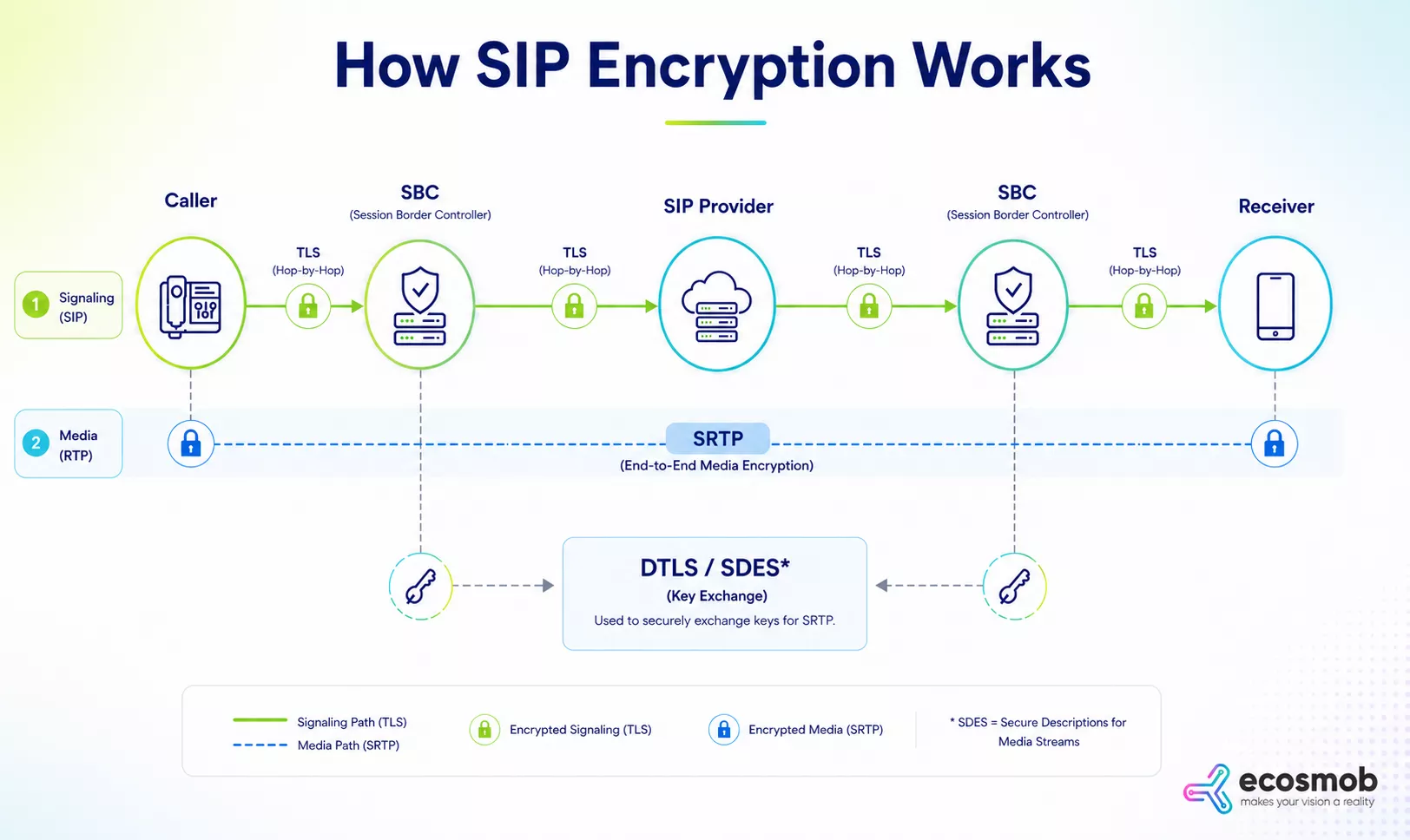
- Call Initiation (SIP Signaling via TLS)
When a call is initiated, SIP messages travel between endpoints. TLS encrypts these messages, ensuring that details like caller ID, session parameters, and routing instructions cannot be intercepted or altered.
- Media Transmission (SRTP for Voice/Data)
Once the call is connected, the actual voice or video data flows through RTP streams. SRTP encrypts this media, making it unreadable to anyone attempting to capture packets.
- Key Exchange (SDES or DTLS)
Encryption relies on keys. These keys are exchanged securely using protocols such as SDES or DTLS, ensuring that only authorized endpoints can decrypt the communication.
Encryption layers at a glance:
| Component | Protocol Used | What It Secures | Risk Without It |
| SIP Signaling | TLS | Call setup, metadata | Interception, spoofing |
| Voice Media | SRTP | Audio/video streams | Eavesdropping |
| Key Exchange | SDES/DTLS | Encryption keys | Key leakage, session hijack |
Each layer protects a different part of the communication flow, creating a complete security model.
SIP encryption works like a layered shield, not a single lock. But why does this matter in real-world deployments?
Secure conversations shouldn’t depend on assumptions. See how it works in your setup.
Why SIP Encryption Matters?
SIP encryption matters because unencrypted SIP traffic can be easily intercepted, altered, or misused by attackers, leading to data breaches, call fraud, and service disruption.
In controlled environments, unencrypted SIP might seem “good enough.” But real-world deployments are messy, distributed, and constantly targeted.
Here’s where encryption becomes critical:
- Financial Services
In VoIP for finance, customer interactions often involve account details, transaction discussions, and sensitive identifiers. Without encryption, this information can be intercepted, increasing the risk of fraud and compliance breaches.
- Healthcare Systems
Voice communication frequently includes patient data. Encryption helps protect sensitive information and aligns with regulatory frameworks that demand data privacy.
- Enterprises with Distributed Teams
Remote work means communication flows across public networks. Encryption ensures internal discussions remain internal, even outside controlled office environments.
- Contact Centers
High call volumes combined with sensitive customer data create a large attack surface. Encryption reduces the risk of data exposure during interactions.
- Technology Providers (VoIP, CPaaS, AI platforms)
For platforms handling communication at scale, encryption is not just a feature; it’s part of the trust layer that customers expect by default.
The pattern is simple: wherever communication carries value, it attracts attention. Encryption ensures that attention doesn’t turn into exploitation.
The more critical the conversation, the less room there is for unprotected traffic. Let’s look at what attackers actually exploit when encryption is missing.
What are the Common Threats to Unencrypted SIP Communication
The common threats to unencrypted SIP communication include eavesdropping, man-in-the-middle attacks, SIP registration hijacking, call tampering, toll fraud, and VoIP DDoS attacks, as both signaling and media remain exposed to interception and misuse.
- Eavesdropping
Attackers capture RTP packets and reconstruct audio streams using readily available tools. Conversations that seem private can be replayed almost instantly.
- Man-in-the-Middle Attacks
An attacker positions themselves between two endpoints, intercepting and potentially modifying SIP messages. This can lead to redirected calls or manipulated session parameters.
- SIP Registration Hijacking
Attackers obtain SIP credentials and register as a legitimate user. From there, they can receive calls, make unauthorized calls, or impersonate users.
- Call Tampering & Injection
Unprotected signaling allows attackers to modify call flows or inject malicious instructions, disrupting communication or rerouting traffic.
- Toll Fraud Attacks
One of the most costly threats. Attackers exploit unsecured systems to place international or premium-rate calls, resulting in significant financial losses.
These aren’t rare incidents. They’re frequent, repeatable, and increasingly automated at scale.
Unencrypted SIP doesn’t just expose gaps; it creates entry points that even fraud detection with AI systems is designed to catch after the fact, not prevent at the source.
Let’s shift focus and see how encryption closes these gaps before they’re exploited.
If your SIP stack isn’t encrypted yet, now is the time to fix it.
Key SIP Encryption Protocols Explained
SIP encryption works because multiple protocols divide responsibility. Each one secures a specific layer of communication, and together they create a complete protection model.
SIP over TLS (Transport Layer Security)
SIP over TLS encrypts the signaling layer, which includes everything required to set up and manage a call.
This covers:
- Caller and receiver identities
- Call routing details
- Session initiation messages (INVITE, BYE, REGISTER)
Without TLS, this information travels in plain text. Anyone with access to the network can read or manipulate it.
With TLS in place:
- SIP messages are encrypted end-to-end between endpoints or via secure hops
- Certificates are used to authenticate servers and prevent impersonation
- Call setup becomes resistant to interception and tampering
In practical terms, TLS ensures that the “instructions” behind every call remain private and intact.
SRTP (Secure Real-Time Transport Protocol)
Once a call is established, the actual conversation flows through RTP streams. SRTP steps in to secure this media layer.
It protects:
- Voice audio
- Video streams
- Media integrity and packet sequencing
Without SRTP, attackers can capture RTP packets and reconstruct conversations with minimal effort.
With SRTP:
- Media streams are encrypted in real time
- Data integrity checks prevent tampering
- Replay attacks are mitigated
Think of SRTP as the layer that ensures what you say stays between you and the other party, not anyone listening on the network.
DTLS (Datagram Transport Layer Security)
Encryption is only as strong as its key exchange. DTLS is used to securely exchange encryption keys, especially in modern environments like WebRTC.
It works by:
- Establishing a secure handshake between endpoints
- Exchanging keys over UDP-based communication
- Enabling end-to-end encryption without exposing keys in signaling
DTLS is particularly important in browser-based communication, where traditional methods like SDES may not be secure enough.
In short, DTLS ensures that the keys used to lock your communication are never exposed in the process.
ZRTP (Optional)
ZRTP takes a different approach. Instead of relying on certificates or centralized infrastructure, it negotiates encryption keys directly between endpoints.
Key characteristics:
- End-to-end encryption without PKI dependency
- Keys are generated dynamically per session
- Users can verify sessions using short authentication strings
This makes ZRTP useful in scenarios where:
- You want stronger privacy guarantees
- You don’t want to rely on third-party certificate authorities
However, it’s not as widely adopted as TLS + SRTP combinations in enterprise environments.
Each of these protocols solves a different problem. TLS secures signaling, SRTP secures media, DTLS secures key exchange, and ZRTP adds an optional layer of end-to-end privacy.
No single protocol secures everything, they operate as a coordinated system. This layered approach often leads to confusion with broader VoIP encryption.
Your calls carry more than voice. Make sure they carry trust too.
SIP Encryption vs VoIP Encryption
These terms often get mixed up, especially in vendor conversations and product documentation.
Here’s the distinction:
- SIP Encryption
Focuses specifically on securing SIP-based communication. It deals with signaling (TLS) and media (SRTP) within SIP environments. - VoIP Encryption
VoIP encryption is a broader concept that includes securing all types of VoIP communication, not just SIP. This can involve additional protocols, network-level security, VPNs, and infrastructure protections.
Why this matters:
A system can claim “VoIP encryption” while still leaving SIP signaling exposed. On the other hand, properly implemented SIP encryption directly addresses one of the most widely used communication protocols.
For decision-makers, this distinction helps cut through vague security claims and focus on what is actually being protected.
SIP encryption is a focused layer within a larger VoIP security strategy, but it’s one you can’t ignore.
Now let’s narrow in on SIP trunks, where encryption often gets overlooked in real deployments.
What is SIP Trunk Encryption for Businesses?
SIP trunk encryption is the process of securing communication over SIP trunking between your business phone system and your service provider, using protocols such as TLS (for signaling) and SRTP (for voice data).
It protects both call setup information and actual conversations from interception, alteration, or unauthorized access during transmission.
Here’s what businesses should evaluate:
- TLS for Signaling
Confirm that your provider supports SIP over TLS for all signaling traffic. Without this, call setup data remains exposed even if the media is encrypted.
- SRTP for Media
Ensure that voice and video streams are encrypted using SRTP. Some providers support TLS but leave media unencrypted, which creates a partial security gap.
- End-to-End vs Hop-by-Hop Encryption
Understand whether encryption is maintained across the entire path or only between certain nodes. True end-to-end encryption provides stronger guarantees.
- SBC Compatibility
Your Session Border Controller (SBC) should support encryption protocols and handle tasks like certificate management, NAT traversal, and traffic inspection without breaking encryption.
- Key Management and Certificates
Encryption is only as strong as how keys and certificates are managed. Poor implementation can introduce vulnerabilities even when protocols are enabled.
- Provider Infrastructure
Look beyond feature checklists. Evaluate how encryption is implemented across the provider’s network, including redundancy, failover, and monitoring.
Choosing an encrypted SIP trunk provider is not about ticking boxes. It’s about ensuring consistent, reliable security across every call path.
Encryption strength depends on real implementation, not just protocol support. Let’s see how all of this plays out in real-world scenarios.
What are the Benefits of SIP Encryption?
SIP encryption strengthens VoIP security by protecting call data, preventing unauthorized access, and ensuring communication remains private and reliable. It secures both signaling and media, helping businesses avoid interception, fraud, and service disruptions while maintaining trust and compliance.

- Confidential Communication
A bank handling customer advisory calls ensures that sensitive discussions remain private, even over public networks.
- Data Integrity
An enterprise running global VoIP operations prevents unauthorized modification of SIP messages, ensuring accurate call routing and session control.
- Authentication & Trust
Large-scale deployments avoid spoofed endpoints by verifying identities during encrypted sessions, reducing impersonation risks.
- Regulatory Compliance
Healthcare providers and financial institutions align with strict data protection requirements by encrypting communication channels.
- Fraud Prevention
Organizations reduce exposure to toll fraud and unauthorized usage by securing both signaling and media streams.
- Operational Reliability
Encrypted environments tend to be more controlled and monitored, reducing unexpected disruptions caused by malicious interference.
The real benefit is not just security. It’s predictability. You know your communication behaves as expected.
Encryption turns communication from vulnerable to dependable.
Real-World Use Cases of SIP Encryption
SIP encryption is rarely visible, but it plays a critical role in everyday communication systems.
Enterprise VoIP Systems
Large organizations use SIP encryption to secure internal communication across offices, regions, and cloud environments, ensuring business discussions remain confidential.
Contact Centers
Customer interactions often include personal and financial data. Encryption ensures that sensitive information is protected during high-volume call handling.
Remote Work Environments
With employees connecting from different networks and locations, encryption ensures that communication remains secure even outside controlled corporate infrastructure.
WebRTC Applications
WebRTC development enables browser-based communication platforms to deliver secure, real-time voice and video using protocols like DTLS and SRTP, without requiring any additional software.
Healthcare and Financial Services
Industries dealing with sensitive data use SIP encryption to meet compliance requirements and protect critical information from exposure.
Government and Defense Systems
High-security environments depend on strong encryption to protect communication against interception and cyber threats.
Across all these use cases, one pattern stands out. Encryption is no longer a premium feature. It’s expected as part of any serious communication system.
SIP encryption operates quietly, but it underpins trust in every secure conversation.
With this foundation in place, the next step is understanding how to evaluate and implement it effectively.
Final Thoughts?
SIP encryption is no longer optional. It’s what separates a working VoIP system from a trustworthy one.
As communication moves across cloud, remote teams, and open networks, the risk surface expands just as fast. Encryption with TLS, SRTP, and secure key exchange ensures your calls stay private, intact, and reliable.
And this is where execution matters. At Ecosmob, secure VoIP architectures are built with encryption embedded across signaling, media, and infrastructure, backed by SBC expertise and intelligent monitoring.
FAQs
Is SIP encrypted by default?
No, SIP is not encrypted by default. Standard SIP transmits signaling data in plaintext unless secured with TLS and SRTP.
What is SIP over TLS, and why is it important?
SIP over TLS encrypts signaling messages such as call setup and routing details. It prevents interception, spoofing, and tampering of communication instructions.
How does SRTP differ from TLS in SIP encryption?
TLS secures SIP signaling (the control layer), while SRTP encrypts the actual voice or video streams (the media layer). Both are required for complete protection.
What is the role of DTLS in SIP encryption?
DTLS is used for secure key exchange, especially in WebRTC environments. It ensures that encryption keys are shared securely without being exposed during transmission.
Is SIP encryption enough to secure VoIP communication?
No, SIP encryption is essential but not sufficient on its own. It should be combined with SBCs, firewalls, authentication mechanisms, and monitoring for complete security.