

Voice over IP (VoIP) systems have become the backbone of modern business communication. They offer flexibility, scalability, and cost savings compared to traditional telephony. Yet, when organizations attempt to migrate their VoIP infrastructure, whether moving from on-premises to the cloud, upgrading legacy systems, or re-architecting to newer platforms, they often encounter challenges that can delay projects, inflate costs, or even compromise communication continuity.
This article examines the five most common roadblocks in VoIP migrations and offers practical strategies for overcoming them.
What Are the 5 Biggest Mistakes in VoIP Infrastructure Migration and How to Avoid Them?
While VoIP infrastructure migration promises significant benefits, it can easily fail if not planned and executed correctly. The consequences of a failed migration can be severe: unhappy customers, wasted resources, and frustrated teams.
Here’s a look at the top 5 mistakes and solutions to avoid them.
1: Complex Data Migration
VoIP platforms store far more than just call records. They contain critical data such as:
- User accounts, domains, and access security details
- Business logic like IVR flows, call queues, and routing strategies
- Compliance-related resources, including call detail records (CDRs), historical reports, and recordings
A poorly managed migration can result in incomplete transfers, corrupted call flows, or even lost compliance records.
Solution:
The most effective approach is a structured and automated migration process. Begin with a detailed assessment of the existing systems, then extract and map the data to the new schema. Dry runs of migration before the final cutover help identify errors early. Using rollback strategies ensures that, if something goes wrong, the old system can be restored without compromising data. Automation tools also play a crucial role in maintaining accuracy while minimizing downtime and reducing manual errors.
2: Service Downtime and Business Continuity
When it comes to communication systems, downtime is more than an inconvenience—it directly impacts customer service and revenue. Migrations that rely on manual cut-over processes often lead to extended outages, dropped calls, or inconsistent call routing.
Solution:
Plan migrations during low-traffic periods and build redundancy into the migration design. Leveraging cloud-native migration services offered by AWS, Azure, or GCP allows for replication of environments in near real-time. Phased cutovers, where traffic is gradually shifted, lower the risk of complete outages. It is equally important to have fallback measures in case the cut-over does not go as planned.
3: Interoperability with Legacy Systems
Many organizations still have a mix of legacy PBXs, hardware phones, or customized call flow configurations that are tightly coupled with the existing infrastructure. These systems can create bottlenecks, as they may not be compatible with new cloud-native platforms.
Solution:
Adopting a hybrid migration strategy helps bridge the gap. Enterprises can retain essential legacy infrastructure while integrating it with modern cloud-based components. Standard migration practices include leveraging SIP gateways, APIs, and softswitch containerization to ensure both old and new systems work seamlessly together. By designing compatibility layers early in the planning process, organizations can avoid surprises during execution.
4: Security and Compliance Risks
VoIP data involves sensitive customer conversations, personal details, regulatory call logs, and business-critical records. Moving these assets without adherence to security protocols risks exposure to eavesdropping, denial-of-service attacks, or data non-compliance with laws such as GDPR and HIPAA.
Solution:
Security should be embedded in every stage of the migration. This includes encryption of data both in transit and at rest, strong access control policies, and compliance validation before and after migration. Organizations must also think beyond migration and deploy disaster recovery-ready architectures, such as data center–disaster recovery (DC-DR) models, which ensure minimal downtime in the event of failures. Selecting cloud providers that align with regional and industry compliance requirements further strengthens defenses.
5: Insufficient Testing and Validation
A significant number of VoIP migration failures stem from inadequate testing. Skipping validation tests means businesses only discover issues such as missing call flows, poor call quality, or broken third-party integrations after going live.
Solution:
Comprehensive pre-deployment testing is non-negotiable. Organizations should carry out:
- Functional tests to validate IVRs, queues, and call routing
- Performance and load testing to check stability under expected traffic
- Failover and disaster recovery drills to confirm resilience
- Security testing to identify vulnerabilities in the new setup
Continuous monitoring post-migration, using tools like CloudWatch (AWS), Azure Monitor, or GCP Operations Suite, ensures ongoing performance visibility and enables proactive issue resolution.
Building a Structured Migration Process
Avoiding these roadblocks requires more than reactive solutions; it demands a structured approach to VoIP migration. A comprehensive methodology often includes:
- Assessment and Planning: Document infrastructure, evaluate costs, and select the migration strategy (rehost, replatform, refactor, hybrid).
- Pre-Migration Preparation: Set up cloud environments, evaluate databases, and verify compliance readiness.
- Execution: Leverage cloud-native data transfer, compute migration tools, and containerization.
- Validation: Conduct rigorous functional, performance, and security testing.
- Optimization and Monitoring: Enable auto-scaling, optimize costs, and ensure system health through monitoring tools.
- Post-Migration Support: Ensure smooth adoption, maintain rollback options, and enable ongoing improvement.
This lifecycle ensures that migrations are predictable, cost-effective, and resilient.
6 Key Benefits of Successful VoIP Migration
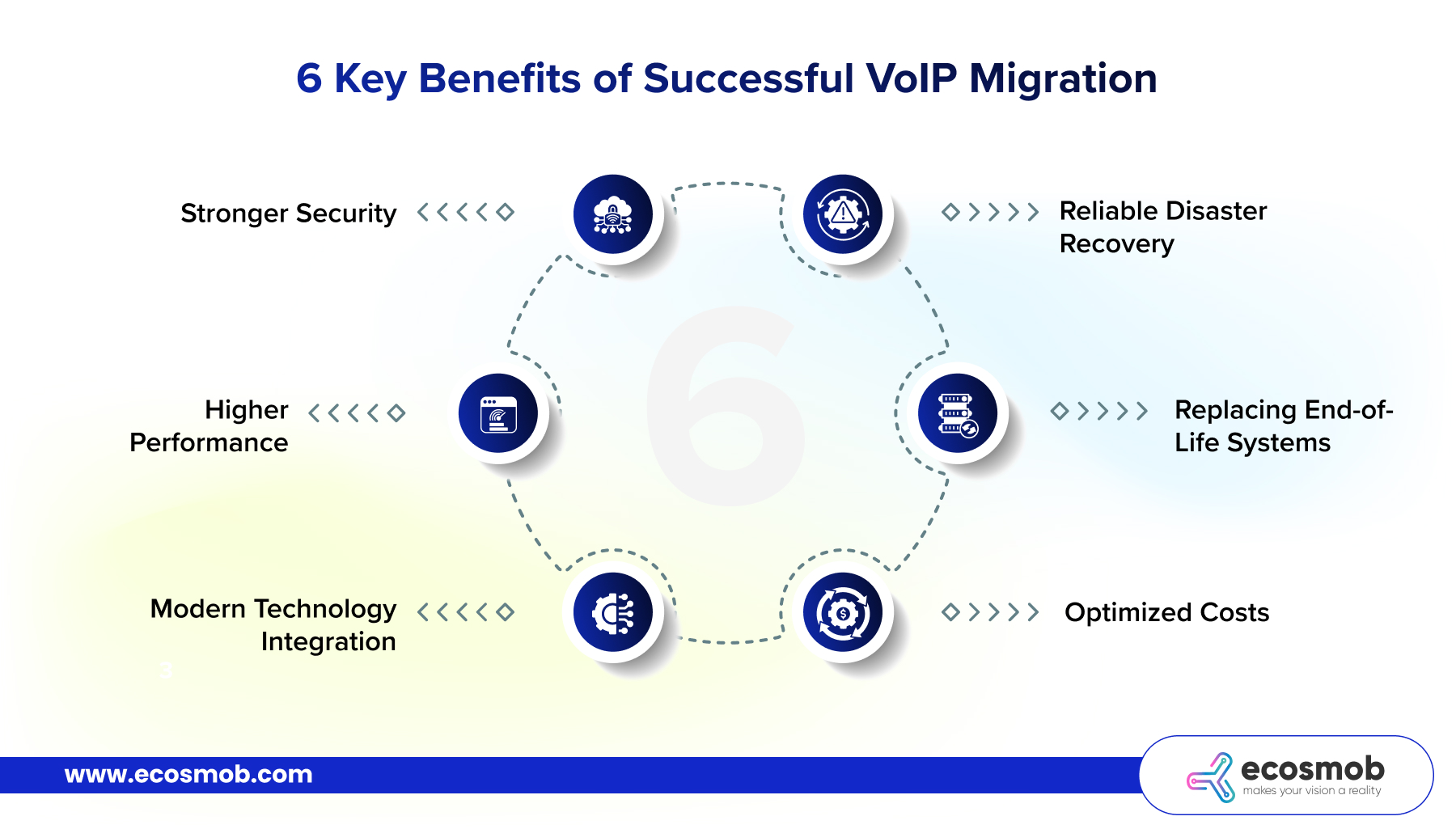 When executed correctly, VoIP infrastructure migration delivers measurable value:
- Stronger Security: Moving to modern, secure infrastructure strengthens defenses against evolving cyber threats and vulnerabilities.
- Higher Performance: Adoption of containerized and cloud-native architectures (e.g., Docker, Kubernetes) ensures better resource utilization, faster processing, and seamless scalability.
- Modern Technology Integration: Advanced automation tools streamline deployments, upgrades, and operations, reducing manual effort, minimizing errors, and enhancing agility.
- Reliable Disaster Recovery: Implementing a Data Center–Disaster Recovery (DC-DR) model ensures high availability, rapid failover, and uninterrupted communication services.
- Replacing End-of-Life Systems: Migration prevents reliance on obsolete or unsupported legacy platforms, keeping systems compatible and efficient.
- Optimized Costs: Cloud-based VoIP reduces capital investments in hardware, while flexible, usage-based pricing models enable significant savings on infrastructure and maintenance.
These benefits extend beyond telecom departments, enhancing overall business communication and customer engagement.
Industries Most Impacted by VoIP Migrations
VoIP infrastructure migration is transformative for industries that rely heavily on real-time communication:
- Telecom providers looking to replace legacy switches with cloud-native agility
- Enterprises adopting remote and hybrid work environments
- Contact centers aiming to deliver uninterrupted customer experiences
- Regulated industries like healthcare and finance, where compliance and security are paramount
Final Thoughts
VoIP infrastructure migration enables organizations to modernize their communication infrastructure, reduce costs, and enhance resilience. At the same time, poorly planned migrations pose risks that can undermine service continuity and client trust. By identifying and addressing the five most common roadblocks: data complexity, downtime, interoperability, security risks, and insufficient testing, organizations can pave the way for a smooth, future-ready communication ecosystem.
The key is preparation and adopting a structured roadmap that strikes a balance between technical precision and business continuity. With the right strategy in place, VoIP migration becomes less about avoiding risks and more about unlocking long-term value for the enterprise. This is where expertise matters. Partnering with a solutions provider such as Ecosmob helps enterprises navigate complexity with confidence and clarity.
Frequently Asked Questions
Yes, VoIP can integrate with most modern CRM and ERP platforms, but compatibility depends on the provider you choose. As part of your VoIP migration plan, make sure your vendor offers APIs or pre-built connectors. This ensures smoother workflows and avoids the headache of disconnected tools after migration.
The key is number porting. Start the process early and run your old PBX alongside your new VoIP until the porting is finalized. Most providers allow this “parallel run,” which keeps calls flowing without disruption. A well-prepared VoIP migration checklist should always include number porting strategy.
Look for open API support, multi-device compatibility, and proven integrations with popular CRMs, ERPs, and helpdesk platforms. Before signing off, always test integrations in a pilot environment; this small step prevents the roadblock of broken workflows later.
Beyond subscription fees, businesses often overlook costs such as headsets, QoS upgrades, advanced features, or long-term support. A structured PBX-to-VoIP migration budget should include all these factors to avoid surprises.
Begin with the total cost of ownership (TCO), which includes licenses, hardware, and maintenance. Then compare savings from reduced phone bills, improved uptime, and productivity boosts. Framing it this way makes the ROI of VoIP migration clear for stakeholders.