
There’s a high chance you’ve faced this scenario: The market shifts, a major event occurs, or your biggest client suddenly launches a campaign. The call volume on your multi-tenant UCaaS platform instantly spikes, and the architecture that seemed stable at average load begins to groan under pressure.
You realize that a simple traffic event can become a total system failure.
For UCaaS scalability solutions, the old, expensive solution (over-provisioning human agents) is no longer necessary or sufficient. We all know by now that the true path to resilience is through intelligent automation at the edge.
But, integrating AI voicebots into your SIP core can often create more problems than it solves, thanks to the fundamental incompatibility between telephony and modern AI platforms. Most teams struggle to connect SIP calls to voicebots. There’s no plug-and-play fix.
So we built a solution: The Voicebot Connector! It’s a specialized, custom-built bridge that acts as the intelligent control plane for all voice traffic. This blog details how a Voicebot Connector guarantees zero experiential downtime during stress events, ensuring robust UCaaS performance optimization.
Why Call Surges Break AI-Enabled UCaaS Platforms
The fundamental cause of failure during a surge is the mismatch between old telephony architecture and new AI demands.
Well, why is SIP-to-AI integration so complex?
Telephony infrastructure runs on SIP/RTP (UDP-based, lossy, telephony codecs), which was designed for circuit-switched calls. And modern AI voicebots operate on WebSocket-based streaming (TCP-based, reliable, JSON-formatted audio streams).
This is a fundamental incompatibility that generic middleware cannot solve.
What Role Do Voicebot Connectors Play in Zero Downtime?
Our Voicebot Connector is the specialized intermediary that resolves the above-mentioned protocol mismatch in real time.
- Custom Technology Stack: The solution is built with OpenSIPS for SIP signaling control and Python-based custom logic for handling RTP, streaming live RTP audio from your IP PBX, and receiving audio replies over WebSocket.
- Real-Time Audio Streaming: The Voicebot Connector sends RTP to the voicebot and receives audio replies over WebSocket, and plays them back to the customer instantly. This process maintains latency below the 200 ms conversational threshold to prevent functional failure.
- Zero-Failure Transfer Logic: It processes the bot’s escalation triggers, handling complex human escalation triggers from the bot to a live agent using your existing IP PBX routing logic. This prevents the high call failure rates seen in systems relying on generic transfer methods.
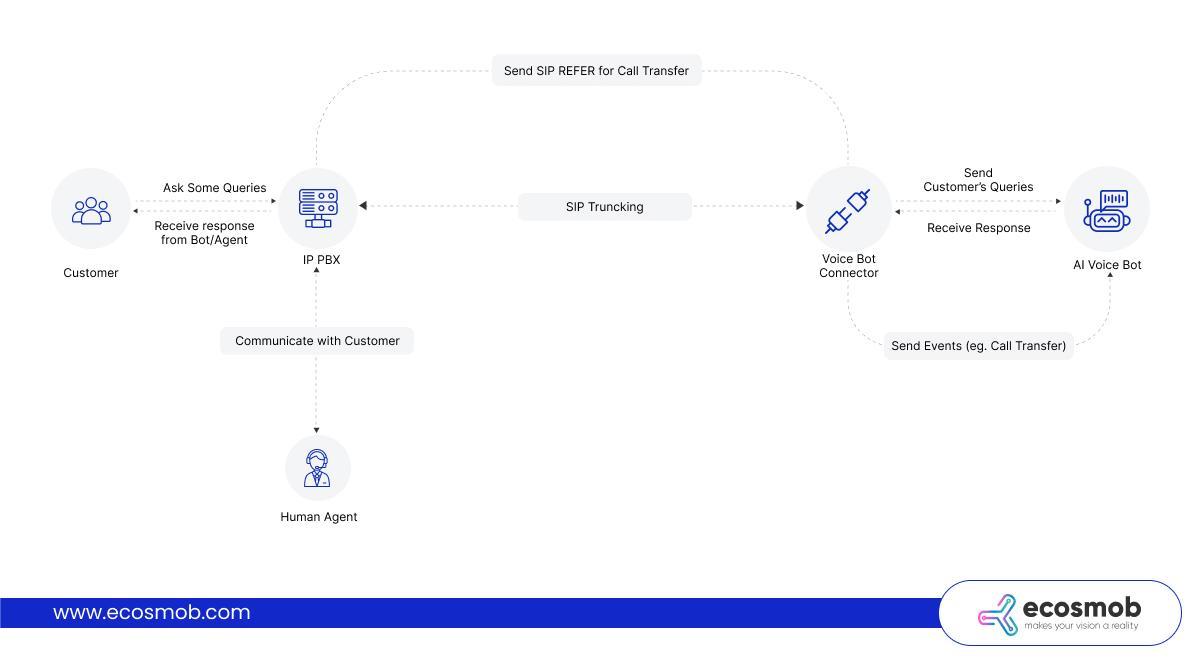 Learn in further detail about what the Voicebot Connector does and how it works.
How to Reduce Operational Costs in UCaaS Solutions with Voicebot Connectors?
Today, the most effective strategy for cost reduction in UCaaS scalability solutions during peak load is offloading high volumes of traffic from expensive human resources.
This can be achieved by deploying AI automation for UCaaS to manage L1 customer inquiries.
- Surge Offloading: The voicebot acts as a massive shock absorber. It handles a vast number of simultaneous, routine calls (automating customer queries before agent escalation) without consuming high-value human resources. This is achieved by routing high-volume inbound calls to a voicebot first.
- Cost Reduction: Automating these L1 inquiries translates directly to lower operational costs, with some high-automation scenarios reducing workforce requirements significantly.
To maintain resilience, the architecture must actively protect its downstream AI and telephony resources from being overwhelmed by unchecked load:
- Capacity Control: The Voicebot Connector manages the flow by ensuring the voicebot receives a stable, controlled stream of audio. It prevents traffic spikes from overwhelming the AI processing capacity or the core SIP logic. This keeps the expensive back-end functional.
- Dynamic Routing via Webhooks: The Voicebot Connector supports dynamic routing via Webhooks, where JSON responses from the bot can direct call transfers dynamically through configured destinations. This rapid, automated decision-making offloads the manual process from agents and supervisors during a surge.
How Do Voicebot Connectors Help Manage Call Congestion and Quality?
57% of business leaders expect customer service call volumes to increase by as much as one-fifth over the next 1-2 years. This trend means static infrastructure is no longer viable.
And that is why Ecosmob’s Voicebot Connector is positioned to ensure quality and prevent resource exhaustion through intelligent traffic management, even though the AI workload is computationally heavy.
Legacy systems often fail by routing sessions based on simple counts, ignoring the highly asymmetrical CPU demands of AI workloads.
But the Voicebot Connector routes based on:
- Real-Time Capacity: Instead of counting sessions, the Voicebot Connector’s internal logic tracks factors essential for UCaaS performance optimization, ensuring that traffic is directed to AI resources that have the physical capacity to process the complex real-time transcription and NLU required by modern voicebots.
- Multi-Tenancy Assurance: The connector’s architecture integrates with SLA data to implement session prioritization, ensuring high-tier tenants are guaranteed access to reserved capacity during a surge, even if lower-tier traffic must be handled with slightly longer queues. This guarantees zero uncontracted downtime.
How Do Voicebots Maintain Response Quality During Traffic Surges?
AI voicebots maintain quality by providing instant L1 responses and avoiding the high latency associated with human queues during peak hours.
The Voicebot Connector also helps ensure high quality by providing a stable, reliable stream for the bot, allowing the AI to process speech accurately and consistently, preventing the quality drop that leads to user frustration.
Ecosmob Expert Tip
Most teams deploy a Voicebot Connector and assume escalations will work. But they may not. To be sure, you need to test them under load. Before any production surge, generate concurrent calls, trigger escalations, and confirm transfers succeed with minimal latency.
If transfers fail or latency spikes, it needs to be fixed now, not during a surge when you need to deliver zero downtime.
Voicebot Connector Analytics That Help Manage Call Surges
Apart from being a bridge between SIP and AI, your Voicebot Connector can be an intelligent hub that gives you real-time visibility into exactly what’s happening during surge events. Because the connector controls both the admission and the outcome of every AI interaction, it captures data that generic solutions miss.
The table below details some of the most crucial metrics that can help achieve zero downtime during call surges:
| Metric Category | Data Source | Strategic Value During a Surge |
| Transfer/Escalation | Human Escalation Triggers (Webhook Events) | Provides immediate, auditable data on the Escalation Rate, identifying which bot flow failures or intents require human intervention, even under high stress. |
| Call Outcome | Inbound/Outbound Call Handling Flow | Tracks the Resolution Rate (successful automated call completion) vs. Transfer Rate, validating the bot’s effectiveness in offloading L1 volume. |
| Intent & Audit | Dynamic Routing via Webhooks (JSON responses) | Logs all Intent Classification and transfer decisions, creating an audit trail required for compliance and revealing the specific cause of the traffic surge (e.g., pricing complaints). |
| Response Quality | Real-Time Audio Streaming (Latency Monitoring) | Monitors the stability of the audio stream (the critical latency metric) to ensure conversational quality remains consistent, preventing “system stutter” that leads to frustrated users. |
The Value of Custom Fit
This level of performance and resilience is only achievable with a custom-built solution like ours. Our architecture, built on OpenSIPS and custom Python logic, simply plugs into your existing infrastructure, maintaining your SIP core logic without expensive platform rewrites.
This means you can stop patching together voicebot workflows!
The integration of AI voicebots into UCaaS is a competitive necessity, but the architecture must be surge-proof. The Voicebot Connector transforms call surge management from a scramble to an automated, predictable process.
By using AI deflection to offload volume, intelligent session management to maintain response quality, and advanced congestion control to stabilize the network fabric, UCaaS providers can confidently guarantee zero experiential downtime (even when traffic spikes unexpectedly!).
This strategic approach ensures your AI automation for UCaaS investment translates into lower operational costs and resilient service delivery, regardless of demand.
Don’t wait for your next traffic surge to expose your scaling limits.
Integrate a Voicebot Connector customized just for you!
Frequently Asked Questions
Operational costs are reduced significantly through L1 query deflection (automating routine customer inquiries). This offloads human agents, allowing a voicebot to handle a vast number of simultaneous, lower-value calls, often cutting staffing needs while preserving agent focus for complex issues.
Voicebots maintain response quality by providing instant L1 responses and avoiding the high latency associated with human queues. Our Voicebot Connector ensures this quality by routing sessions based on real-time capacity rather than simple session count, preventing exhausted servers from accepting new calls.
The 200ms threshold is critical because it represents the maximum acceptable end-to-end delay for a conversation to feel natural to a human. Exceeding 500ms functionally breaks the interaction, making the voicebot integration unusable regardless of infrastructure uptime.
The voicebot connector uses human escalation triggers via webhook events mid-call. It processes the event and transfers the call using existing IP PBX routing logic, allowing for seamless and dynamic routing decisions during the interaction.
Yes. The custom Voicebot Connector is designed to support both inbound call handling (routing an incoming call to the bot) and outbound call handling (the telephony engine dials out, then the call is sent to the bot for interaction).