












QUICK SUMMARY
This blog explores how WebRTC services for healthcare power secure telemedicine platforms through scalable architecture, HIPAA compliance, EHR integration, performance optimization, and real-time patient communication. It also covers key healthcare use cases, WebRTC infrastructure decisions, and custom development considerations for modern healthcare platforms.
“It’s red, kind of swollen, and there’s this small bump near the…” You pause.
The doctor pauses.
You both know the next sentence: can you just look at it?
But you’re on a phone call. So you keep explaining it. Poorly. For another five minutes.
Healthcare has spent years trying to fix this moment. WebRTC video consultations are finally making it possible.
Healthcare providers now need faster, more accessible virtual care. That demand is driving the rise of WebRTC services for healthcare across telemedicine platforms, hospitals, and healthcare apps.
But successful WebRTC healthcare platforms need more than video calling. They need secure architecture, low-latency communication, EHR integration, firewall traversal, and scalable infrastructure.
That’s where smart WebRTC development becomes critical.
At Ecosmob, our AI-driven WebRTC development approach helps healthcare platforms improve real-time communication, automate workflows, strengthen consultation reliability, and deliver more connected patient care experiences.
This guide explores how WebRTC telemedicine platforms work, key architecture decisions, and how improved healthcare services with WebRTC are reshaping real-time patient care.
What is WebRTC in Healthcare?
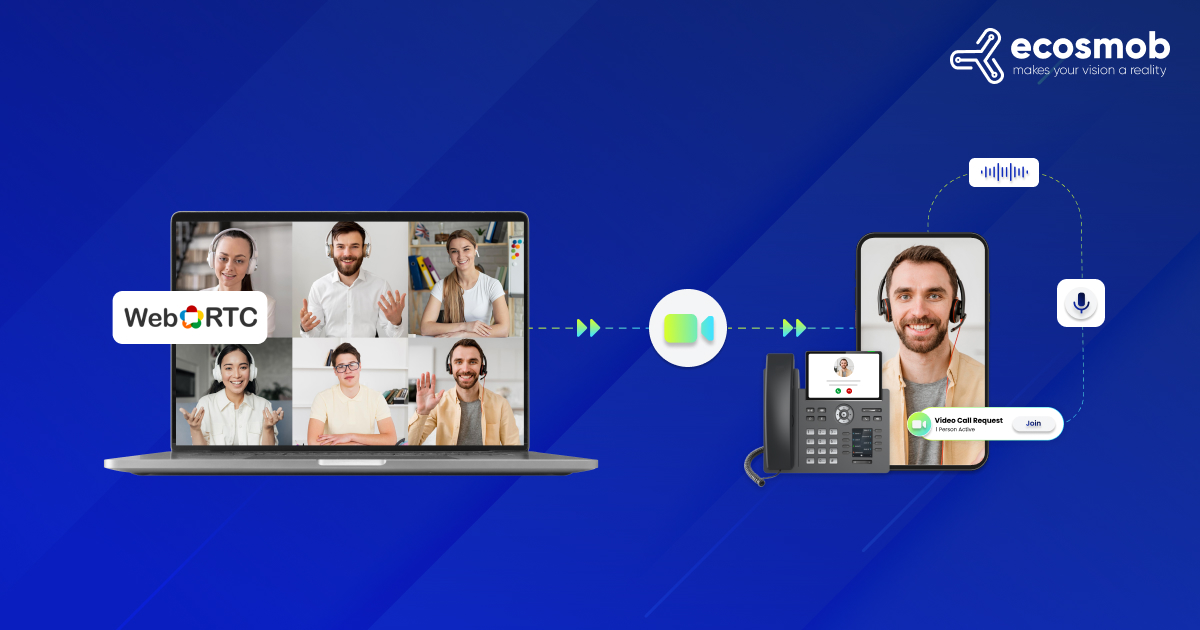
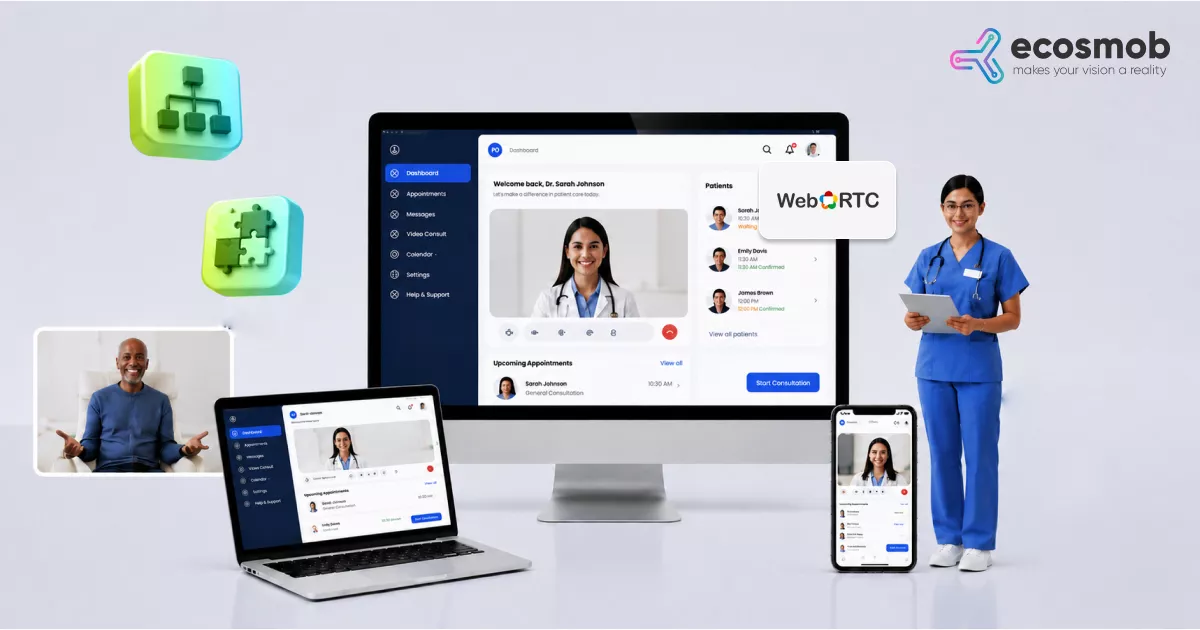
WebRTC in healthcare is a real-time communication technology used for secure video consultations, audio calls, and live patient communication inside healthcare platforms. It allows doctors and patients to connect directly through browsers and mobile apps without extra plugins or software.
WebRTC services for healthcare are now widely used in telemedicine platforms, remote consultations, emergency care, and multi-specialist collaboration.
The goal is simple: faster and more accessible patient communication.
A WebRTC healthcare platform works through a few core components:
- Media Engine: Handles live audio and video streams during consultations.
- Signaling Server: Manages session setup, authentication, and participant connections.
- STUN and TURN Servers: Help users connect across firewalls and unstable networks.
- SFU and MCU Servers: Manage multi-user video sessions and stream distribution.
Unlike traditional video calling tools, WebRTC video conferencing and telemedicine platforms integrate directly with healthcare workflows across industries. They can connect with EHR systems, appointment scheduling, AI transcription, and patient monitoring tools in real time.
This is why improved healthcare services with WebRTC are becoming a major priority for modern healthcare providers and digital care platforms.
Video consultations fail quietly until patient trust starts dropping.
Key Use Cases of WebRTC Services for Healthcare
WebRTC services for healthcare are transforming how providers deliver real-time patient care across hospitals, clinics, and telemedicine platforms. From virtual consultations to emergency response systems, WebRTC healthcare applications support faster and more connected care delivery.
1. Virtual Doctor Consultations
WebRTC enables secure one-to-one video consultations between doctors and patients. Patients can join directly from a browser or mobile app without complicated setup. This reduces appointment delays and improves healthcare accessibility.
2. Multi-Party Clinical Collaboration
Healthcare teams often need multiple specialists in a single session. WebRTC telemedicine platforms support real-time collaboration between doctors, nurses, caregivers, and specialists during diagnosis or treatment discussions.
3. Remote Patient Monitoring
WebRTC healthcare platforms can connect with wearable devices and monitoring systems for live patient tracking. Doctors can review patient conditions remotely while maintaining continuous communication when needed.
4. Interpreter-Assisted Sessions
Hospitals frequently require interpreters during consultations. WebRTC development allows interpreters to join live sessions securely without interrupting the consultation workflow. This improves communication accuracy for multilingual patient care.
5. Emergency and Ambulance Triage
Emergency response teams can use WebRTC video consultations during ambulance transport or remote triage situations. Clinicians can assess injuries, monitor patient conditions, and guide first responders before hospital arrival.
These use cases show how improved healthcare services with WebRTC and an AI voice agent in healthcare solutions are making patient communication faster, more accessible, and more connected.
Let’s see what the architecture should look like!
WebRTC Healthcare Architecture and Infrastructure Considerations
WebRTC healthcare architecture includes frontend systems, backend infrastructure, a signaling layer, and network optimization for secure, real-time patient communication. A well-designed architecture helps healthcare platforms maintain low latency, scalability, and stable consultation experiences.
1. Frontend and Backend Architecture
The frontend layer includes patient apps, doctor dashboards, and web consultation interfaces. These applications handle video calls, chat, appointment scheduling, and file sharing across web and mobile devices.
The backend infrastructure manages authentication, session orchestration, notifications, analytics, and EHR integrations. This layer keeps WebRTC healthcare platforms scalable and operational across high consultation volumes.
2. Signaling and Identity Management
The signaling layer establishes communication between participants before the video session begins. It manages room creation, participant coordination, and device negotiation in real time.
Healthcare platforms also need secure identity management. Token-based authentication and isolated session IDs help prevent unauthorized access and patient data exposure.
3. Session Lifecycle and Token Authentication
Every WebRTC telemedicine session follows a lifecycle. The platform validates appointments, authenticates users, starts media exchange, monitors connection quality, and securely closes the session after completion.
Short-lived access tokens are commonly used in WebRTC development to improve session security and reduce misuse risks.
4. TURN Server Placement and Firewall Traversal
Hospital networks often block direct peer-to-peer communication. This makes TURN servers essential for maintaining stable WebRTC video consultations across restricted environments.
Regional TURN server deployment also improves latency and connection quality for distributed healthcare users.
5. Mobile Network Recovery and Scalability
Patients frequently move between Wi-Fi and mobile networks during consultations. WebRTC healthcare platforms must recover sessions quickly without forcing users to restart calls.
Scalable infrastructure is equally important. Modern WebRTC services for healthcare should support thousands of concurrent consultations while maintaining stable audio, video, and real-time communication performance.
Strong infrastructure alone cannot improve real-time communication in customer interactions without the right media architecture behind every session.
Your telemedicine platform should feel clinical, not chaotic.
Mesh, SFU, or MCU: Which Topology Fits a Telehealth Platform?
Mesh, Selective Forwarding Unit (SFU), and Multipoint Conferencing Unit (MCU) are the three main media architectures used in WebRTC-based healthcare platforms to manage how video and audio streams are routed between participants.
The choice of topology affects scalability, latency, privacy, and consultation quality in telemedicine applications.
| Architecture | How it work? | Best for | Limitations |
| Mesh | Devices connect directly to each participant | One-to-one consultations | Poor scalability |
| SFU | Server forwards streams between users | Multi-party healthcare sessions | Limited media privacy |
| MCU | Server mixes streams into one feed | Large conferencing setups | Higher latency and cost |
Mesh architecture works well for simple doctor-patient consultations with fewer participants. But performance drops quickly as more users join the session because every device processes multiple streams simultaneously.
SFU architecture is widely used in modern WebRTC telemedicine platforms. It scales better for multi-party consultations involving specialists, interpreters, or caregivers because the server forwards streams instead of processing them heavily.
MCU architecture combines all streams into a single output before sending it to participants. This reduces device processing but increases server load, latency, and infrastructure costs.
For most WebRTC-based healthcare services, an SFU architecture offers the best balance among scalability, latency, and consultation quality. This makes it the preferred choice for modern telemedicine platforms.
Privacy is another major consideration in WebRTC healthcare platforms. In SFU-based systems, media streams may briefly pass through the server layer during routing.
This is why many healthcare platforms building scalable and secure real-time apps with AI and WebRTC now use Insertable Streams and end-to-end encryption for stronger communication privacy.
HIPAA Compliance and Security Requirements for WebRTC Healthcare Platforms
WebRTC is not inherently HIPAA-compliant, but it can support compliant healthcare communication with the right security architecture, encryption, and data protection controls.
1. DTLS, SRTP, and WebRTC Encryption
WebRTC healthcare platforms use DTLS and SRTP protocols to encrypt audio, video, and data during transmission. This helps protect patient communication during live consultations.
2. SFU Privacy Limitations in WebRTC Telemedicine
In SFU-based WebRTC telemedicine platforms, media streams may temporarily pass through the server layer for routing. This creates additional privacy considerations for sensitive healthcare sessions.
Many WebRTC development teams use end-to-end encryption and Insertable Streams to strengthen media privacy further.
3. Session Recording and Consent Management
Healthcare platforms should capture patient consent before recording consultations. They also need clear policies for recording access, retention, and sharing.
4. Audit Logs and Secure Data Storage
WebRTC services for healthcare should maintain audit logs for consultations, access activity, and recording events. Secure storage and access controls are essential for long-term compliance and monitoring.
But secure communication alone is not enough. Healthcare platforms also need seamless clinical workflows behind every consultation.
EHR Integration and Workflow Automation in WebRTC Healthcare Platforms
EHR integration in WebRTC healthcare platforms, combined with AI in healthcare, helps connect consultations, patient records, and clinical workflows in real time for faster care delivery.
This helps healthcare providers deliver faster and more connected care experiences.
1. Integrating WebRTC with Epic and Cerner
Modern WebRTC telemedicine platforms commonly integrate with EHR systems like Epic and Cerner. This allows clinicians to access patient records, prescriptions, consultation history, and scheduling data during live sessions.
2. FHIR and HL7 Integration Patterns
FHIR and HL7 APIs are widely used in WebRTC development for healthcare data exchange. They help synchronize appointment details, patient information, consultation notes, and workflow updates securely across systems.
3. Appointment Scheduling Workflow Automation
WebRTC services for healthcare can automate scheduling workflows from consultation booking to follow-up reminders. Patients can receive session links, waiting room access, and appointment notifications automatically.
4. AI Transcription and Consultation Summaries
Many WebRTC healthcare platforms now integrate AI transcription and clinical summary tools. These systems help reduce manual documentation workload for healthcare teams.
So, what data should be stored inside the EHR?
Not all consultation data belongs inside the EHR. Media streams, signaling logs, and temporary session data are often stored separately to maintain scalability, security, and compliance boundaries.
But even connected workflows fail if video performance breaks during patient consultations.
WebRTC Performance Optimization for Telemedicine Platforms
Performance optimization in WebRTC telemedicine platforms improves video quality, reduces latency, and maintains stable patient communication across different devices and network conditions. Reliable performance is critical for delivering uninterrupted healthcare consultations.
1. Latency Reduction Techniques in WebRTC Healthcare
Low latency is essential in real-time healthcare communication. Delays during consultations can affect the quality of care and the patient experience.
WebRTC healthcare platforms reduce latency through regional media servers, optimized routing, and efficient signaling infrastructure.
2. Adaptive Bitrate Streaming for Unstable Networks
Patients often join consultations from unstable mobile networks. Adaptive bitrate streaming automatically adjusts video quality based on available bandwidth.
This helps WebRTC services for healthcare maintain stable sessions without frequent call drops or frozen screens.
3. Codec Optimization for WebRTC Video Consultations
Video codecs directly affect consultation quality and bandwidth usage. Efficient codecs help healthcare platforms deliver clearer video while reducing network load.
Codec optimization also improves scalability across large WebRTC telemedicine deployments.
4. Audio Handling for Medical Devices
Healthcare audio requires different optimization than regular video calls. Noise suppression and audio filters can distort sounds from digital stethoscopes and monitoring devices.
Many WebRTC development teams customize audio processing for clinical use cases to preserve diagnostic accuracy.
5. Monitoring Packet Loss and QoS Metrics
Continuous monitoring helps WebRTC healthcare platforms detect connection issues before consultations fail. Packet loss, jitter, and latency are key QoS metrics for maintaining stable communication.
Real-time monitoring also helps healthcare providers improve consultation reliability across distributed networks.
The next challenge is deciding whether to build, customize, or rely on existing telehealth infrastructure.
The right WebRTC architecture saves more than bandwidth.
Build vs CPaaS vs Custom WebRTC Development for Healthcare Platforms
Healthcare platforms can build custom infrastructure, use CPaaS providers, or adopt AI and WebRTC in VoIP solutions based on their scalability, compliance, and operational requirements.
The right approach depends on consultation volume, integration complexity, and long-term platform goals.
| Approach | Best for | Advantages | Limitations |
| CPaaS Platforms | Fast deployment | Faster launch and lower setup effort | Limited customization |
| Off-the-Shelf Telehealth Tools | Basic virtual consultations | Simple workflows and predictable costs | Restricted scalability and integrations |
| Custom WebRTC Development | Large-scale healthcare platforms | Full control over infrastructure and workflows | Higher development complexity |
When CPaaS Makes Sense for Healthcare
CPaaS platforms work well for providers that need faster deployment with limited infrastructure management. They help healthcare teams launch WebRTC video consultations without building media infrastructure from scratch.
Limitations of Off-the-Shelf Telehealth Platforms
Prebuilt telehealth tools often struggle with custom workflows, EHR integrations, and advanced healthcare use cases. Scalability and compliance flexibility can also become limited over time.
When Custom WebRTC Development Is the Better Choice
Custom WebRTC development is better for healthcare platforms with complex workflows, high consultation volumes, or strict compliance requirements. It gives providers greater control over security, scalability, and real-time communication infrastructure.
Cost, Scalability, and Operational Trade-Offs
CPaaS platforms reduce upfront investment but may increase operational costs at scale. Custom WebRTC healthcare infrastructure requires more engineering effort initially, but offers better long-term flexibility and optimization for large deployments.
Now that we’ve gone through the core architecture decisions, the bigger picture becomes easier to see.
The Bottom Line?
If there’s one thing healthcare platforms are realizing quickly, it’s this: patients don’t remember the protocol stack behind a consultation. They remember whether the conversation felt instant, clear, and reliable when they needed care the most.
That’s why WebRTC healthcare platforms need more than basic video calling. They need secure architecture, scalable infrastructure, reliable performance, and workflows that actually fit how healthcare teams operate.
At Ecosmob, we help healthcare organizations build WebRTC services for healthcare that are designed for real-world telemedicine challenges. From custom WebRTC development and EHR integrations to scalable real-time communication infrastructure, we focus on building platforms that feel less like software and more like connected patient care.
FAQs
What is WebRTC in healthcare?
WebRTC in healthcare is a real-time communication technology used for secure video consultations, audio calls, remote patient monitoring, and live healthcare collaboration inside web and mobile applications.
How does WebRTC work for healthcare video consultations?
WebRTC enables direct real-time audio and video communication between patients and healthcare providers using browsers or apps. It uses signaling servers, STUN/TURN servers, and media servers to maintain stable connections.
What are the key WebRTC use cases in healthcare?
Common WebRTC healthcare use cases include virtual doctor consultations, remote patient monitoring, ambulance triage, interpreter-assisted sessions, and multi-party clinical collaboration.
What are the benefits of WebRTC services for healthcare providers?
WebRTC services for healthcare help providers deliver faster consultations, improve patient accessibility, reduce communication delays, and support scalable telemedicine workflows across distributed healthcare systems.
Is WebRTC HIPAA compliant for telemedicine platforms?
WebRTC is not automatically HIPAA compliant. Healthcare platforms need additional security controls like encryption, access management, audit logging, and secure data storage to support compliance requirements.