
Are your telecom clients demanding real-time video calling, screen sharing, and browser-based communications that your current infrastructure can’t deliver?
Or maybe you’re a managed telecom provider watching competitors roll out WebRTC-powered UCaaS platforms while you’re still explaining why your customers need desktop applications for voice calls.
Today, customers expect meetings, calls, and collaboration features to be embedded directly into CRMs, customer portals, and web applications, with no need for plugins or downloads.
This is precisely what WebRTC can do for telecoms: deliver real-time voice, video, and data directly in browsers and mobile apps, while still utilizing the existing SIP trunks and carrier infrastructure.
Instead of being displaced by over-the-top (OTT) players, telecoms can use WebRTC to modernize their managed services portfolio, offering enterprises the same agility and seamless experience, but with telecom-grade reliability.
WebRTC Integration with Telecom Solutions
WebRTC (Web Real-Time Communication) is an open-source technology that enables real-time peer-to-peer communication directly through web browsers and mobile applications without requiring plugins or additional software installations.
For telecommunications companies, however, WebRTC represents more than just “browser-based calling.”
It’s a fundamental shift from traditional circuit-switched and SIP-based architectures to flexible, software-defined communication platforms. Unlike conventional telecom protocols that require dedicated hardware and specialized endpoints, WebRTC democratizes real-time communications by making them accessible through standard web technologies.
What WebRTC means to telecoms extends far beyond simple browser calling. It’s the foundation for building next-generation communication platforms that can compete with consumer applications like WhatsApp or Zoom while maintaining enterprise-grade security, compliance, and reliability standards that telecom customers demand.
The technology stack includes JavaScript APIs for media capture, STUN/TURN servers for NAT traversal, and sophisticated codec negotiation that adapts to network conditions in real-time. But for telecom providers, the real value lies in WebRTC’s ability to integrate seamlessly with existing infrastructure while opening new revenue opportunities through embedded communications, omnichannel contact centers, and API-driven communication services.
WebRTC vs Traditional Telecom Infrastructure
Understanding the technical differences between WebRTC and traditional telecom infrastructure helps explain why so many providers are investing in WebRTC development services while maintaining their existing systems for specific use cases.
| Aspect | Traditional SIP/Telecom | WebRTC |
| Signaling Protocol | SIP over UDP/TCP | WebSocket/HTTP |
| Media Transport | RTP (unencrypted by default) | SRTP (encrypted mandatory) |
| Client Requirements | Dedicated software/hardware phones | Standard web browsers, mobile apps |
| Deployment Friction | High (software installation required) | Zero (browser-based) |
| NAT Traversal | Often problematic, requires firewall config | Built-in (ICE, STUN, TURN) |
| Media Architecture | Centralized servers handle all calls | Peer-to-peer when possible |
| Development Complexity | Requires telecom expertise | Standard web technologies |
| PSTN Integration | Native, excellent | Requires gateways |
| Scalability Pattern | Linear infrastructure costs | Reduced costs for P2P scenarios |
| Security Model | Optional encryption | Mandatory end-to-end encryption |
| Customization | Limited, specialized knowledge needed | High flexibility, standard APIs |
Ecosmob Expert Tip
WebRTC excels in user experience and modern integrations, while traditional SIP focuses on PSTN connectivity and carrier-grade reliability. You should use hybrid approaches that leverage the strengths of both technologies, as seen in most successful telecom WebRTC implementations.
Core Components of Enterprise WebRTC Solutions Architecture for Telecoms
When telecom providers implement WebRTC development services, the architecture must address challenges that consumer applications typically do not face: carrier-grade reliability, multi-tenant isolation, regulatory compliance, and seamless integration with legacy telecom infrastructure.
Signaling Infrastructure and Session Management
WebRTC handles media transport, but signaling (call setup, user presence, session control) requires custom development. Enterprise implementations use WebSocket-based signaling servers that can handle thousands of concurrent connections while maintaining sub-100ms response times. These servers integrate with existing telecom billing systems, customer databases, and SIP infrastructure through carefully designed APIs.
Media Relay and TURN Server Architecture
Direct peer-to-peer connections work in ideal network conditions, but enterprise environments often involve firewalls, NATs, and security policies that block direct connections. Production WebRTC systems deploy geographically distributed TURN servers that relay media when direct connections fail. The architecture must intelligently route traffic to minimize latency while optimizing bandwidth costs.
Codec Management and Quality Optimization
WebRTC supports multiple audio and video codecs (Opus, VP8, VP9, H.264), but optimal performance requires dynamic codec selection based on network conditions, device capabilities, and bandwidth availability. Enterprise implementations include adaptive bitrate algorithms that maintain call quality even when network conditions fluctuate.
Security and Compliance Integration
Unlike consumer WebRTC applications, telecom implementations must satisfy strict security requirements, including end-to-end encryption, identity verification, call recording for compliance, and integration with enterprise authentication systems. This requires custom development that goes far beyond basic WebRTC capabilities.
Essential WebRTC Development Services for Managed Telecom Providers
The scope of WebRTC application development services for telecommunications extends well beyond basic video calling functionality. Today, web application development companies help modern managed telecom providers build comprehensive communication platforms. These platforms integrate seamlessly with existing business processes and deliver the scalability and reliability enterprise customers expect.
Custom WebRTC Platform Development
Every telecom provider has unique infrastructure, customer requirements, and business models that generic WebRTC solutions can’t accommodate.
WebRTC development services create custom platforms tailored to specific telecom environments. This includes building signaling servers that integrate with existing billing systems, developing custom client applications for web and mobile platforms, creating administrative dashboards for monitoring and managing communication sessions, and implementing APIs that allow enterprise customers to embed communications into their own applications.
Legacy System Integration and Migration
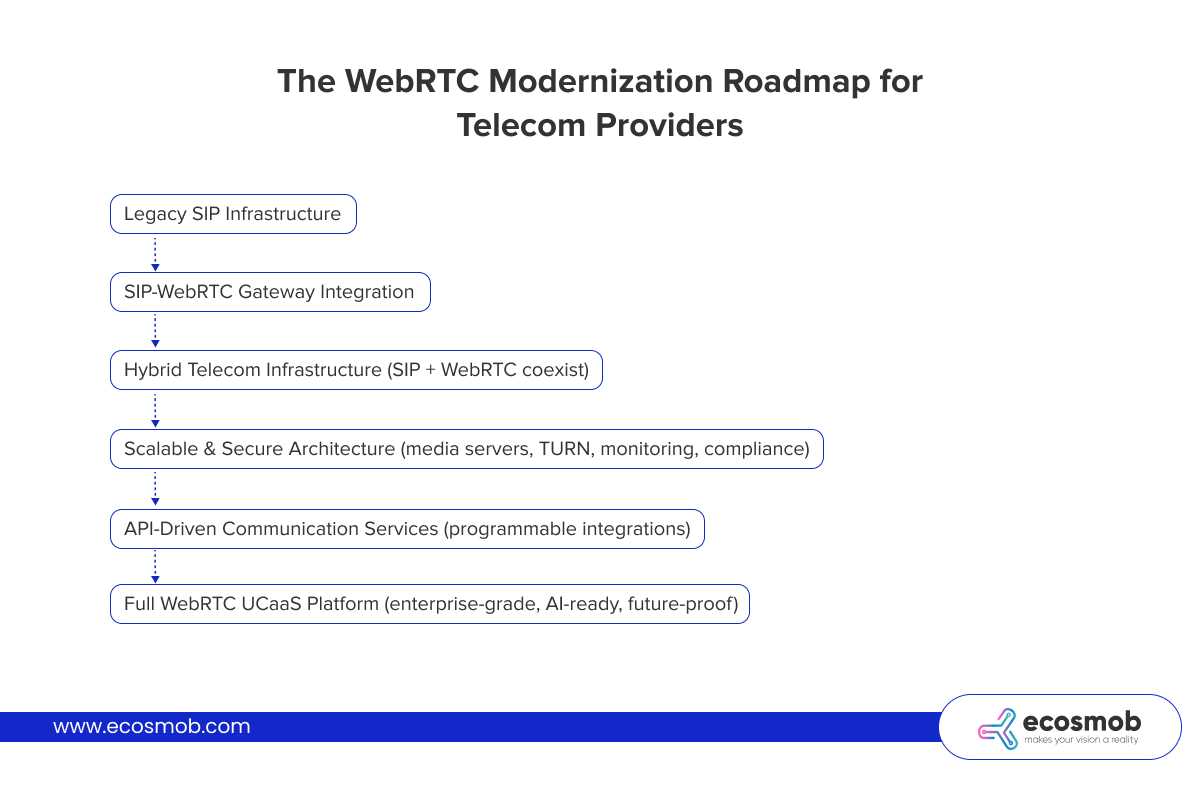
Most telecom providers operate hybrid environments where new WebRTC capabilities must coexist with existing SIP, PSTN, and proprietary communication systems. WebRTC development service providers specialize in creating integration layers that bridge these technologies while maintaining service quality and regulatory compliance.
The integration process typically involves building SIP-WebRTC gateways that translate between protocols, migrating customer configurations and routing rules to new platforms, and implementing fallback mechanisms that ensure service continuity during transitions.
Scalable Infrastructure Design and Deployment
Enterprise WebRTC solutions must handle traffic patterns that consumer applications never encounter. Telecom customers expect 99.9% uptime, sub-second call setup times, and consistent quality regardless of geographic location or network conditions.
This requires sophisticated infrastructure design: geographically distributed media servers, intelligent load balancing that considers both CPU and network proximity, database architectures optimized for real-time session management, and monitoring systems that provide visibility into every aspect of system performance.
API Development and Third-Party Integrations
Modern telecom services succeed by enabling integration rather than creating isolated communication silos. WebRTC development services create comprehensive APIs that enable enterprise customers to integrate real-time communications into their CRM systems, customer support platforms, e-commerce applications, and custom business software. These APIs must provide consistent functionality across web, mobile, and desktop platforms while maintaining the security and compliance standards that enterprise customers require.
The WebRTC Modernization Roadmap for Telecom Providers
Critical Architecture Decisions for WebRTC at Telecom Scale
Here’s the reality: most WebRTC applications work perfectly fine in demos with 10 users but completely fall apart when you hit 1,000 concurrent connections. The difference between a prototype that impresses stakeholders and a production system that actually serves telecom customers comes down to these make-or-break architecture decisions.
Signaling Server Architecture and Session Management
Your signaling infrastructure is what keeps calls connected when everything else goes wrong. Production WebRTC systems need signaling servers that can handle:
- Rapid connection establishment without bottlenecks
- User presence management across distributed server instances
- Call state synchronization using Redis clusters or similar distributed caching
- Session affinity management so users don’t lose connections during load balancing
The key insight?
Design for horizontal scaling from day one. You can’t bolt on clustering later without major architectural changes.
Media Server Selection and Deployment Strategy
Sure, WebRTC does peer-to-peer beautifully, but telecom applications need media servers for the scenarios that actually generate revenue:
- Multi-party conferences (more than two participants)
- Call recording for compliance and quality assurance
- Codec transcoding for device compatibility
- Advanced features like call transfer and conference bridging
Production deployments require media server clusters with intelligent load balancing that considers both CPU capacity and network proximity. Your customers in Tokyo shouldn’t connect to media servers in Virginia just because they have spare capacity.
Quality Monitoring and Adaptive Optimization
Telecom customers don’t care about your infrastructure challenges. They expect crystal-clear calls every time. Production WebRTC implementations monitor everything in real-time:
- Packet loss and jitter metrics
- Round-trip time measurements
- Codec performance across different network conditions
- Adaptive algorithms that adjust bitrates automatically
This monitoring data drives intelligent decisions: should we drop video to maintain audio quality? Route through a different path? Switch codecs entirely?
Database Architecture for Real-Time Performance
WebRTC applications are data-intensive in ways that catch developers off guard. You’re processing session data, user presence, and call detail records, all in real-time, all without impacting call quality. This requires:
- Time-series databases for metrics storage
- Document databases for session state management
- Traditional relational databases for billing and user configuration
- Careful partitioning strategies to avoid hotspots during peak usage
How to Choose the Right WebRTC Development Service Providers?
Choosing the wrong WebRTC development service providers can cost you months of delays and hundreds of thousands in re-development costs. Here’s how to separate the real experts from teams that aren’t ready for telecom-grade systems.
Questions That Reveal True Technical Expertise
You can ask these specific questions and observe how they respond:
How do you handle signaling server clustering for 10,000+ concurrent users?
- Expert Answer: Discusses Redis clustering, session affinity, and WebSocket connection pooling.
- Red Flag Answer: Talks about “scaling horizontally” without specific implementation details.
What’s your approach to TURN server placement and media relay optimization?
- Expert Answer: Mentions geographic distribution, network proximity analysis, and bandwidth cost optimization.
- Red Flag Answer: Generic responses about “deploying servers globally.”
How do you integrate WebRTC CDRs with existing telecom billing systems?
- Expert Answer: Discusses data format mapping, real-time vs batch processing, and handling call transitions.
- Red Flag Answer: Assumes you’ll replace your entire billing system.
Telecom Industry Experience Markers to Check
Look for these specific indicators of telecommunications expertise:
- Previous projects with telecom service providers (not just enterprise customers)
- Understanding of regulatory requirements (HIPAA, financial services, international compliance)
- Experience with SIP-WebRTC gateway implementations
- Knowledge of telecom-specific monitoring and SLA requirements
More Portfolio Questions That Matter
Don’t stop at asking for case studies, you should also dig into the technical details, like:
- “What was the largest concurrent user load you’ve successfully deployed?”
- “How did you handle geographic distribution and latency optimization?”
- “What monitoring and alerting systems did you implement?”
- “How do you manage codec optimization for different network conditions?”
The right WebRTC development service providers will eagerly discuss these technical challenges because they’ve solved them before.
Future-Proofing Your WebRTC Investment
WebRTC technology evolves rapidly, and your implementation needs to evolve with it. Here’s how smart telecom providers are building platforms that won’t become technical debt in two years.
Emerging Standards and Protocol Enhancements
New WebRTC capabilities (better codecs, enhanced security, improved mobile optimization) arrive regularly. Future-ready implementations use:
- Modular architectures: Add new capabilities without system redesigns
- Extensible APIs: Support new media types and communication modes
- Flexible signaling protocols: Extend for new features without breaking existing functionality
AI Integration and Smart Communication Features
AI will help WebRTC platforms increasingly incorporate advanced features like real-time transcription, sentiment analysis, and intelligent routing. Planning ahead requires:
- Data processing pipelines designed for AI workloads
- Privacy-compliant architectures for AI-processed communications
- Integration patterns that enhance communications without adding latency
Whether you’re a managed service provider looking to add real-time communications to your portfolio, an established telecom company modernizing legacy infrastructure, or a technology company building communication features into your platform, the right WebRTC development services can accelerate your time-to-market while ensuring your solution can scale and evolve with your business.
The key is working with WebRTC development service providers who understand both the technical complexities of building production-ready systems and the business requirements of the telecommunications industry.
We architect custom WebRTC solutions that integrate seamlessly with your infrastructure, scale reliably, and keep you ahead of OTT competitors.
Ready to modernize your telecom portfolio with WebRTC?
Frequently Asked Questions
WebRTC development services involve building custom real-time communication platforms using WebRTC technology, enabling telecom companies to offer browser-based calling, video conferencing, and integrated communications without requiring client software installations, resulting in improved customer experience and new revenue opportunities.
WebRTC application development services create integration layers including SIP-WebRTC gateways for protocol translation, API connectors for billing system integration, and hybrid architectures that allow WebRTC services to coexist with traditional PSTN and SIP infrastructure while maintaining service quality and regulatory compliance.
You should look for WebRTC development service providers with proven telecom industry experience, demonstrated expertise in scalable real-time systems architecture, understanding of telecommunications compliance requirements, and track records of building production systems that handle thousands of concurrent connections with carrier-grade reliability.
WebRTC integration enables managed telecom providers to offer browser-based communications, embed real-time features into customer applications, reduce client deployment complexity, and create new API-driven revenue streams while maintaining existing infrastructure investments and service level agreements.
Enterprise WebRTC solutions require carrier-grade infrastructure with 99.9% uptime, multi-tenant architecture for service provider environments, comprehensive security and compliance features, integration with existing business systems, and scalable architectures that handle thousands of concurrent users with consistent quality.