













QUICK SUMMARY
✅AI + WebRTC = Smarter Real-Time Apps → AI brings predictive scaling, smart noise suppression, and automated insights that make WebRTC applications more intelligent and user-friendly.
✅Scalability & Security at the Core → With AI-powered load management and advanced encryption, businesses can build WebRTC apps that scale globally while keeping communication safe.
✅Practical Roadmap for Developers → A step-by-step guide shows how to design, secure, and optimize WebRTC apps with AI, ensuring businesses can confidently deploy future-ready solutions.
Think about the last time you joined a video call, played an online game, or consulted a doctor through a mobile app. Chances are, you didn’t stop to marvel at the technology running in the background; you just expected it to work. However, the moment a call lags, the audio drops, or your data feels insecure, frustration sets in. That’s because in today’s world, real-time apps are not a luxury; they’re a necessity.
At the heart of this revolution is WebRTC, the backbone of real-time WebRTC communication that allows users to connect instantly without extra downloads or plugins. Pair this with AI, which brings intelligence, automation, and security, and you get applications that aren’t just functional, but also scalable and secure enough to support millions of users.
This blog examines how AI and WebRTC collaborate to power AI-driven real-time applications, the key challenges developers encounter, and the best practices for building solutions that can scale without compromising user trust.
Up next, we’ll take a closer look at why Real-time Apps need AI and WebRTC. So you know exactly why it matters for real-time communication.
Why Real-time Apps Need AI and WebRTC?
WebRTC, short for Web Real-Time Communication, is the foundation of today’s interactive digital experiences. Whether it’s a video chat app with WebRTC, live streaming, or collaboration platforms, this technology enables low-latency video, audio, and data sharing directly in browsers and mobile devices. Developers worldwide rely on WebRTC app development because it eliminates barriers like plugins or complex installations, making real-time communication effortless.
But the true strength of WebRTC lies in its versatility. From startups building niche healthcare solutions to enterprises running global conferencing platforms, real-time WebRTC technology adapts to different use cases. It supports high-definition video, secure peer-to-peer connections, and flexible integration with cloud infrastructure. That means whether you’re supporting a small group of users or millions across continents, WebRTC gives you a scalable foundation.
Yet, scalability and performance alone don’t cover the whole picture. In a world where sensitive conversations happen online daily, secure WebRTC app development is equally important. Encryption protocols like DTLS and SRTP ensure that data streams remain private, but as cyber threats evolve, developers must also explore how to secure WebRTC applications with AI-driven monitoring and fraud detection.
Clearly, the combination of AI and WebRTC isn’t just a nice-to-have; it’s becoming the backbone of modern real-time experiences. But how exactly does AI add that extra layer of intelligence to WebRTC?
Let’s break it down: here’s how AI transforms WebRTC from simply enabling live connections to powering truly smart, secure, and engaging real-time interactions.
Poll Question
If you had to prioritize ONE feature in a real-time app, what would it be?
How Does AI Enhance WebRTC for Smarter Real-Time Communication?
If WebRTC is the engine, then AI is the smart navigation system that makes it more efficient, responsive, and future-ready. Traditional apps built with WebRTC are powerful, but they rely heavily on human intervention for scaling, quality control, and security management. What does this mean?- Platforms like Choicely AI app builder let developers turn their website content into fully native iOS and Android apps, and then extend them via the Choicely Mobile App SDK to integrate AI‑driven, real-time features. By infusing WebRTC AI, businesses gain the ability to create self-optimizing, proactive, and smarter apps with every interaction.
Take call quality, for example. AI algorithms can predict network congestion in real time and automatically adjust bitrate or resolution to ensure smoother conversations. In customer support, AI for WebRTC scalability means AI voice assistants can handle thousands of concurrent calls, routing only complex issues to human agents. Similarly, natural language processing (NLP) enables features such as real-time translation and sentiment analysis, creating AI-powered applications that are more inclusive and empathetic.
For developers, this integration also eases operational challenges. Rather than manually monitoring servers, AI models can forecast traffic surges, allocate resources effectively, and detect unusual behaviors that may signal potential fraud or DDoS attacks. The combination of AI and real-time WebRTC, therefore, delivers not just communication, but communication that is scalable, adaptive, and secure.
So, while AI empowers WebRTC apps to adapt, predict, and secure conversations, the real difference is best observed when comparing apps built with AI to those built without it.
Here’s a quick side-by-side look to help you clearly see how AI and WebRTC together create a smarter, more scalable experience compared to traditional real-time apps.
| Features | Without AI in WebRTC Apps | With AI in WebRTC Apps |
| Scalability | Limited manual scaling required | Predictive auto-scaling with Kubernetes and ML |
| QoS (Quality of Service) | Prone to jitter, Packet loss | AI adapts bitrate, improves call quality dynamically |
| Secuirty | Standard encryption, Basic monitoring | Noise Cancellation, live translation, Smart enhancements |
| User Experience | Manual controls, Static features | AI detects anomalies, prevents fraud, and DDoS prevention |
| Operational Costs | Higher costs due to insufficient Scaling | Optimized resources, reduced cloud expenses |
As you can see, the difference is striking; adding AI doesn’t just refine WebRTC, it redefines what real-time apps can deliver. The real question now is: how does this intelligence translate into scalability?
How AI Enhances Scalability for WebRTC?
The success of a real-time application often hinges on its ability to handle growth. A video chat app with WebRTC may work perfectly for 50 users, but starts breaking down when 5,000 people join simultaneously. This is where scalable real-time apps with WebRTC require more than just strong servers; they need intelligent design.
AI provides the missing link. Through predictive analytics, applications can forecast usage patterns, say, a sudden surge during a product launch or a live sports event, and pre-scale infrastructure accordingly. With AI for WebRTC scalability, developers no longer need to guess how many servers to spin up; machine learning models can dynamically balance workloads, ensuring smooth performance regardless of traffic spikes.
Another consideration is global reach. Users connecting from different regions may face latency or quality issues without proper optimization. Here, AI helps identify the closest data centers and reroute traffic for optimal speed and performance. The result is a seamless user experience, whether someone is joining a webinar in San Francisco or a medical consultation in Mumbai. By combining WebRTC app development best practices with AI-driven scaling, businesses can create platforms that scale without interruption.
Scalability issues? Think of it like hosting a party for 10 people… and suddenly 10,000 show up. That’s WebRTC without AI!!!!
So, while AI ensures your WebRTC apps can handle growth without breaking a sweat, scalability alone isn’t enough; security is the other side of the coin.
Now, let’s examine how AI enhances the security of WebRTC, safeguarding real-time interactions against threats while maintaining seamless performance.
How AI Strengthens WebRTC Security?
In an era where data breaches and cyberattacks make headlines almost daily, securing WebRTC applications is a question no developer can afford to ignore. While WebRTC already comes with strong encryption, the security landscape is constantly evolving. Malicious actors often target real-time applications with threats such as man-in-the-middle attacks, identity spoofing, and fraudulent call injection.
This is where secure WebRTC app development demands AI as an added layer of defense. Machine learning models can analyze call patterns and detect anomalies in real time, shutting down suspicious sessions before they cause harm. AI can also monitor for unusual login behavior, flagging potential account takeovers and protecting sensitive conversations.
Moreover, AI-powered tools can continuously update their knowledge base, adapting to new threats faster than traditional rule-based systems. This proactive approach ensures that AI-powered real-time applications remain resilient against emerging risks. In practical terms, this means businesses can confidently build platforms where users know their calls, messages, and data are fully protected.
Security is no longer just about encryption; with AI, it becomes proactive, adaptive, and always one step ahead. Now that we’ve seen how intelligence fortifies protection, let’s shift our focus to the bigger picture: building apps that are not only secure but also scalable.
If your customers knew their conversations were 100% protected from intruders, how much more would they trust your platform?
Here’s a practical, step-by-step roadmap to guide you through creating real-time applications that strike a balance between scalability, security, and performance without compromise.
Your users want more than just video calls, they want intelligent, smooth experiences. Ready to deliver?
7 Steps to Building Scalable, Secure Real-Time Apps
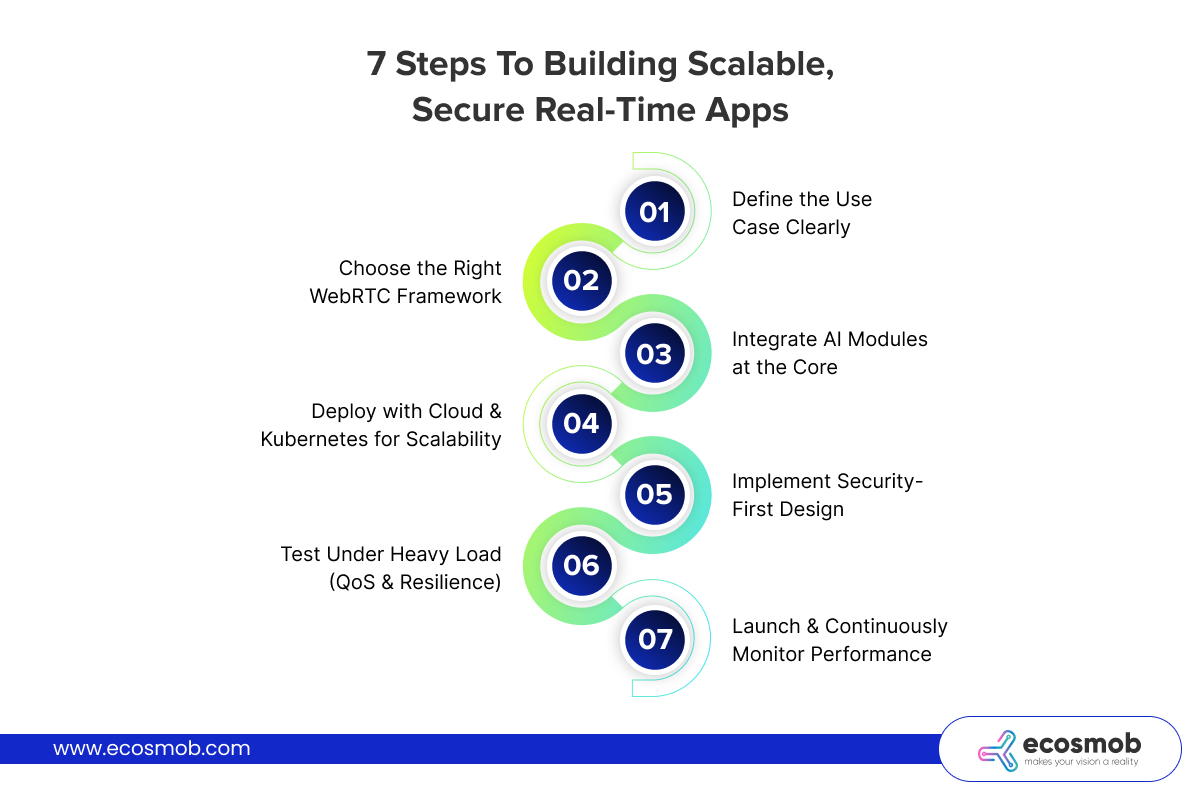 Building a scalable, secure, AI-driven WebRTC app isn’t just about plugging in APIs and deploying on the cloud. It requires a structured, layered approach, where each stage builds upon the foundation laid by the previous one. Below is a step-by-step framework that blends real-time WebRTC capabilities with AI intelligence and enterprise-grade security.
Step 1 – Define the Use Case Clearly
Every real-time app has unique needs; what works for telehealth won’t necessarily work for gaming or contact centers.
- Telehealth: Requires HIPAA/GDPR compliance, secure video with E2EE, AI transcription for patient-doctor consultations.
- Gaming: Needs ultra-low latency, anti-cheat AI, and scalable infrastructure to handle peak traffic surges.
- Customer Support: Intelligent call routing, sentiment analysis, multilingual AI-powered IVRs.
- E-Learning: Interactive whiteboards, real-time subtitles, scalable classrooms with hundreds of participants.
👉 Clearly defining the end goals ensures that technology choices (WebRTC frameworks, AI modules, cloud providers) align with your business requirements.
Step 2 – Choose the Right WebRTC Framework
WebRTC is the backbone of real-time apps, but the framework you select determines performance, scalability, and flexibility.
- Jitsi: Open-source, quick setup, great for small/medium real-time apps like classrooms and team meetings.
- Janus: Lightweight, modular, ideal for multiparty streaming and integration-heavy projects.
- Mediasoup: High-performance SFU, built for massive scalability (10,000+ participants).
- Pion (Go-based): Best for custom, lightweight WebRTC solutions in gaming and IoT.
👉 The decision depends on whether you need plug-and-play or deep customization for features like recording, analytics, or AI integration.
Step 3 – Integrate AI Modules at the Core
AI is what transforms a regular WebRTC app into an intelligent real-time platform.
- Speech Recognition & NLP: Enables real-time transcription, translation, and voice commands.
- Fraud Detection AI: Continuously monitors suspicious activity in financial or gaming apps.
- QoS Optimization (Machine Learning): AI predicts bandwidth issues and adjusts bitrate dynamically.
- Computer Vision: For facial recognition, gesture detection, or emotion-based responses.
👉 Instead of adding AI as an afterthought, embed it within the data pipeline for maximum impact on user experience and scalability.
Step 4 – Deploy with Cloud & Kubernetes for Scalability
Real-time apps demand elastic scaling, especially during traffic spikes.
- Cloud-Native Microservices: Break down features (authentication, media routing, AI modules) into independent services.
- Kubernetes Orchestration: Ensures horizontal scaling—adding/removing servers based on real-time demand.
- Global CDNs & Edge Servers: Reduce latency by placing users closer to the media servers.
👉 Example: A video chat app with WebRTC for education can seamlessly expand from 100 to 10,000 concurrent sessions with Kubernetes + AI load balancing.
Step 5 – Implementing Security-First Design
Security can’t be an afterthought in secure WebRTC app development. Combine native WebRTC security with AI-driven monitoring.
- End-to-End Encryption (E2EE): Protects video, audio, and data channels.
- Identity Management: Use OAuth 2.0, JWT tokens, and MFA for user validation.
- AI Threat Detection: Detects anomalies like DDoS attempts or account takeovers in real-time.
- Session Border Controllers (SBCs): Add enterprise-grade signaling and media security.
👉 This step is crucial for compliance-heavy industries like telehealth (HIPAA) and banking (PCI DSS).
Don’t let outdated communication hold your business back. AI & WebRTC is the upgrade you need.
Step 6 – Test Under Heavy Load (QoS & Resilience)
Before going live, stress testing is essential.
- Simulate Peak Load: Use traffic generators to simulate 10k+ concurrent calls.
- AI for Monitoring: AI models can predict when packet loss or jitter may degrade call quality.
- Resilience Testing: Ensure fallback servers and TURN servers are working for users behind strict firewalls.
👉 Testing ensures your scalable real-time apps with WebRTC perform under worst-case conditions.
Step 7 – Launch & Continuously Monitor Performance
Deployment isn’t the end, it’s just the beginning.
- AI Monitoring Dashboards: Real-time QoS, user behavior, fraud detection, and bandwidth analytics.
- Auto-Healing Networks: AI detects outages and reroutes traffic automatically.
- Feedback Loop: Gather user experience data to fine-tune AI models and app performance.
👉 Continuous optimization is what makes apps scalable, secure, and future-ready.
By following these seven steps, businesses can move from idea → architecture → AI integration → secure scaling → market-ready AI-powered real-time applications.
Let’s examine some real-world scenarios where AI and WebRTC converge, illustrating how industries are already leveraging this powerful combination to create practical solutions.
Real-World Use Cases of AI and WebRTC
The combination of AI and WebRTC isn’t theoretical; it’s already transforming industries. In telehealth, doctors use AI-powered real-time applications for live diagnostics, where AI analyzes medical images during a WebRTC session. In education, platforms integrate real-time WebRTC with AI translation, allowing students across countries to learn without language barriers.
Customer support centers also rely on WebRTC AI to efficiently handle massive call volumes. AI voice agents resolve common issues, while human agents focus on complex cases. Even in gaming and live streaming, scalable real-time apps with WebRTC support, backed by AI, ensure smooth interactions, regardless of the number of players or viewers logging in simultaneously.
These use cases demonstrate the significant potential of integrating WebRTC app development with AI-driven intelligence. The results are smarter, safer, and more scalable platforms that redefine how people connect digitally.
These use cases show that the blend of AI and WebRTC isn’t just a trend; it’s already shaping how businesses connect, collaborate, and scale.
When Google Meet integrated AI noise cancellation, it instantly became a lifesaver for millions working from home.
So, what does this mean when we step back and look at the bigger picture?
To wrap things up, let’s bring together the key insights on why AI and WebRTC are redefining real-time app development, and what it means for businesses moving forward.
Wrapping Up
The demand for real-time applications is expected to grow rapidly, from simple video chat tools powered by WebRTC to enterprise-grade collaboration platforms that connect millions. The real challenge, however, lies not only in making these apps functional but also in ensuring they are scalable, intelligent, and secure. By blending the strengths of WebRTC with the intelligence of AI, businesses can overcome these challenges with ease. Together, they enable applications that scale without lag, safeguard every interaction, and create user experiences that feel natural, responsive, and future-ready.
🔑 Key Takeaways
- Scalability without compromise: AI-enhanced WebRTC ensures smooth performance, even as apps scale to millions of users.
- Security you can trust: AI enhances WebRTC’s native security, detecting and neutralizing threats in real-time.
- Smarter experiences: From noise cancellation to predictive analytics, AI brings personalization and intelligence to every conversation.
For developers and businesses, the message is clear: the future of communication isn’t just real-time, it’s real-time supercharged with AI.
At Ecosmob, we specialize in helping businesses build exactly these kinds of scalable, secure, and intelligent real-time applications. With deep expertise in AI, WebRTC, and cloud-native development, our team designs solutions tailored to your needs — whether it’s a custom collaboration platform, a smart contact center, or enterprise-grade video communication. Partnering with Ecosmob means turning your vision into a future-ready solution that grows with your business.
Scaling to thousands, or even millions, of users doesn’t have to be painful. We’ll show you how.
FAQs
What is WebRTC, and why is it important for real-time apps?
WebRTC (Web Real-Time Communication) is an open-source technology that enables real-time audio, video, and data sharing directly in browsers and apps without the need for plugins. It’s crucial for building apps like video conferencing platforms, live streaming solutions, and collaborative tools because it offers low latency and high-quality communication.
How does AI improve WebRTC-based applications?
AI enhances WebRTC by adding smart features such as real-time transcription, live translations, noise suppression, sentiment analysis, and intelligent routing. This makes communication more efficient, accessible, and user-friendly while also improving scalability and security.
Are WebRTC apps secure enough for business communication?
Yes, WebRTC has built-in encryption (DTLS and SRTP), ensuring that data streams are secure. When combined with AI-driven security measures like anomaly detection, fraud prevention, and real-time monitoring, businesses can achieve enterprise-grade protection against modern threats.
Can AI and WebRTC together help apps scale for millions of users?
Absolutely. AI can optimize traffic routing, balance loads, and predict usage spikes, while WebRTC provides the real-time framework to handle massive concurrent users. Together, they allow apps to scale seamlessly without compromising speed or quality.
What are some real-world examples of AI + WebRTC applications?
Smart video conferencing tools with live captions and translations, AI-powered virtual call centers with sentiment analysis, Healthcare teleconsultation platforms with automated diagnostics support, and E-learning apps offering real-time tutoring and instant feedback are some of the real-world examples of AI + WebRTC applications.