Support calls generally follow predictable paths: identity authentication, issue description, diagnostic steps, resolution. Enterprise sales conversations do not.
Picture an enterprise sales call: An account executive is halfway through demonstrating a custom integration framework. The prospect suddenly leans into their microphone and says: “Wait, before we get into that, if we buy 500 seats by the end of the quarter, does that trigger the 30% tier, and can we split invoicing across two entities?”
Within five seconds, the call pivoted across three functional domains:
- Enterprise Information Security (InfoSec) and architecture
- Contractual commercial tiers and volume discounting
- Corporate billing operations and split-entity invoicing
If your real-time agent assistance software relies on naive keyword matching or dumps a rolling five-minute transcript window into a Large Language Model (LLM) on every pause, it will fail. It pops up a stale Service Organization Control 2 (SOC 2) compliance card three seconds after the prospect has already moved on to payment terms. The representative gets distracted, ignores the monitor, and the co-pilot becomes visual clutter.
Managing that transition requires an architecture designed specifically for rapid conversational pivots.



Don’t just watch the future
happen. Why should the right answer?

How Does Real-Time Agent Assist Work on Live Calls?
To understand why context switching trips up basic software, it helps to look at the baseline mechanics of in-call guidance.
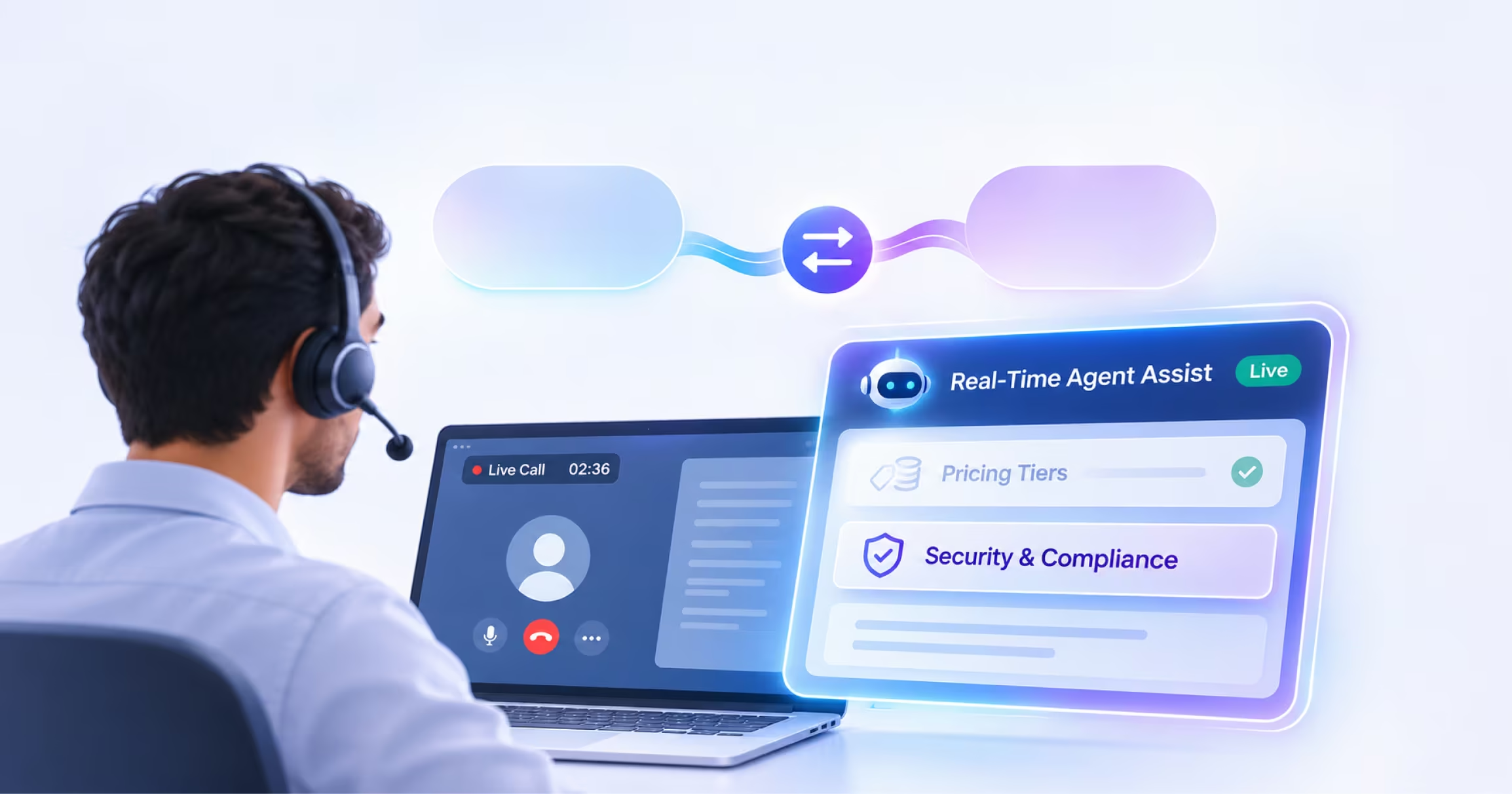
At its core, real-time agent assist is an interconnected media and reasoning pipeline. The system taps directly into the audio plane of an ongoing phone or web call, generates continuous real-time transcripts, identifies customer intent, searches a corporate knowledge base, and pushes relevant guidance directly onto the sales representative’s screen while the conversation is still happening.
The end-to-end operation flows through four sequential stages:
- Audio Capture and Media Splitting: The system forks live audio streams from the telephony network using Session Initiation Protocol Recording (SIPREC) or media server hooks, ensuring the customer’s voice and the representative’s voice remain on isolated, pristine channels.
- Streaming Speech-to-Text (STT): Automatic Speech Recognition (ASR) engines process the audio in real time, converting acoustic phonemes into streaming text tokens within milliseconds.
- Intent Detection and Topic Tracking: The language pipeline continuously analyzes transcripts to detect questions, competitor mentions, pricing inquiries, or objections.
- Retrieval-Augmented Generation (RAG) and UI Delivery: The platform queries structured product documentation, Customer Relationship Management (CRM) records, and competitive battlecards, formatting the answer into a scannable, two-line prompt on the representative’s screen.

When a conversation moves along a single topic, this workflow performs smoothly. But the moment a buyer pivots, the relationship between speech recognition, state tracking, and vector search must adapt instantly.
This is where the capabilities of a real-time agent assist platform become particularly important, and it’s also what has inspired our new launch: Convoiz, Ecosmob’s conversation intelligence platform, which brings several of these capabilities together to support representatives through live interactions and give teams more to work with after the conversation.
CONVOIZ
Know what to say. While you’re saying it.
Built around the realities of live conversations, CONVOIZ gives representatives access to relevant information without making them break their train of thought.
During live conversations:
- Live Response: Contextual suggestions to help representatives respond.
- Objection Playbook: Guidance for navigating buyer objections.
- Technical Lifesaver: Quick access to technical information.
- Shorthand Notes: A convenient way to capture important points.
For post-call intelligence:
- Conversation Analytics: BANT Radar, Speaking Rate, Sentiment Trend, and Talk Ratio.
- Meeting Insights: Transcripts, AI-generated summaries, insights, and coaching history.
Why Is Context Switching Difficult in Real-Time Agent Assistance?
The fundamental challenge of in-call assistance isn’t speech recognition accuracy or LLM reasoning depth. It is conversational velocity versus pipeline latency.
In natural human dialogue, the gap between conversational turns averages roughly 200 milliseconds, with natural pauses rarely exceeding one second. If an agent assist platform takes 2.5 seconds to ingest audio, transcribe the turn, query a vector database, and render an answer, the opportunity is gone. The rep has already improvised an answer or transitioned the topic.
Context switching compounds this latency problem in three distinct ways:
- The Entanglement Trap: If a buyer weaves an objection into an anecdote, the system must separate the conversational filler from the actionable intent. Passing raw conversational transcripts causes the retrieval model to pull collateral based on secondary adjectives rather than the primary objection.
- The Visual Overload Penalty: When topics pivot rapidly, naive systems push new guidance cards without dismissing previous ones. The rep’s workspace becomes cluttered with obsolete battlecards, forcing them to scan through multiple tiles while trying to maintain eye contact and vocal composure.
- The Unresolved Topic Debt: Buyers frequently interrupt with an operational question, wait for a quick confirmation, and immediately say: “Okay, back to what you were saying about data encryption.” The software must maintain an active stack of open topics, popping resolved detours off the stack without losing the primary conversational thread.
Also learn how one wrong AI model can wreck your voicebot accuracy.
Capturing Dual-Channel Audio (The Telephony AI Foundation)
Effective real-time artificial intelligence is impossible if you feed mixed mono audio into your ingestion pipeline. When both speakers share a single audio track, overlapping speech (crosstalk) corrupts acoustic phonemes, causing streaming transcription models to drop words precisely during critical interruptions.
Before choosing an ingestion architecture, engineering teams must evaluate how different audio extraction points handle physical latency, separation overhead, and platform stability across enterprise networks:
| Audio Capture Method | Ingestion Point | Latency Floor | Crosstalk Isolation | Suitability for Real-Time Assist |
| Desktop Virtual Audio Cable | OS-level application loopback | 400 ms – 700 ms | Poor (software mixing issues) | Low (fragile, client-dependent) |
| WebRTC Media Stream Capture | Browser tab recording API | 300 ms – 600 ms | Moderate (browser process throttling) | Medium (browser-only setups) |
| SBC / Network Media Forking (SIPREC) | Carrier Session Border Controller | 80 ms – 150 ms | Complete (Hardware SSRC split) | Enterprise Standard |
Production-grade real-time agent assist systems tap into the media plane directly at the Session Initiation Protocol (SIP) and Real-time Transport Protocol (RTP) layer, enforcing strict channel separation.
Using SIPREC or native media bugs inside switches like FreeSWITCH (mod_audio_stream) or Asterisk (AudioSocket), the telephony server forks the caller and representative legs as isolated audio streams.
This gives your streaming speech pipeline clean synchronization sources (SSRC). The system transcribes the customer’s objection independently of the sales rep’s breathing or keyboard typing, enabling accurate Voice Activity Detection (VAD) and immediate interruption awareness.
How Does Real-Time Agent Assist Manage State (Topic Pivots)?
Once clean audio is streaming into the application, how does the system recognize that a topic shift occurred without running heavy, slow reasoning models across the entire call transcript?
High-performance platforms employ a structured state evaluation model that runs continuously on sliding phonetic windows:

1. Spoken Language Understanding (SLU) at the Edge
Rather than waiting for a turn to complete, a lightweight Spoken Language Understanding (SLU) model processes partial transcripts (interim tokens) emitted by the streaming ASR engine.
Trained on conversational transition markers (“on another note”, “actually”, “what about”, “going back to”), this classification layer identifies intent boundaries in under 60 milliseconds. It does not attempt to formulate an answer; it simply evaluates a single mathematical question:
Did the current semantic vector diverge from the active topic centroid by more than the threshold distance?
2. The Dialogue State Machine (Context Stacking)
Human conversation is non-linear. A buyer rarely closes a topic cleanly before introducing another; they nest questions inside objections.
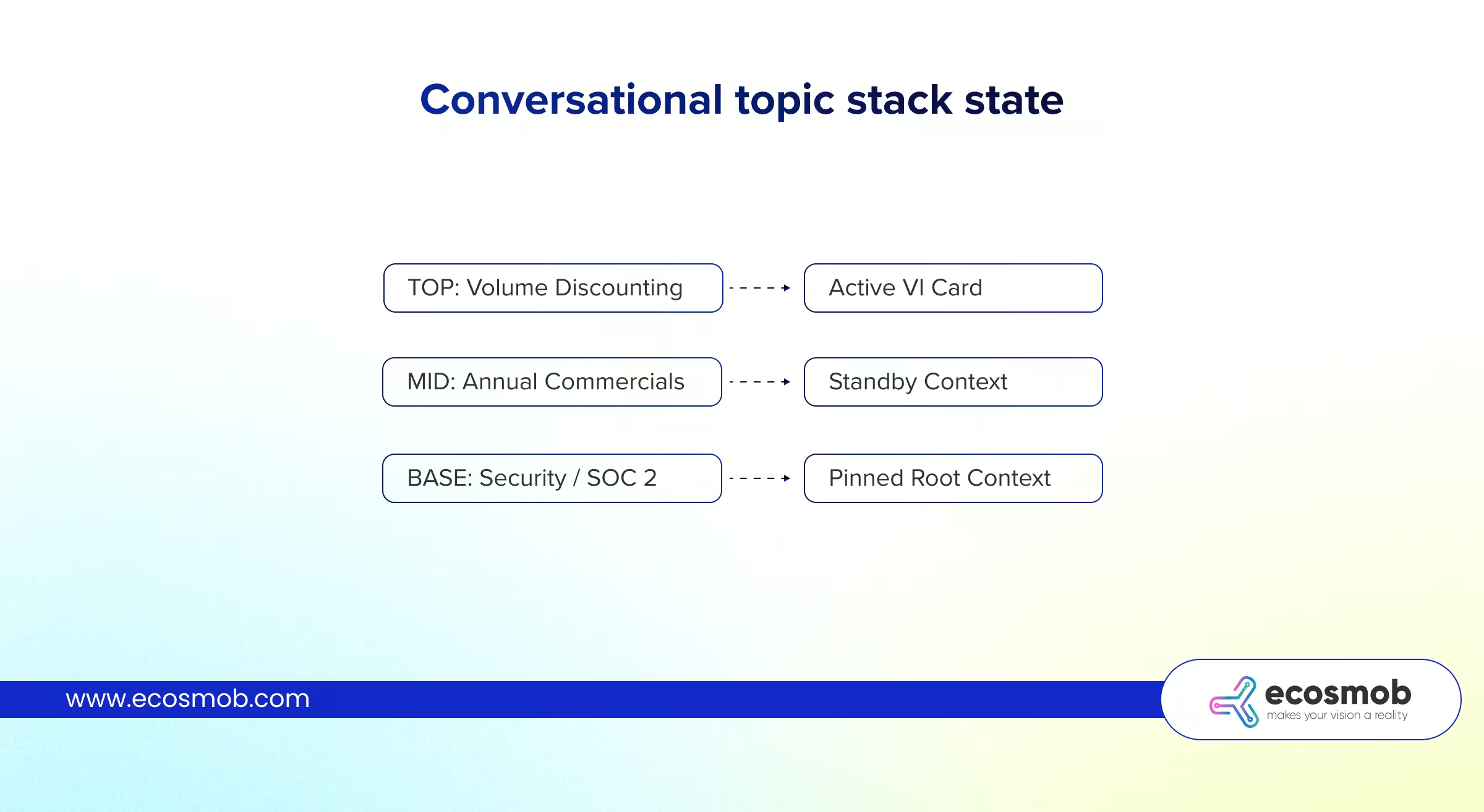
To manage this without hallucinating, the engine tracks conversational state using a pushdown automaton model:
When the buyer introduces a sudden digression (“Wait, are you SOC 2 compliant?”), the state machine pushes a new frame onto the stack. The UI immediately swaps the primary tile to the security compliance battlecard.
When the rep addresses the point (“Yes, Type II certified, reports available under NDA”), and the buyer acknowledges (“Great, makes sense”), the system pops the frame off the stack.
The assist surface automatically restores the underlying parent frame (commercial pricing), preventing the rep from losing their place in the broader deal narrative.
3. Immediate Vector Retrieval Invalidation
If the buyer changes their mind mid-sentence (“Tell me about your Salesforce integration—actually, skip that, we use HubSpot”), any pending vector search or LLM generation for Salesforce must be aborted instantly.
Production platforms use event-driven cancellation tokens. The moment the intent transition fires, an abort signal cancels in-flight embeddings and LLM stream requests. This frees compute resources and prevents outdated information from rendering on the sales rep’s screen.
Measuring Latency Thresholds in Real-Time Agent Assistance
Building real-time copilots requires aggressive latency budgets across the entire pipeline. When delays mount, the guidance arrives after the representative has already spoken, breaking the flow of dialogue.
The temporal constraints of real-time conversational interaction are well established in telecommunications and human-machine systems. Technical standards documented in IEEE Technology Navigator on Telepresence Systems demonstrate that perceptible round-trip transport delays exceeding 150 milliseconds noticeably degrade natural conversational turn-taking, forcing speakers to talk over one another or hesitate.
In a real-time agent assist pipeline, this transport ceiling defines the outer boundary of the end-to-end processing budget:
- Speech-to-Text finalization: 150 ms – 250 ms
- Intent classification and state update: 100 ms – 200 ms
- Vector retrieval (RAG) and card formatting: 250 ms – 400 ms
- Frontend WebSocket transport and User Interface (UI) render: 50 ms – 100 ms
Total elapsed time remains between 550 ms and 950 ms. If an agent assist platform cannot process audio, detect a topic switch, and render an answer within that sub-second window, the cognitive window closes. The rep cannot read the assistance, process its relevance, and vocalize a response naturally, rendering the co-pilot functionally useless during rapid conversational pivots.
Ecosmob Expert Tip
Streaming speech engines emit partial hypotheses every 50 to 100 milliseconds as acoustic data clarifies. If you trigger semantic vector searches on every raw partial token, you will swamp your vector database and trigger UI flicker.
Implement a 250ms phonetic debounce window that waits for stable syntactic phrase boundaries before committing an intent shift to your retrieval layer.
What Are the Common Failure Modes When Real-Time Agent Assist Handles Context Shifts?
When designing assistance systems for sales teams, engineers must identify specific failure states and build safeguards so the software degrades gracefully under pressure:
| Failure Mode | Root Architectural Cause | Real-World Impact | Solution |
| Battlecard Thrashing | High sensitivity on semantic vector distances | UI rapidly flashes 3 different cards in 2 seconds | Enforce a 1.2-second display hysteresis lock before swapping tiles |
| Premature Barge-In Drop | VAD configured with aggressive short silence (<150ms) | Bot interrupts user mid-thought during breathing pauses | Dynamically expand VAD trailing windows during complex explanations |
| Entity Hallucination | Out-of-domain terms injected into unconstrained LLMs | Co-pilot suggests non-existent integrations or pricing | Constrain output to strict JSON schemas backed by deterministic knowledge graphs |
| Stale Context Desync | Failure to pop resolved frames off the state stack | Competitor comparison card stays visible for 10 minutes | Implement timeout decay: auto-retire cards after 45 seconds without topic reinforcement |

Every conversation has more to offer than what was said.
Static Search vs. State-Aware Real-Time Agent Assist
Understanding how basic retrieval tools differ from true conversational state machines illustrates why purpose-built telephony architectures are necessary for sales workflows:
| System Capability | Basic Keyword / Static Vector Assist | State-Aware Real-Time Agent Assist |
| Audio Processing | Mono mixed desktop audio | Hardware-split dual RTP/SIPREC streams |
| Trigger Mechanism | Explicit keyword spotting (“pricing”, “competitor”) | Continuous semantic vector distance tracking |
| Topic Handling | Flat, stateless replacement (last keyword wins) | Multi-tier pushdown automaton with context memory |
| Interruption Handling | Ignores interrupts; runs queries to completion | Instant cancellation tokens on in-flight inference |
| UI Presentation | Wall-of-text knowledge base article links | Scannable, 2-line conversational bullet cards |
| Latency Benchmark | 2,000 ms – 4,000 ms (unusable in real time) | 600 ms – 900 ms end-to-end |
The comparison above focuses on how assistance responds to a changing conversation. But there’s another dimension to consider: what happens to all the information gathered during that interaction?
Convoiz, for example, combines live conversational guidance with post-meeting analysis.
Its conversation metrics include BANT qualification, sentiment trends, speaking rate, and talk ratio. And its meeting records provide transcripts, summaries, and coaching insights.
These serve a different purpose from real-time battlecards: they help teams examine conversations, assess performance, and identify what needs attention beyond the live interaction.
The goal of a real-time sales co-pilot is not to replace the human representative, nor is it to turn them into an automated teleprompter reader.
The real value lies in cognitive offloading. In complex B2B sales, reps are forced to juggle product documentation, complex tier discounting, partner agreements, and competitive battlecards (all while actively listening to the buyer’s tone and body language).
When your architecture handles context switching properly, the technology fades into the background. The software tracks the non-linear detours of human conversation, silently queues the right operational data at the exact moment an objection is voiced, and dismisses stale context the second the room moves on.
That is how you turn chaotic sales calls into structured, repeatable revenue.
Want to put conversation intelligence to work on your sales calls? Explore Convoiz!
Building an AI voice agent of your own? Ecosmob’s AI Voice Agent Development & Integration service takes your concept from an isolated sandbox to a production-wired pilot in 4–8 weeks (integrated with your SIP, WebRTC, CRM, and BSS infrastructure)!
Frequently Asked Questions
Real-time agent assist captures live audio directly from telephone calls or WebSockets, transcribes both channels independently using streaming speech recognition, analyzes customer intent in real time, and dynamically surfaces relevant battlecards, pricing calculators, or answers onto the sales representative’s screen in under one second.
The real-time agent assistance system uses sliding semantic context windows and hierarchical state machines rather than static keyword matching. When a buyer pivots from technical compliance to pricing, the engine identifies the shift in topic vector distance, cancels in-flight database lookups for the previous topic, and pushes the new subject to the top of the conversational stack without corrupting underlying call history.
While widely used in customer service for compliance checklists, real-time agent assistance is increasingly deployed in enterprise sales. It helps account executives navigate complex commercial terms, handle unexpected competitor objections, remember specific feature limits, and enforce deal playbooks during live, unstructured conversations.
To be actionable, the platform must deliver guidance within 800 milliseconds of the buyer finishing their sentence. If assistance takes longer than 1.5 seconds to display, the representative has already moved past the moment or improvised an answer, rendering the on-screen card distracting rather than helpful.
A voice agent (voicebot) replaces the human speaker, holding an autonomous conversation directly with the caller by running speech-to-text, large language models, and text-to-speech synthesis. Real-time agent assist operates silently in the background, listening to a conversation between two humans and feeding the human representative private, real-time intelligence to improve their performance.