














QUICK SUMMARY
⚡ At a Glance
The Problem: AI in UC platforms shines in demos but underperforms in real voice environments.
What We Break Down: The demo-to-production gap, infrastructure constraints, and the specific AI capabilities that fail under live traffic.
Key Takeaway: A practical roadmap to close the gap between AI vendor promises and actual voice performance.
“Sure, AI can transcribe 98% accurately!” the vendor told you during the demo. But then real calls hit: someone with a heavy regional accent dials in from the road, another is in a noisy office, and suddenly the transcripts make no sense at all. You end up correcting AI output, rerouting calls manually, and, ironically, doing the busywork the AI was supposed to eliminate.
Look, I don’t believe AI will take everyone’s job. It won’t. But what it can do, and should do, is take the busywork out of the job, so humans can focus on real thinking. Unfortunately, when it comes to AI in UC platforms, that promise often doesn’t pan out in practice.
Most vendors love phrases like “AI-powered calls,” “smart routing,” and “real-time insights.” But in production, you see dropped context, inaccurate transcription, and wrong intent detection. The core reason isn’t that the AI itself is fundamentally broken, it’s that voice environments are messy, unpredictable, and deeply tied to network and infrastructure conditions that most AI tools aren’t engineered for.
In this blog, we’ll break down why AI voice features struggle in real-world Unified Communications environments, and what actually needs to change to make them work.
Let’s see!
Why AI Voice Features Perform Well in Demos but Fail in Real UC Environments
In marketing decks and controlled demos, speech AI and UC features look amazing:
✅ Clean audio
✅ A single speaker
✅ Stable bandwidth
✅ Native accents
But that’s not how live traffic works. In real voice communications, you deal with:
❌ Packet loss, jitter, and echo on VoIP links
❌ Background noise, call centers, roads, public spaces
❌ Code-switching and regional accents
❌ Overlapping speech
❌ Low-bitrate compression designed to save bandwidth
These aren’t edge cases, they’re everyday reality. And they wreck speech recognition accuracy compared to clean, studio-quality samples. Real-world error rates can be far higher than what the lab numbers suggest, because noise and network distortion compound transcription challenges.
The gap between controlled tests and live conditions is the first shock most teams face, and it’s where many AI in Unified communication solutions’ promises start to unravel.
And even if you solved every audio quality issue, voice AI would still struggle, because the real friction often starts inside the infrastructure itself.
Myth vs Fact
❌ Myth: If AI works in a demo, it’s production-ready.
✅ Fact: AI models trained on clean audio often degrade significantly in real telephony environments with noise, compression, and packet loss.
Your AI is 'listening' to the call, but is it actually hearing the customer?
How Infrastructure Issues Impact AI Voice Features Performance in UC Platforms
Even if the AI model is strong, it still depends on the telephony stack supporting it. Here’s where many UC platform AI problems start.
1. Latency Accumulation
AI processing doesn’t happen instantly. Audio is captured, streamed, processed for transcription, then fed into NLP for intent detection, and then passed into routing logic. Each stage adds milliseconds.
Individually, that seems harmless. Collectively, it creates a noticeable delay.
That’s the trade-off most teams underestimate: to balance AI accuracy with real-time latency and jitter requirements in UC platforms is more complex than it sounds. The deeper the processing layers, the more delay you introduce into conversations that rely on immediacy.
That’s when conversations start to feel robotic. Slight pauses creep in. Agents and callers talk over each other. The flow breaks.
Voice communication is extremely sensitive to timing. Add enough processing layers, and the “real-time” experience stops feeling real.
2. Poor Media Handling
In many deployments, audio gets transcoded before it even reaches the AI engine. Compression codecs reduce quality. Signal clarity drops. The AI works with what it gets, but what it gets is already compromised.
If your SBC or media server wasn’t architected for AI inspection, the AI layer is operating on degraded input from the start.
Garbage in, guesswork out.
3. Compute and Scaling Limits
AI workloads aren’t lightweight, especially when analyzing concurrent calls in real time.
Under-provisioned environments throttle performance. Transcription queues build up. Response time increases.
Just because a platform is labeled “AI-enabled” doesn’t mean it’s engineered for AI at scale.
And this is where AI voice features performance quietly collapses in production.
But infrastructure isn’t the only pressure point; even with a perfectly tuned network, the real test begins when individual AI capabilities start making decisions on live calls.
Did You Know?
Even a 5–10% drop in speech recognition accuracy can disrupt intent detection, routing logic, and sentiment analysis, multiplying errors across the entire UC workflow.
I see what you’re building. But if your AI can't handle a real-world accent, the vision fails.
Key AI Capabilities in UC Platforms That Struggle in Production
By the time AI reaches production inside a UC environment, it’s already fighting an uphill battle. The problem isn’t just infrastructure or network instability, it’s that the very capabilities being marketed as “intelligent” weren’t built for the unpredictability of live telephony. AI models trained on clean data fail with telephony audio because real calls are compressed, distorted, interrupted, and layered with context that doesn’t exist in training datasets. And when that gap shows up, it doesn’t affect just one feature. It ripples across multiple AI layers inside the system.
Let’s break down where things actually start to crack.
1. Speech Recognition Accuracy
Everything begins with transcription. If the system can’t reliably capture what was said, nothing downstream stands a chance.
In real UC deployments, speech recognition struggles for three consistent reasons:
- Accent variability – Regional pronunciation shifts, speech rhythm differences, and multilingual speakers introduce patterns the model may not have seen frequently in training.
- Domain vocabulary – Industry terms, product names, and acronyms are easily misheard unless the model is tuned for that specific environment.
- Environmental noise – Background chatter, traffic sounds, or compressed VoIP streams reduce acoustic clarity, forcing the model to approximate instead of recognize.
Even a small transcription error can distort meaning. And those distortions don’t stay isolated, they cascade. When people talk about UC platform AI problems, this is usually where the chain reaction begins.
2. Intent Detection & Context Understanding
Let’s assume the transcription is mostly correct. Now the system has to decide what the caller meant.
This is where things get messy.
Intent detection engines often rely on pattern matching layered over NLP models. But real conversations are rarely linear.
- Keyword spotting isn’t true contextual understanding.
- Models trained on generic datasets often misfire in specific business workflows.
- Errors in sentiment or intent detection can lead to unnecessary escalations.
And here’s how the damage compounds:
Small transcription deviation → incorrect intent tag → unnecessary escalation → supervisor intervention → increased operational load.
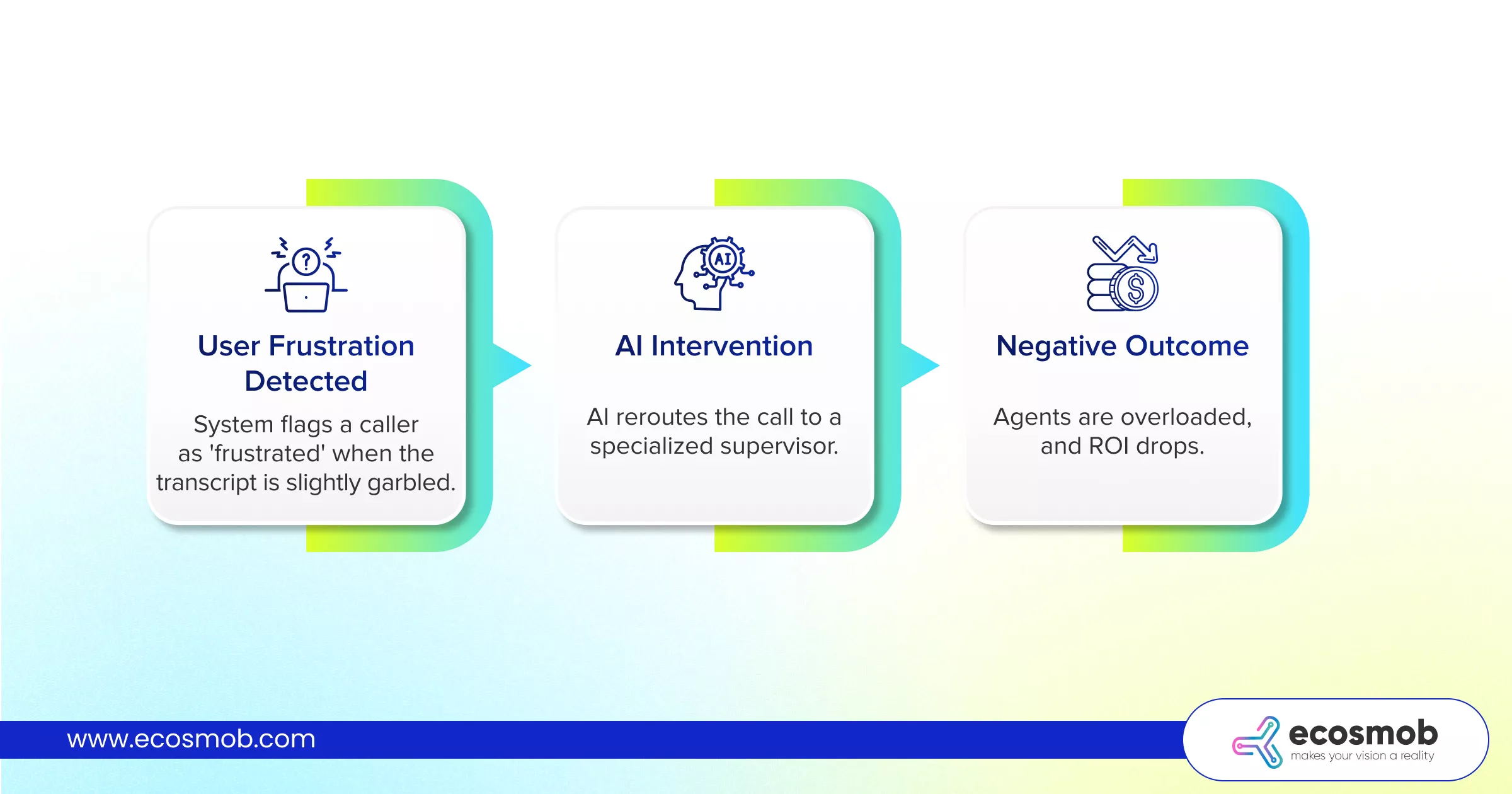 That escalation loop is subtle but costly. AI processing consume so much compute without delivering ROI when those classifications are unreliable. You’re paying for real-time inference, model processing, and infrastructure scaling, but if the intent signal isn’t trustworthy, the automation creates friction instead of removing it.
3. Sentiment Analysis Reliability
Voice call Sentiment analytics sounds impressive in marketing copy. In reality, it’s fragile.
Emotion isn’t universal. Tone shifts across cultures. Some speakers naturally sound intense. Others sound flat even when frustrated. Add compression artifacts and background noise, and vocal cues become harder to interpret.
Now imagine the system flags a caller as “angry” when they’re simply speaking loudly in a noisy environment. Or worse, it fails to detect genuine frustration because the signal was distorted.
Unlike humans, AI doesn’t understand nuance. It predicts emotional state based on acoustic markers and word patterns. If those markers are distorted, emotional classification becomes guesswork.
And guesswork doesn’t scale well in customer-facing systems.
4. AI-Based Call Routing & Automation
This is where all upstream weaknesses converge.
AI-based call-handling decisions depend on accurate transcription, accurate intent detection, and reliable sentiment tagging. If any one of those layers falters, routing logic becomes unstable.
What looks like “smart routing” in a demo becomes inconsistent queue assignment in production. Calls get escalated unnecessarily. Agents receive conversations without proper context. Automation workflows trigger incorrectly.
The system isn’t just slightly wrong; it compounds earlier errors.
That’s the danger of layered AI architectures inside UC platforms. Each feature depends on the reliability of the one before it. And when the foundation shifts, everything built on top becomes unpredictable.
5. Real-Time AI vs Post-Call Processing
Finally, there’s the marketing versus architectural reality.
Real-time AI has to operate within strict latency boundaries. It doesn’t get a second chance to reinterpret audio. It must process, classify, and act within milliseconds, while balancing compute limits and network variability.
Post-call AI doesn’t face those constraints. It can reprocess segments. It can apply heavier models. It can afford to be more accurate because time isn’t the enemy.
This is why many “real-time AI” features feel underwhelming in practice. The architectural trade-offs required for speed reduce analytical depth. And when marketing promises intelligence but infrastructure demands instant decisions, performance naturally suffers.
When you step back, you see a pattern.
It’s not one catastrophic failure. It’s cumulative fragility.
Once you see where these AI layers start breaking down, the real question becomes how to redesign them so they survive real-world voice traffic instead of collapsing under it.
You’ll never stand out with laggy, robotic conversations. If your infrastructure isn't tuned, your AI is just friction.
How to Improve AI Voice Features Performance in UC Platforms
 If you’ve made it this far, one thing should be clear: the issue isn’t that AI is useless; it’s that it’s often deployed without structural alignment to voice reality. That’s what creates the gap between AI vendor promises and actual voice performance.
Closing that gap doesn’t require hype or bigger models. It requires architectural decisions, operational discipline, and a smarter approach to integrating AI into UC platforms within the telephony stack. So instead of saying “use better AI,” let’s talk about what actually changes outcomes.
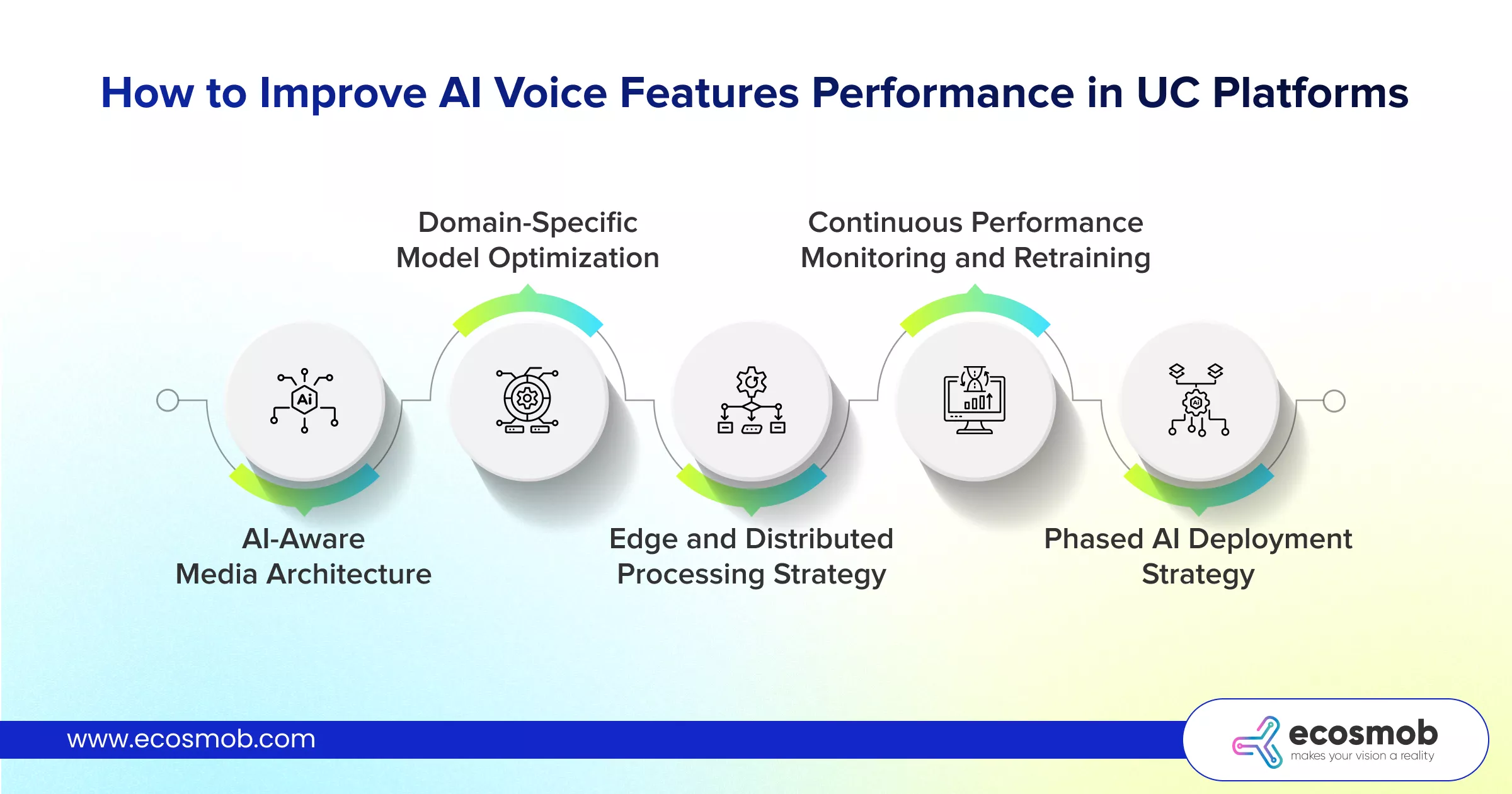
1. AI-Aware Media Architecture
Before AI in UC platforms ever analyzes a word, the audio has already passed through layers of processing. If that pipeline degrades signal quality, everything downstream suffers.
Start here:
- Minimize unnecessary transcoding. Every codecs conversion strips detail from the audio signal. If you don’t need it, don’t do it.
- Preserve RTP quality. Protect packet integrity and reduce jitter wherever possible. Clean input improves model confidence.
- Optimize the audio pipeline before AI ingestion. AI should receive the highest-fidelity signal available, not a compressed afterthought.
Many AI in UC platforms deployments focus on model selection but ignore media flow. That’s backwards. If the signal is compromised, no model will rescue it.
2. Domain-Specific Model Optimization
Generic AI works generically. Production systems need precision.
To improve AI voice features performance, models must reflect how your users actually speak.
- Inject custom vocabulary. Add product names, industry acronyms, and internal terminology directly into the model’s language set.
- Adapt for accents and multilingual speech. If your user base is global, your AI in UC platforms must reflect that diversity.
- Train on industry-relevant datasets. Models perform better when they’ve seen similar conversations before.
This is where many UC platform AI problems originate: teams assume the base model is “good enough.” It rarely is.
3. Edge and Distributed Processing Strategy
Not every AI decision needs to travel to a distant cloud endpoint.
- Reduce round-trip latency. Processing closer to the user minimizes delay and improves conversational flow.
- Balance real-time constraints. Some tasks demand speed. Others allow deeper analysis post-call. Architect accordingly.
To balance AI accuracy with real-time latency requirements in UC platforms, you need intentional placement of AI workloads. Real-time doesn’t mean everything must be processed the same way.
4. Continuous Performance Monitoring and Retraining
AI in UC platforms should not be static.
If you’re not measuring performance after deployment, you’re guessing.
- Monitor false positives and false negatives. Where does intent detection fail? Where does sentiment misfire?
- Track automation accuracy. Are calls being routed correctly? Are escalations justified?
- Retrain models using live call data. Often captured and analyzed through a structured SIP Rec solution, because production data is far more valuable than controlled test samples.
AI systems improve when exposed to their own mistakes. Without structured feedback loops, UC platform AI problems persist indefinitely.
5. Phased AI Deployment Strategy
One of the biggest mistakes in AI in UC platforms is trying to automate everything immediately.
Start with augmentation. Instead of handing control to AI right away,
- Let it assist agents as a co-pilot, for example, by incorporating insights from an AI voice assistant to improve agent efficiency
- Use AI insights as recommendations, not a final authority.
- Gradually increase automation as model confidence stabilizes.
Full automation without performance stability amplifies errors. Augmentation builds trust while reducing risk.
Reality Check
Most AI in UC platforms fails not because the model is weak, but because the telephony infrastructure wasn’t designed to support AI workloads at scale.
Improving AI voice features performance isn’t about chasing trends. It’s about engineering alignment between media flow, model capability, and operational design. When AI in UC platforms is treated as a system-level component, not a feature checkbox, performance shifts from fragile to dependable.
And that architectural shift is what ultimately determines whether AI in UC platforms becomes operational value, or just another underperforming feature.
The Bottom Line?
The Unified Communication market was valued at USD 73.35 billion in 2025 and is expected to reach USD 181.84 billion by 2034, growing at a CAGR of 10.7%. No doubt, AI can be a game-changer in UC platforms, but only when deployed carefully. What most people experience instead is a mismatch between AI promise and production reality. AI voice features performance falters not because the technology is hopeless, but because it’s often used in environments it wasn’t engineered for. Fixing that requires infrastructure, tuning, and integration, not buzzwords.
Who is this for?
This guide is for you if:
- You’re deploying AI in UC platforms and seeing inconsistent results.
- You’re dealing with recurring UC platform AI problems.
- You want structural fixes, not surface-level AI upgrades.
At Ecosmob, we know where UC platforms fail and where they succeed. We build AI in UC platforms that account for real-world voice behavior, optimizing AI voice features performance and solving common UC platform AI problems by engineering AI as an integral layer, not an add-on.
FAQs
Why do AI features in UC platforms perform well in demos but fail in real deployments?
Because demos operate in controlled environments. Live voice traffic introduces packet loss, jitter, compression, background noise, accent variation, and overlapping speech. AI models trained on clean data often struggle when exposed to real telephony audio, which leads to performance degradation in production.
What are the most common UC platform AI problems in production?
The most common UC platform AI problems include inaccurate speech recognition, unreliable intent detection, incorrect sentiment analysis, misrouted calls, and latency introduced by real-time AI processing. These issues usually stem from infrastructure limitations and a lack of domain-specific tuning.
How does infrastructure affect AI voice features performance?
Infrastructure plays a critical role in AI voice features performance. Excessive transcoding, RTP packet loss, network jitter, and poor media handling degrade audio quality before AI processing even begins. Additionally, real-time AI workloads require significant compute resources, and under-provisioned systems introduce latency.
Why does speech recognition accuracy drop in real-world voice environments?
Speech recognition models are highly sensitive to acoustic clarity. Accents, domain-specific vocabulary, background noise, and compressed VoIP audio reduce signal quality. When audio input is distorted, transcription confidence decreases, which impacts all downstream AI features.
Is real-time AI less accurate than post-call AI?
In many cases, yes. Real-time AI must operate within strict latency constraints and cannot reprocess audio extensively. Post-call AI has more time and computational flexibility, which often results in higher accuracy and deeper analysis.