













QUICK SUMMARY
As synthetic voices get harder to distinguish from real callers, static IVR logic is showing its limits. This blog connects the dots between IVR attack patterns, security gaps in legacy systems, and how dynamic IVR design helps reduce those risks in practice.
A caller dials into your contact center sounding calm, clear, and familiar.
The IVR asks a few routine questions; the answers are perfect, and the call moves forward without any gaps. What the system doesn’t know is that the voice responding isn’t human, it’s AI-generated.
For contact centers, this is where an IVR attack quietly begins.
IVRs sit at the first point of interaction and are built to move calls fast, not to question who’s speaking. Because of that, attackers go after IVRs before apps, agents, or backend systems. Fixed prompts and predictable call flows make them the easiest entry point to exploit.
As synthetic voices become more realistic, static call flows struggle to distinguish genuine callers from artificial ones.
A dynamic IVR solution changes that balance.
Adjusting call paths in real time helps contact centers close these gaps without adding friction for genuine callers.
To understand why these attacks slip past traditional IVRs so easily, let’s first break down what “synthetic voice attacks” really mean.
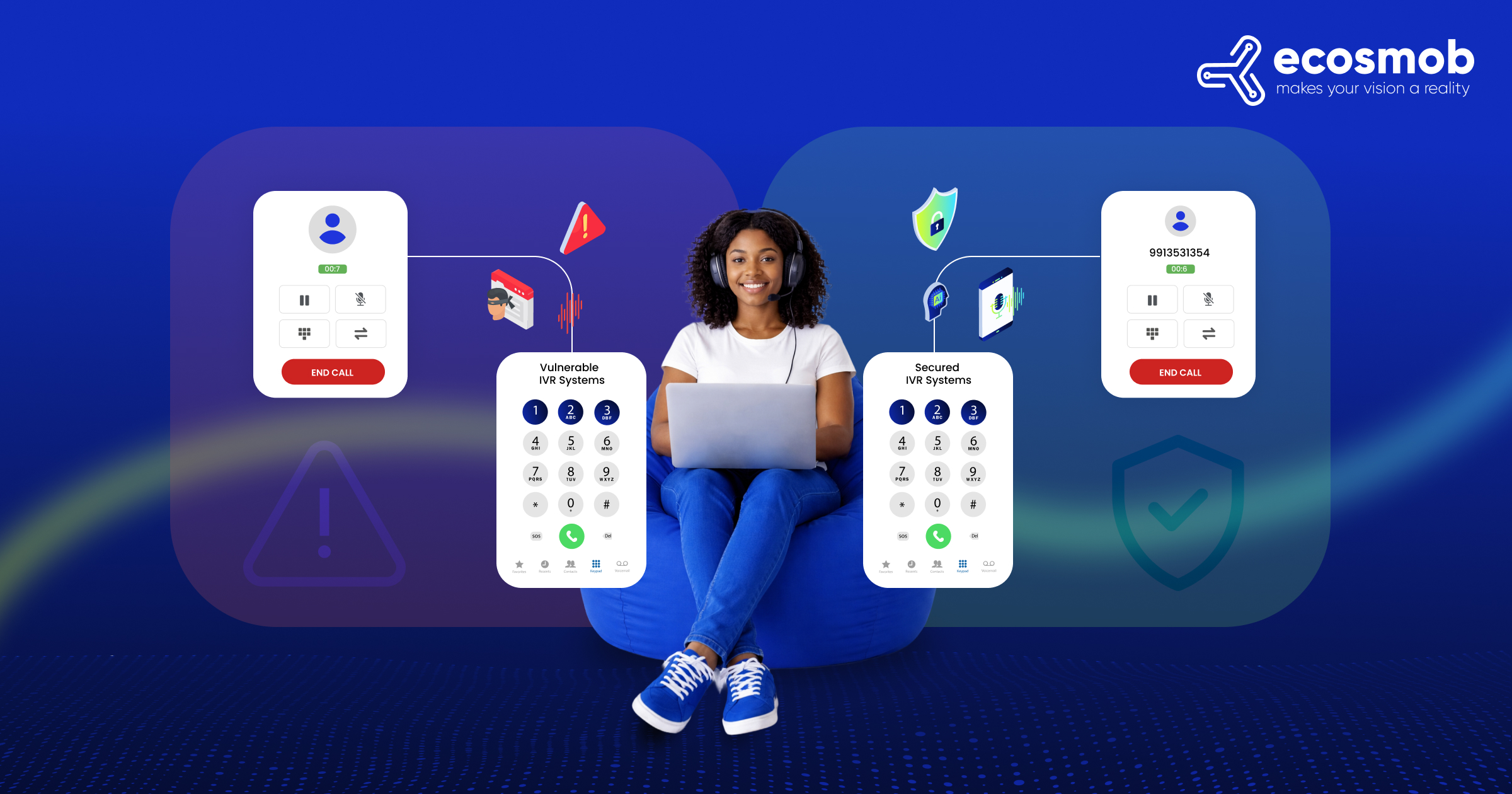
Synthetic voice attacks use AI-generated or deepfake speech to sound human while responding perfectly to IVR prompts. These voices are created from short audio samples and reused at scale, which makes static IVRs with fixed flows easy to exploit.
Because traditional Irely onrust expected inprather thand of questioning the voice itself, these attacks often go unnoticed. A dynamic IVR solution adapts call flows in real time, making IVR attacks harder to blend in or scale.
With that context in mind, it’s clear why certain IVR design choices make these attacks surprisingly effective.
Common IVR Security Risks Exploited by Synthetic Voice Attacks
Most IVR attacks don’t succeed because of a single flaw. They succeed because a handful of familiar design choices quietly work together: predictable call flows, reused prompts, early trust in caller input, and very little scrutiny once a call starts moving. These patterns keep IVRs efficient, but under synthetic voice attacks, they introduce IVR security risks that are easy to exploit and hard to spot in real time.
Static menu trees that never change
Most IVRs follow the same menu structure on every call, and while that keeps things familiar for customers, it also makes flows easy to rehearse. Synthetic voices can practice these paths repeatedly, so when a real IVR attack happens, the system sees nothing unusual because everything follows the expected order.
Fixed DTMF and voice prompts reused across calls
When the same prompts and input patterns are reused, attackers don’t have to guess. They know exactly what the IVR will ask and when, which reduces uncertainty and lowers the effort needed to scale an attack. From an IVR system security standpoint, predictability becomes a liability.
Single-factor or no voice verification at all
Many IVRs still rely on one signal, like a spoken response or keypad input, to move a call forward. And if that input sounds right, the system trusts it. Synthetic voices are built to sound right every time, which is why single-factor checks often fail under modern IVR security risks.
No real-time behavior analysis during the call
Traditional IVRs listen for answers, but they don’t watch how those answers are delivered. Timing, consistency, and interaction patterns rarely factor into decisions mid-call, so even perfectly automated responses blend in as normal behavior.
Over-trusting caller input early in the flow
IVRs often make routing or access decisions too early, before there’s enough context to assess risk. Once a call moves forward, it’s hard to roll that trust back. That early assumption is what allows many IVR attacks to progress quietly without triggering intervention.
But then, why are the security add-ons in the traditional IVRs not enough for IVR system security?
Traditional IVR Security Add-Ons Don’t Stop Modern Voice Attacks
It’s easy to assume a traditional IVR is covered once security add-ons are in place—voice biometrics, fraud rules, encryption, all checked off. But when synthetic voice attacks enter the picture, those layers often don’t hold up the way teams expect. The problem isn’t a lack of tools; it’s that most add-ons don’t change how the IVR behaves once a call is underway.
Voice Biometrics – Voice matching confirms how a voice sounds, but without liveness checks, it can’t tell whether that voice is real or generated. Synthetic voices are designed to pass these checks by sounding consistently correct.
Fraud Rules – Rule-based controls depend on fixed thresholds, and once attackers learn them, they simply stay within bounds. Over time, those rules become guidelines instead of barriers.
Bolt-On Layers – Security tools added around the IVR operate outside the call flow. When something feels off mid-call, they can’t adjust prompts or slow decisions, so the IVR continues as if nothing changed.
Encryption Limits – Encryption protects the connection, not the interaction. It doesn’t stop social or synthetic voice attacks that exploit trust rather than the channel itself.
If static design is what makes these IVR attacks possible, the answer lies in IVRs that can adapt instead of repeat.
Would a synthetic voice get past your IVR without friction?
How Dynamic Secure IVR Design Closes Synthetic Voice Attack Gaps
Dynamic IVR design focuses on making IVRs less predictable and more responsive during live calls. Instead of relying on fixed scripts, secure IVR design allows call flows to adjust based on how an interaction unfolds.
| Aspect | Traditional IVR | Dynamic IVR |
| Call Flow | Fixed scripts | Adaptive paths |
| Attack Risk | Easy to exploit | Hard to predict |
| Change Handling | Manual updates | Real-time updates |
This section highlights how dynamic behavior helps reduce common IVR attack paths and why modern secure IVR solutions are better suited to handle synthetic voice risks without disrupting genuine callers.
Flexible call flow logic
Dynamic IVRs don’t follow the same path on every call. Menus, prompts, and sequences can change, which makes rehearsed attack flows unreliable and harder to scale.
Context-based decision making
Rather than trusting the first response, dynamic IVRs build context as the call progresses. Decisions are based on a broader interaction pattern, not just a single input.
Behavior-aware call handling
Dynamic IVRs pay attention to timing and interaction patterns, not just correct answers. This helps identify automated behavior that static systems often miss.
Easier security updates over time
Because the logic isn’t locked into fixed scripts, secure IVR solutions can adapt as new IVR attack techniques emerge, without redesigning the entire system or adding friction for real callers.
That shift from static logic to adaptive IVRs needs more than theory, it needs careful integration into real systems.
Where would an IVR attack likely enter your system first?
How Ecosmob Helps Build Secure IVR Design into Dynamic IVR Systems?
Building a dynamic IVR isn’t just about adding flexibility, it’s about designing call flows that stay reliable even when attack patterns change. Ecosmob approaches secure IVR design by creating IVR systems that adapt in real time, instead of relying on fixed scripts that attackers can learn and exploit.
Rather than offering one-size-fits-all menus, Ecosmob builds secure IVR solutions with customized, logic-driven call flows that respond to caller behavior and intent. This reduces early trust in inputs and helps limit how far automated or synthetic voices can progress without scrutiny.
Ecosmob’s IVR systems are also designed to integrate seamlessly with existing platforms like CRM, voice analytics, and AI-based intent detection. That integration adds context to each interaction, which strengthens IVR system security without adding friction for genuine callers.
Most importantly, these dynamic IVR systems are built to evolve. Whether deployed in the cloud, on-premises, in hybrid setups, or in other configurations, they can be adjusted as new threats emerge without requiring a full redesign or disrupting live operations.
Also, here is the answer to the frequently asked question 👍
How do dynamic IVRs shift the cost and complexity for attackers?
Dynamic IVRs change the economics of IVR attacks by removing the consistency attackers rely on.
- Call flows vary, so rehearsed responses stop working
- Attacks require real-time adjustment instead of automation
- Scaling across thousands of calls becomes unreliable and costly
As a result, synthetic voice attacks become harder to execute, easier to detect, and less worth the effort
With the problem, the gaps, and the solution now clear, here’s the key conclusion to take away.
Do you need secure IVR solutions that won’t disrupt CX?
Key Takeaways
Traditional IVRs were designed to route calls efficiently, not to handle AI-driven deception. Fixed flows, early trust in caller input, and predictable logic make them increasingly exposed as synthetic voice attacks become more common. Adding security layers helps, but it doesn’t change how the IVR behaves once a call is in progress.
Dynamic IVRs address this by adapting in real time. They reduce predictability, observe call behavior as it unfolds, and strengthen protection without disrupting genuine callers. When built with a secure IVR design, they turn the IVR from a weak entry point into a more resilient part of the communication stack.
If you’re evaluating how prepared your IVR is for modern voice threats, Ecosmob’s secure IVR solutions offer a practical way to move from static scripts to adaptive, security-aware call flows.
See whether a dynamic IVR approach fits your contact center. Contact now!
FAQs
What is the business impact of IVR-based voice fraud?
IVR-based voice fraud rarely shows up as a single incident. It typically leads to financial loss, increased chargebacks, higher handling costs, and reputational damage when customers lose trust. Over time, it also forces contact centers to add manual checks that slow operations and increase agent workload.
How can we modernize IVR security without hurting customer experience?
Modern IVR security focuses on adapting call flows rather than adding visible hurdles. Dynamic IVR design adjusts prompts, timing, and decisions based on behavior, so suspicious calls face more scrutiny while genuine customers move through normally, without extra steps or delays.
How can we stop automated IVR abuse without blocking real customers?
The key is avoiding blanket restrictions. Instead of blocking based on static rules, secure IVR solutions use behavior patterns during the call to identify automation. That way, automated abuse is slowed or redirected, while real callers aren’t caught in false positives.
Can IVR integrate with real-time fraud detection systems?
Yes. Modern IVRs can integrate with real-time fraud detection, analytics, CRM systems, and risk engines. This added context allows the IVR to make smarter decisions during the call rather than relying only on predefined logic.
How do you design a secure IVR for UCaaS or CCaaS platforms?
Secure IVR design for UCaaS and CCaaS platforms starts with flexibility. The IVR must adapt in real time, integrate with cloud-native services, and update logic without downtime, while maintaining consistent performance across high call volumes.