











In the digital era of a unified communication system environment, a Session Border Controller solution is critical to security, interoperability, and transcoding. With the help of built-in interoperability features, the SBC software is incredibly capable of automating the entire process and doing call translations. An SBC can easily carry out the audio translation process because of its sophisticated transcoding skills.
At Ecosmob, as a Session Border Controller provider, we continually endeavor to add new capabilities to this solution. In addition, we offer SBC Development Services for the Telecom Industry to make it more resilient and effective against ever-increasing network security threats. We have included thorough explanations of what is a Session Border Controller and how it benefits both businesses and communication service providers in this blog.
Let’s dive in!
What is a Session Border Controller (SBC)?
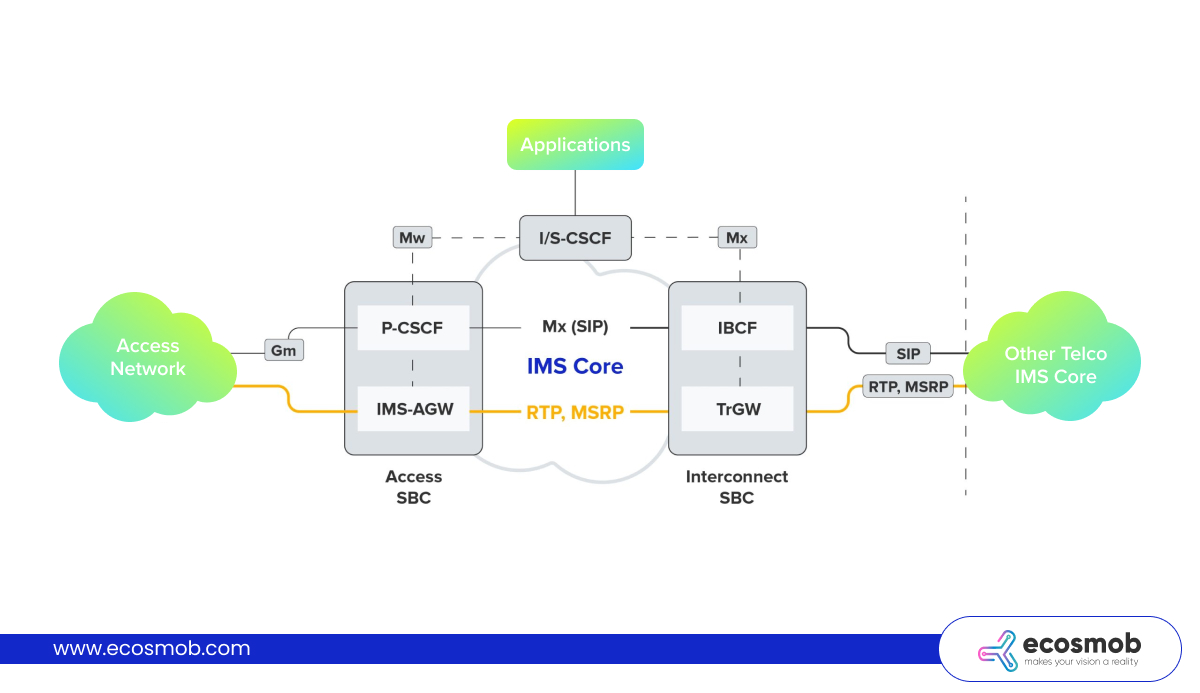
A Session Border Controller, sometimes called an SBC, is a dedicated device that controls and safeguards IP communication flows. As their name suggests, Session Border Controllers are installed at network boundaries to manage IP communications sessions. SBC software was first designed to protect and manage VoIP networks. Still, they handle all real-time communication channels, including VoIP, SBC voice, IP video, text chat, and collaboration sessions.
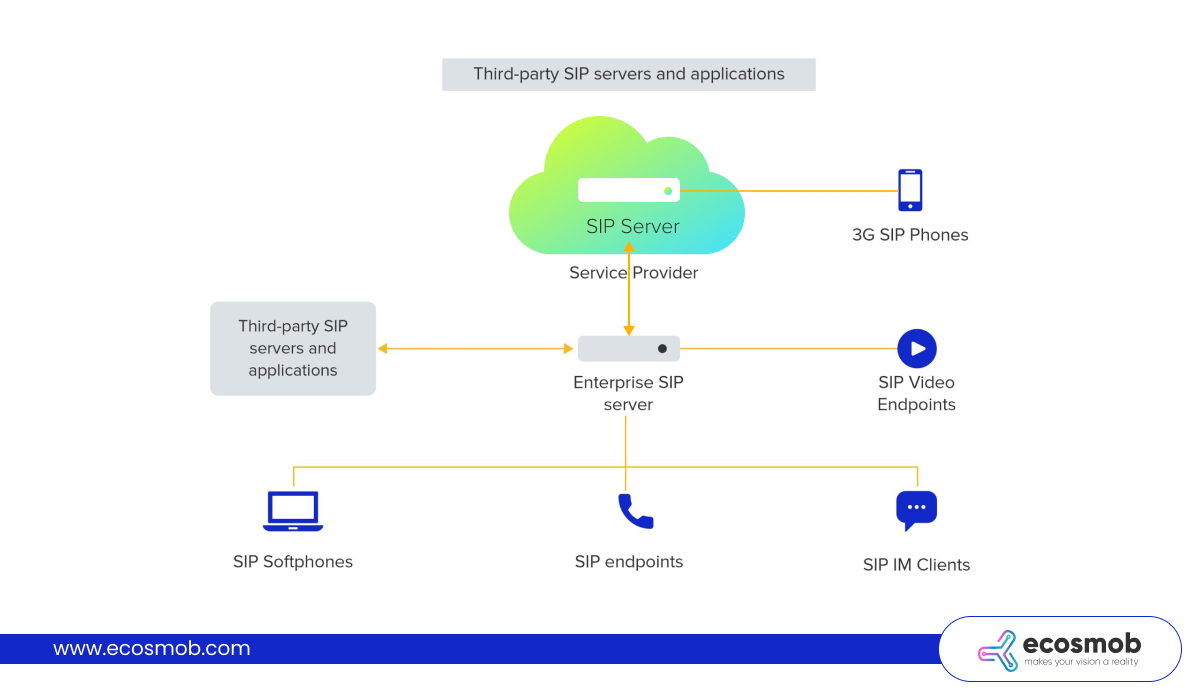
Enterprise Session Border Controllers are dedicated hardware devices or software applications that govern session initiation, conduction, and termination in Voice over IP (VoIP) networks. Essentially, they act as the intermediaries between the internal and external networks, ensuring the smooth flow of SBC voice and video communications. SBCs also play a crucial role in enhancing network security, routing, and policy adherence.
Session Border Controller Trends
According to market research, Session Border Control solutions are predicted to have a market value of $920 million by the end of 2026. As a result, SBCs record a CAGR of roughly 8.26%. According to analysts, the key factor driving this expansion is the rising demand for secure corporate data.
SBCs specifically assist businesses in deploying UC more rapidly, securely, and effectively. The SBC market is driven by several trends, some of which are listed below.
1. Enhanced Security Focus
Today’s world is preoccupied with privacy and security. SBCs help VoIP service providers exert greater control over their VoIP environments. SIP attacks impact enterprise productivity and revenue. Therefore, companies need to be sure they have end-to-end management. A SBC can function as a firewall. As a result, they defend SIP sessions as they transit between endpoints and safeguard the UC network. The demand for SBCs will increase as businesses adopt more sophisticated UC networks due to call routing, security, interoperability, and network administration demands.
2. Knowledgeable Management
Enterprise Session Border Controller can guarantee that every organization has the best path to deliver a call to its destination, in addition to increasing the security of VoIP network interactions. Therefore, in the era of the customer experience, the call routing procedure is becoming more and more crucial. Intelligent call routing ensures the appropriate dialogue gets to the proper person to increase satisfaction and reduce business costs. Even better administration of SIP connections through multiple devices is made possible by the intelligent control that the Session Border Controller renders. As a result, businesses have greater flexibility in using the solutions required for an improved communication strategy.
3. Calls for BYOD
With businesses implementing BYOD policies, SIP communications traffic will keep growing as the workplace becomes more adaptable and mobile. Due to the BYOD movement, organizations must manage more SIP devices for end-to-end security. An ideal Session Border Controller solution will be able to handle the increasing traffic demands of evolving enterprises and give them the resources they require to accommodate a shifting workforce. SBC solution providers are increasingly investing in SBC solutions that offer security and the scalability that businesses need as they examine various facets of their digital transformation roadmap.
4. The need for BYOC
Over the past two years, organizations have been pushed to adopt cloud-based collaboration systems like Microsoft Teams and Zoom due to the rise in remote and hybrid working. They are now attempting to connect these new platforms with outdated telephony systems as they return to their workplaces. Enterprise Session Border Controller can help enterprises keep their current phone systems and phone numbers while utilizing the power of the cloud by routing legacy phone traffic to platforms like Teams and Zoom. The ownership of the SBC will pass from the end user or a service partner to the carrier itself, thanks to programs like Operator Connect.
Are you worried about VoIP security? Customized SBC Solution can protect you!
Functions of a SBC Software
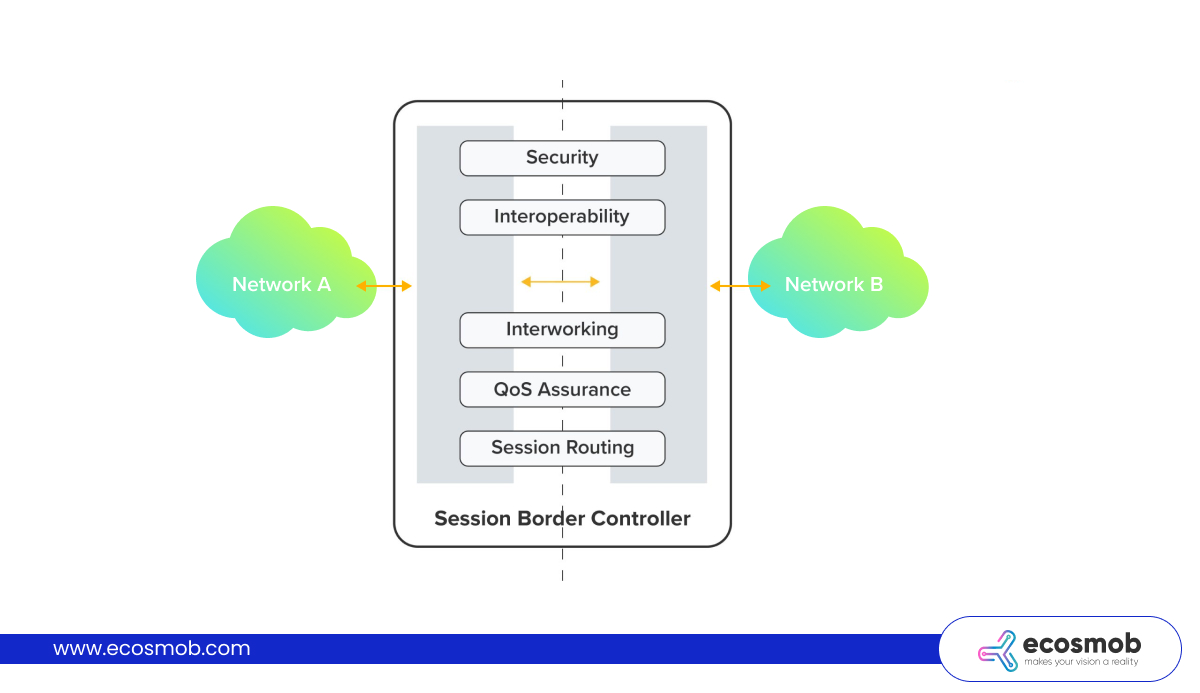
SBCs control media streams and IP communications signaling to perform several tasks, such as:
-
Security
SBCs provide media and signaling encryption to assure confidentiality, guard against impersonation/masquerade, safeguard against toll fraud and service theft and provide Denial of Service (DoS) and Distributed DoS (DDoS) assault protection.
-
Interoperability
To reduce multi-vendor incompatibilities, SBCs standardize the headers and messages of the SIP (Session Initiation Protocol) signaling stream.
-
Interworking
SBCs allow for the interoperability of several protocols (such as SIP-to-H.323) or codecs (such as g.711 to g.729 transcoding).
-
QoS Assurance
SBCs implement call admission control (CAC) rules, type of service (ToS) tagging, and rate limitation to ensure service quality.
-
Session Routing
SBCs route sessions across network interfaces, allowing least-cost routing (LCR) or high availability.
How Does an SBC Work? (Step-by-Step)
Every call that passes through an SBC follows a defined lifecycle. Here’s what happens under the hood:
Step 1 – Session Initiation
When a call is placed, a SIP INVITE message is sent. The SBC intercepts this signaling message before it reaches the destination network. It checks:
Is this source authorized to place calls?
Does this request comply with security policies?
Is this a known attack pattern (SIP flooding, spoofing)?
Step 2 – Session Admission Control (SAC)
The SBC evaluates whether to admit the session based on:
Available bandwidth on the network
Concurrent call limits (capacity thresholds)
Authentication credentials
Regulatory compliance rules (e.g., emergency call prioritization)
If the call fails any check, the SBC rejects it with the appropriate SIP response code.
Step 3 – Protocol & Codec Normalization
Different vendor equipment often uses different SIP dialects and audio codecs. The SBC:
Translates SIP headers and messages to ensure interoperability between endpoints
Transcodes audio between incompatible codecs (e.g., G.711 ↔ G.729, Opus ↔ AMR)
Handles SIP-to-H.323 protocol bridging when needed
Step 4 – NAT Traversal & Media Path Management
Network Address Translation (NAT) is one of the most common VoIP problems. The SBC resolves this by:
Acting as a media anchor — both signaling and media traffic flow through it
Rewriting SIP headers with routable IP addresses
Opening and closing media ports (RTP pinholes) dynamically for each session
Step 5 – Security Enforcement
Throughout the session, the SBC enforces:
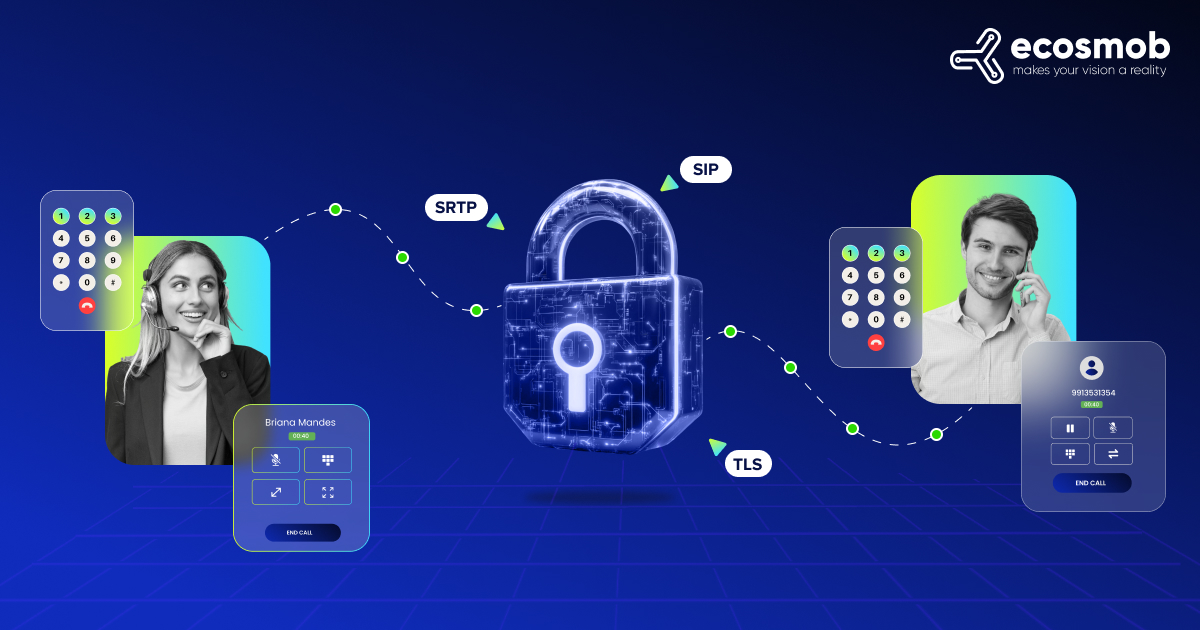
TLS (Transport Layer Security) for SIP signaling encryption
SRTP (Secure Real-time Transport Protocol) for media stream encryption
Topology hiding masking internal IP addresses from external parties
Rate limiting blocking SIP flood attacks in real time
Step 6 – Quality of Service (QoS) Monitoring
The SBC applies QoS policies to prioritize voice and video traffic over regular data, monitors MOS scores, jitter, latency, and packet loss and can trigger alerts or reroute sessions when quality degrades.
Step 7 – Session Termination & Reporting
When the call ends, the SBC:
Cleanly terminates the session (SIP BYE handling)
Logs Call Detail Records (CDRs) for billing and analytics
Releases all reserved bandwidth and ports
Reports session quality data for monitoring dashboards
The result: Every call is secure, compatible, and high quality regardless of what networks, vendors, or protocols are involved on either side.
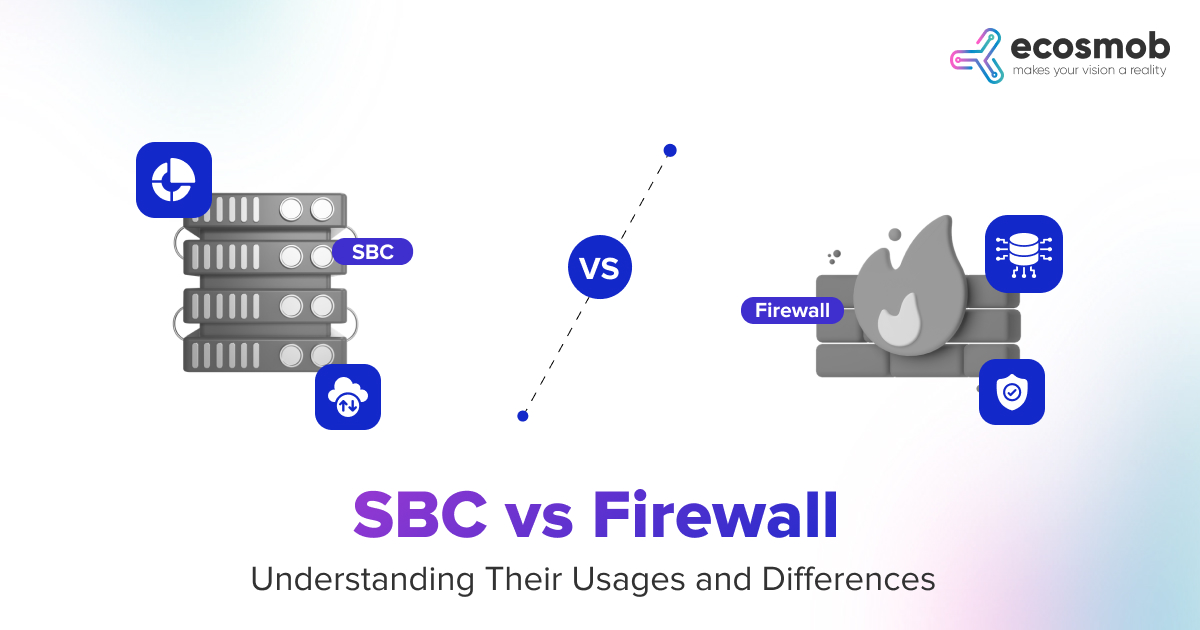
SBC vs. Firewall: What’s the Difference?
This is one of the most common questions. Many teams assume their existing firewall handles what an SBC does. It doesn’t – and the gap can be costly.
| Capability | Traditional Firewall | Session Border Controller |
| Protocol awareness | Layer 3/4 (IP/TCP/UDP packets) | Layer 5-7 (SIP, RTP, H.323 — application layer) |
| SIP inspection | Limited or none | Deep SIP message inspection and manipulation |
| Media (RTP) handling | Cannot anchor or control media streams | Full media proxy, NAT traversal, transcoding |
| VoIP security threats | Cannot detect SIP flooding, toll fraud, SPIT | Specifically designed to detect and block all VoIP threats |
| QoS enforcement | Basic traffic shaping | Session-level QoS, MOS monitoring, call admission control |
| Codec translation | None | Full transcoding between any supported codecs |
| Topology hiding | No | Hides internal network topology from external parties |
| Compliance (CALEA, SIPREC) | No | Built-in lawful intercept and call recording support |
Bottom line: A firewall protects your network at the packet level. An SBC protects your communications at the session level. In a VoIP environment, you need both — they are complementary, not interchangeable.
📖 Deep dive: SBC vs. Firewall – Full Comparison
What are the Benefits of Session Border Controller?
SBCs give businesses the following benefits. Some of the reasons to have SBC are mentioned below:
Enhanced Network Security
Modern VoIP networks cannot function without an SBC Controller, which is crucial for enhancing network security. They are a strong barrier against various cyber threats, such as DDoS assaults, Denial of service (DoS), toll fraud, and malicious intrusions. They minimize the danger of security breaches by inspecting the data packets passing over the network to ensure that only permitted communications are supported.
Improve Call Quality
Call quality is essential to guarantee efficient communication both inside and outside of a business. SBCs manage and minimize packet loss, delay, and jitter issues to ensure optimal call quality. They increase communication while maintaining the quality of SBC voice and video connections by utilizing state-of-the-art techniques like media transcoding and Quality of Service (QoS).
Reduced Operating Costs
SBC deployment can result in significant cost reductions in several ways. They first streamline the network infrastructure by doing away with the requirement for several-point solutions. By offering centralized control and monitoring capabilities, they also lower the troubleshooting and network maintenance costs. Cloud-based SBC solutions can also reduce costs for purchasing and maintaining hardware.
Flexibility and Scalability
Having a scalable and adaptable communication infrastructure is essential in the face of shifting organizational needs and increasing network demands. SBCs are built to easily handle increased traffic volume, enabling businesses to scale their operations without significantly investing. Because SBCs are so adaptable, companies can easily include new communication channels and keep up with rapidly changing technology.
Regulatory Support
Many businesses, particularly healthcare, finance, and government sectors, must adhere to regulatory regulations and compliance expectations. SBCs encourage regulatory compliance by ensuring secure communication networks and adhering to industry-specific laws. They include robust logging, call recording, and dependable data encryption—features often required to adhere to legal frameworks such as GDPR or HIPAA.
SBC Deployment Use Cases
1. SIP Trunking for Enterprises
The most common enterprise SBC deployment. The E-SBC sits between the enterprise IP-PBX and the ITSP (Internet Telephony Service Provider), handling:
- Authentication of trunk traffic
- Codec negotiation between PBX and carrier
- Failover to secondary trunks on primary failure
- Capacity enforcement (max concurrent calls)
2. Microsoft Teams Direct Routing
Organizations using Microsoft Teams as their phone system need a certified SBC to connect to PSTN carriers. The SBC:
- Translates between Teams’ SIP implementation and the carrier’s
- Manages TLS/SRTP for compliance
- Provides failover and load balancing across trunks
- Enables legacy PBX features not native to Teams
3. UCaaS Provider Infrastructure
UCaaS platforms deploy SBCs at every network peering point to:
- Onboard enterprise customers securely
- Normalize SIP across hundreds of customer PBX types
- Enforce per-customer QoS and capacity policies
- Provide multi-tenant isolation
4. Carrier-to-Carrier Peering (Wholesale VoIP)
Carriers use SP-SBCs at interconnect borders to:
- Enforce bilateral peering agreements
- Block fraudulent traffic before it enters the core network
- Apply least cost routing between peers
- Gather CDRs for inter-carrier settlement
5. Contact Center Deployments
SBCs in contact centers handle:
- Routing inbound calls to the correct agent groups
- Recording all sessions via SIPREC
- Scaling to absorb sudden call volume spikes
- Integration with CRM platforms via SIP headers
📖 Related: How SBCs Help VoIP Service Providers
6. Healthcare (HIPAA-Compliant Communications)
Healthcare organizations use SBCs to:
- Encrypt all voice and video sessions (TLS/SRTP)
- Enforce HIPAA-compliant call recording via SIPREC
- Prioritize emergency communications
- Enable compliant telemedicine platforms
📖 Related: SBC in Healthcare – HIPAA Compliance
7. Remote Worker & Branch Office Connectivity
E-SBCs securely extend enterprise communications to:
- Remote employees connecting over public internet
- Branch offices with local PSTN breakout
- Mobile workers using softphones or WebRTC clients
SBC + AI: The Next Frontier
Modern SBCs are evolving far beyond their original security-and-interoperability mandate. AI integration is transforming what SBCs can do in real time.
AI-Powered Fraud Detection
Traditional SBCs rely on static rules to detect fraud. AI-enhanced SBCs apply machine learning models to:
- Detect anomalous call patterns (unusual destinations, call volumes, time patterns)
- Identify toll fraud attempts before significant damage is done
- Adapt detection thresholds dynamically based on traffic baselines
Predictive Traffic Management
AI models trained on historical call data can predict traffic spikes before they happen — allowing the SBC to pre-scale resources, pre-open additional trunks, or shed load proactively.
Real-Time Call Quality Optimization
AI can analyze RTP stream characteristics in real time and:
- Predict call quality degradation before users notice
- Trigger codec switches or rerouting decisions automatically
- Generate predictive MOS scores per session
AI Voicebot Integration
SBCs are increasingly becoming the integration layer between AI voicebots and the PSTN. The SBC:
- Routes inbound calls to AI voicebot engines (Google CCAI, Amazon Connect, custom LLM voicebots)
- Handles the SIP/RTP bridging between the PSTN and AI platforms
- Manages escalation back to human agents seamlessly
📖 Related: Scaling SBCs for UCaaS/CCaaS with AI
AI-Assisted SBC Traffic Analytics
AI applied to SBC CDR and session data can surface:
- Early warning patterns for network issues
- Traffic trends for capacity planning
- Security threat intelligence across the network
📖 Related: AI-Assisted Analytics for SBC Traffic
How to Choose the Right SBC
Use this framework when evaluating SBC options:
1. Define Your Scale
- How many concurrent sessions do you need to support today? In 3 years?
- Do you need geographic redundancy?
- Will you handle media (transcoding) or pass it through?
2. Identify Your Deployment Environment
- On-premises data center → Hardware or Virtual SBC
- Cloud-first infrastructure → Cloud SBC
- Hybrid environments → Virtual SBC with cloud bursting
3. Evaluate Protocol & Codec Requirements
- Which SIP variants do your carriers and endpoints use?
- Do you need WebRTC-to-SIP bridging?
- Which codecs must be supported on each side?
4. Security & Compliance Requirements
- Do you need HIPAA, GDPR, PCI-DSS, or CALEA compliance?
- What encryption standards are required (TLS 1.2/1.3, SRTP)?
- Do you need built-in lawful intercept?
5. Build vs. Buy Decision
- Commercial SBC (Ribbon, Oracle, AudioCodes, Cisco): Faster deployment, vendor support, but vendor lock-in and higher cost.
- Open-source SBC (Kamailio, OpenSIPS, FreeSWITCH): Full customization, no license cost, but requires expert development and ongoing maintenance.
- Custom-built SBC: Maximum flexibility, built precisely to your use case — ideal for service providers with unique requirements.
Ecosmob specializes in building custom SBC solutions on open-source platforms for telecom operators, UCaaS providers, and enterprises who need carrier-grade performance without commercial appliance lock-in. Talk to our SBC experts →
What’s New in Session Border Controllers Offerings?
Session Border Controllers (SBCs) area of expertise is constantly evolving to match the shifting needs of businesses and service providers. Here are some of the most recent developments and products in the world of SBCs:
1. Cloud-native SBC Solutions
SBC Session Border Controllers have evolved to meet the demands of contemporary, cloud-focused businesses. These services guarantee scalability, flexibility, and deployment simplicity without buying actual hardware. Additionally, they are for interacting easily with other cloud-based services, improving operational effectiveness and streamlining management.
2. Analytics and Monitoring Powered by AI
Network management capabilities significantly improved with the inclusion of AI and machine learning algorithms in SBC products. Real-time analytics, anomaly detection, and predictive insights offered by these developments support proactive problem-solving and improved network performance.
3. Emerging Standards and Protocols Support
New protocols and standards are introduced as the industry develops. Modern SBCs mainly accommodate these developing protocols and standards, allowing businesses to take advantage of the latest innovations without making significant updates.
4. Customizable Offerings
SBC Session Border Controller Solution providers offer more adaptable solutions to meet the several needs of various industries. This trend is assisting firms in creating a customized SBC structure that properly satisfies their operational needs and financial limitations. As a result of ongoing innovation in SBC voice products, businesses can maintain a secure, dependable, and high-performance communication infrastructure that can change with the rapidly changing technological environment. Incorporating AI is ushering in a new era of complex and advanced SBC solutions, enhanced security, and cloud-native solutions, among other things.
Let’s Join Hands and Start your Session Border Controller Journey with Ecosmob Technologies!
SBCs are now a requirement in digital communication rather than a luxury. They act as sentinels, ensuring each SBC voice and video connection is safe, effective, and of the highest caliber. The capabilities of Session Border Controllers grow along with technology, making them a crucial component of the current communication infrastructure. Understanding and integrating SBCs can change how you communicate, whether you run a small business, a large corporation, or a service provider. However, if you require any assistance, contact us immediately, and our specialized Session Border Controller team will communicate with you and provide you with on-time support.
Is Your VoIP system safe? Let’s review it. Our experts would love to help!
FAQs
Why are SBCs essential for VoIP networks?
An SBC protects the VoIP network from various assaults, including distributed and denial-of-service (DDoS) attacks. It also facilitates the connection between other networks using other protocols, assisting in resolving interoperability concerns.
How Does an SBC Help with Cost-Cutting?
An SBC can considerably help a VoIP network save money by optimizing the bandwidth, assuring the quality of the service, and lowering the likelihood of toll fraud.
Does SBC Support All VoIP Phone Systems?
SBCs are often made to work with the majority of VoIP phone systems. However, confirming compatibility before integrating an SBC with your current VoIP phone system is always essential.
Is Setting Up and Installing an SBC Challenging?
The unique requirements of your network mainly determine an SBC's installation and configuration difficulty. To ensure a seamless setup, dealing with a qualified service provider or having a trained Session Border Controller team is advisable.
Does My Company Require an SBC?
Purchasing an SBC is essential if your Company uses VoIP technology or intends to transition to one to secure the security, dependability, and quality of your communications.
What does a Session Border Controller do?
An SBC controls, secures, and manages real-time communication sessions (voice, video, messaging) as they cross the border between IP networks. It handles security enforcement, protocol interoperability, codec transcoding, NAT traversal, QoS, and call routing.
Do I need an SBC for my business?
If you use SIP trunking, connect to a UCaaS platform like Microsoft Teams via Direct Routing, run a contact center, or exchange calls between different network domains — yes, you need an SBC. If you use a fully hosted cloud phone system where the provider manages all infrastructure, your provider likely operates the SBC on your behalf.
What is the difference between an SBC and a firewall?
A firewall inspects and filters network packets at layers 3 and 4 (IP/TCP/UDP). An SBC operates at the application layer (layer 5-7), with deep understanding of SIP signaling and RTP media streams. Firewalls cannot detect SIP-level attacks, perform transcoding, or handle NAT traversal for media streams functions critical for VoIP security. You need both.
What is an E-SBC?
An Enterprise Session Border Controller (E-SBC) is an SBC deployed and managed within an enterprise network typically at the SIP trunk termination point between the enterprise and its carrier. Unlike service provider SBCs managed by carriers, E-SBCs are controlled by the enterprise's own IT team and can be customized for multi-provider and multi-platform environments.
Can an SBC work with Microsoft Teams?
Yes. Organizations using Microsoft Teams Phone (formerly calling plans via Direct Routing) require a Microsoft-certified SBC to connect Teams to PSTN carriers. The SBC handles the SIP interworking, encryption, and failover between Teams and the carrier network.
What is the difference between a hardware SBC and a virtual SBC?
A hardware SBC is a physical appliance with dedicated processing (including DSPs for transcoding), offering highest raw performance. A virtual SBC runs as software on standard servers or VMs, offering greater flexibility and lower upfront cost. Cloud SBCs are hosted by providers and offer elastic scaling on demand. The right choice depends on your scale, budget, and infrastructure strategy.
What open-source SBC platforms exist?
The most widely used open-source SBC frameworks are Kamailio, OpenSIPS, and FreeSWITCH. Kamailio and OpenSIPS are SIP proxies that can be configured as high-performance SBCs. FreeSWITCH is a full B2BUA (the same architecture used by commercial SBCs) with deep media handling capabilities.
How does an SBC prevent toll fraud?
SBCs prevent toll fraud through: authentication enforcement (rejecting unauthenticated SIP requests), IP whitelisting/blacklisting, anomaly detection (unusual call destinations or volumes), rate limiting (blocking bursts of SIP requests from a single source), and topology hiding (preventing attackers from probing internal network structure).
What is SBC transcoding?
Transcoding is the process of converting audio between different codecs in real time. When an endpoint on one side of the network uses G.711 and an endpoint on the other side uses G.729, the SBC decodes one codec and re-encodes it in the other transparently and in real time ensuring both sides can communicate regardless of codec incompatibility.
How is AI changing SBC capabilities?
AI is enhancing SBCs with: real-time fraud detection using anomaly models, predictive traffic management, AI-driven call quality optimization, and seamless integration with AI voicebot platforms. AI-enhanced SBCs can also provide predictive MOS scoring, dynamic routing decisions, and early warning analytics on traffic patterns capabilities not possible with traditional rule-based SBC logic.







![SIP Protocol [SIP Signalling]](https://cd3e0a26.delivery.rocketcdn.me/wp-content/uploads/2024/12/Blog-79.jpg)