












Do you actually need an SBC? A quick decision framework
Before we get into the technical detail, answer these five questions. If you say “yes“ to any of them, an SBC isn‘t optional for you:
- Are you terminating SIP trunks from one or more ITSPs into your PBX or UCaaS platform?
- Are you connecting Microsoft Teams Phone to the PSTN via Direct Routing?
- Are you bridging an AI voicebot, contact centre, or WebRTC application to a telephony carrier?
- Do you carry voice traffic across untrusted networks (public internet, partner networks, branch WAN)?
- Do regulatory frameworks (HIPAA, PCI-DSS, GDPR, MiFID II, FINRA) apply to your voice recordings or call metadata?
Ifyou answered “no“ to all five you have a single–site analogue PBX, no SIP trunks, no cloud voice, no compliance scope you don‘t need an SBC. For everyone else, the question isn‘t ifbut which type and where.
What a session border controller actually does
A session border controller is a purpose–built network element that sits between two VoIP networks and mediates every SIP session that crosses the boundary. It‘s architecturally a back–to–back user agent (B2BUA) which means it terminates the incoming SIP dialog on one side and originates a new, independent SIP dialog on the other. Every signalling message and (optionally) every RTP media packet passes through it.
That B2BUA architecture is what gives the SBC its power. Unlike a firewall which at best inspects IP headers and port numbers an SBC parses SIP headers, validates the SDP body, can rewrite Via and Contact headers, can transcode between codecs, and can anchor or bypass media based on policy. It operates simultaneously on two planes:
- Signalling plane: handling SIP, SIP-I, SIP-T, and in 5G networks, SIP over HTTP/2 with JSON bodies (HTTP/2 for the N2/N4 interfaces, SIP for the IMS core).
- Media plane: handling RTP, SRTP, and the DTLS-SRTP used by WebRTC clients with per-session encryption, codec transcoding, and DTMF interworking between RFC 2833 and SIP INFO.
Amodern SBC processes all of this at wire speed. Production–grade deployments handle anywhere from a few hundred to tens of thousands of concurrent sessions; carrier–class SBCs like those used in Tier 1 operator networks scale to hundreds of thousands.
9 critical reasons you need an SBC in 2026
1. Security against SIP–specific attacks that firewalls cannot see
Afirewall operates on IP and TCP/UDP it doesn‘t parse SIP. That‘s the entire problem. Every SIP–aware attack is invisible at Layer 4 because the malicious traffic is syntactically valid SIP riding on legitimate ports (5060, 5061). Your firewall sees packets; the attacker sees an unprotected SIP endpoint.
Thethreats an SBC blocks that a firewall can‘t:
- SIP registration floods thousands of fake REGISTER requests per second designed to exhaust the registrar’s capacity
- INVITE storms call-setup floods that consume CPU on your PBX without ever completing a call
- SIP fuzzing attacks malformed headers designed to crash or exploit vulnerabilities in specific SIP stacks
- Toll fraud compromised credentials used to route premium-rate international calls at your expense
- Spoofed caller ID and vishing mitigated by STIR/SHAKEN validation, which modern SBCs enforce
- Eavesdropping via RTP interception blocked by forced SRTP encryption at the SBC
Toll fraud alone is not a small problem. The Communications Fraud Control Association‘s industry surveys have consistently placed global telecom fraud losses in the tens of billions of US dollars annually, with PBX hacking and SIP–based fraud among the top vectors. An unprotected SIP endpoint exposed to the public internet is typically attacked within hours of coming online
this is measurable with any honeypot deployment and it hasn‘t improved in 2026.
2. DDoS and volumetric attack mitigation at the SIP layer
AnSBCenforces per–source rate limits on SIP methods (REGISTER, INVITE, OPTIONS) with much finer granularity than a Layer 4 DDoS scrubber. When a botnet points 40,000 requests per second at your SIP registrar, the SBC‘s dynamic blacklist kicks in on the first few hundred, long before your PBX notices.
Modern SBCs also implement:
- Adaptive thresholds that learn your normal traffic pattern and alert on deviation
- CAC (call admission control) policies that cap concurrent sessions per trunk, per customer,
or per geography
- Grey–listing of unknown sources until they prove well-behaved
- Topology–aware pattern detection that identifies distributed attacks from different IPs sharing behavioural fingerprints
- Topology hiding making your network invisible
Without an SBC, every SIP message leaving your network leaks internal information in the Via, Record–Route, Contact, and User–Agent headers. Attackers read these to map your softswitch vendor, software version, internal IP addressing, and PBX topology. Half the battle of a targeted attack is reconnaissance topology hiding shuts it down.
AnSBCrewrites all externally–visible SIP headers so the outside world sees only the SBC‘s public IP and a generic User–Agent string. Your internal IP scheme, vendor, version, and infrastructure are invisible.
3. Interoperability making mismatched SIP dialects talk
SIPis a standard. SIP implementations are not. Every vendor Cisco, Avaya, Metaswitch, FreeSWITCH, Asterisk, BroadSoft, Microsoft Teams has subtly different header handling, PRACK behaviour, timer values, SDP offer/answer quirks, and codec negotiation patterns.
Connecting two “compliant“ SIP endpoints that have never spoken to each other before frequently produces one–way audio, failed call setup, or DTMF that doesn‘t work.
This is where the SBC earns its keep for any SIP trunk integration. It performs:
- Header manipulation to rewrite non-conformant fields
- SDP normalisation so codec negotiation actually succeeds
- Codec transcoding (G.711 ↔ G.729 ↔ Opus ↔ AMR-WB) when the two sides can’t agree on a common codec
- DTMF method conversion between RFC 2833, SIP INFO, and in-band audio
- Timer alignment for Session-Expires and Min-SE
Any enterprise connecting more than one SIP trunk provider will encounter dialect mismatches within the first month of operation. An SBC is the one place to fix them.
1. Quality ofService enforcement per session
Network QoS (DSCP marking, queue prioritisation) only works if the traffic is marked correctly at the edge. An SBC is that edge. It enforces:
- DSCP marking on media packets so your WAN and LAN honour voice priority
- Bandwidth reservation per trunk or per customer via CAC policies
- Jitter buffer control and packet loss concealment decisions
- Call admission control that rejects new calls rather than degrading existing ones when
bandwidth is saturated this is the single most important QoS lever
Asoftswitch without an SBC will happily accept the 101st call onto a 100–call trunk and let every call on it sound terrible. An SBC rejects it cleanly with a 503 Service Unavailable.
2. NAT traversal and far-end NAT handling
NATis still the silent killer of VoIP in 2026, especially for remote–worker deployments, branch offices on residential–grade internet, and mobile softphones. SIP and RTP were designed before ubiquitous NAT and break in specific, predictable ways most famously, the Contact header advertises a private IP that the far end can‘t route to, and RTP streams never establish media.
AnSBCresolves this with far–end NAT traversal: it detects the true public IP of the remote endpoint from the source address of the SIP packet, rewrites the Contact and SDP accordingly, and anchors the media stream so RTP flows symmetrically through the SBC regardless of what the NAT device is doing. This is also the mechanism that makes remote–worker softphones actually work without configuring port forwards on every home router.
3. Microsoft Teams Direct Routing this is the 2026 killer use case
Ifyou‘re connecting Microsoft Teams Phone to the PSTN via Direct Routing (rather than paying Microsoft for Calling Plans), you need a Microsoft–certified SBC. Full stop. Teams Direct Routing is one of the largest single drivers of SBC deployments in the enterprise market right now.
TheSBChandles:
- TLS 1.2+ and SRTP termination to Teams (Teams won’t accept anything less)
- SIP dialect translation between Teams’ specific flavour and your upstream ITSP
- Media bypass vs media relay decisions for call path optimisation
- Local media optimisation for branch-office PSTN breakout
- Survivable Branch Appliance (SBA) functionality when the WAN to Microsoft 365 fails
Microsoft maintains a narrow list of certified SBC vendors. If your platform isn‘t on that list, Direct Routing won‘t work this is a hard architectural requirement, not a preference.
4. AI voicebot and WebRTC bridging the 2026 growth edge
Theexplosion ofAI voice agents for contact centres, outbound sales automation, voice–first customer support has created a new class of SBC use case. The AI agent typically runs on a cloud voice platform (WebRTC–native) but needs to place and receive calls to regular phone numbers (SIP over the PSTN).
TheSBCbridges that gap. It terminates DTLS–SRTP from the WebRTC side, transcodes Opus to G.711, and originates a standard SIP/RTP leg to the carrier. At the same time it handles the signalling translation, jitter smoothing between the two network paths, and DTMF interworking so the AI agent can navigate IVR menus on the PSTN side.
Ifyou‘re building anything in the AI voice space Ecosmob‘s own AI voicebot solutions practice is seeing this constantly the SBC is the piece that makes the economics work. Without it, every voicebot deployment requires custom gateway code that breaks every time a carrier changes a SIP timer.
5. Compliance, lawful intercept, and recording
Regulatory obligations on voice traffic keep expanding. HIPAA for healthcare, PCI–DSS for any voice channel that carries card data, GDPR for EU customer recordings, MiFID II for financial services, FINRA for US broker–dealers, and lawful intercept obligations imposed by carriers in most jurisdictions.
An SBC is the natural enforcement point because it sees every session. It can:
- Selectively record based on policy (origin, destination, trunk, user)
- Redact DTMF from recordings to meet PCI-DSS requirements
- Forward metadata to lawful intercept collection functions
- Apply retention policies consistent with your jurisdiction
- Provide an audit trail of every call setup decision
Trying to bolt this onto a PBX directly is much harder than doing it once, correctly, at the SBC.
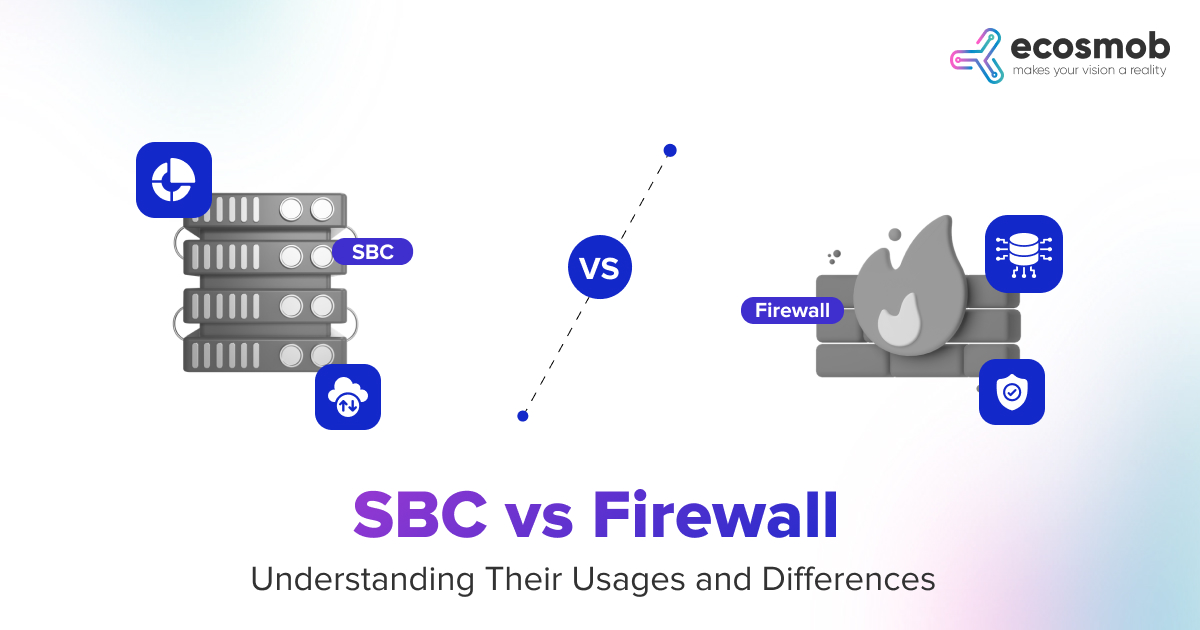
SBC vs firewall: why a firewall is not enough
This question comes up in every procurement conversation, so let‘s settle it with a table:
| Capability | Firewall (even NGFW) | Session Border Controller |
| Inspect IP + TCP/UDP headers | Yes | Yes |
| Parse SIP messages | No (or limited ALG) | Yes, natively |
| Rewrite SIP headers | No | Yes |
| Transcode codecs | No | Yes |
| Anchor RTP media | No | Yes |
| Defend SIP registration floods | No | Yes |
| STIR/SHAKEN validation | No | Yes |
| Teams Direct Routing certification | No | Yes (if certified) |
| NAT traversal for SIP | Breaks it with SIP ALG | Fixes it correctly |
| SRTP encryption | No | Yes |
Themost common failure pattern is turning on “SIP ALG“ on a firewall or router and believing it‘s equivalent. SIP ALG implementations in commodity firewalls are notoriously buggy they mangle headers, break registrations, and the standard advice from every VoIP vendor is “turn SIP ALG off.“ A firewall and an SBC are complementary devices, not substitutes.
When you don’t need an SBC (the honest take)
We said we‘d be honest about this. Skip the SBC or defer the decision if:
- You’re using a fully hosted UCaaS provider (RingCentral, 8×8, Zoom Phone) that terminates all carrier connectivity on their side. They run SBCs so you don’t have to.
- You have a single small office with an on-prem PBX and no SIP trunks (all calls via PRI/analogue).
- You’re in a purely internal voice scenario (intercom, site-to-site) with no public network exposure and no compliance scope.
For everyone else SIP trunks, hybrid deployments, multi–site, remote workers, Teams Direct Routing, AI voice, compliance obligations an SBC is infrastructure, not a luxury.
Deployment options in 2026
Modern SBCs come in three forms. The right choice depends on scale, where your voice workloads live, and your operations model.
- On–premises appliance. Physical or virtual appliance in your data centre. Still the dominant model for enterprises with significant on-prem telephony or strict data-residency requirements. Vendors: Ribbon SBC, AudioCodes Mediant, Oracle Enterprise SBC, Cisco CUBE.
- Cloud–native / virtualised SBC. Runs in AWS, Azure, GCP, or on Kubernetes. Scales horizontally based on session count. Ideal for cloud-first enterprises, service providers, and AI voicebot platforms that need elasticity. Billed per session or per instance.
- SBC–as–a–Service (managed SBC). You consume the SBC as a service someone else runs it, patches it, scales it, integrates it with Teams or your ITSP. Best for mid-market enterprises that need SBC functionality but don’t have dedicated VoIP ops staff. This is how many Ecosmob customers run their SBC we provide it as a managed service on our SBC platform, so the certification, patching, and capacity planning are our problem, not yours.
How to choose an SBC vendor: 7 evaluation criteria
If you’re evaluating options, score candidates on these seven dimensions:
- Microsoft Teams Direct Routing certification either current or on the certified vendor
list. Non-negotiable if Teams is in your roadmap.
- Concurrent session capacity and transcoding capacity these are different numbers, and transcoding is usually the constraint. A box rated for 5,000 sessions might transcode only 500.
- STIR/SHAKEN support for caller ID authentication FCC mandate in the US, and increasingly required by international carriers.
- TLS 1.3 and post–quantum crypto readiness if you’re buying in 2026, you should be asking about the 2028–2030 transition.
- Interop certification matrix does the vendor publish signed interop guides for your upstream carrier(s) and your downstream PBX/UCaaS?
- Observability and API surface can you pull SIP trace, call metrics, and security events into your SIEM/observability stack? Proprietary logging only is a red flag.
- Licensing model and elasticity per-session, per-port, or capacity-based. Burst handling matters for contact centres and AI voicebot platforms.







![SIP Protocol [SIP Signalling]](https://cd3e0a26.delivery.rocketcdn.me/wp-content/uploads/2024/12/Blog-79.jpg)