










QUICK SUMMARY
A PBX solution is a private phone system that manages internal and external calls for a business. Modern IP PBX systems use the internet to route calls replacing traditional EPABX hardware and offer features like call routing, IVR, video conferencing, and AI-powered automation. Compared to legacy EPABX systems, IP PBX solutions reduce telecom costs by 40–60%, scale instantly across locations, and integrate directly with CRMs, helpdesks, and AI tools.
This guide explains how IP PBX works,, what features matter in 2026, and how to choose the right solution for your business.
Are you still dealing with dropped calls and missed opportunities?
I know running a business is hard enough without struggling with outdated phone systems. This only creates’ “ Sorry, I couldn’t hear you” moments for your customers.
If this sounds like you, believe me: It’s not your competitors eating your market share; your old, outdated phone systems are keeping you back and draining your resources.
It’s time to ditch your 90s traditional PBX setup and upgrade your conventional telephony systems to cloud telephony with IP PBX solutions.
In this blog post, we will explore IP PBX solutions, their different types and features, and how integrating with AI ML can help you stay ahead of the competition.
What is an IP PBX Solution and How Does It Work?
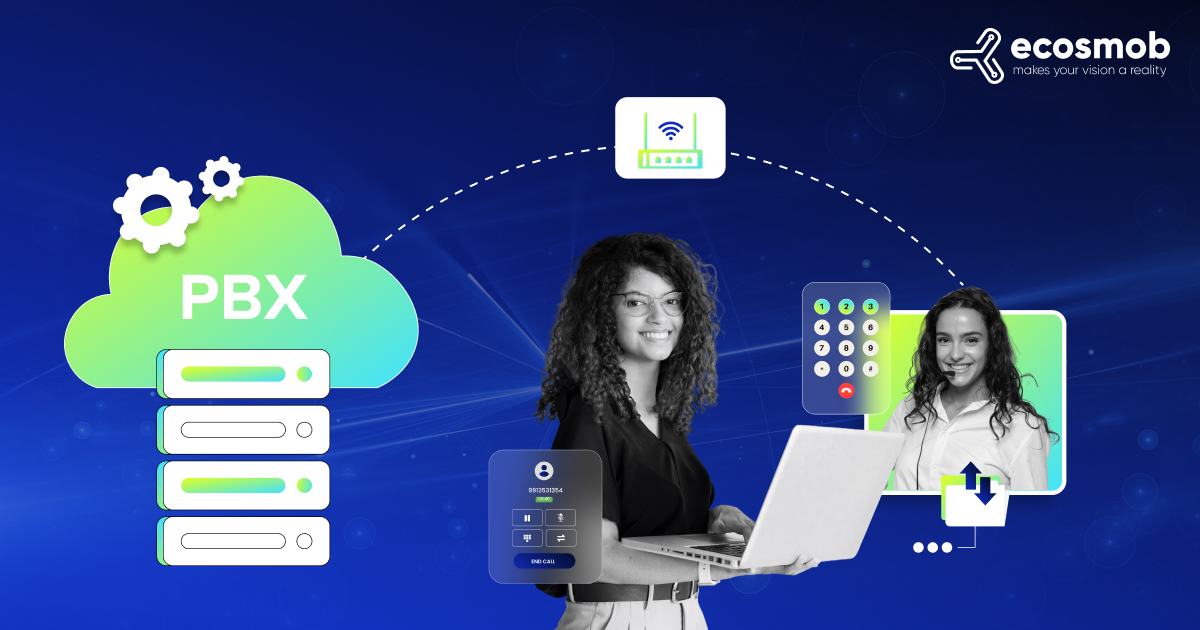
An IP PBX solution or an Internet Protocol Private Branch Exchange supplies and manages voice communication services. The primary function of the IP PBX solution is to manage call traffic to and from the business premises and internal communications over the company’s telephone network.
An IP PBX system exchanges calls between VoIP (Voice Over Internet Protocol) users and enables users to share multiple phone lines. With the increasing adoption of cloud PBX solutions, businesses have greater flexibility and cost savings.
To understand this better, let’s consider the history of IP PBX solutions and how they impact VoIP communication.
How Has the PBX System Evolved Into Modern IP PBX?
Since the advent of hosted PBX solutions, PSTN has become a thing of history. Many industry leaders predict that the rise of WebRTC will increase the requirement for hosted PBX, which indicates that this technology will stay on top in the coming years.
Save Time and Money with Modern IP PBX Solutions.
It has evolved from traditional electromechanical PBX to VoIP-based cloud PBX, bringing more features and facilities at reduced capital expenditure and operational costs. Today, IP PBX has more to offer, having advanced from its rudimentary form to a unified communication platform that enables fax, voicemail, instant messaging, and even conference calls and mobility.
Ecosmob’s latest custom Multi-tenant IP PBX solution development service raises the bar on customization and technical features.
Please don’t get overwhelmed. I understand it is difficult to summarize the years of history in two to three paragraphs.
This is just a short description of the evolution of the traditional PBX system, which relied on physical hardware and telephone lines, into the more advanced VoIP PBX systems (also known as hosted PBX, on-cloud PBX, or IP PBX), which utilize internet-based communication.
Today, these systems have further progressed into multi-tenant PBX solutions designed to support multiple businesses on a single, scalable, and flexible platform, offering enhanced features and cost-efficiency.
To make this clearer, let’s understand how these types of PBX systems differ from each other.
What is the Difference Between Traditional PBX, IP PBX and Multi-Tenant PBX?
| Traditional PBX | IP PBX | Multi-Tenant PBX | |
| Technology | Relies on physical hardware and phone lines (PSTN). | Operates over the internet using VoIP protocols. | A VoIP-based PBX that supports multiple businesses or users on a shared infrastructure. |
| Cost | Requires significant upfront investment in hardware and ongoing maintenance. | Lower operational costs; no need for extensive on-premises hardware. | Economical for service providers or businesses with multiple locations/users. |
| Scalability | Limited; expanding requires new hardware installations. | Highly scalable; businesses can add/remove users or features easily. | Designed for multi-user environments; highly flexible. |
| Features | Basic calling and voicemail capabilities, with limited integration options. | Advanced features like video conferencing, call routing, and integrations with AI tools. | Secure, isolated environments for each tenant; supports extensive customization for each user group. |
We have discussed the main differences between traditional PBX, IP PBX, and multi-tenant PBX. Now, let’s look at the advanced features that make IP PBX solutions a powerful option for today’s businesses.
What Features Should a Modern IP PBX Solution Have in 2026?
IP PBX Solution has some advanced features that pave the way for employee productivity and growth for business owners. Some of the most sought-after features of an IP PBX solution are:
1) Cutting-Edge Technology:
Modern IP PBX solutions can offer cutting-edge technology features that are unavailable with traditional PBXs and analog phone systems because of the internet’s power. Several instances are :
- Cost-effective International Calls
- Contact Center Features
- Built-In Video Conferencing
- Call-Routing Technology
- Enterprise Level Live Chat
- Auto Attendants.
2) One-Time Investment:
Developing a custom Cloud PBX solution is like a one-time investment. All you require is IP PBX software to get going. It never deteriorates like hardware. A business must invest once in a hosted PBX to enjoy its benefits forever.
3) Easy To Upgrade:
Upgrading the existing IP PBX system is effortless. When a small or mid-sized business expands and decides to add more channels or capabilities, it is relatively simple to do so.
Additionally, businesses benefit from only paying for the channels they currently need; when demand grows, they can add other channels by paying the additional expenses. Therefore, the business does not need to invest in something it does not now require.
Why Should Businesses Switch to an IP PBX Solution in 2026?
IP PBX offers many benefits that help you grow your business exponentially. Here are some of the most lucrative reasons to switch-
1) Cost-Effective:
One key benefit of a hosted PBX is its affordability due to cloud-based architecture. Businesses can save money by eliminating the need for on-premises hardware, licensing payments, and recurring maintenance costs.
It also reduces the need for time-consuming and costly on-site monitoring.
2) Multi-Tenant Features:
IP PBX solutions enhance your customer base globally through multi-tenant features. It has no barriers, and companies across the globe can readily use it.
3) Huge Volume:
IP PBX systems handle huge call volumes conveniently without violating VoIP telephony. Hosted PBX is a reliable system that works 24/7, providing the best call quality regardless of the load.
Features like the above can benefit you in many different ways, but there’s one more hidden corner we can discuss.
That is integration with artificial intelligence technology. With this integration, you can totally level up your communication with the help of an AI-powered IP PBX solution with new advanced capabilities. Let’s take a sneak peek at the future of IP PBX with AI technology.
How Does AI Improve Modern IP PBX Solutions?
A customized business IP PBX with a high level of artificial intelligence and machine learning integration is an intelligent way of getting along with new technology. For instance, an IP PBX can be smart enough to be voice-operated and learn to recognize owners who can initiate a call simply by issuing a voice command.
This capability transforms an IP PBX solution for businesses into an invaluable tool. It is like having a secretary to dial for you, and you can conduct hands-free conversations while carrying out other tasks.
Machine Learning (ML) means the system keeps learning and becomes an expert at dialing and routing calls to the right person. Users benefit, and customers who call have a good experience. Such advanced features enhance the functionality of enterprise PBX systems, offering significant advantages to users while ensuring customers enjoy seamless experiences.
What Makes Ecosmob’s Custom IP PBX Solution Different?
Ecosmob’s IP PBX solution offers extreme customization that may not be available elsewhere. It offers Freeswitch or Asterisk-based IP PBX development to suit an enterprise’s requirements. An enterprise may need a centralized IP PBX solution or a hosted IP PBX solution with a multi-tenant architecture.
Customizable Features:
- Multi-level IVR and direct inward dialing.
- Advanced call routing and returns.
- Mobility extensions and multilingual support.
- Integration with AI for intelligent call handling.
Apart from offering ease of use and low cost of operation, customizing an IP PBX solution means you have only those features you need with no extra baggage. This reduces the load on infrastructure and CAPEX.
For instance, a startup may use a hosted service using WebRTC that eliminates the need for IP Phones and routers. Startups enjoy full-fledged IP PBX solutions without the associated cost, and, in addition, the change of office location does not affect their communication setup.
The Bottom Line: Is an IP PBX Solution Right for Your Business?
Minor elements hold the underlying potential in reality. A feature-rich IP PBX solution may sound appealing, but you may better appreciate voice clarity on IP networks and the ability to handle codecs.
At Ecosmob, we provide a custom multi-tenant IP PBX solution for businesses and service providers with an easy-to-understand interface and smooth navigation features.
Contact us at sales@ecosmob.com to get the most out of your IP PBX Solution.
Upgrade to an IP PBX and Boost Operational Efficiency Across Your Business.
FAQs
What is a PBX solution?
A PBX solution is a private business phone system that manages incoming, outgoing, and internal calls.
It allows teams to share phone lines, route calls efficiently, create extensions, and automate communication. Modern PBX systems are typically cloud-based (IP PBX), reducing the need for physical hardware.
What is the difference between EPABX and IP PBX?
The main difference is that EPABX uses traditional phone lines, while IP PBX uses the internet to handle calls.
EPABX relies on physical hardware and analog systems, whereas IP PBX is software-based, more scalable, cost-effective, and supports advanced features like video calls, CRM integration, and AI-driven routing.
How does an IP PBX solution work?
An IP PBX solution works by converting voice into digital data and transmitting it over the internet.
It routes calls using predefined rules such as IVR menus, call queues, and agent availability, then connects the call to the right user or device while logging data for analytics and integrations.
Is an IP PBX cheaper than a traditional EPABX system?
Yes, IP PBX is generally cheaper than traditional EPABX systems.
Businesses typically reduce telecom costs by eliminating hardware, lowering maintenance expenses, and avoiding per-line charges while consolidating communication tools into one platform.
What features should a modern IP PBX solution have in 2026?
A modern IP PBX solution should include intelligent call routing, IVR, and seamless integrations.
Key features include video conferencing, call recording, voicemail-to-email, CRM integration, mobile access, multi-tenant support, and AI capabilities like transcription and sentiment analysis.
Can IP PBX integrate with CRM and other business tools?
Yes, most IP PBX solutions integrate directly with CRM and business tools.
They automatically log calls, display customer data during calls, trigger follow-ups, and store call summaries, improving productivity and customer experience.
Is a hosted IP PBX solution secure for enterprise use?
Yes, hosted IP PBX solutions are secure when properly configured.
They include encryption, compliance standards, access controls, and monitoring features, making them suitable for industries with strict data security requirements.
What is a multi-tenant IP PBX solution?
A multi-tenant IP PBX solution is a cloud-based system that supports multiple users or businesses on one platform.
Each tenant operates independently with separate data and configurations, making it ideal for service providers and organizations managing multiple clients or locations.
How long does it take to deploy an IP PBX solution?
Deployment time depends on the size and complexity of the system.
Cloud-based IP PBX can be set up in a few weeks, while custom or on-premise deployments may take longer due to integrations, testing, and migration.
Should small businesses choose hosted PBX or on-premise IP PBX?
Hosted PBX is usually the best option for small businesses.
It requires no upfront hardware, is easy to scale, and reduces maintenance, while on-premise systems are better suited for large enterprises with advanced customization and control needs.