

You’re in a planning meeting. Whiteboard out. Someone says, “Let’s use OpenSIPS.” Someone else says, “No, FreeSWITCH.” A third person asks, “Why not both?”
Sound familiar?
OpenSIPS and FreeSWITCH are often compared, but they’re not direct competitors. They solve different problems within the same VoIP architecture.
OpenSIPS handles SIP signaling, routing, and traffic orchestration. FreeSWITCH handles media processing, IVR, conferencing, and real-time call control.
In smaller deployments, some capabilities overlap, which is why teams often evaluate them together. At scale, however, the distinction becomes clear: OpenSIPS powers the signaling layer, while FreeSWITCH powers the media layer.
The real question isn’t which platform is better. It’s where each platform fits in a scalable VoIP architecture.
OpenSIPS vs. FreeSWITCH Comparison for Scalable VoIP Deployment
OpenSIPS and FreeSWITCH are built for different layers of VoIP infrastructure. One focuses on SIP routing and SIP signaling, while the other handles media processing and real-time call control.
The comparison below shows where each platform fits best in scalable VoIP, WebRTC, and telecom deployments.
| Use Case | Recommended Deployment |
| SIP Load Balancing | OpenSIPS |
| Media Processing | FreeSWITCH |
| IVR and Voicebot Flows | FreeSWITCH |
| High CPS and Routing | OpenSIPS |
| WebRTC Gateway | Combined |
| AI Voice Agent Integration | Combined |
| Carrier SBC Deployment | OpenSIPS |
| Conferencing | FreeSWITCH |
| Kubernetes Scaling | Combined |
| Multi-Tenant CPaaS | Combined |
The fastest way to choose between OpenSIPS and FreeSWITCH is to determine whether the deployment is signaling-heavy, media-heavy, or a mix of both.
If you’ve explored how modern businesses use VoIP integrations to connect their communication workflows, the next step is to understand where OpenSIPS fits within that architecture.
What is OpenSIPS in VoIP Architecture?
OpenSIPS is a high-performance SIP proxy server built for signaling control, SIP routing, and telecom traffic orchestration. If you’re searching for what OpenSIPS is, the short answer is simple: it controls how VoIP calls move across networks before media processing begins.
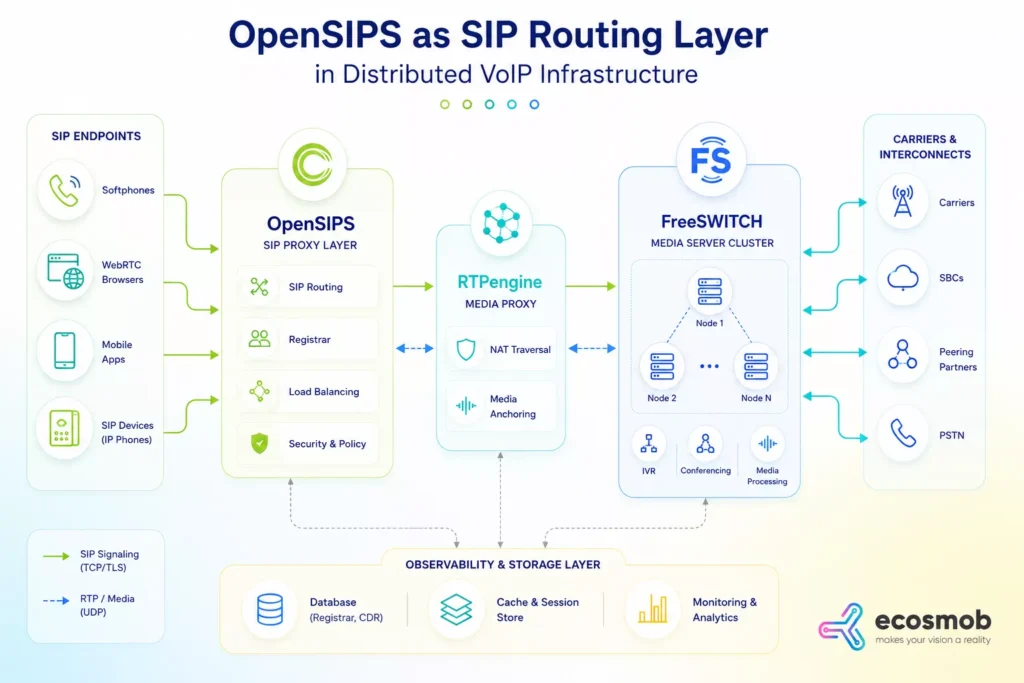
OpenSIPS in VoIP Architecture
Unlike media servers, OpenSIPS focuses on SIP signaling instead of RTP protocol handling. That makes it ideal for ITSP, CPaaS, MVNO, and carrier-grade VoIP infrastructure.
1. SIP Routing and Signaling Control
OpenSIPS routes SIP traffic between carriers, PBXs, WebRTC gateways, and application servers with very low latency. Its lightweight architecture is designed for high CPS handling and distributed telecom deployments.
OpenSIPS supports both stateless and stateful routing. Stateless routing improves signaling speed, while stateful routing enables failover, authentication, and advanced session logic.
2. SIP Registration and Load Balancing
The registrar function allows SIP devices to register dynamically inside the network. This helps OpenSIPS track active endpoints and route inbound traffic correctly.
For traffic distribution, OpenSIPS uses the Dispatcher module. It balances SIP requests across multiple FreeSWITCH nodes, SBCs, or application servers while supporting health checks and failover logic.
3. Dialog Management and Session Awareness
The Dialog module helps OpenSIPS maintain active session awareness. It tracks call states, manages concurrency, and supports timeout handling for large-scale VoIP deployments.
This becomes especially useful in multi-tenant CPaaS and carrier routing environments where thousands of concurrent dialogs move through the signaling layer.
4. RTPengine Pairing and NAT Traversal
Although OpenSIPS does not process media directly, it commonly works alongside RTPProxy or RTPengine for RTP handling and NAT traversal.
This pairing helps manage secure media flows, WebRTC interoperability, and SIP endpoint connectivity across firewalls and distributed networks.
5. SIP Security and Horizontal Scaling
OpenSIPS often sits at the edge of VoIP infrastructure as a SIP firewall layer. Teams use it for rate limiting, SIP authentication, fraud prevention, and carrier interconnect protection.
Because OpenSIPS is lightweight and modular, it supports horizontal scaling extremely well. Modern cloud-native deployments frequently run OpenSIPS containers across Kubernetes clusters for telecom-scale SIP orchestration.
OpenSIPS performs best when signaling speed, routing intelligence, and telecom-scale traffic distribution matter more than media execution.
What is FreeSWITCH in Media Server Deployment
FreeSWITCH is an open-source media server built for real-time call control, RTP handling, and voice application execution. In simple terms, it manages the media side of VoIP communication after SIP signaling is established.
Unlike OpenSIPS, which focuses on SIP routing, FreeSWITCH works as a B2BUA (Back-to-Back User Agent). It controls both sides of a call session independently for deeper media and application control.
1. RTP Handling and Media Processing
FreeSWITCH is designed for RTP/media handling across voice and video sessions. It manages media bridging, codec transcoding, DTMF processing, and real-time stream orchestration inside VoIP infrastructure.
This makes it a strong fit for conferencing platforms, call centers, voice broadcasting, and enterprise communication systems.
2. IVR, Conferencing, and Voice Applications
Many telecom platforms use FreeSWITCH for IVR execution and conferencing workloads. It supports queue management, call recording, voicemail, and advanced voice workflows through flexible call logic.
Its voice application layer helps teams build interactive communication systems without relying on traditional monolithic PBX infrastructure.
3. XML Dialplan and ESL Integration
One of the most widely used FreeSWITCH capabilities is XML dialplan configuration. Developers can create custom routing and media workflows using simple application actions.
Example XML dialplan:
<extension name="support_queue">
 <condition field="destination_number" expression="^5000$">
   <action application="answer"/>
   <action application="playback" data="welcome.wav"/>
   <action application="bridge" data="sofia/gateway/provider/1001"/>
 </condition>
</extension>
FreeSWITCH also supports ESL (Event Socket Library) integration. This allows external applications to control live calls, automate workflows, and interact with media sessions in real time.
4. AI Voice and WebRTC Applications
Modern deployments increasingly use FreeSWITCH for AI/STT/TTS orchestration, conversational voicebots, and real-time transcription pipelines.
Its native WebRTC support also enables browser-based voice and video communication across scalable cloud-native deployments.
Compared to traditional PBX systems, FreeSWITCH works better in distributed media clusters where workloads scale independently across multiple nodes.
As communication platforms evolve from simple SIP routing to advanced media services, FreeSWITCH development often becomes a critical part of the architecture.
OpenSIPS vs FreeSWITCH Architecture for Scalable VoIP Systems
OpenSIPS and FreeSWITCH architecture works best when both platforms handle separate layers of the VoIP stack. OpenSIPS manages SIP signaling and traffic orchestration, while FreeSWITCH controls RTP/media processing and real-time call applications.
In modern VoIP deployments, SIP signaling and RTP/media paths typically operate independently to improve SIP scalability and overall system performance. SIP requests pass through OpenSIPS for routing, authentication, load balancing, and failover handling, while media traffic flows through RTPengine and FreeSWITCH for conferencing, transcoding, recording, and session control.
1. SIP Signaling and RTP Flow
OpenSIPS acts as the signaling brain inside distributed telecom infrastructure. It handles SIP trunk orchestration, session routing, and carrier interconnect management with very high CPS capacity.
FreeSWITCH handles the media layer after signaling is established. It processes RTP streams, IVR execution, WebRTC media sessions, and advanced voice applications in real time.
This separation improves performance, fault isolation, and infrastructure scalability across large VoIP environments.
2. Distributed Node Architecture
Modern telecom systems rarely run on single-server deployments anymore. Most platforms now use a distributed node architecture with active-active deployments spread across multiple regions.
OpenSIPS containers often run stateless inside Kubernetes clusters for horizontal scaling.
FreeSWITCH media workers scale independently based on concurrent RTP workloads and transcoding demand.
This architecture supports geo-redundancy, edge POP deployments, and carrier-grade failover across cloud-native VoIP infrastructure.
3. Kubernetes and Cloud-Native Deployments
By 2026, Docker deployment and Kubernetes orchestration have become standard for scalable VoIP systems. Teams increasingly deploy OpenSIPS pods behind ingress SBC layers while autoscaling FreeSWITCH workers dynamically during traffic spikes.
Many deployments also integrate service mesh frameworks for observability, policy enforcement, and secure east-west communication between telecom microservices.
OpenSIPS Dispatcher Configuration Example
OpenSIPS commonly uses the Dispatcher module to distribute SIP traffic across multiple FreeSWITCH nodes.
Example dispatcher.list:
1 sip:freeswitch-1.internal:5060 0 0
1 sip:freeswitch-2.internal:5060 0 0
1 sip:freeswitch-3.internal:5060 0 0

This setup allows OpenSIPS to route sessions dynamically while supporting failover
and load balancing across media clusters.
OpenSIPS vs FreeSWITCH Architecture Comparison:
| Architecture Layer | OpenSIPS | FreeSWITCH |
| SIP Routing | Primary role | FreeSWITCH |
| RTP Handling | Primary role | Secondary |
| Scalability | External pairing | Native |
| Stateful Sessions | Very high CPS | Media-bound scaling |
| Call Logic | Basic | Advanced |
| Media Applications | Limited | Extensive |
Modern deployments also include Redis, PostgreSQL, Prometheus, Grafana, and Homer SIP capture for session storage, monitoring, and telecom observability across distributed clusters.
In modern deployments, OpenSIPS and FreeSWITCH usually operate as complementary infrastructure layers rather than competing platforms.
How Do OpenSIPS and FreeSWITCH Support WebRTC and AI Voice Applications?
OpenSIPS and FreeSWITCH support WebRTC and AI voice applications by handling different parts of the communication stack. OpenSIPS manages signaling and session routing, while FreeSWITCH processes media, voice interactions, and real-time call workflows.
1. WebRTC Calling Infrastructure
In WebRTC deployments, OpenSIPS commonly handles SIP over WebSocket connections between browsers and telecom networks. It routes signaling traffic efficiently while maintaining session control across distributed environments.
FreeSWITCH manages the media layer once the session is established. It processes voice and video streams while working alongside TURN/STUN services for NAT traversal and reliable browser-based calling.
2. AI Voicebot Orchestration
AI voice platforms often combine OpenSIPS and FreeSWITCH to create scalable voice automation workflows. OpenSIPS orchestrates SIP sessions, while FreeSWITCH connects live media streams with AI engines and external services.
This architecture powers AI-powered IVR systems, OpenAI voice agents, virtual assistants, and automated customer interactions.
3. Real-Time Transcription and Voice Automation
FreeSWITCH integrates with STT and TTS engines to support real-time transcription and voice synthesis. This enables conversational AI pipelines that can listen, process, and respond during active calls.
Many organizations also use these integrations for live call analytics, agent assistance, compliance monitoring, and intelligent voice automation.
As WebRTC and AI adoption grow, telecom infrastructure increasingly relies on separate signaling and media layers to deliver scalable real-time communication experiences.
The rise of conversational AI is pushing telecom infrastructure toward hybrid signaling and media architectures.
That same architecture is now becoming the foundation for WebRTC and AI-driven voice systems.
As voice systems become smarter, securing them becomes significantly more complex.
How Do OpenSIPS and FreeSWITCH Secure Carrier-Grade VoIP Networks?
OpenSIPS and FreeSWITCH secure carrier-grade VoIP networks by protecting different layers of the communication stack. OpenSIPS focuses on signaling security and traffic control, while FreeSWITCH protects media sessions and application-level interactions.
1. SIP Authentication and Traffic Protection
OpenSIPS is often deployed at the network edge to authenticate SIP traffic before it reaches core infrastructure. It supports SIP authentication, rate limiting, geo-blocking, and SIP anomaly detection to stop malicious traffic early.
Many providers also use OpenSIPS for DDoS protection and SIP reputation filtering. This helps reduce unwanted traffic from suspicious sources before sessions are established.
2. Media Security and Session Protection
FreeSWITCH secures active call sessions through TLS for signaling encryption and SRTP for media encryption. This helps protect voice and video traffic from interception during transmission.
Because FreeSWITCH manages live media sessions, it also plays a key role in enforcing secure call flows and application-level policies.
3. Toll Fraud Defense and Zero-Trust Security
Modern VoIP attacks increasingly target telecom infrastructure through toll fraud and account abuse. OpenSIPS and FreeSWITCH can work together to enforce call restrictions, traffic policies, and real-time fraud detection rules.
Many deployments now adopt a zero-trust VoIP architecture where every user, endpoint, and service must be continuously verified before access is granted.
4. Cloud-Native Security Controls
As VoIP platforms move to Kubernetes, security extends beyond SIP traffic alone. A well-designed Kubernetes architecture incorporates network segmentation, API-based policy enforcement, and centralized secrets management to secure distributed telecom deployments.
These controls help reduce lateral movement risks while strengthening security across cloud-native communication environments.
5. Monitoring and Threat Visibility
Security also depends on visibility. Modern deployments commonly use Prometheus and Grafana for monitoring, Homer SIP Capture for signaling analysis, Loki for log aggregation, and Fail2Ban for automated threat mitigation.
Together, these tools help teams detect anomalies, investigate incidents, and maintain carrier-grade reliability at scale.
As VoIP infrastructure becomes cloud-native, observability and zero-trust security move from optional features to deployment requirements.
Security is only one piece of the decision. Platform selection is the next.
How Do OpenSIPS, Kamailio, and FreeSWITCH Compare for VoIP Deployments?
OpenSIPS, Kamailio, and FreeSWITCH serve different roles in the VoIP infrastructure. OpenSIPS and Kamailio are SIP proxies built for signaling and routing, while FreeSWITCH is a media server designed for call processing and voice applications.
The OpenSIPS vs Kamailio comparison appears frequently because both platforms compete in the SIP routing layer. They share similar capabilities but differ in routing philosophy, configuration approaches, and ecosystem preferences.
1. Platform Comparison at a Glance
| Platform | Primary Role | Best use case |
| OpenSIPS | SIP Proxy | Telecom Routing |
| Kamailio | SIP Proxy | Custom SIP Logic |
| FreeSWITCH | Media Server | IVR and Media Apps |
2. OpenSIPS vs Kamailio
OpenSIPS is often preferred for telecom routing, carrier interconnects, load balancing, and large-scale signaling deployments. Its modules are designed to simplify common telecom use cases while maintaining high performance.
Kamailio offers similar SIP proxy capabilities but is often chosen for highly customized SIP environments. Many engineering teams favor it when extensive scripting flexibility and custom SIP logic are priorities.
Both platforms are mature, widely adopted, and capable of handling carrier-grade traffic volumes. In most cases, the choice comes down to operational preferences and deployment requirements rather than performance limitations.
3. Where FreeSWITCH Fits
FreeSWITCH belongs to a different category altogether. It focuses on media handling, IVR execution, conferencing, recording, transcoding, and real-time voice applications.
This is why OpenSIPS and FreeSWITCH are not direct replacements. One manages signaling paths, while the other manages media workloads after sessions are established.
Teams comparing OpenSIPS vs Kamailio are usually choosing a signaling engine, while FreeSWITCH enters the architecture at the media layer.
The final choice depends less on features and more on deployment goals.
When Should You Use OpenSIPS, FreeSWITCH, or Both?
You should use OpenSIPS when signaling, and SIP routing are the priority, FreeSWITCH when media processing is the focus, and both platforms together when building a scalable VoIP infrastructure. The right choice depends on the workload, growth plans, and architecture requirements.
1. Recommended Stack by Deployment Goal
| Deployment Goal | Recommended Stack |
| SIP trunk routing | OpenSIPS |
| Call center platform | FreeSWITCH |
| CPaaS infrastructure | OpenSIPS + FreeSWITCH |
| WebRTC Platform | Combined |
| AI Voice Automation | Combined |
| Carrier-grade SBC | OpenSIPS |
| Conferencing System | FreeSWITCH |
| Multi-region VoIP scaling | Combined |
2. For Startups and New Deployments
Smaller deployments often start with a single platform to reduce operational complexity. If the requirement is routing-focused, OpenSIPS is usually the better starting point. For IVR systems, conferencing, and voice applications, FreeSWITCH offers more value from day one.
3. For Enterprise-Scale Infrastructure
Enterprise deployments rarely rely on a single platform. Separating signaling and media layers improves scalability, fault isolation, and operational flexibility across large VoIP environments.
This is why many CPaaS providers, carriers, and telecom platforms deploy OpenSIPS and FreeSWITCH together.
4. Migration from Asterisk and FreeSWITCH Alternatives
Teams migrating from Asterisk often adopt FreeSWITCH for greater media scalability and application flexibility. As traffic grows, many also introduce OpenSIPS to handle signaling workloads, preventing routing bottlenecks from limiting FreeSWITCH scalability.
When evaluating FreeSWITCH alternatives, it is important to compare not just features but also architectural roles. In many cases, alternatives solve only part of the problem that a combined OpenSIPS and FreeSWITCH deployment addresses.
5. Planning for Future Scale
A common scaling path starts with one platform and gradually separates signaling from media as traffic grows. This approach reduces complexity early while creating a clear path toward carrier-grade architecture later.
The strongest VoIP deployments in 2026 separate signaling intelligence from media execution instead of forcing one platform to handle both.
A pattern should be clear by now: the best choice depends on the role each platform is expected to play.
So let’s conclude,
Conclusion
The OpenSIPS vs FreeSWITCH debate becomes much simpler once you separate signaling from media. OpenSIPS excels at SIP routing, traffic orchestration, and scalability, while FreeSWITCH handles media processing, conferencing, IVR, WebRTC, and AI-driven voice experiences.
As telecom infrastructure moves toward cloud-native deployments, conversational AI, and multi-region scaling, the most resilient architectures increasingly rely on both platforms working together.
OpenSIPS routes the conversation. FreeSWITCH powers the experience. Scalable VoIP infrastructure usually needs both to work together.
If you’re planning a VoIP platform, CPaaS solution, AI voice application, or carrier-grade deployment, Ecosmob can help design and build an architecture that scales with your business, not against it.
Frequently Asked Questions
Neither platform is inherently better. OpenSIPS is designed for SIP routing, signaling, and traffic management, while FreeSWITCH focuses on media processing, conferencing, IVR, and voice applications. The better choice depends on the role you need the platform to perform.
Yes. In fact, many modern VoIP deployments use both platforms together. OpenSIPS handles signaling and session routing, while FreeSWITCH manages media processing and real-time call control.
The main difference is architectural responsibility. OpenSIPS acts as a SIP proxy for signaling traffic, whereas FreeSWITCH functions as a media server and B2BUA for handling RTP streams, voice applications, and call sessions.
Yes. FreeSWITCH supports WebRTC media processing, browser-based calling, conferencing, and voice/video communication. It is commonly deployed alongside OpenSIPS and RTPengine in scalable WebRTC environments.
No. OpenSIPS is not designed for media processing. It focuses on SIP signaling and routing. Media-related tasks such as transcoding, recording, conferencing, and IVR execution are typically handled by FreeSWITCH or other media servers.