













QUICK SUMMARY
Moving an enterprise telecom engine from a stateful, channel-bound system to a thread-isolated application requires more than rewriting configuration files.
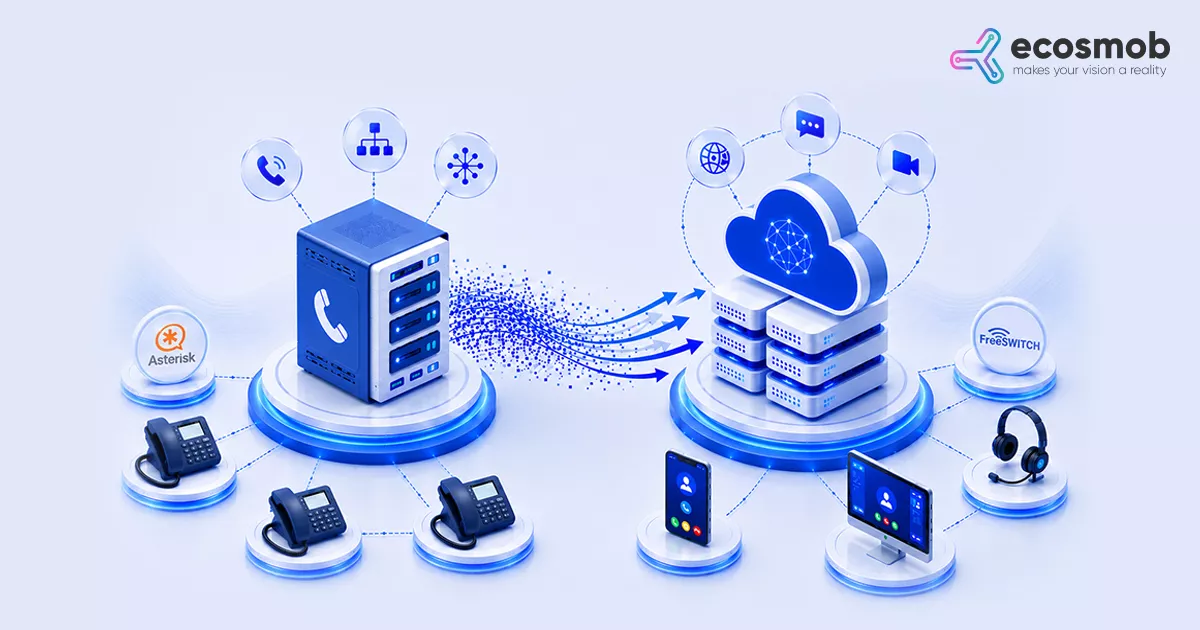
This technical blueprint explores the definitive architectural mapping, step-by-step pipeline execution, and parallel-running strategies you need to execute a zero-downtime Asterisk to FreeSWITCH migration.
If you’re sitting at your desk right now researching how to migrate Asterisk to FreeSWITCH, it most likely didn’t come out of the blue. It is probably because you’re finally hitting the ceiling on concurrent channels. Maybe a heavy morning traffic spike caused an unexplainable thread lock that dropped half your active calls. Or maybe you’re just tired of spinning up endless clusters of Asterisk instances just to handle basic state coordination across your network.
So, if you are actively planning an Asterisk to FreeSWITCH migration, it’s best to know that moving a live production system requires a strategy that goes far beyond a simple configuration rewrite. Telephony environments are unforgiving. An unoptimized dialplan regular expression or a misconfigured SIP profile can immediately impact audio paths and billing verification loops.
To pull this off without losing your uptime, your deployment strategy should focus on architectural mapping, parallel network topologies, and comprehensive validation. Let’s break down exactly how to execute this migration while keeping your active traffic completely unaffected.
What is the FreeSWITCH Equivalent of the Asterisk Dialplan, AGI, and AMI?
You cannot safely begin editing configuration files until you understand how elements map across both systems. Asterisk operates on a stateful, channel-centric model where features are tightly coupled inside modules. The FreeSWITCH architecture, conversely, relies on a modular, thread-isolated core driven by an asynchronous state machine.
If you are still weighing the structural choices for your roadmap, you can review our detailed comparison of Asterisk vs FreeSWITCH.
When you are ready to build out your new environment, your team should map your legacy Asterisk primitives directly to their modern architectural counterparts:
| Asterisk Component | FreeSWITCH Equivalent | Operational Difference during Migration |
| extensions.conf | XML Dialplan (or mod_lua / mod_xml_curl) | Asterisk parses configurations sequentially line-by-line.
FreeSWITCH compiles the dialplan tree entirely into memory, matching regex fields instantly. |
| sip.conf / pjsip.conf | sofia.conf.xml (Profiles & Gateways) | Asterisk binds options per peer.
FreeSWITCH abstracts interfaces into distinct “SIP Profiles” (internal vs. external), each handling its own ports and security boundaries. |
| Asterisk Gateway Interface (AGI) | Event Socket Outbound (ESL Outbound) | AGI forks a new operating system process per call.
FreeSWITCH pipes a lightweight TCP stream out to an asynchronous socket container. |
| Asterisk Manager Interface (AMI) | Event Socket Inbound (ESL Inbound) | AMI requires constant polling and text-line parsing.
FreeSWITCH sends structured asynchronous JSON or plain text events over dedicated TCP sockets. |
| voicemail.conf | mod_voicemail | Asterisk manages voicemail inside file directories.
FreeSWITCH stores profiles inside its core XML data structures, integrating directly with databases. |
| CEL / CDR Records | mod_xml_cdr / mod_cdr_csv | Asterisk writes to database backends synchronously.
FreeSWITCH utilizes non-blocking HTTP POST webhooks to send call states to your processing engines safely. |
How to Run Asterisk and FreeSWITCH in Parallel During Migration?
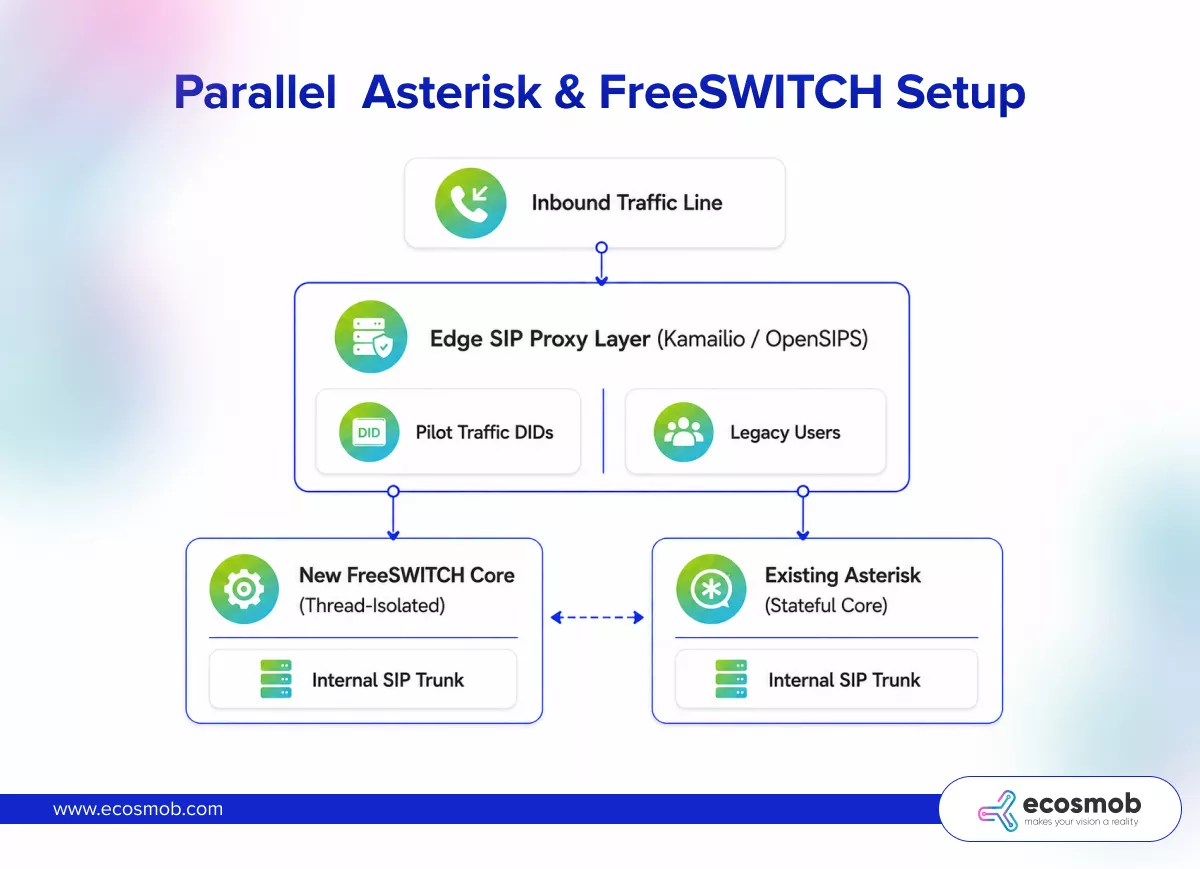
Attempting a sudden cutover on a high-concurrency network introduces unnecessary risk. The most reliable alternative is constructing a parallel-running architecture. By keeping both engines alive simultaneously, you can safely bleed traffic off the old system in controlled phases.
 1. Insert an Upstream Edge Proxy
If your endpoints point directly to an Asterisk core, the first step is inserting a proxy layer like Kamailio or OpenSIPS at the front of your network. This proxy handles carrier lines and registrations. Once active, you can instantly shift a user or a DID from Asterisk to FreeSWITCH via a backend database update at the edge (completely eliminating the need to reconfigure physical client hardware or softphones).
2. Establish an Internal Core Bridge Trunk
Build a dedicated, high-capacity internal SIP trunk linking your existing Asterisk boxes straight to your new FreeSWITCH cluster. This bridge acts as a temporary data highway. If an enterprise customer who hasn’t been migrated yet dials an extension that has already moved to the FreeSWITCH side, your edge proxy or dialplan routes the call across this internal trunk cleanly, keeping the transition invisible to the end user.
3. Move Traffic in Incremental Batches
Do not move your entire volume at once. Split your migration into tight, controlled traffic groups:
- The Ghost Loop: Route test numbers and dummy DIDs through the new FreeSWITCH setup to verify media path integrity and audio transcodes.
- The Pilot Group: Move a single low-risk tenant, an internal department, or a minor geographic DID range over to the FreeSWITCH core. Run this for a week to catch any hidden edge cases.
- The Fractional Escalation: Scale up your traffic shift in increments (10%, 25%, 50%), monitoring server CPU cores and event queues at every step.
Migrating from Asterisk and worried about system disruption?
Step-by-Step: How to Migrate Asterisk Dialplans and Media Files to FreeSWITCH?
Once your parallel network topology is verified, you must systematically extract, transform, and load your active application resources.
1. Normalize Your Media Prompt Catalog
Asterisk handles compressed, raw monaural formats like .sln (slin), .ulaw, or standard .wav files recorded at a fixed 8kHz sample rate. FreeSWITCH features a multi-rate native media engine designed to process high-fidelity wideband audio (from 8kHz all the way up to 48kHz) cleanly.
While FreeSWITCH can read a legacy 8kHz file, forcing its media engine to dynamically upsample old audio prompts during hundreds of concurrent calls will increase your CPU usage.
Avoid the performance penalty by batch-converting your entire prompt library to 16kHz or 32kHz using a tool like sox before deploying:
2. Rewrite Procedural Logic into Declarative XML Trees
Asterisk dialplans are fundamentally procedural. The system evaluates lines sequentially based on priority numbers. FreeSWITCH, however, compiles your configurations into an XML document tree and processes destinations using a highly optimized regular expression engine.
Take this classic, sequential Asterisk pattern:
To reconstruct this functionality within FreeSWITCH’s declarative framework, you must build a structured condition node inside your routing context:
3. Abstract the User Directory with mod_xml_curl
If you have thousands of SIP users, writing them to static XML files on your FreeSWITCH box makes your configuration massive and slow to reload.
Instead, leverage the power of mod_xml_curl. This module tells FreeSWITCH to completely offload user management to your web server. Whenever a phone attempts to register or a call needs routing, FreeSWITCH fires a fast HTTP POST request to your application backend.
Your backend queries your centralized database and returns a tiny, dynamically generated snippet of XML code on demand. This keeps your FreeSWITCH nodes light, stateless, and incredibly easy to scale.
Asterisk Data Schema & CDR Migration to FreeSWITCH
When you migrate Asterisk to FreeSWITCH, your data reporting layer requires an immediate structural audit. Asterisk typically dumps raw call records into flat files or databases using its rigid Call Detail Record (CDR) or Channel Event Logging (CEL) formats.
FreeSWITCH completely changes this paradigm by compiling a massive, detailed JSON or XML document for every single call leg, detailing exact packet counts, jitter statistics, and precise timing stamps.
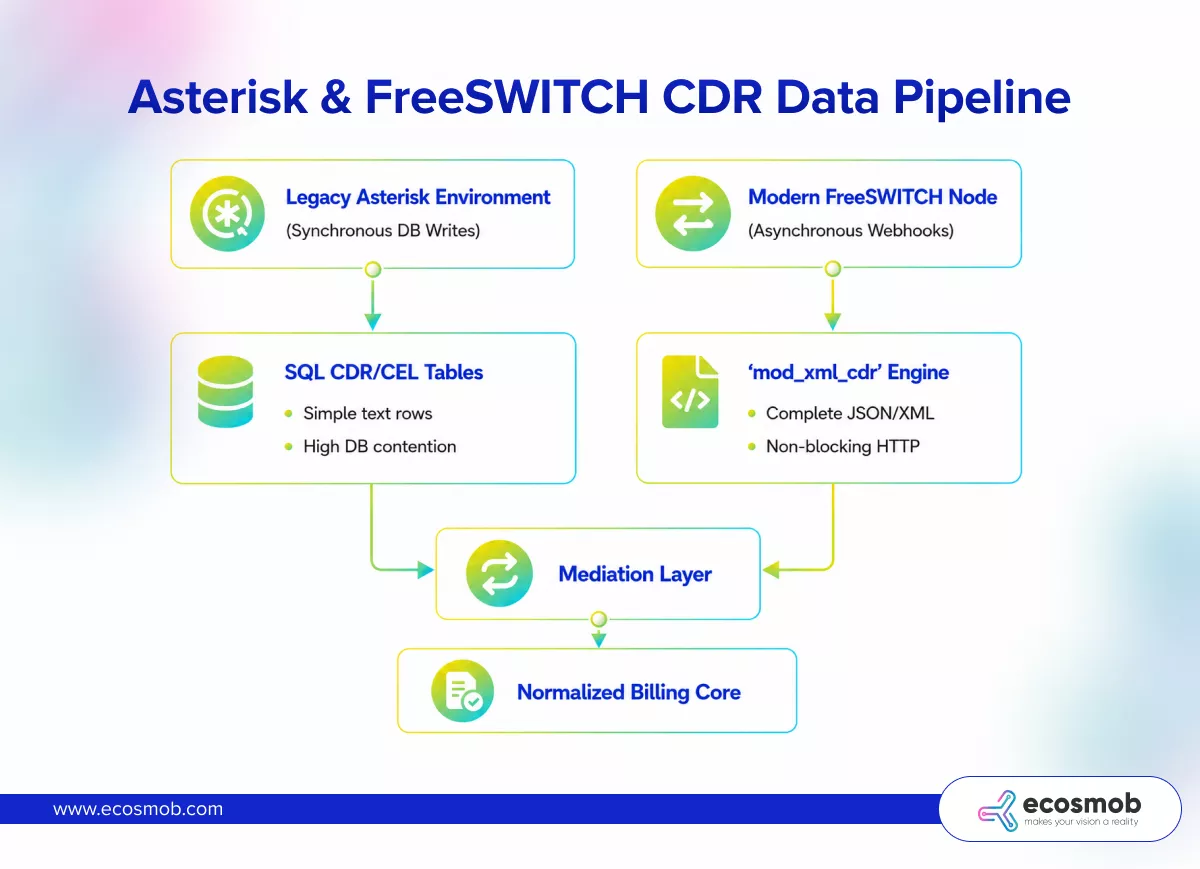 If you try to map FreeSWITCH’s highly verbose metrics directly into your old, legacy Asterisk database schema rows, you will drop critical tracking metadata.
- The Strategy: Do not force FreeSWITCH to write to your legacy SQL tables synchronously. Instead, enable mod_xml_cdr and point it to an isolated, asynchronous HTTP receiver service.
- The Mediation Path: Build a simple normalization or data mediation script that catches FreeSWITCH’s webhooks, extracts the specific billing, duration, and routing fields your accounting software expects, and safely writes them to your database. This keeps your media paths completely isolated from database write latency.
Need a high-concurrency, cluster-ready FreeSWITCH platform built for scale?
How to Test and Validate Your FreeSWITCH Architecture Before Cutover?
Never assume your new FreeSWITCH configuration can handle real-world scenarios just because a few manual test calls worked. Before you dismantle your parallel setup and complete the cutover, your engineering team must run your new platform through a rigorous automated validation routine:
- SIPp Load Testing: Use the open-source tool SIPp to replay real-world traffic patterns against your staging FreeSWITCH cluster. Blast the box with high call-arrival rates (CPS) and sustain hundreds of concurrent channels to watch how your mod_xml_curl endpoints handle database connections under real pressure.
- RTP Media Loopback Validation: Run automated regression scripts that answer calls and force media loopbacks. Monitor your packet captures using tools like sngrep to ensure codecs aren’t causing one-way audio anomalies across asymmetric network boundaries.
- DTMF Integrity Checks: Verify that both In-band and Out-of-band (RFC 2833 / SIP INFO) DTMF signals pass cleanly through the system. If your bot or automated IVR relies on keypress collections, a slight mismatch in payload types will cause your system to completely ignore client inputs.
Ecosmob Expert Tip
If your current Asterisk system relies heavily on complex inner AGI scripting, do not attempt to port that procedural logic directly into native FreeSWITCH XML configurations.
Instead, look to write your application tier cleanly outside the telecom chassis using the Event Socket Layer (ESL). By executing your voice loops over an ESL Outbound socket connection, you isolate your heavy core routing, API integration calls, and business logic dependencies inside independent microservices (written in Go, Python, or Node.js), keeping your FreeSWITCH cluster 100% focused on low-latency media and signaling control.
When is an Asterisk to FreeSWITCH Migration Not Worth the Operational Overhead?
A system migration of this scale is a major investment of time, resource optimization, and operational testing. There are specific development environments where executing this transition simply does not make practical sense:
- Low-Concurrency Requirements: If your platform rarely scales past 200 concurrent channels, your baseline Asterisk architecture has more than enough capacity to handle the workload safely.
- Heavy Reliance on App-Layer Modules: If your business logic depends deeply on niche, community-developed Asterisk application macros or specialized interface cards (like analog DAHDI hardware), porting those edge components over to FreeSWITCH will require significant engineering workarounds.
- Team Technical Constraints: FreeSWITCH strips away the simplified scripting safety nets of old telephony tools. If your on-site engineering team lacks deep familiarity with advanced multi-threaded patterns, distributed data caching, and asynchronous TCP debugging, managing an enterprise FreeSWITCH cluster in production can introduce unforeseen troubleshooting delays.
The path to a resilient, high-capacity voice network requires moving past legacy structural boundaries. Transitioning your platform over to a thread-isolated FreeSWITCH architecture provides the definitive foundation required to scale your concurrency limits, minimize lock friction, and deploy dynamic real-time integrations safely.
By systematically mapping your legacy variables, utilizing OpenSIPS or Kamailio for a clean parallel-running network edge, and decoupling your backend application state via external ESL socket listeners, you eliminate deployment blind spots and ensure your new voice engine operates with absolute stability under peak enterprise volume.
Ready to systematically map your open-source telecom migration or optimize your core switching performance? Discuss it with Ecosmob’s core platform migration architects today!
FAQs
Can I migrate from Asterisk to FreeSWITCH without experiencing network downtime?
Yes, absolutely. By positioning an edge SIP proxy layer (like Kamailio or OpenSIPS) upstream from your systems, you can establish an internal SIP trunk to run both platforms in parallel. This methodology allows you to shift user registrations and DID routing tables incrementally over multiple deployment windows, ensuring zero disruption to active live traffic.
Will my existing Asterisk custom dialplans and AGI scripts work natively on FreeSWITCH?
No. Asterisk dialplans use a sequential, priority-based syntax that is structurally incompatible with FreeSWITCH's declarative XML regex framework. Additionally, Asterisk AGI forks a heavy operating system process for every new call loop, whereas FreeSWITCH utilizes a highly efficient, non-blocking Event Socket Layer (ESL) protocol to pass channel controls to external applications.
How does the FreeSWITCH architecture handle custom IVR prompts and media compression?
FreeSWITCH features a multi-rate media core capable of processing high-fidelity audio streams up to 48kHz seamlessly. During a system migration, any legacy 8kHz audio prompts should be pre-sampled to 16kHz using automated tools like sox to eliminate real-time CPU upsampling overhead at the application layer.
How long does a standard Asterisk to FreeSWITCH migration take to execute safely?
The technical timeline varies based on dialplan density, database structural alignments, and active test coverage. A basic system transition can frequently be mapped and staged within a few weeks, whereas a massive, carrier-grade wholesale platform featuring complex real-time billing and external microservice integrations often requires an iterative multi-month staging and verification schedule.
How does FreeSWITCH prevent the internal process locking issues common in high-volume Asterisk nodes?
Asterisk relies heavily on stateful, shared-memory channel tracking where a single locked process can cascade to cause thread blocks across the entire system core. FreeSWITCH uses an isolated multi-threaded engine where every call channel is allocated its own dedicated, protected memory stream, allowing nodes to scale processing density linearly across modern multi-core server hardware.