














QUICK SUMMARY
When FreeSWITCH starts stuttering under load, the instinct is to buy bigger servers. That rarely works. Scaling FreeSWITCH is a protocol and architecture challenge, not just a compute problem.
This blog breaks down how to eliminate FreeSWITCH call center distribution delays, architect true FreeSWITCH high availability, and properly decouple your signaling from your media to handle massive concurrent call volumes without breaking a sweat.
What if the real reason your calls struggle under load has nothing to do with traffic, and everything to do with how FreeSWITCH is tuned beneath the surface?
Most teams only start worrying about FreeSwitch’s concurrent call limit when audio stutters or dial plans slow down, but by then, the platform is already telling you it’s overwhelmed. And in that moment, the question of “how many concurrent calls FreeSWITCH can handle?” becomes no longer theoretical but painfully honest.
When you push past thousands of active sessions, concurrency isn’t just a metric; it is a reflection of your architecture, network topology, and thread management. And once you’ve seen how quickly concurrent calls in FreeSWITCH environments can slip from smooth to unpredictable, the need for high-availability and performance optimization becomes impossible to ignore.
What Are the Core Architectural Strategies to Scale FreeSWITCH?
Scaling FreeSWITCH requires shifting from a single monolithic server to a fully distributed network topology. The core FreeSWITCH scaling strategies involve decoupling SIP signaling from media processing, implementing horizontal load balancing, optimizing OS-level thread management, and leveraging containerized orchestration.
When FreeSWITCH starts showing strain under high call volume, the instinct is to add capacity. But call instability rarely begins with traffic volume; it starts with how the platform is architecturally designed to handle concurrent requests.
In short, you cannot brute-force telecom capacity with larger servers; you must engineer a highly available system capable of routing traffic efficiently.
Here is how you engineer FreeSWITCH for scale:
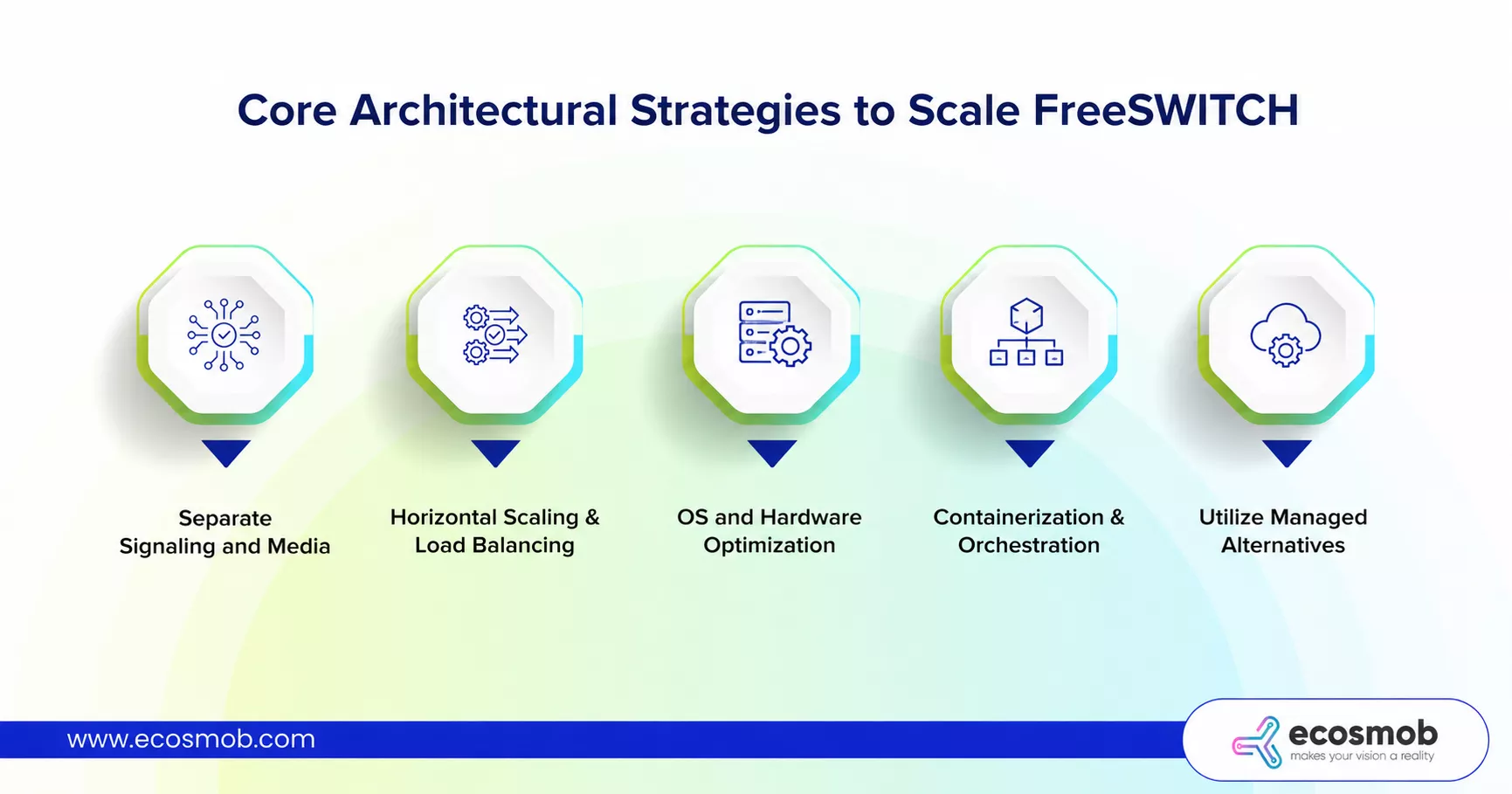
1. Separate Signaling and Media
Forcing a single machine to handle both connection setups and heavy audio processing is the fastest way to crash a PBX. You must divide these responsibilities across dedicated infrastructure.
- Never force FreeSWITCH to handle basic SIP registrations and heavy audio transcoding on the same processing threads.
- Place a dedicated signaling proxy (like Kamailio) at the edge to handle the SIP traffic, allowing FreeSWITCH to dedicate 100% of its CPU to executing dial plans and anchoring RTP media.
2. Horizontal Scaling & Load Balancing
Vertical scaling (simply buying a larger AWS instance) eventually hits a hard computational ceiling. True high availability requires a distributed cluster of smaller, highly efficient nodes.
- Stop relying on single-server deployments. You must deploy multiple FreeSWITCH nodes behind a stateless SIP load balancer to distribute the session load.
- Use intelligent dispatch routing so that if one node hits 80% CPU capacity, new INVITEs are automatically routed to a backup node, preventing any single server from locking up.
3. OS and Hardware Optimization
Out-of-the-box operating systems are designed for general web traffic, not synchronous real-time audio. Your Linux environment must be aggressively tuned for telecom workloads.
- A default Linux kernel will choke high-concurrency VoIP. You must increase file descriptor limits (ulimit) and optimize the ephemeral UDP port range (net.ipv4.ip_local_port_range) to handle thousands of simultaneous RTP streams.
- Move internal databases (like core.db) off of physical disk writes and into a tmpfs RAM disk to eliminate disk I/O bottlenecks that cause call setup delays.
4. Containerization and Orchestration
Static server deployments cannot adapt to sudden, massive influxes of callers. Modern telecom architectures rely on dynamic orchestration to self-heal and scale on demand.
- Deploying FreeSWITCH in Docker containers managed by Kubernetes allows for instant, automated scaling and self-healing during traffic spikes.
- Ensure you use hostNetwork: true in Kubernetes to bypass NAT overhead, which is notorious for breaking RTP audio streams in containerized environments.
5. Utilize Managed Alternatives
Building and maintaining a carrier-grade cluster requires an elite team of VoIP engineers. If that talent isn’t in-house, outsourcing the infrastructure is the safest operational choice.
- If your team lacks the deep telecom engineering required to manage Kamailio and FreeSWITCH clusters, relying on managed CPaaS (Communications Platform as a Service) backends handles the infrastructure for you.
- Managed solutions abstract the load balancing and media server maintenance, letting your developers focus purely on building the frontend call center applications.
Did You Know?
The global open-source services market was valued at USD 25.03 billion in 2022 and is expected to grow to USD 83.87 billion by 2030, with a CAGR of 16.9%.
As more enterprises build custom telecom stacks, relying on open-source engines like FreeSWITCH is becoming the industry standard over proprietary PBX vendor lock-in.
Maximize FreeSWITCH performance and prevent call drops.
Which Load Balancer Works Best for FreeSWITCH High Concurrency Setups?
Kamailio and OpenSIPS are the absolute best load balancers for FreeSWITCH. They act as highly efficient, stateless SIP proxies that can process tens of thousands of connections per second, shielding your FreeSWITCH media servers from signaling floods.
Your FreeSWITCH servers should never perform load balancing; they should only process media and dial plans.
To maximize performance and ensure your system scales reliably from hundreds to tens of thousands of sessions, you must strategically introduce a purpose-built load balancer for real-time communication. This involves decoupling the signaling (call setup) from the media (audio/video streams).
Here’s how the key load balancer solutions for FreeSWITCH scaling compare:
Kamailio (The Signaling Specialist)
Kamilio is a highly-performant, modular, open-source SIP Server and proxy.
It acts as the primary entry point, handling all SIP traffic, performing tasks like registration, NAT traversal, and, crucially, load-balancing the INVITE requests (call attempts) to the least-loaded FreeSWITCH instance.
- Why it’s Best: Kamailio is designed to handle extremely high volumes of SIP signaling (the control traffic for calls) very efficiently. It is lightweight and can handle an order of magnitude more concurrent SIP sessions than a full media server such as FreeSWITCH, making it the top choice for separating signaling from media.
- Key Advantage: Its focus on pure SIP signaling enables your FreeSWITCH servers to handle only the heavy-lifting tasks of media processing (Real-time Transport Protocol), transcoding, and application logic. This architectural separation is the key to maximizing FreeSWITCH’s capacity for concurrent calls.
OpenSIPS (The Feature-Rich Proxy)
OpenSIPS is a highly optimized, flexible open-source SIP proxy and server, sharing a common heritage with Kamailio.
It is well known for providing granular control over routing decisions, often distributing calls based on a precise calculation of the current load on the FreeSWITCH instances (e.g., lowest CPU usage or lowest channel count).
- Why it’s a Strong Choice: OpenSIPS excels at handling high-volume signaling and is often preferred for its rich, modular feature set, including a sophisticated built-in load balancer. It offers excellent tools for real-time monitoring and routing control.
- Key Advantage: It provides an excellent balance of raw signaling performance and advanced routing features, allowing for dynamic, load-aware scaling of your FreeSWITCH resources. It’s particularly beneficial for complex multi-tenant or customized routing needs.
Session Border Controllers (SBCs)
SBCs are specialized network devices (often running commercial software or hardware) that control, manage, and secure VoIP traffic at the network edge.
- Why it’s a Good Alternative: In regulated environments or those requiring rigorous security and network control, an SBC offers load balancing and capabilities that dedicated proxies may lack.
- Key Advantage: Simplifies the architecture by consolidating load balancing, security, and complex media processing into a single, carrier-grade, highly supported gateway.
FreeSWITCH’s Internal Mod Distributor
FreeSWITCH’s mod_distributor is a built-in FreeSWITCH module designed to redirect calls to a list of configured gateway destinations or other FreeSWITCH servers.
It operates by listing target FreeSWITCH servers and routing traffic using basic algorithms (e.g., weighted round-robin). And for simple health checks, it uses SIP OPTIONS messages.
- Why it’s a Good Alternative: This is the lowest-cost, simplest option, as it requires no external software. It is well-suited for smaller internal clusters or simple Active/Passive High Availability setups where only moderate FreeSWITCH concurrent call volumes are expected.
- Key Limitation: This method still relies on the primary FreeSWITCH instance for distribution logic, diverting resources from media processing and making it less suitable for true large-scale, extreme concurrency.
Ecosmob Expert Tip
Never let FreeSWITCH handle NAT traversal in a high-concurrency environment. Offload NAT pinging and topology hiding entirely to your Kamailio SBC at the network edge. This keeps your FreeSWITCH dial plans clean and prevents CPU spikes caused by dead network paths.
Quick Comparison of FreeSWITCH Load Balancers
The path to maximizing FreeSWITCH’s concurrent calls and capacity is not about finding a single, larger server; it is about adopting a distributed, specialized architecture.
By strategically implementing a specialized SIP proxy such as Kamailio or OpenSIPS, you not only eliminate a single point of failure but also fundamentally transform your system into a horizontally scalable voice platform.
| Solution | Best Use Case | Primary Strength | Complexity |
| Kamailio | Massive Signaling Scale | Unmatched speed and SIP connection handling. | High |
| OpenSIPS | Complex Routing Logic | Real-time, load-aware routing decisions. | High |
| SBC | Strict Compliance/Security | Consolidates security, NAT, and load balancing. | Medium |
| mod_distributor | Small Internal Clusters | Requires no external software; built-in module. | Low |
AIOps for Predictive Scaling in FreeSWITCH
In high-concurrency telecom, the real power of Artificial Intelligence solutions lies in AIOps (Artificial Intelligence for IT Operations). Generative AI cannot fix network topology, but machine learning models can absolutely predict a catastrophic node failure before it happens.
Modern telecom environments use AIOps platforms to continuously ingest real-time RTCP telemetry, SIP retransmission rates, and CPU thread locks.
If the AI detects the microscopic signatures of a memory leak or an RTP port exhaustion, it instantly hits your Kamailio API to lower the dispatch routing weight for that specific server. The AI stops sending new calls to the struggling node (allowing it to recover) without a human NOC engineer ever having to intervene.
How Should Failover Be Handled in Large-Scale FreeSWITCH Systems?
To achieve true FreeSWITCH high availability, failover must be handled via active-active clustering, continuous SIP heartbeat monitoring, and externalizing your databases (like PostgreSQL) so active calls survive individual node crashes.
If a single node failure drops hundreds of calls, your architecture is reactive, not resilient.
Here is how large-scale FreeSWITCH systems maintain call continuity under failure conditions:
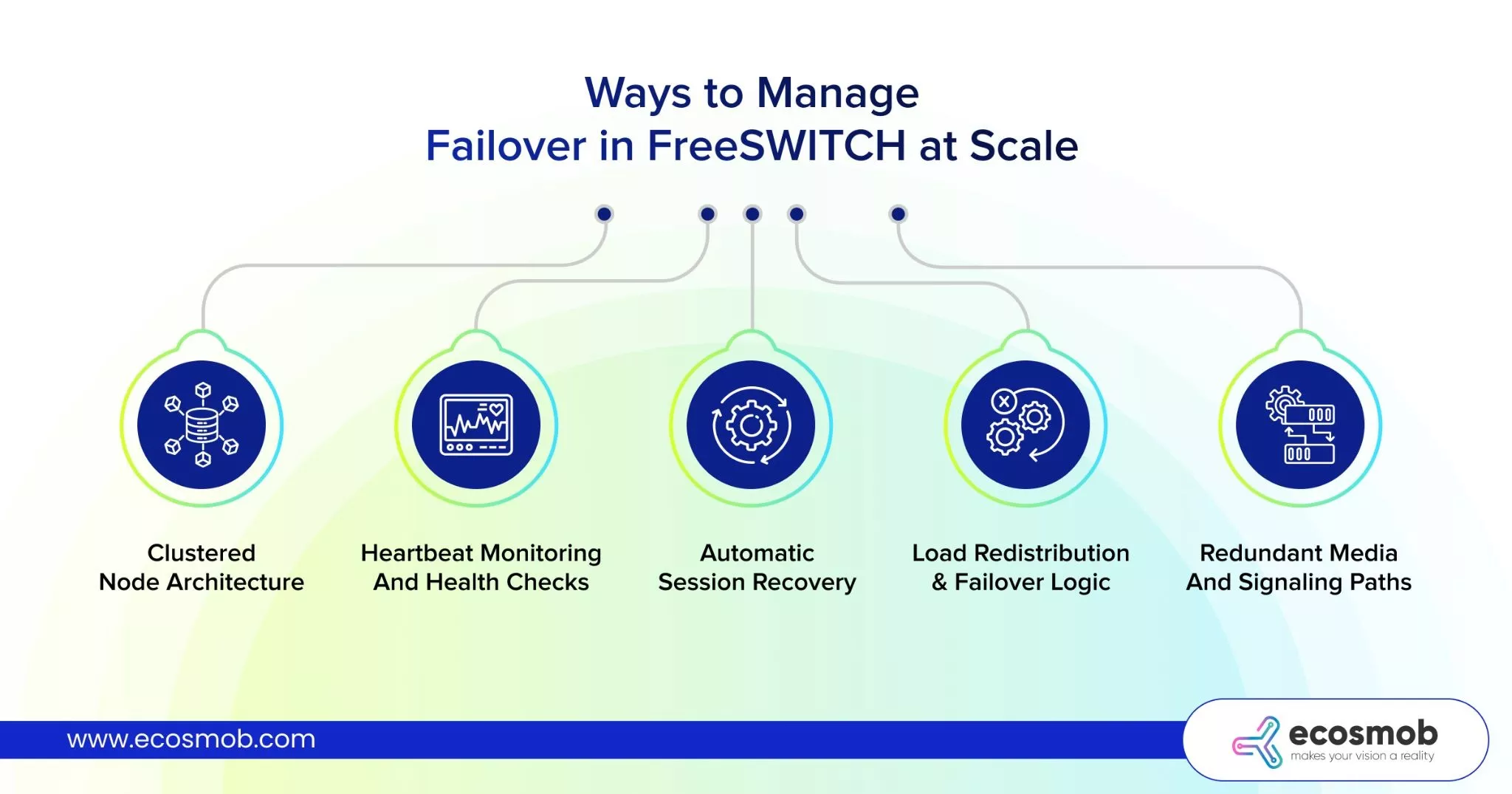
Clustered Node Architecture
Never run standalone servers. Organize your FreeSWITCH instances into active-active clusters. By sharing a centralized database (like PostgreSQL or Redis) for state and configuration, any node can instantly process a call if another goes offline, ensuring your capacity never abruptly drops.
Heartbeat Monitoring & Health Checks
Your load balancer must continuously monitor the health of all FreeSWITCH nodes. By sending constant SIP OPTIONS “pings,” Kamailio can instantly detect if a FreeSWITCH server freezes. If a ping fails, Kamailio automatically removes that node from the active routing pool before a customer’s call is sent to a dead server.
Automatic Session Recovery
Design the system to preserve active sessions during node switching. By replicating dialog states and utilizing SIP re-INVITEs, the cluster can seamlessly shift the logical control of a call to a healthy server, preventing phantom hangups and dropped sessions.
Load Redistribution & Failover Logic
Integrate intelligent load redistribution mechanisms to balance calls among remaining nodes after a failure. Failover logic should account for current load, session counts, and node capacity to avoid overloading healthy nodes.
Redundant Media & Signaling Paths
Decoupling signaling from media saves your audio. By using a clustered media proxy like RTPEngine alongside FreeSWITCH, the actual RTP audio streams bypass the PBX core. If FreeSWITCH crashes mid-call, the audio keeps flowing through RTPEngine while the signaling shifts to a backup node.
Make your FreeSWITCH deployment resilient and scalable.
How to Prevent Call Drops During FreeSWITCH High-Concurrency Spikes?
Preventing call drops during peak traffic surges requires aggressive runtime management to protect your active sessions. You must enforce strict session stickiness at the load balancer, physically isolate outbound dialer traffic from inbound queues, streamline codec translation, and enforce real-time rate limiting. Even the most robust architecture will fail if traffic isn’t strictly controlled during high-concurrency events.
Keep active calls stable and eliminate FreeSWITCH call center distribution delay with these technical runtime adjustments: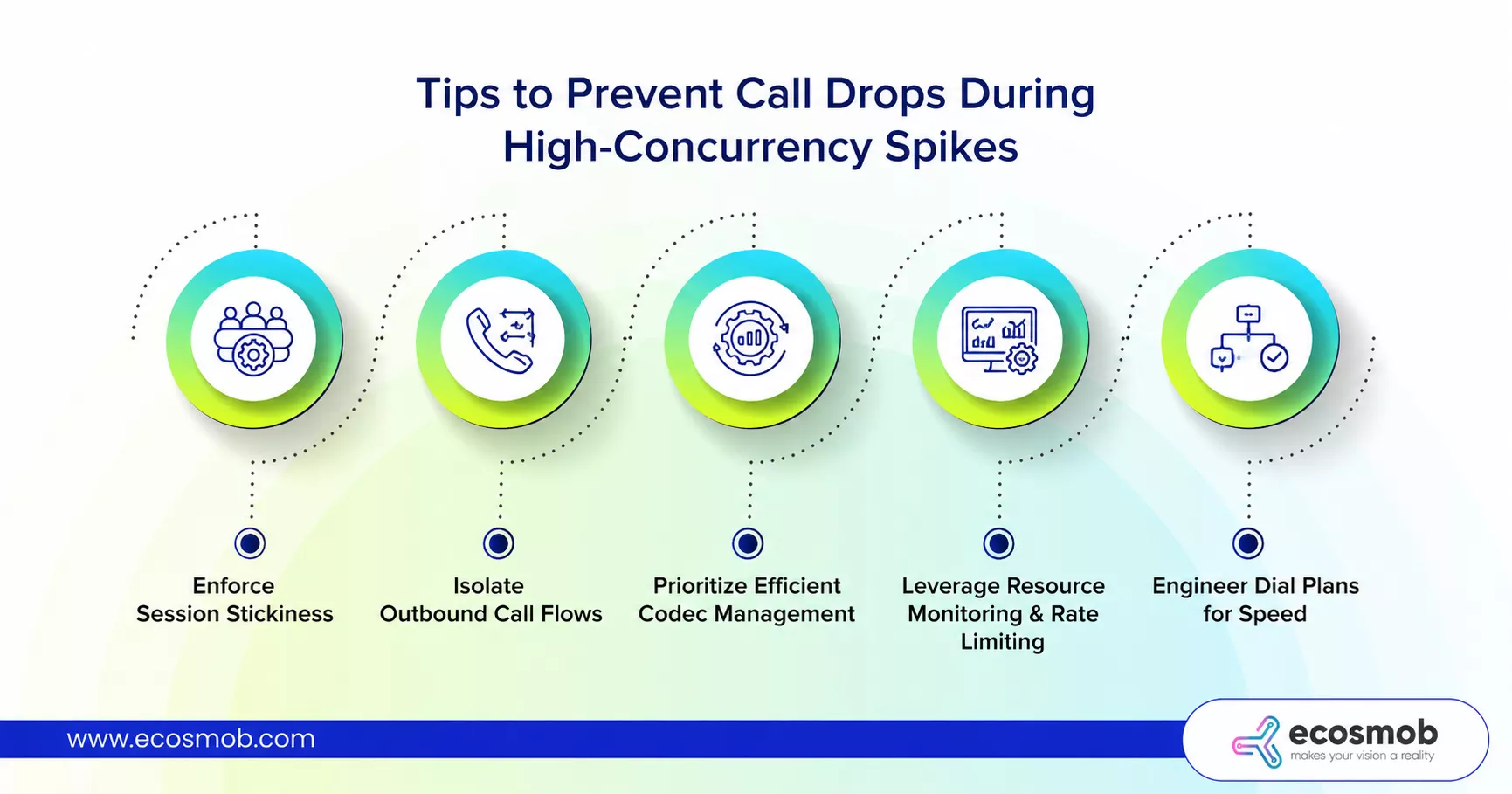
Enforce Session Stickiness
VoIP is a heavily stateful protocol, meaning the server must remember the exact context of the conversation. If that context is lost during a mid-call update, the connection dies.
- Ensure your SIP proxy forces all requests for a specific dialogue back to the exact same FreeSWITCH node.
- If a mid-call re-INVITE accidentally gets sent to a different server due to improper load balancing, the audio path breaks instantly.
Isolate Outbound Call Flows
Outbound and inbound traffic behave completely differently at the network level. Mixing them on the same hardware creates fatal resource contention during peak hours.
- Outbound dialers create aggressive, rapid-fire SIP traffic with high failure rates. If inbound customer service queues share the same FreeSWITCH nodes as your outbound dialers, inbound quality will degrade.
- Physically isolate these workloads onto separate server pools so dialer spikes never impact live customer conversations.
Prioritize Efficient Codec Management
Audio translation is incredibly CPU-intensive. If your servers are constantly translating audio formats on the fly, your processing threads will quickly max out.
- High concurrency strains the CPU if heavy transcoding is required between different endpoints.
- Standardize your endpoints to avoid excessive real-time transcoding (e.g., constantly converting G.711 to Opus), which eats up threads and causes audio stuttering.
Leverage Resource Monitoring & Rate Limiting
You cannot wait for a server to crash to realize you have a capacity problem. The network must be configured to gracefully reject excess traffic before it overwhelms the core.
- Track CPU, memory, and channel utilization in real time using predictive scaling.
- Configure your edge proxy to enforce strict Calls-Per-Second (CPS) rate limits, gracefully rejecting excess traffic (using 503 responses) before it can overwhelm the FreeSWITCH core.
Engineer Dial Plans for Speed
FreeSWITCH has to read and execute your dial plan logic for every single call. Bloated XML code creates micro-delays that compound into massive latency at scale.
- Deep, nested dial plan XML files cause micro-delays. Exit conditions early and eliminate unnecessary database dips.
- Optimize your routing logic for execution speed, not just readability, ensuring that your SIP signaling paths remain completely clear.
The ultimate truth of telecom engineering is that concurrency limits are rarely hardware problems. They are architectural bottlenecks. Brute-forcing your way through traffic spikes by simply buying more AWS instances is a guaranteed path to unpredictable downtime and ballooning infrastructure costs.
To maximize FreeSWITCH’s high concurrency, you must respect the protocol.
If you are struggling to push past 10,000 concurrent sessions, let Ecosmob’s experienced FreeSWITCH engineers audit your cluster, decouple your architecture, and build a voice platform that actually scales. Get in touch today!
FAQs
What Is the Maximum Number of Concurrent Calls FreeSWITCH Can Handle?
It depends on hardware, configuration, and call-flow efficiency. Optimized signaling, media separation, and proper load balancing allow FreeSWITCH to handle more concurrent calls reliably.
How Can I Reduce Call Drops in High-Concurrency Deployments?
Use session stickiness, asynchronous media handling, efficient dial plans, and resource monitoring to scale proactively. Separating inbound and outbound calls improves overall stability.
Which Load Balancer Works Best for FreeSWITCH High-Concurrency Setups?
SIP proxies like Kamailio and OpenSIPS efficiently manage signaling, distribute calls to the least-loaded nodes, and prevent thread contention under heavy load.
How Do I Handle Failover in Large-Scale FreeSWITCH Systems?
Cluster nodes, monitor health with heartbeat checks, implement session recovery, and redistribute load intelligently. Redundant media and signaling paths prevent call disruption during failures.
What Are the Key Engineering Strategies to Optimize FreeSWITCH Performance?
Decouple signaling from media, optimize dial plans, manage threads effectively, isolate outbound flows, and continuously monitor system behavior to ensure predictable performance.