











QUICK SUMMARY
Most VoIP providers struggle with legacy dialer systems that can’t scale during campaigns, lack multi-tenant isolation, or trap them in vendor lock-in. This blog reveals how FreeSWITCH dialers deliver predictive dialing, real-time analytics, and disaster recovery capabilities that transform outbound operations, without the licensing nightmares of commercial platforms.
Your sales team launches a 10,000-contact outbound campaign at 9 AM. By 9:15, your legacy dialer is dropping calls. By 9:30, agents are staring at blank screens, waiting for connections. By 10:00, your campaign manager is calculating how much revenue just evaporated because your dialer couldn’t handle predictable volume.
Meanwhile, your competitor, running a FreeSWITCH dialer, processes the same campaign with:
- Zero dropped calls
- Real-time answer rate optimization
- Complete visibility into which trunks are performing and which need replacement
Their agents spend significantly more time actually talking to prospects while yours troubleshoot infrastructure issues.
The difference isn’t budget or team size. It’s architecture.
Commercial dialer platforms weren’t built for the flexibility modern VoIP providers need (multi-tenant isolation, trunk vendor independence, custom routing logic, and horizontal scalability).
FreeSWITCH dialer solutions deliver all of this without per-seat licensing costs or vendor lock-in that cripples profitability.
Why Legacy Outbound Dialers Fail VoIP Providers
Most VoIP providers inherit outbound dialer infrastructure that was designed for single-tenant, on-premise call centers with static trunk configurations.
Here’s why these systems collapse under modern demands:
Vertical scaling hits hard limits.
Legacy dialers scale by adding more CPU and RAM to a single server. This works until it doesn’t (usually during your biggest campaign). When you hit the ceiling, your only options are expensive hardware upgrades or accepting lower call volumes. There’s no easy path to distribute load across multiple servers.
Per-seat licensing destroys margins.
Commercial dialer platforms charge per concurrent agent, per active campaign, or per successful connection. When you’re a VoIP provider serving multiple clients, these costs compound quickly, eating into profitability before you account for infrastructure, support, or customization expenses.
Multi-tenancy requires architectural gymnastics.
Most VoIP dialer solutions weren’t designed for multiple isolated clients on shared infrastructure. You end up running separate dialer instances for each customer, multiplying your operational overhead and infrastructure costs. Campaign data bleeds between tenants, reporting requires custom database queries, and white-labeling is an afterthought.
Trunk vendor lock-in limits optimization.
Your dialer is hardcoded to work with specific SIP trunk providers. When their quality degrades or pricing increases, you can’t easily route campaigns through alternate carriers. You’re stuck negotiating from weakness because migration means rebuilding the configuration.
Disaster recovery is a manual nightmare.
When your primary dialer goes down, failover involves manual DNS changes, database replication lag, and significant downtime. During high-value campaigns, this translates to immediate revenue loss and angry clients questioning your reliability.
Reporting lives in vendor-controlled black boxes.
You need custom metrics (answer rates by trunk, average time to connect by campaign type, agent utilization by client), but your legacy system only exposes canned reports. Getting the data you need requires expensive professional services or accepting limited visibility.
The result? VoIP providers either accept these limitations and watch margins shrink, or they spend months building custom solutions from scratch with incomplete requirements and untested architecture.
Also read our CEO’s piece on What Is a Sales Dialer?
Stop losing leads to outdated dialer infrastructure.
How FreeSWITCH Dialers Transform Outbound Operations
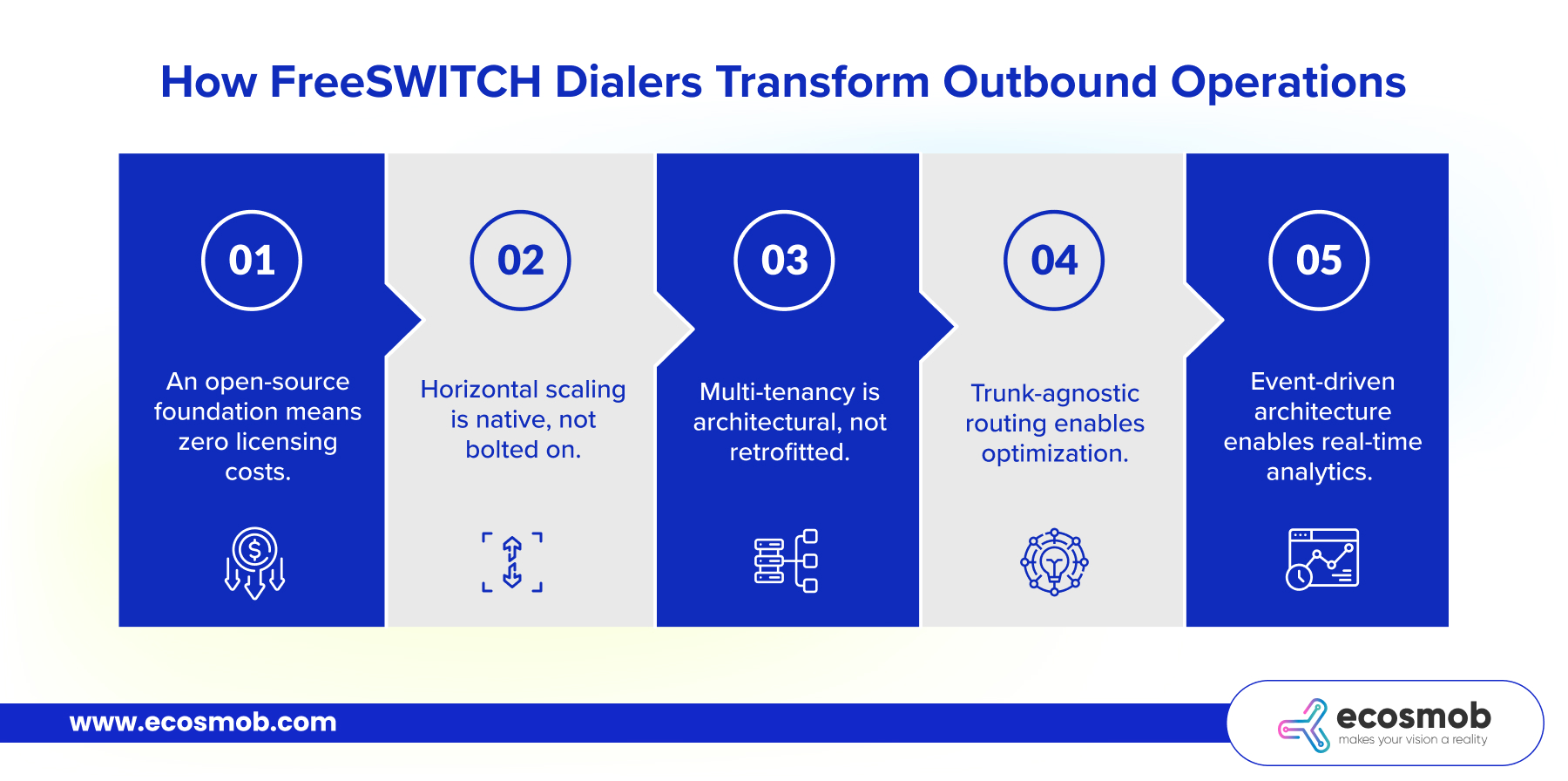 FreeSWITCH dialer architecture eliminates these constraints by providing a fully programmable, horizontally scalable platform built specifically for carrier-grade voice applications.
An open-source foundation means zero licensing costs.
FreeSWITCH is licensed under MPL 1.1, which allows commercial use without per-seat, per-call, or per-feature fees. Your costs scale with infrastructure (servers, bandwidth, storage), not artificial licensing metrics. Large agent deployments become economically viable without the crushing recurring costs of commercial platforms.
Horizontal scaling is native, not bolted on.
FreeSWITCH dialers distribute campaigns across multiple nodes using ESL (Event Socket Layer) for coordination. When call volume spikes, you spin up additional dialer nodes, spread the load, and scale down when campaigns complete. Each node operates independently, so a failure on one doesn’t cascade to others.
Multi-tenancy is architectural, not retrofitted.
FreeSWITCH’s domain structure provides true isolation between clients:
- Separate dial plans per tenant
- Isolated CDR databases
- Independent campaign queues
- Per-tenant trunk configurations
- White-labeled agent interfaces
This means you can serve dozens of clients on shared infrastructure while maintaining complete data separation and customizable feature sets.
Trunk-agnostic routing enables optimization.
Your FreeSWITCH dialer can route calls through any SIP trunk provider based on:
- Cost per minute
- Answer seizure ratio (ASR)
- Average call duration
- Geographic destination
- Time of day
- Campaign priority
If Trunk Provider A’s quality degrades, you dynamically shift traffic to Provider B without touching campaign configurations. This competitive positioning forces better pricing and service from your carriers.
Event-driven architecture enables real-time analytics.
Every call event (dial attempt, answer, busy signal, no answer, agent connection) generates ESL events that flow into your analytics pipeline in real-time. You’re not polling databases for reports; you’re streaming call state into dashboards that update every second.
Ecosmob Expert Tip
When building a FreeSWITCH dialer, implement separate ESL connections for campaign control and analytics streaming. This architectural separation prevents analytics queries from blocking dialing operations during peak load, ensuring consistent campaign performance even when your reporting dashboards are under heavy use by multiple clients simultaneously.
Predictive Dialing Logic That Actually Works
The power of any VoIP dialer solution comes from intelligent call pacing: dialing more leads than you have available agents to maximize talk time while minimizing abandoned calls when no agent is free.
Here’s how FreeSWITCH enables sophisticated dialing algorithms:
Predictive dialing calculates the optimal dial ratio dynamically.
The algorithm monitors in real-time:
- Number of available agents
- Average conversation duration for this campaign
- Historical answer rates for this time of day
- Current abandonment rate
- Trunk capacity and answer delay
Based on these inputs, it calculates:
Dial Ratio = (Available Agents × Target Utilization) / (Answer Rate × (1 – Abandon Threshold))
For example: You have 10 agents available, target high utilization, current answer rate is moderate, and you want to keep abandons under compliance thresholds. The dialer places multiple simultaneous calls, knowing that approximately the right number will connect to keep agents busy while staying compliant.
Power dialing offers controlled, compliant pacing.
For campaigns where compliance requirements limit abandon rates strictly (TCPA in the US requires very low abandon rates), power dialing places exactly one call per available agent. The moment an agent becomes free, the next dial initiates. This guarantees zero abandoned calls while still maximizing agent utilization.
Preview dialing gives agents research time.
For high-value, consultative sales, preview mode displays lead information to the agent before dialing. The agent reviews CRM data, previous interaction notes, and account details, then clicks to dial. The FreeSWITCH dialer initiates the call and connects the agent only when the prospect answers.
Campaign-Specific Dialer Optimization
Different campaign types require different dialing strategies.
A FreeSWITCH dialer lets you configure:
Retry Logic per Campaign
- How many attempts before marking a lead as unreachable?
- What’s the optimal time gap between retry attempts?
- Should retries happen at different times of day?
- Do busy signals get immediate retries or scheduled callbacks?
Time-zone Awareness
- Automatically adjust dialing windows based on the lead geographic location
- Respect state-specific calling hour restrictions
- Optimize contact attempts for when answer rates peak in each region
Lead Prioritization
- Score leads based on demographic data, previous interaction history, or external signals
- Dial high-value leads first when agent availability is highest
- Automatically reorder the queue based on real-time campaign performance
Answering Machine Detection (AMD)
- Identify voicemail versus human answers using tone analysis and speech detection
- Drop to voicemail message or mark for later retry
- Reduce wasted agent time on unanswered calls
Your outbound campaigns deserve enterprise-grade automation without enterprise pricing.
Multi-Tenant Architecture for Serving Multiple Clients Efficiently
For VoIP providers, the ability to serve multiple clients on shared infrastructure while maintaining complete isolation is critical for profitability.
Here’s how FreeSWITCH dialers enable true multi-tenancy:
Domain-based Isolation
Each client gets a dedicated FreeSWITCH domain. This creates a hard separation at the dial plan level. Client A’s campaigns can’t accidentally dial through Client B’s trunks or access Client C’s lead lists.
Per-tenant Resource Allocation
Control exactly how much infrastructure each client consumes:
- Maximum concurrent calls per tenant
- Trunk allocation and cost allocation
- Agent seat limits
- Storage quotas for recordings and CDRs
- API rate limits for campaign management
Isolated Campaign Management
Each tenant receives:
- Dedicated web portal with white-label branding
- Separate campaign queues and scheduling
- Independent reporting dashboards
- Custom field definitions for lead data
- Tenant-specific routing rules and business hours
Granular Permission Controls
Define roles within each tenant:
- Campaign managers can create campaigns, upload leads, and view reports
- Agents can only handle calls and update dispositions
- Supervisors can monitor calls, review recordings, and adjust queues
- Administrators have full tenant configuration access
This eliminates the operational complexity of managing separate dialer instances while giving each client the experience of a dedicated system.
Real-Time Reporting and Analytics in FreeSWITCH Dialers
The value of a FreeSWITCH dialer multiplies when paired with comprehensive analytics that expose exactly what’s happening across campaigns, agents, and trunks.
Campaign Performance Metrics |
|
Answer Rate Analysis:
|
Agent Utilization:
|
Trunk Performance:
|
Campaign ROI Tracking:
|
Also, modern VoIP dialer solutions need dashboards that update live:
Real-Time Dashboard Requirements |
||
Campaign Monitoring View:
|
||
Agent Status:
|
||
System Health Monitoring:
|
FreeSWITCH Dialer Migration Strategy
Most of you aren’t starting from scratch, but migrating from existing dialer infrastructure.
Here’s how to execute the transition without disrupting active campaigns.
Phase 1: Parallel Deployment
Stand up FreeSWITCH infrastructure alongside the legacy system:
- Deploy initial dialer nodes with test campaigns
- Configure trunk connectivity using non-production carriers
- Build agent interface and basic reporting
- Validate call quality and system stability
Train team on the new platform:
- Campaign managers learn lead upload and campaign configuration
- Agents practice with test calls
- Supervisors explore monitoring and reporting tools
- IT staff validate disaster recovery procedures
Phase 2: Pilot Campaign Migration
Select a low-risk campaign for initial migration:
- Choose a campaign with moderate volume (not your biggest)
- Pick a team familiar with the new system from training
- Set clear success metrics (answer rate, agent utilization, abandon rate)
Run parallel campaigns:
- Split the lead list between FreeSWITCH and legacy systems for direct comparison
- Compare performance metrics daily
- Adjust dialing algorithms based on results
- Document any issues and resolution steps
Phase 3: Full Migration
Migrate campaigns in tranches:
- Move highest-performing campaigns first (prove success)
- Migrate one client/department at a time for multi-tenant deployments
- Maintain the legacy system as a hot standby during the transition
- Monitor closely for performance regressions
Cutover remaining workload:
- Schedule final migration during a low-volume period
- Update DNS, agent login URLs, API endpoints
- Archive historical data from the legacy system
- Decommission old infrastructure only after a sufficient stability period
Phase 4: Optimization (Ongoing)
Leverage FreeSWITCH advantages:
- Implement predictive dialing for campaigns still using power mode
- Add trunk providers for cost optimization
- Build custom reporting for client-specific needs
- Deploy additional nodes for geographic redundancy
Adding Advanced Capabilities to FreeSWITCH Dialers
Beyond basic dialing, modern VoIP dialer solutions need sophisticated features that commercial platforms charge premium rates for.
- Voicebot Integration for Pre-Qualification: Connect your FreeSWITCH dialer to AI voicebots for first-stage qualification.
- CRM Integration for Context: Through VoIP CRM integration, you can pull customer data in real-time as calls connect.
- Compliance and Recording: Many industries require built-in compliance features like compliant recording, etc.
- Quality Monitoring and Coaching: Supervisor tools for team improvement are an addition that every team can benefit from
Legacy dialers keep you locked into vendor limitations, licensing fees, and architectural constraints that prevent growth. FreeSWITCH dialers eliminate these barriers while delivering enterprise-grade reliability, multi-tenant isolation, and real-time analytics that transform outbound operations.
Your outbound campaigns deserve automation that works as hard as your agents.
Your clients deserve reliability that doesn’t evaporate during peak volume.
And your business deserves margins that aren’t eaten by per-seat licensing.
Ready to build a FreeSWITCH dialer that scales without limits?
Let’s architect your outbound infrastructure the right way!
FAQs
What is a FreeSWITCH dialer?
A FreeSWITCH dialer is an open-source, carrier-grade outbound calling system built on the FreeSWITCH telephony platform. Unlike legacy or commercial dialers that impose per-seat licensing and vendor lock-in, a FreeSWITCH dialer offers full programmability, multi-tenant isolation, real-time analytics, and horizontal scalability. It can handle predictive, power, and preview dialing modes, while also integrating with CRMs, SIP trunks, and compliance tools, making it ideal for VoIP providers who need enterprise-grade automation without enterprise-level costs.
Can FreeSWITCH dialers help reduce call abandonment and increase connect rates?
Yes, significantly. FreeSWITCH dialer solutions implement predictive algorithms that calculate optimal dial ratios in real-time based on available agents, historical answer rates, and target abandon thresholds. The system dynamically adjusts pacing throughout campaigns as answer rates fluctuate, and trunk performance monitoring automatically routes calls through carriers, increasing overall connect rates substantially compared to legacy systems with static dialing ratios.
What reporting and analytics options exist in FreeSWITCH for outbound campaigns?
FreeSWITCH dialers generate real-time ESL events for every call state change, enabling comprehensive analytics dashboards that update live: campaign performance metrics, agent utilization tracking, trunk performance comparison, and historical trending for optimization.
Is it possible to replace a legacy outbound system with FreeSWITCH dialers?
Absolutely. Migration follows a phased approach: parallel deployment for testing, pilot campaign migration with performance comparison, full workload migration in tranches, and ongoing optimization. The FreeSWITCH dialer architecture supports a gradual transition (running alongside legacy systems during validation), ensuring zero disruption to active campaigns.
How does a FreeSWITCH dialer ensure multi-tenancy for VoIP providers?
FreeSWITCH natively supports domain-based isolation, allowing providers to host multiple clients on the same infrastructure with strict separation of dial plans, databases, trunks, and reporting. Each tenant gets independent campaign management, branded web portals, and granular role-based permissions. This ensures complete data privacy, cost efficiency, and the ability to scale outbound operations for dozens of clients without spinning up separate dialer instances for each.