












QUICK SUMMARY
Twilio’s complex pricing and developer-heavy approach are driving enterprises toward better alternatives. This migration guide reveals cost considerations, which solutions handle enterprise traffic reliably, proven integration strategies, and a decision framework that prevents costly migration mistakes. Whether facing budget constraints or scale challenges, discover platforms that deliver predictable performance and transparent pricing.
Your monthly communication platform costs keep fluctuating unpredictably. Three months ago, usage patterns seemed stable, but billing complexity made budgeting nearly impossible. The development overhead for maintaining custom dashboards and integrations is consuming engineering resources you’d rather dedicate to core product features.
You’re not alone. Many enterprise customers seek alternatives that provide better cost predictability and reduced operational complexity. The global communications platform market offers mature alternatives that deliver enterprise-grade performance with more transparent pricing models and simplified operational management.
The challenge isn’t just cost; it’s finding VoIP platforms that are an alternative of Twilio that match enterprise traffic demands while simplifying integration complexity. The companies making successful migrations aren’t just managing costs; they’re building more predictable, scalable communication infrastructure that grows sustainably with their business.
What Costs Drive Enterprises to Consider Alternatives to Twilio?
Understanding the total cost of ownership reveals why enterprises explore Twilio alternative platforms beyond headline pricing comparisons.
Twilio’s usage-based pricing model includes multiple cost components that enterprises must factor into budgeting decisions. Voice calls involve per-minute charges that vary by region and direction, while messaging costs depend on channel type, destination country, and message volume. Phone number rentals, compliance fees, and feature add-ons create additional recurring expenses that can significantly impact total costs.
The Enterprise Complexity Factor
Large-scale deployments face pricing complexity that smaller businesses rarely encounter:
- International rate variations that multiply costs across global operations
- Compliance requirements that add regulatory fees and specialized feature costs
- Integration development that requires ongoing engineering resources
- A multi-region redundancy architecture that increases infrastructure expenses
Hidden Operational Expenses
Beyond direct usage fees, enterprises incur substantial operational costs:
- Custom dashboard development since Twilio provides a limited native UI
- Ongoing API integration maintenance across platform updates
- Compliance implementation for A2P messaging and industry regulations
- 24/7 monitoring and alerting system development
- Support ticket management without dedicated account support
These operational overhead costs often equal or exceed direct usage fees, making the total cost of ownership significantly higher than initial pricing analysis suggests.
Break free from unpredictable costs. Build better with proven alternatives.
Benefits of Twilio Alternatives
Migration case studies reveal consistent patterns in cost optimization and operational improvements across different enterprise segments.
Cost Structure Improvements
Enterprises report meaningful cost reductions through multiple optimization areas:
- Simplified pricing models that eliminate surprise charges and complex rate calculations
- Bundled compliance features that reduce regulatory implementation costs
- Native management interfaces that eliminate custom dashboard development
- Predictable monthly billing that improves budget planning and financial forecasting
- Reduced engineering overhead through pre-built integrations and user-friendly administration
Operational Efficiency Benefits
Cost optimization represents only one dimension of migration value. Enterprises consistently achieve operational improvements:
- Faster feature deployment through pre-built integrations and simplified APIs
- Improved support responsiveness with dedicated account management
- Reduced technical complexity through comprehensive management dashboards
- Enhanced reliability monitoring with native alerting and reporting tools
- Streamlined compliance management through built-in regulatory features
Time-to-Market Acceleration
Twilio alternative platforms designed for enterprise deployment often eliminate weeks of custom development work. Features like native CRM integration, automated compliance handling, and comprehensive analytics dashboards that require significant custom development with developer-first platforms come standard with enterprise-focused alternatives.
Which Twilio Alternatives Should You Consider?
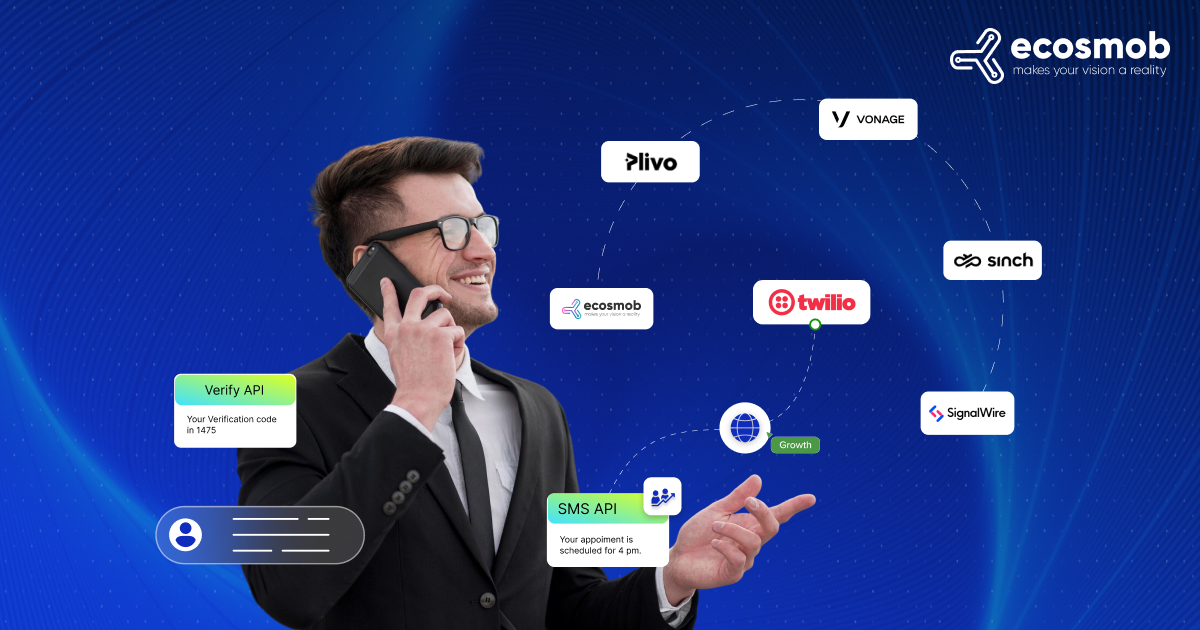
Here are the leading platforms that enterprises are successfully migrating to, each with distinct strengths for different use cases.
1. Ecosmob
Ecosmob specializes in building custom communication platforms and API solutions for enterprises seeking alternatives to complex, developer-heavy platforms. Rather than offering another off-the-shelf API service, Ecosmob develops tailored communication infrastructure that eliminates the unpredictable costs and integration complexity that drive enterprises away from platforms like Twilio.
Their approach focuses on creating purpose-built solutions with transparent pricing and seamless enterprise system integration.
🏆 Best for: Enterprises needing custom communication platforms without the complexity and cost unpredictability of generic APIs
💪 Key strengths: Custom API development, transparent pricing models, enterprise-grade integrations
🏢 Enterprise features: Tailored architecture, dedicated support, compliance-ready solutions
Ready for scalable, affordable enterprise comms? Let's architect your solution.
2. Plivo
Plivo offers Twilio-compatible APIs that significantly reduce migration complexity while providing more predictable pricing structures. Their platform includes native CRM integrations and compliance features that eliminate much of the custom development Twilio requires.
🏆 Best for: Companies wanting familiar API structures with improved cost predictability
💪 Key strengths: Twilio API compatibility, transparent pricing, global coverage in 190+ countries
🏢 Enterprise features: HIPAA compliance, dedicated support, SLA guarantees
3. Bandwidth
Bandwidth operates as an actual telecommunications carrier, offering direct network access that can provide superior call quality and reliability. Their platform includes extensive APIs plus enterprise-grade support and compliance features.
🏆 Best for: High-volume voice applications requiring maximum reliability
💪 Key strengths: Direct carrier connections, 99.999% uptime SLA, comprehensive fraud protection
🏢 Enterprise features: Dedicated account management, custom SLAs, on-premises options
4. Vonage API
Vonage API provides extensive global coverage with enterprise-focused features like advanced analytics, workflow automation, and native business system integrations.
🏆 Best for: Global enterprises needing multi-channel communications
💪 Key strengths: 190+ country coverage, advanced routing, comprehensive APIs
🏢 Enterprise features: Advanced analytics, workflow automation, dedicated support
5. Sinch
Sinch specializes in omnichannel messaging with strong WhatsApp Business, RCS, and social media integrations alongside traditional voice and SMS capabilities.
🏆 Best for: Businesses prioritizing modern messaging channels
💪 Key strengths: WhatsApp Business API, RCS messaging, social platform integration
🏢 Enterprise features: Campaign management, customer journey orchestration
6. MessageBird (now Bird)
Bird combines communications APIs with customer engagement tools, CRM integration, and marketing automation in a unified platform.
🏆 Best for: Companies wanting communications integrated with customer engagement tools
💪 Key strengths: Unified customer profiles, marketing automation, omnichannel workflows
🏢 Enterprise features: Advanced segmentation, campaign analytics, dedicated success management
7. SignalWire
SignalWire offers modern cloud communications with advanced programmability and elastic scaling, built specifically to address limitations of older platforms.
🏆 Best for: Developers wanting modern architecture with advanced customization
💪 Key strengths: Elastic scaling, advanced programmability, modern WebRTC stack
🏢 Enterprise features: Custom deployments, dedicated clouds, advanced security
Twilio vs Leading Twilio Alternative Platforms Comparison Table
| Feature/Criteria | Twilio | Twilio Alternative Platforms |
| Pricing Model | Usage-based with complex variables | Usage-based with more predictable structures |
| Phone Number Coverage | Extensive global inventory | Comprehensive coverage with competitive rates |
| API Compatibility | Proprietary with wide adoption | Many offer Twilio-compatible endpoints |
| Enterprise Uptime SLA | Industry-standard guarantees | Comparable or superior reliability commitments |
| Developer Tools | Comprehensive SDKs, limited GUI | SDKs plus enhanced management interfaces |
| CRM Integration | Requires custom development | Native connectors for major platforms |
| Compliance Features | Available with additional complexity | Often built-in with simplified implementation |
| Support Model | Tiered with a documentation focus | More direct access across service levels |
| Redundancy Options | Multi-region with robust architecture | Industry-standard with failover capabilities |
When Does Twilio Make Sense vs When Do Alternatives Win?
Understanding optimal use cases for different platform approaches will help inform your strategic migration decisions.
Twilio Remains Optimal For:
- Organizations with substantial developer resources dedicated to communications platform management that need maximum customization flexibility.
- Companies requiring access to cutting-edge beta features where development investment justifies early access to innovative capabilities.
- Businesses with highly specialized, custom workflows that require deep platform modification and integration.
Twilio Alternatives Provide Superior Value For:
- Enterprises prioritizing cost predictability and operational simplicity over maximum customization flexibility.
- Organizations needing faster time-to-market for standard communication features without extensive development overhead.
- Companies requiring seamless integration with existing enterprise systems like CRM, ERP, and contact center platforms.
- Businesses seeking comprehensive support including dedicated account management rather than documentation-based problem resolution.
Hybrid Implementation Strategies
Some enterprises adopt hybrid approaches, maintaining developer-first platforms for specialized applications requiring maximum flexibility while leveraging alternatives for high-volume, standardized communication needs.
This strategy optimizes both functionality and economics but requires careful architecture planning to prevent integration complexity that could offset benefits.
Ecosmob Expert Tip
Before selecting any Twilio alternative platform, implement comprehensive cost modeling that includes usage fees, development time, support overhead, and integration complexity. Many migrations fail because teams compare only headline pricing without accounting for total operational costs. Run parallel pilots with 2-3 alternatives using real production traffic patterns to generate accurate cost and performance comparisons before making final platform decisions.
Will Twilio Alternatives Integrate Smoothly With Existing Systems?
Integration compatibility determines migration feasibility and directly impacts implementation timelines and success rates.
CRM and Contact Center Compatibility
Enterprise environments depend on seamless CRM integration for customer context and automated workflow management. While developer-first platforms typically require custom integration development, many alternatives provide native connectors for Salesforce, HubSpot, Microsoft Dynamics, and other enterprise CRM systems. These pre-built integrations reduce implementation complexity and accelerate deployment timelines.
API Migration Considerations
The most significant migration challenge involves adapting existing applications built on platform-specific APIs. However, many alternatives provide compatibility layers that minimize code changes during migration. Some platforms offer Twilio-compatible API endpoints for common functions, while others provide migration tools that automate the conversion of existing implementations.
Legacy System Integration Support
Enterprise environments frequently include legacy systems requiring specialized integration approaches. Many alternatives offer broader compatibility through SIP trunking, traditional telephony interfaces, and on-premises deployment options that cloud-only platforms cannot provide. This flexibility often enables integrations that would be difficult or impossible with purely cloud-native solutions.
Building Your Strategic Migration Action Plan
Successful platform migrations require systematic planning addressing technical, operational, and business continuity requirements throughout the transition process.
Phase 1: Current State Documentation
Catalog existing platform usage patterns, document integration dependencies, and identify custom development requiring adaptation during migration. This baseline assessment enables accurate comparison with alternatives of Twilio and realistic timeline planning.
Phase 2: Platform Evaluation and Testing
Evaluate 2-3 Twilio alternative platforms using pilot applications representing actual production workloads. Focus on integration compatibility, performance metrics under load, and comprehensive cost analysis, including hidden operational expenses.
Phase 3: Proof of Concept Development
Build functional prototypes incorporating real integrations with CRM, contact center, and other critical enterprise systems. Validate that alternatives handle specific workflow requirements and compliance needs before committing to full-scale migration.
Phase 4: Migration Execution and Monitoring
Implement a detailed migration timeline with parallel operation periods enabling gradual traffic transition. Establish comprehensive monitoring, automated alerting, and documented rollback procedures, ensuring service continuity throughout the transition process.
Migration Best Practices:
- Maintain comprehensive monitoring throughout all phases with automated alerting
- Document rollback procedures before each migration phase
- Test integrations with actual production data patterns, not synthetic scenarios
- Plan communication strategies for internal teams and external customers
- Implement gradual DNS or load balancer changes to enable instant traffic redirection
- Validate compliance and security requirements in the production environment before full cutover
In a world where every millisecond of connection shapes customer loyalty, settling for “just good enough” is a silent killer of growth.
It’s not about abandoning Twilio out of frustration. It’s about seizing control of your tech stack, slashing unpredictable bills, and unlocking integrations that finally move the needle. The future belongs to those who relentlessly chase precision, reliability, and innovation.
So, ask yourself: will you keep throwing good money at rising costs, or will you build a platform your customers can trust for decades to come?
Ready to stop settling and start scaling?
Let’s design your tailored Twilio migration blueprint today.
FAQs
Will migrating from Twilio disrupt existing customer communications?
Proper migration strategies using parallel operation and gradual traffic shifting prevent service disruption. Most enterprises complete migrations with zero customer-facing downtime by running both platforms simultaneously during carefully planned transition periods.
Can I maintain some services on Twilio while moving others to Twilio alternatives?
Hybrid approaches work effectively for many enterprises. You can migrate high-volume, standardized features to cost-effective alternatives while keeping specialized applications on existing platforms. This requires careful integration architecture planning.
How do I make sure that Twilio alternatives will integrate with our existing systems?
Run proof-of-concept testing with actual production data and workflow patterns. Test CRM connections, API compatibility, and compliance requirements using real enterprise scenarios rather than synthetic testing environments.
How do Twilio alternatives compare in pricing and scalability?
Some Twilio alternatives often provide more transparent, customizable billing and can match or exceed Twilio’s scalability with proven uptime and support for global traffic spikes.
Do Twilio alternatives support native CRM and contact center integrations?
Yes, leading alternatives offer out-of-the-box connectors for Salesforce, HubSpot, Microsoft Dynamics, and contact center platforms, reducing integration time and effort.