













QUICK SUMMARY
Conversational AI is already changing how businesses talk to customers, from banking and healthcare to retail, support, and beyond. In this guide, we explored real conversational AI examples and use cases across industries, and how companies are building smarter, more scalable customer interactions with it.
Conversation is a two-way street.
Now imagine calling customer support, explaining your problem, and hearing only the same automated response: Beep. Press 1. Press 2. Over and over again.
Frustrating, right?
This is the type of experience that businesses aim to improve with conversational AI, including modern voicebot solutions designed to understand spoken language and respond more intelligently.
In this guide, we’ll explore real-world conversational AI examples and how companies are using them to improve customer interactions.
Conversational AI is technology that lets computers talk with people using natural language, through chat or voice.
You’ve probably seen it in website chatbots, voice assistants, customer support bots, or automated phone systems.
Behind the scenes, it uses technologies like Natural Language Processing (NLP), machine learning, and speech recognition to understand what users say and respond with relevant answers.
Did you know? Modern conversational AI systems can handle thousands of conversations at the same time while still providing personalized responses.
Why Businesses are Investing in Conversational AI
Companies are not adopting conversational AI just because it’s trendy. They’re doing it because it solves real operational problems.
Here are some of the biggest reasons organizations are implementing conversational AI today:
1. High Interaction Volumes
Modern businesses receive customer queries across multiple channels such as websites, apps, messaging platforms, and phone calls. Conversational AI allows companies to manage large volumes of interactions simultaneously without overwhelming support teams.
2. Repetitive Task Automation
A significant portion of customer queries involves routine tasks like order tracking, account information, or appointment scheduling. Conversational AI can automate these repetitive interactions, allowing human agents to focus on more complex requests.
3. Consistent Customer Responses
Human responses can vary depending on workload or individual interpretation. Conversational AI ensures customers receive accurate and consistent information across every interaction.
4. Omnichannel Communication
Customers interact with businesses across several digital touchpoints. Conversational AI enables companies to provide seamless conversations across chat, voice, mobile apps, and messaging platforms while maintaining context.
5. Lead Engagement & Qualification
Many organizations use conversational AI to engage website visitors, answer product questions, qualify leads, and guide potential customers toward the right solutions.
6. Agent Workload Reduction
Support teams often deal with large volumes of repetitive queries. Conversational AI helps reduce this workload by handling routine conversations, allowing agents to focus on high-value customer interactions.
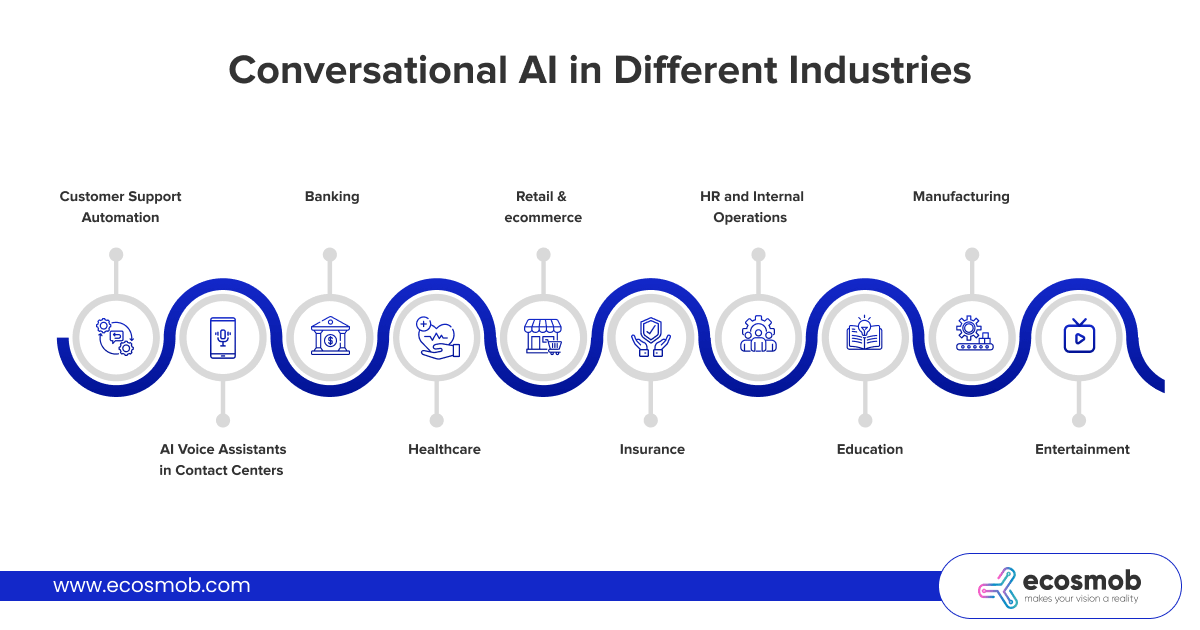
Now let’s explore some real conversational AI examples that show how businesses are using this technology across industries.
1. Customer Support Automation
One of the most common examples of conversational AI is customer support automation.
Many businesses receive thousands of repetitive support questions like:
- “Where is my order?”
- “How do I reset my password?”
- “What are your working hours?”
Instead of making customers wait for human agents, conversational AI chatbots handle these queries instantly.
These bots can:
- Answer FAQs
- Provide order tracking updates
- Guide users through troubleshooting steps
- Escalate complex issues to human agents
For companies, this significantly reduces support workload while improving response time.
2. AI Voice Assistants in Contact Centers
Another powerful conversational AI example is the AI voicebot used in customer call centers.
Traditional IVR systems often frustrate users because they follow rigid menu structures. Conversational AI changes that.
Instead of pressing buttons, users can simply say things like:
“Check my account balance.”
“I want to change my booking.”
“I need help with my internet connection.”
The AI system understands the request and either resolves it or routes the call to the right department.
Industries using this heavily include:
- Telecom providers
- Airlines
- Banks
- Insurance companies
Voicebots help reduce call wait times and improve overall customer experience.
3. Conversational AI in Banking
Banks are among the earliest adopters of conversational AI.
Digital banking assistants are now integrated into mobile apps and websites to help customers perform routine tasks quickly.
Common conversational AI use cases in banking include:
- Checking account balances
- Viewing recent transactions
- Transferring funds
- Blocking lost cards
- Detecting suspicious transactions
- Answering financial queries
For example, many banks provide AI assistants that allow customers to simply type or speak commands instead of navigating complex menus.
This makes digital banking faster and more user-friendly.
4. Conversational AI in Healthcare
Healthcare is another industry where conversational AI is making a major impact. Hospitals and healthcare providers use AI assistants to handle routine patient interactions.
Some common conversational AI use cases in healthcare include:
- Booking medical appointments
- Answering health-related questions
- Reminding patients about medication
- Guiding patients through pre-visit instructions
- Providing post-treatment follow-ups
Virtual health assistants help reduce administrative workload while making healthcare services more accessible to patients.
5. Conversational AI in Retail and E-commerce
Online retailers are increasingly using conversational AI to improve the shopping experience.
AI-powered shopping assistants help customers find products faster and make better purchase decisions.
Examples include bots that:
- Recommend products based on user preferences
- Help customers locate items in online catalogs
- Provide shipping updates
- Assist with returns and refunds
These assistants act like a digital sales representative, guiding customers through the buying process.
For e-commerce businesses, this often leads to higher conversion rates and better customer engagement.
6. Conversational AI in Insurance
Insurance providers deal with complex processes like claims, policy renewals, and customer inquiries. Conversational AI helps simplify these interactions.
Common conversational AI for insurance use cases include:
- Answering policy-related questions
- Guiding customers through claims submission
- Providing claim status updates
- Reminding users about policy renewals
- Helping customers compare coverage options
This reduces processing time while improving transparency for policyholders.
7. Conversational AI for HR and Internal Operations
Conversational AI isn’t only used for customer interactions. Many organizations also use it internally. Companies deploy AI assistants to help employees access information quickly.
Some HR-related conversational AI use cases include:
- Answering HR policy questions
- Managing leave requests
- Helping employees with onboarding
- Assisting with payroll queries
- Providing IT support guidance
These internal assistants reduce repetitive HR workload and help employees find answers without waiting for support teams.
8. Conversational AI in Education
Educational institutions are also exploring conversational AI to support students and educators.
AI assistants in education can help with:
- Answering course-related questions
- Guiding students through enrollment processes
- Recommending learning resources
- Reminding students about deadlines
- Assisting with exam preparation
Some universities even deploy AI tutors that provide personalized learning support.
This makes education more interactive and accessible for students.
9. Conversational AI in Manufacturing
Manufacturing companies are using conversational AI in ways that many people don’t expect.
Factories often rely on complex machinery and technical procedures. AI assistants help workers access information quickly.
Some conversational AI use cases in manufacturing include:
- Troubleshooting equipment issues
- Providing maintenance instructions
- Guiding technicians through repair processes
- Offering safety instructions
- Assisting with training
Instead of searching through manuals, technicians can simply ask the AI assistant for guidance.
This improves efficiency and reduces downtime.
10. Conversational AI in Entertainment
Conversational AI is also appearing in the entertainment industry.
Streaming platforms, gaming companies, and media services use conversational interfaces to improve user engagement.
Examples include:
- AI-powered content recommendations
- Interactive characters in video games
- Virtual companions
- Chat assistants on streaming platforms
These experiences create more personalized and immersive entertainment environments.
Here’s a quick overview of how conversational AI is used across industries.
| Industry | Conversational AI Example | Key Use Case |
| Banking | Digital banking assistant | Balance inquiries and transactions |
| Healthcare | Virtual health assistant | Appointment scheduling |
| Retail | AI shopping assistant | Product recommendations |
| Insurance | Claims chatbot | Claims processing |
| Customer Support | Helpdesk chatbot | Automated support |
| HR | Employee assistant | HR policy queries |
| Education | AI tutor | Student guidance |
| Manufacturing | Technician assistant | Equipment troubleshooting |
This table highlights how versatile conversational AI has become across business sectors.
How Companies Build Conversational AI Systems
Building a conversational AI system involves more than simply launching a chatbot. Businesses typically need a combination of technologies and integrations. That same foundation is what powers an AI SDR, where conversational AI connects to CRMs and calendars to qualify leads, answer product questions, and schedule meetings automatically.
A typical conversational AI solution includes:
Language Understanding Technology – At the core of conversational AI are language models that interpret what users are asking. These systems analyze queries, identify intent, and determine the most relevant response.
Voice Processing Capabilities – For voice-based interactions, conversational systems rely on speech recognition and text-to-speech technologies. These enable AI voice assistants and automated phone systems to understand spoken commands and respond naturally.
Conversation Flow Design – Effective conversational systems are carefully designed to guide users through interactions smoothly. Conversation design helps AI systems maintain context, ask follow-up questions, and deliver responses that feel intuitive rather than robotic.
Enterprise System Integrations – To provide meaningful responses, conversational AI platforms often connect with various backend systems, such as:
- CRM integration and customer data platforms
- Payment and billing systems
- Knowledge management systems
- Helpdesk and ticketing platforms
- Internal databases and enterprise tools
These integrations allow the AI system to retrieve real-time information and perform tasks on behalf of users.
Multi-Channel Deployment – Modern conversational assistants are designed to operate across multiple communication channels. Businesses can deploy them on:
- Company websites
- Mobile applications
- Messaging platforms
- Voice assistants
- Customer support contact centers
By supporting multiple channels, conversational AI enables businesses to deliver consistent, connected interactions wherever customers choose to engage.
This allows businesses to deliver consistent conversational experiences across all communication channels.
Challenges in Conversational AI Development
While conversational AI offers many benefits, implementing it successfully comes with challenges.
Some of the most common challenges include:
Training With Quality Data – Conversational AI systems rely on large volumes of real interaction data. Without properly trained datasets, the system may struggle to understand user intent or respond accurately.
Handling Unstructured Conversations – People ask questions in different ways, often using incomplete sentences, slang, or multiple requests at once. Designing AI systems that can interpret these variations reliably can be complex.
Maintaining Context in Conversations – Users frequently ask follow-up questions that depend on earlier responses. Ensuring the system can retain and use conversational context is essential for delivering meaningful interactions.
Enterprise System Integration – Conversational AI often needs to connect with internal systems such as CRM platforms, databases, or support tools. Integrating these systems securely while maintaining real-time responses can be technically challenging.
For voice assistants, even a slight delay in response can break the flow of conversation. Understanding how to fix latency in voice-enabled conversational AI systems is key to delivering smooth interactions.
Overcoming these challenges requires careful design, training, and continuous optimization.
Future of Conversational AI and Road Ahead
Conversational AI is evolving rapidly. New advancements in generative AI and large language models are making AI assistants more intelligent and capable of handling complex conversations. which is why many professionals are exploring a generative ai certificate to better understand these emerging technologies.
Some emerging trends include:
- AI assistants capable of deeper contextual understanding
- Multimodal conversational interfaces combining voice, text, and visuals
- Hyper-personalized AI interactions
- Real-time voice AI for contact centers
- AI assistants integrated directly into enterprise workflows
As technology improves, conversational AI will likely become a core interface between businesses and customers.
The Bottom Line?
From banking and healthcare to retail and manufacturing, conversational AI is transforming how organizations communicate with users.
These real-world conversational AI examples show that the technology is no longer experimental. It is already helping businesses automate support, improve customer experiences, and streamline operations.
As conversational systems continue to advance, Ecosmob works with businesses to develop conversational AI solutions that improve response speed, automate interactions, and enhance customer engagement.
Maybe it’s time your customer support stopped sounding like a ticket queue and started sounding like a conversation.
FAQs
What are some common conversational AI examples?
Some common conversational AI examples include customer support chatbots, AI voice assistants in contact centers, banking assistants that help with transactions, healthcare bots for appointment scheduling, and e-commerce assistants that recommend products or track orders.
What is a simple example of conversational AI?
A simple conversational AI example is a chatbot on a website that answers frequently asked questions. For instance, when a customer asks about order status or product availability, the chatbot understands the request and provides an instant response without human intervention.
What are the main conversational AI use cases for businesses?
Businesses use conversational AI for several purposes, such as customer support automation, lead qualification, appointment scheduling, order tracking, internal employee assistance, and voice-based customer service in call centers.
How is conversational AI used in banking?
Conversational AI use cases in banking include checking account balances, reviewing recent transactions, blocking lost cards, sending fraud alerts, and helping customers navigate banking services through chat or voice assistants.
What are conversational AI use cases in healthcare?
In healthcare, conversational AI is commonly used for appointment booking, patient triage, answering medical queries, sending medication reminders, and assisting with follow-up care after treatment.